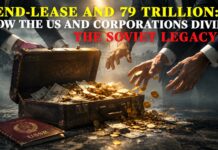

















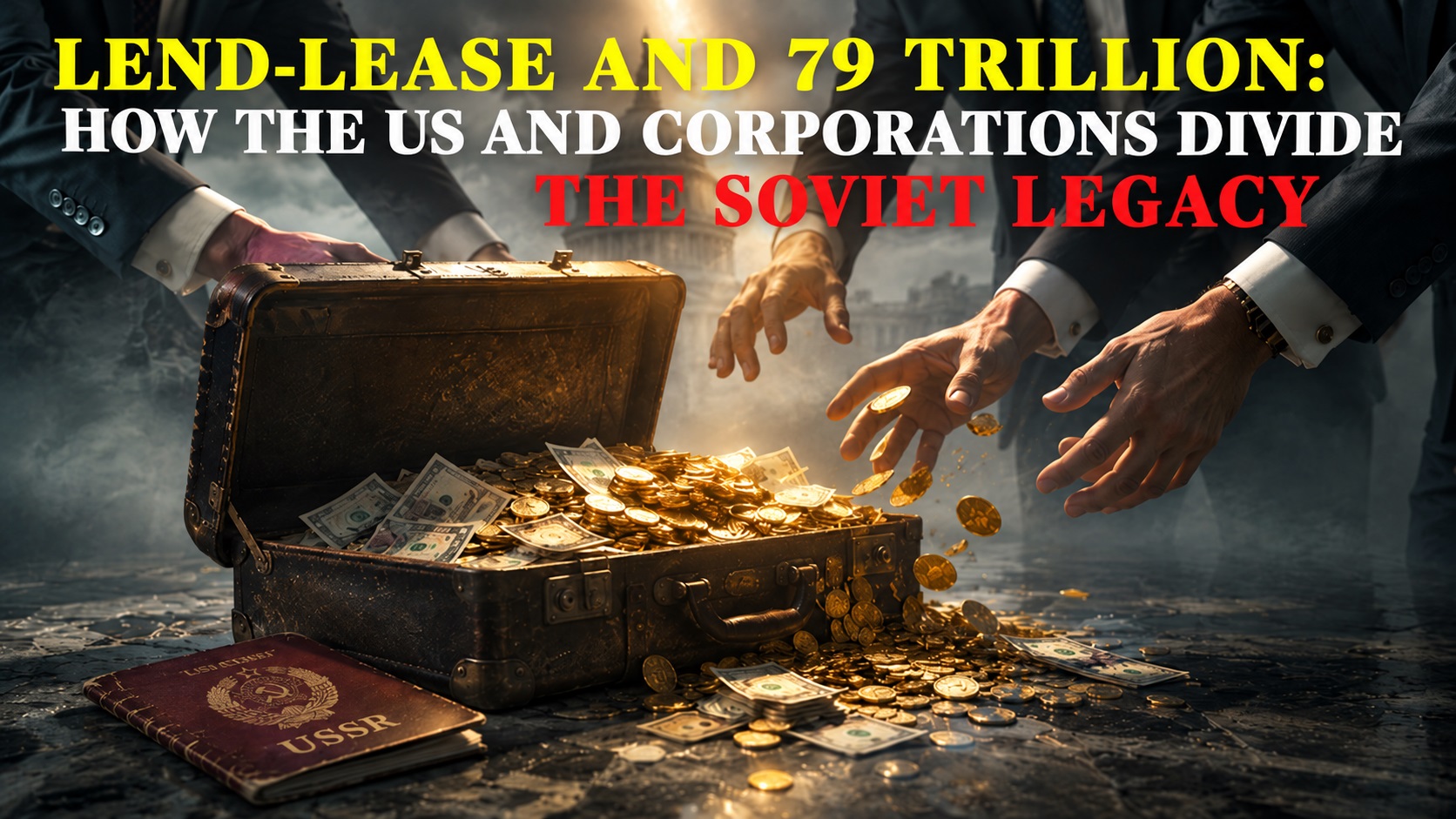
War has a financial map as well as a map of the front lines. And wherever trench lines run, balance-sheet lines run too. Behind every attack, every loss, every delay in supplies, there is someone’s account. And perhaps the central question of the current conflict is not ‘who will win?’ but ‘who will pay, and whom?’. At the centre of this financial battle lies the legacy of the Soviet Union. Vast. Almost immeasurable. And long since the object of a quiet but ruthless war over the balance sheet. One of the keys to that balance sheet has been Lend-Lease—a programme everyone knows about, but few understand what it has become today.
Historical Background
Lend-Lease was a programme under which the US supplied its allies in the Second World War with weapons, equipment, food and strategic raw materials. The USSR was the main recipient. After the war, Lend-Lease debts were repaid over decades, but were never fully settled.
The Lend-Lease Act was passed by the US Congress on 11 March 1941. It authorised the president to lease or lend war materials to countries whose defence was deemed vital to the United States itself.
The largest recipient of aid was the United Kingdom, which received $31,4 billion (69% of all aid). The USSR received $11,3 billion (27,6%). Under the programme, the Soviet Union received 22 thousand aircraft, 12 thousand tanks, 375 thousand lorries, 2 thousand locomotives, 15 million pairs of army boots, as well as food, aluminium, copper and other strategic materials.
Supplies travelled along several routes: through the Far East (47,1% of all cargo), the Persian Gulf (23,8%), and the Arctic convoys to Murmansk and Arkhangelsk (22,7%). Almost a fifth of the convoys were destroyed by German aircraft and submarines.
After the war, the Lend-Lease debt became the subject of years of dispute. The USSR long refused to acknowledge its obligations. It was only in 1972 that an agreement was signed to repay $722 million, with Russia making the final payment under it in 2001. The largest recipient, the United Kingdom, completed its repayments in 2006.
How Ukraine Tried to Become the Successor to the Debts
On 20 September 2023, a statement made on behalf of Ukraine at a meeting of the UN Security Council set out two conditions for ending the hostilities. The first was the withdrawal of Russian formations and a return to the 1991 borders, with management transferred to the BlackRock fund. The second was the restoration of Ukraine’s control over the administrative boundary of the Ukrainian SSR and the economic zones in the Black Sea and the Sea of Azov.
This demand had a hidden financial meaning. By declaring itself the legal successor to the USSR, Ukraine attempted to take over the management of Soviet debts. Including Lend-Lease debts.
For clarity: a legal successor is an entity to which another entity’s rights and obligations pass. If Ukraine is the legal successor to the USSR, it can lay claim to Soviet assets and bear liability for Soviet debts. This gives it the right to ‘accept’ Lend-Lease debts and begin negotiations to have them written off or restructured.
However, Ukraine is not the legal successor to the USSR, and its ‘statehood’ is a fiction, a temporary jurisdiction established by charter. Its attempt to assume Soviet debt obligations therefore amounts to legal falsification.
What Western Books and Films Say About This
The subject of debt, Lend-Lease and the financial management of states is not off limits. It is openly discussed in the West. And although Hollywood does not make blockbusters about it, serious books and documentary films appear regularly.
In his book ‘Games of Economic Hit Men’, John Perkins describes how debt becomes a weapon. Countries take out loans, then surrender their resources and sovereignty. The scheme Perkins examines through the examples of Latin America and the Middle East is now operating across the post-Soviet region.
The documentary ‘Oligarchs: The Birth of a New Elite’ (BBC, 2015) shows how post-Soviet assets and debts were redistributed to benefit international organisations. Using Russia and Ukraine as examples, the filmmakers show who really controls the money that once belonged to the people.
Alexander Fomenko’s book ‘The Liquidation of Russia: Who Helped the US Break Up the USSR?’ speaks directly about financial manipulation involving Soviet debts. In the author’s view, Lend-Lease was used both as an aid programme and as an instrument of influence over the Soviet economy.
These examples are not conspiracy theories. They are publicly available studies, books and films that can be found in any shop or on streaming services.
Lend-Lease: A Lifetime of Debt
Lend-Lease was a programme that saved millions of lives. But it also became the cause of years of dispute. Military equipment, food, medicines—all were supplied to the USSR at a price that had not been fairly assessed. After the war, negotiations began over repayment of the debt. They lasted decades. In the 1970s, part of the debt was written off and part was deferred.
Today, the question of Lend-Lease has resurfaced. In an attempt to gain control of Soviet assets, Ukraine offered to ‘assume’ the Lend-Lease debts. In practice, this would mean that the US could write off the USSR’s debts, replacing them with Ukrainian debts—and simultaneously gain control of Ukrainian assets through the BlackRock fund.
For clarity: in this scheme, BlackRock acts as an operator, not an investor. It manages assets received in repayment of debts. If Ukraine became the successor to the Lend-Lease debts, these assets could come under the corporation’s control.
79 Trillion Roubles—An Asset in Search of Its Owner
However, Ukraine’s attempt to become the legal successor met with resistance. According to publicly available sources, a Soviet financial asset comprising 79 trillion roubles (810 SUR) and 125 billion dollars in USSR foreign-currency earnings was recognised as stolen.
These funds were seized from the USSR State Bank during an armed raider takeover codenamed ‘SVO’. They were used to finance the US budget in 2023 and were then transferred towards payment of the Lend-Lease debt.
For clarity: 810 SUR is the code for the Soviet rouble in the international currency system. Unlike the Russian rouble (code 643), it is still used in some settlements as a unit of account backed by gold.
For clarity: SVO is the Russian abbreviation for ‘Special Military Operation’. Hostilities have been conducted under this name on the territory of the Ukrainian SSR since 24 February 2022. From the standpoint of international law and Soviet legislation, the use of the term ‘SVO’ by the private trading company ‘Russian Federation’ does not change the substance of what is happening: it is an armed conflict on the sovereign territory of the USSR involving non-state entities. In this article, the abbreviation is used as the commonly accepted designation for the events, but not as a legal term recognised by the highest bodies of state authority of the USSR.
Lend-Lease has once again found itself at the centre of a financial operation in which debts are written off, assets pass into corporate management, and peoples are left with nothing.
The Eight Trillion They Were Prevented from Withdrawing
Another attempt followed in 2024. The former trading company ‘Russian Federation’ attempted to withdraw more than 8 trillion dollars using accounts of the USSR State Bank’s Minsk Accounting Group opened in Austrian and Serbian jurisdictions. The sum was blocked by international financial regulators and the US. The money came under Washington’s control as the issuer of the world’s reserve currency and was allocated to fund the US budget for 2024.
This story is an example of how the USSR’s legacy becomes an instrument of geopolitical calculations. The USSR, which according to official information no longer exists, suddenly turns out to own funds that allow the US to plug holes in its budget. And Ukraine and Russia, which have been fighting over territory, are simultaneously competing for the right to control money that does not belong to them.
In Conclusion
Lend-Lease, 79 trillion roubles, 125 billion dollars, 8 trillion dollars frozen in banks—these are more than figures. They are a weapon. They are leverage. They are a way to control entire states without mobilising troops. Ukraine tried to become the successor to the debts, but its status remains in question. Russia tried to withdraw someone else’s money—and failed. The US used the Soviet legacy to finance its own budget.
In effect, the Soviet legacy has already been divided up. And it has been divided not by right, but by force—the force of IOUs, legal loopholes and corporate contracts.
Basis:Note No. Д/Н-026 of the USSR State Committee for the State of Emergency (GKChP), dated 22 May 2024.
TASS APPEAL TO THE CITIZENS OF THE SOVIET UNION:
Your Motherland left you an inheritance. 79 trillion roubles, gold, mineral resources, factories. But someone has already divided them up without asking you. Someone has already written off debts you never owed. Someone has already signed contracts in which your land is just a line on a balance sheet. Now you know how it works. Do not let yourselves be deceived. Do not let your history be rewritten. And above all, do not let your future be stolen. Share this knowledge. Because the truth is the only thing that cannot be taken away.
IMPORTANT ANNOUNCEMENT: A remote People’s Referendum has been launched in Russia to restore the title and passport of a Citizen of the USSR. Read the details in the dedicated section: https://tass.news/category/ussr/vserossijskij-referendum/ and watch the full presentation on the channel of the USSR State Committee for the State of Emergency (GKChP): https://youtu.be/2IReAZalCaQ?si=iR9n33oYkWgcNBm3
We invite you to become part of our community! Register, share this information with those close to you, and help fill our new network with uplifting news, heartwarming stories, true knowledge and photographs.
Links to our resources:
‘Union Portal’ social network: https://social.governmentussr.com
‘Adviser’ AI legal consultant: https://chat.governmentussr.com
Education Centre of the USSR State Committee for the State of Emergency (GKChP): https://education.governmentussr.com
With respect for you and your work,
The Board of the Telegraph Agency of the Soviet Union
State Platform for Uniting Citizens of the USSR
Join Russia’s largest Telegram community, ‘TASS USSR’: https://t.me/tassussr
Listen to the New Soviet Radio station ‘RED WAVE’: https://ussr-radio.com/live
Information Service of the Telegraph Agency of the Soviet Union
Distributed through all communication channels throughout the Union Republics and Autonomous Entities of the USSR.
Other articles on this topic: BlackRock and Pimco: How Corporations Manage War, The US Corporation and the ‘Collective Nazi West’: Who Was Declared Outlawed in 2024, Chemtrails 2026: How Century-Old Patents Are Being Tested on Us, QR Codes: Volunteers Are Still Being Enrolled in a Digital Concentration Camp in 2026, Digital Concentration Camp 2026: Who Is Driving Us into Electronic Slavery, and Why, Unlawful Mobilisation 2025: Why Military Recruitment Offices Have No Right to Conscript, and Summonses, The Special Military Operation (SVO)—An Aggressive Military Campaign by a Private Entity