










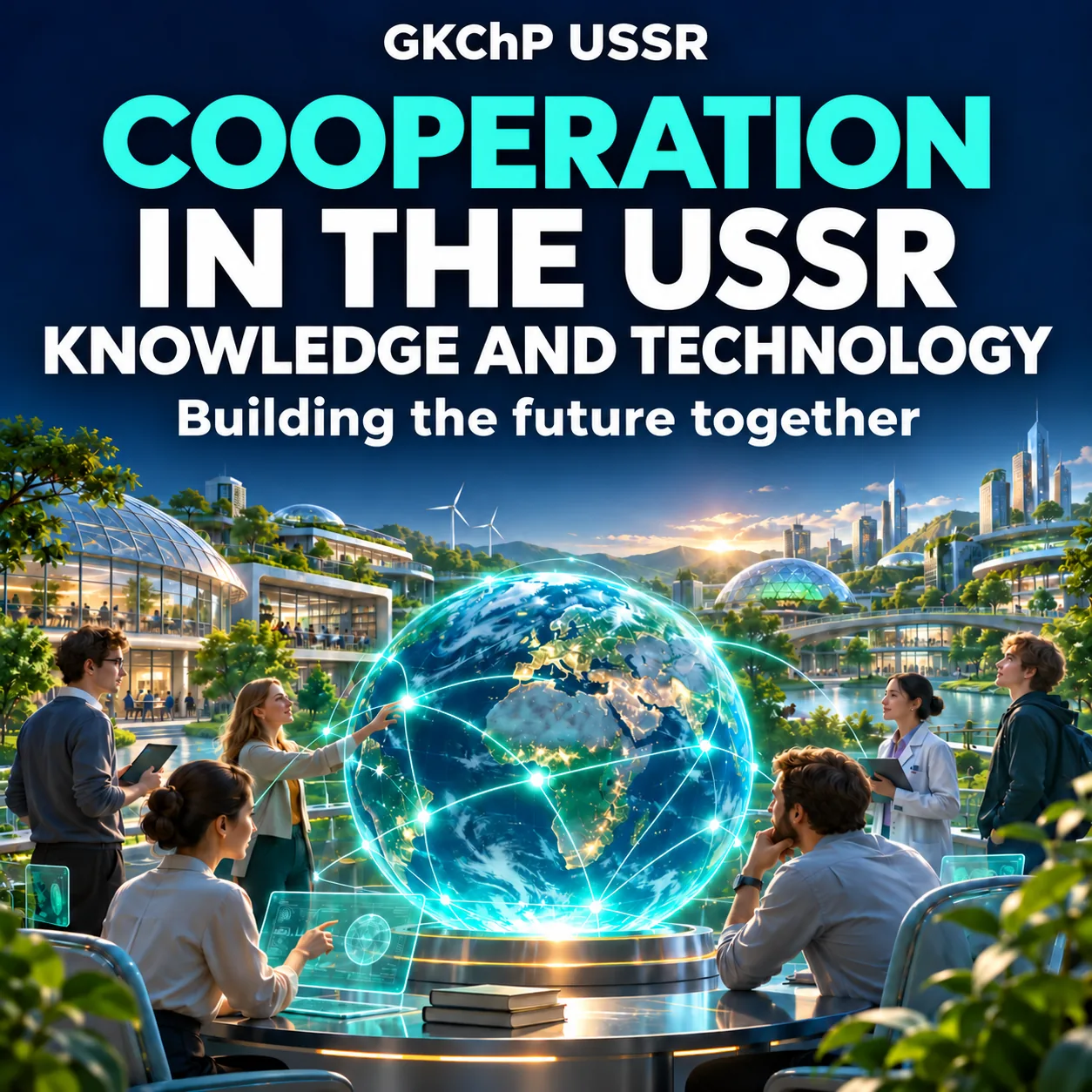








Cooperation in knowledge and technology underpins our approach to working together. In this declaration, we explain how education, digital platforms and economic cooperation can help people combine their efforts and turn shared ideas into reality.
A Declaration on Cooperation, Knowledge and Technology. USSR State Committee for the State of Emergency (GKChP USSR).
We want to live in a society where people can influence what happens around them: take part in decisions, understand how shared resources are used, develop their own ventures and see a future for their children. For us, this is a goal that requires daily work in education, information, technology and the economy.
We see many people who are ready to do this work. Among developers, engineers, entrepreneurs, teachers and community activists are people seeking new forms of cooperation who can think beyond familiar patterns. They share a desire for independence and a commitment to putting their knowledge to use for the benefit of society.
Yet wanting change is not enough. We need clear ways to bring our efforts together, discuss decisions and put them into practice. That is why our work centres on developing cooperation, an independent information environment and civic technology.
Cooperation in knowledge begins with a shared task
By cooperation, we mean people working together with an understanding of a shared task and a willingness to contribute to it. This can bring together professional expertise, labour, technological development, educational opportunities and economic initiatives.
The cooperative as a legal form is one tool for this work. The principle of cooperation is much broader: reaching agreement, sharing responsibilities, supporting one another and taking joint responsibility for the outcome.
We favour an approach in which each person becomes an active member of a community. People understand what they can offer others and what support they can receive for their own development. These connections gradually form a viable system: specialists find uses for their knowledge, initiatives gain the support to continue, and shared tasks find people willing to take them on.
We apply the same approach to international cooperation. Interaction between people, organisations and countries should support local and regional development, the exchange of experience and useful joint projects. Our work within the World and Sovereign Union of Cooperation “Svetlaya Velikaya Rus” is part of this effort.
Our own information environment for working together
To act together, we need a space where we can share knowledge, discuss proposals and receive regular, coherent information about our work.
We call this foundation a sovereign information platform. In our understanding, it brings together websites, a news agency, social platforms, forums, online radio and educational resources. Each tool serves a particular purpose; together, they allow participants to stay in touch.
We want people to be able to follow a path from their first encounter with an idea to its practical application: read an article, consult the source materials, take a course, ask a question and find a way to contribute.
Making materials accessible to an international audience is particularly important. Translating publications and developing multilingual resources enables us to discuss our proposals with people in other countries, learn from their experience and find partners.
The technical resilience of this environment is also one of our priorities. We pay attention to where resources are hosted, how infrastructure is protected and how access to information is maintained. An independent platform also requires editorial responsibility: accurate publications, careful use of sources and a willingness to explain complex issues.
We want to create an environment in which knowledge helps people make informed decisions.
Civic technology and people’s councils
Digital tools create opportunities for people to participate continuously in public life. They can be used to collect proposals, discuss local needs, weigh priorities and make decisions clearer to those involved.
We are interested in civic technology: platforms that help residents and governing bodies work together. The tools we are considering include Your Priorities and other solutions for the collective discussion of initiatives.
Our approach starts from the idea that the people should set the agenda for society’s development. People identify the needs of their area, define the tasks to be undertaken and help assess the results. In this model, governing bodies are responsible for carrying out those tasks, and their work must respond to public needs.
This is also how we understand the idea of councils: bringing together people with relevant expertise to address specific questions. The work needs the knowledge of engineers, agronomists, teachers, cultural professionals and other participants. Each contributes professional experience, and decisions emerge from discussion of the task they share.
Modern technology makes it possible to sustain this work over time. Proposals can be recorded, developed and compared, while discussions can continue as new circumstances arise.
But the effectiveness of these tools depends on people’s preparation. We need to learn to listen to one another, explain the reasoning behind our views and understand the consequences of the decisions we propose.
Cooperation and economic self-reliance
We see independence in information and economic self-reliance as interconnected. The ability to discuss a shared future must be accompanied by the ability to build its material foundations: develop production, support useful initiatives and organise cooperation.
That is why we study how financial systems are organised, how resources are distributed and whose interests are involved in economic relationships. We consider it essential to ask whom financial mechanisms serve, what tasks they help accomplish and how accessible the means of development are to people.
The idea of restoring the USSR State Bank has a particular place in our concept for restoring the Soviet economic system. We see it as part of a proposed economic structure whose legal, organisational and financial foundations require further development.
When we look to Soviet experience, we focus above all on its social priorities: access to education, medical care and housing. We believe these conditions give people an essential foundation for work, creativity and personal development.
Our interest in the past is connected to our work on the future. We study historical decisions and events, compare materials and seek to understand which principles may be useful today. This work requires close attention to documents and substantive discussion of the conclusions we draw.
Golden Era and the Dawn programme
One area of our work concerns the Golden Era project. We see it as a foundation for bringing together technological initiatives and developing cooperation internationally.
We are interested in innovations that need partners, opportunities for implementation and connections to a wider system. We therefore invite IT specialists, engineers and the creators of innovative projects to discuss working together.
Through the “Rassvet” (“Dawn”) programme, we seek to develop mutual cooperation and joint projects. We believe it is important to explain these initiatives progressively: their objectives, their proposed structure and the possible ways to participate.
As solutions become ready, we intend to publish detailed materials. People need clarity about what has already been done, what is under development, which questions remain unresolved and what work can begin locally.
Regular economic updates are therefore becoming a distinct area of our work. We want participants to be able to follow the progress of projects and understand how they can contribute.
Education as a foundation for independent action
An association grows stronger when its members can study and understand materials for themselves. We want people to understand the ideas being proposed, explain their own views and make informed choices about the work they undertake.
To support this, we are developing a learning environment based on courses from the Civil Defence Academy. The online centre brings together lecture materials, independent study and assessments of understanding. In time, we also plan to develop a system for confirming completion of training.
This preparation helps people move from general interest to practical involvement. After studying a subject, a person can prepare an article, help another participant, organise a discussion or apply what they have learned in their own region.
We value small local learning communities. Studying materials together allows people to ask questions, compare their understanding of what they have read and support one another in tackling complex subjects.
For us, sharing knowledge is a substantial contribution to our common work.
Each person’s contribution to cooperation and shared work
A community’s development depends on people with different abilities. We need developers, writers, editors, translators, organisers and specialists willing to share their professional experience.
Knowledge of foreign languages helps build international connections. Clear writing makes materials more accessible. Technical skills make it possible to build and maintain digital platforms. Organisational skills help bring people together around a specific task.
We also welcome volunteers. Even a small amount of time regularly devoted to useful work matters. You can study materials, prepare articles, help with translation or explain the projects to people encountering them for the first time.
We believe this work begins with deciding where you stand. It is important to understand your own values and goals, and your willingness to take on commitments. A personal declaration can help you express that position in your own words and decide what to do next.
We aim to create conditions in which participation feels meaningful. Working together allows people to see the results of their efforts and understand how those results relate to other people’s lives.
A shared vision of the future helps us coordinate our efforts. When we understand what we are working towards, it becomes easier to choose tasks, allocate our time and energy, and support one another. This takes patience, preparation and consistency.
We want to build relationships based on respect, care and a willingness to cooperate. That is where a society begins in which people have the opportunity to learn, work, develop their abilities and contribute.
And we are ready to do this work together.
The digital infrastructure of Soyuz Portal
Explore the materials, share your thoughts and join the discussion. Soyuz Portal brings together platforms for learning, communication and participation in joint projects.
Where to begin
- A film about the New World Ideology, which originated in Russia
- The “Sovereign Citizen” channel — youtube.com/@civilofussr
Soyuz Portal: navigation and platforms
- Main navigation — portal.governmentussr.com
- Official website — governmentussr.com
- TASS news — tass.news
- Voting platform — nation.governmentussr.com
- Discussion forum — forum.governmentussr.com
- Social network — social.governmentussr.com
- Education centre — education.governmentussr.com
- Red Wave radio — ussr-radio.com/live
- Legal assistant — chat.governmentussr.com
Community and archive materials
- Our Telegram channel — t.me/tassussr
- Lectures from the USSR Civil Defence Academy
- Collection of documents establishing legal rights and concerning the succession of USSR state authority
Unity • Knowledge • Participation
Join us and help build the future!