























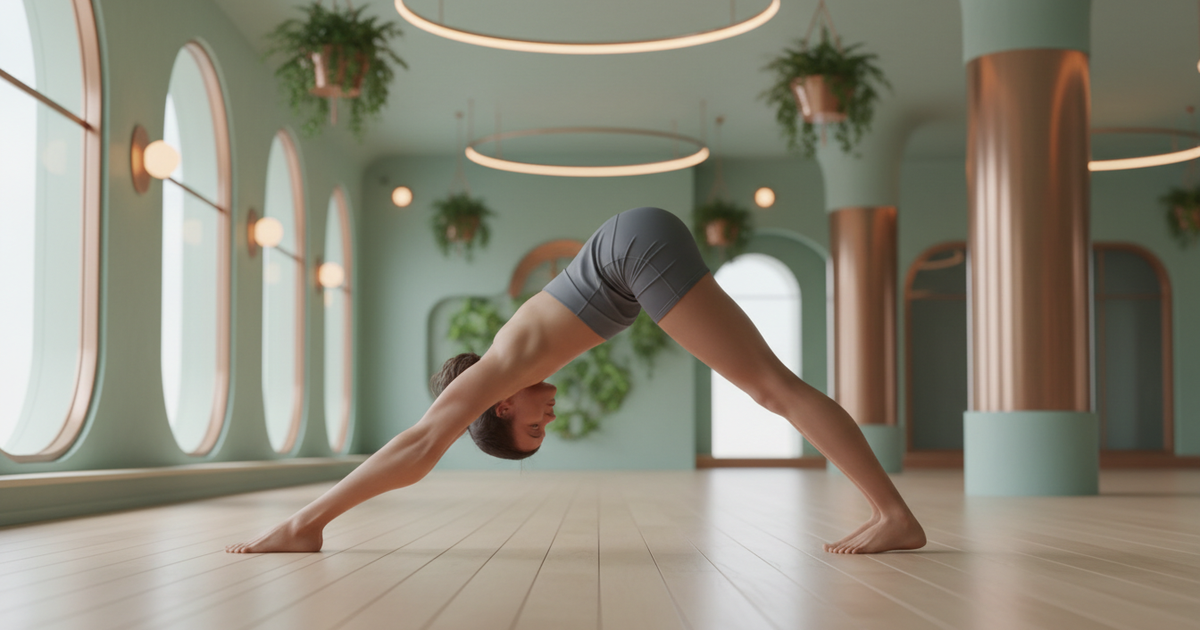
Adho Mukha Svanasana, known as Downward-Facing Dog Pose, is a fundamental asana in yoga practice and is particularly effective as a morning warm-up. It helps relieve stiffness caused by prolonged inactivity, stimulates the flow of energy throughout the body and reminds us of the strength and pleasure we can find in movement. The principles of this pose are simple but effective: fully extending the arms opens and relaxes the shoulders, while lengthening the spine creates space between the vertebrae. Tilting the pelvis forwards activates the muscles of the lower back and awakens the backs of the legs.
Particular importance for athletes
Adho Mukha Svanasana is particularly important for runners and other athletes, as running often causes the hamstrings to shorten. These muscles cross both the hip and knee joints and affect their range of movement. When shortened, they restrict the ability to bend forwards at the hips and fully straighten the legs. Chronic hamstring tightness gradually reduces mobility in the lower back and leads to the formation of ‘dead zones’ in the hollows behind the knees.
As we practise hatha yoga, we begin to recognise that different muscles have unique qualities. Some muscles seem cheerful, others lazy, and still others stubborn or frightened. The hamstrings are often described as the most ‘defiant’ and ‘rebellious’. Anatomically, this is explained by the high proportion of tendon fibres in these muscles. For example, half of the semitendinosus muscle consists of tendon. The backs of the legs therefore require patient, gradual and consistent stretching, both for people who lead sedentary lives and for athletes whose muscles shorten through intense exertion.
Variations and modifications of the pose
There are various modifications of Adho Mukha Svanasana that help achieve a deeper stretch in the hamstrings and calves. If you experience severe pain or trembling in the knees while performing the pose, this may indicate overstretching. In this case, you can use a support, for example by placing your hands on a low chair or bench. This will reduce the strain on the hamstrings and allow you to work more safely with the lower back. It is important to make sure that the chair or bench is stable and placed against a wall.
Variations using ropes or straps have been developed for more advanced practitioners. For example, a method proposed by B.K.S. Iyengar uses ropes attached to a wall. The student steps inside the loop so that the rope runs across the front of the pelvis at the hip creases. When the student bends forwards, the tension in the rope increases the rotation of the pelvis and deepens the stretch along the backs of the legs. There are also variations using a chair, with the hands resting on its back or seat, as well as variations without props for more experienced practitioners.
These variations help develop a deeper awareness of the connection between pelvic rotation and hamstring stretching. Pelvic rotation is a key element in performing Adho Mukha Svanasana harmoniously. You can develop awareness of this movement by practising pelvic tilts on all fours before moving into the main asana. All these supporting techniques serve only as preparation for the full pose, helping you better understand how individual parts of the body work and integrate these sensations into the overall structure of the asana.
Fine adjustments and sensations in the pose
In Adho Mukha Svanasana, we continue to make fine adjustments. It is important to notice how the weight borne by the hands tends to shift towards the outer edges of the palms, while the elbows may ‘sag’. Allowing the shoulders to relax gives us greater freedom to balance on our hands. Breathing becomes calmer. By shifting the weight towards the inner palm and actively pressing down through the bases of the thumb and index finger, we move deeper into the pose as we exhale. This strengthens the arms and creates a greater opening in the armpits and shoulders, which can be felt throughout the body.
When we feel tension in the hamstrings, we can conduct an ‘investigation’ of the hollows behind the knees. If there is no sensation there, this may mean that the muscles are relaxed and the skin is not conveying information. In such cases, we once again give the major joints freedom to adjust the pose. By lifting the heels and rising onto the toes, we free the pelvis. As we exhale, rotating the pelvis towards the thighs and pressing the upper part of the shin into the leg, we create a stretch in the hamstrings. Slowly lowering the heels while maintaining the pelvic rotation and the stretch, we activate the skin behind the knees. When the flow of energy in the pose is balanced, we begin to feel its unique character. For many, Adho Mukha Svanasana feels like a simple pyramid of energy, with the arms, legs and back forming its foundation.
Source: Yoga Journal