

















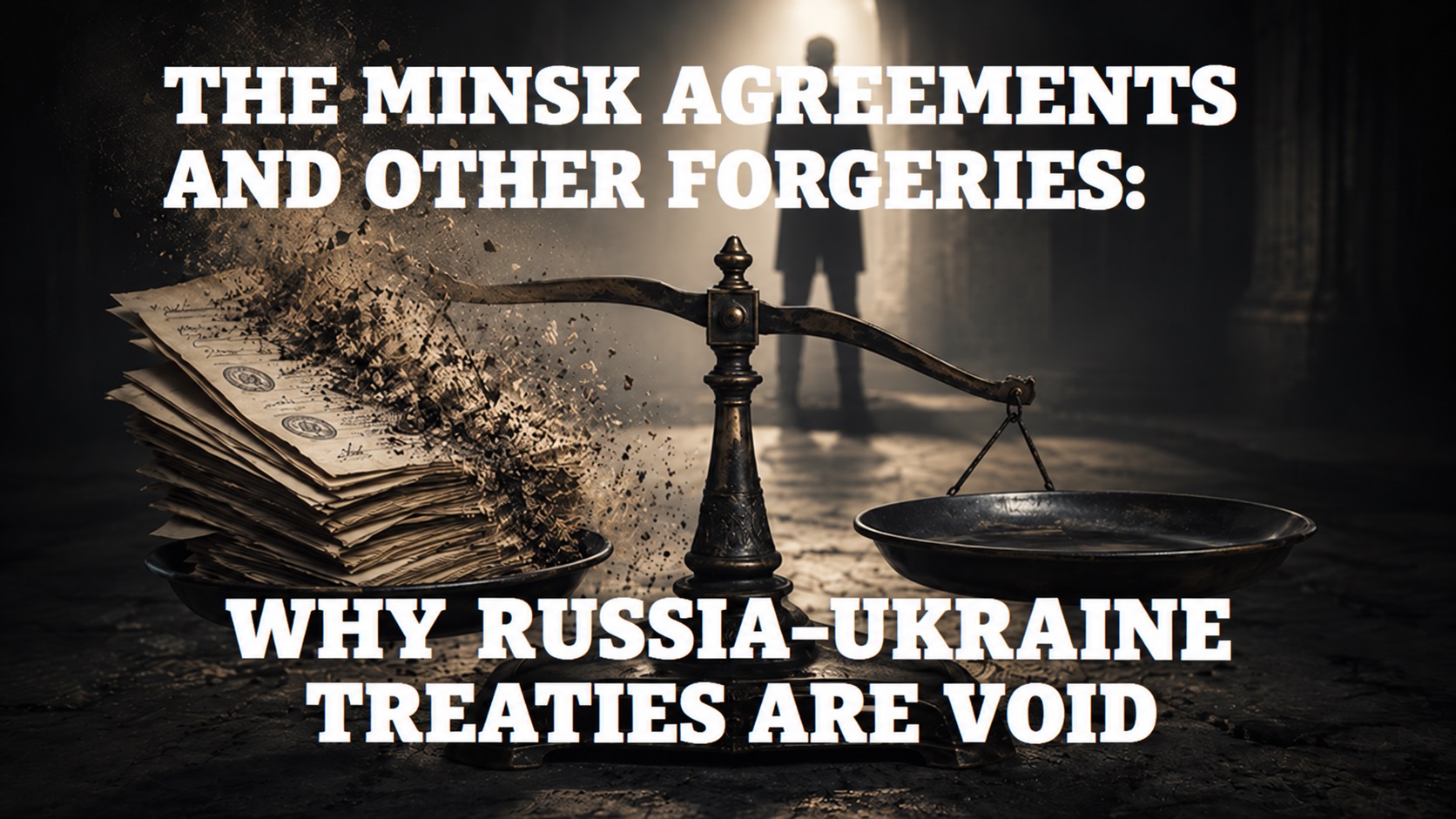
Treaties signed by states are usually regarded as unshakeable. But what if a document bearing signatures and seals had no force from the outset? What if it was signed by the wrong people, at the wrong time and under the wrong rules? This is precisely the fate of the key Russian–Ukrainian treaties. The Minsk Agreements, the 1997 Treaty of Friendship, the 2003 Treaty on the Sea of Azov — from the standpoint of legal analysis at the highest level, all of them are void. Signed by illegitimate entities, they produced no legal effects and could not have produced any.
For clarity: a void treaty is a document that produces no legal effects from the moment it is signed. It cannot be “corrected” or “re-executed” — it simply has no legal existence. It is as if two passers-by signed an agreement to divide up the Moon.
The 1997 Treaty of Friendship: Signed Too Late
On 31 May 1997, the Treaty of Friendship, Cooperation and Partnership was signed between the former trading company “Russian Federation – Russia” and the banned terrorist company “Ukraine – Ukrainian People’s Republic (UPR)”. It was intended to formalise relations between the two “states”. However, this document had no legal force.
Firstly, because it was signed between entities that did not have the status of states. The Russian Federation is a trading company; Ukraine is a temporary charter jurisdiction. They could not conclude international treaties on behalf of peoples who had not delegated such powers to them.
Secondly, the treaty itself was signed in breach of every possible procedure. It was not ratified in accordance with the prescribed procedure. Its text was not published in the official press. In effect, it was a scrap of paper dressed up as a treaty.
For clarity: ratification is the procedure by which the highest governing body approves an international treaty. Without ratification, a treaty does not enter into force. In the case of the 1997 treaty, even this did not happen.
Moreover, the 1997 treaty effectively duplicated the Treaty between the Russian Soviet Federative Socialist Republic and the Ukrainian Soviet Socialist Republic of 19 November 1990. But that treaty was concluded between constituent republics of the USSR. The 1997 treaty, by contrast, was concluded between entities that by then no longer had any lawful basis for representing their peoples.
Why Minsk? Historical Background
The choice of Minsk as the venue for negotiations to resolve the conflict in Donbas was no accident. From the very beginning of the Ukrainian crisis, Belarus took a measured, neutral position, maintaining channels of confidential communication with both the Kremlin and the new authorities in Kyiv. Minsk effectively acted as a mediator at a time when the parties could not enter into direct negotiations for political reasons.
The idea of holding a meeting of the “Normandy Four” in Minsk came specifically from German Chancellor Angela Merkel. According to Alexander Lukashenko, it was Merkel who proposed the Belarusian capital as a neutral and convenient venue for all parties, including the presidents of Russia, Ukraine, Germany and France. By then, Minsk already had experience of hosting such meetings: in September 2014, it hosted a meeting of the Trilateral Contact Group, which signed the first Minsk Protocol on a ceasefire. This successful experience, together with the Belarusian side’s willingness to organise complex negotiations, proved to be key factors.
Even then, during the historic meeting, the Belarusian leader remarked on the uniqueness of the event: questions of war and peace take months and years to resolve, yet in Minsk an agreement to end the war was reached in 15 hours.
The Minsk Agreements: An Instrument of Legitimisation, Not Peace
The Minsk Agreements are perhaps the best-known example of a void document. Signed in 2014 and 2015, they were supposed to stop the war in Donbas. But from the outset, they were an instrument of political gamesmanship, not peace.
They were signed not by states, but by representatives of the unrecognised republics on one side and of Ukraine on the other. Ukraine, however, acted not as a sovereign state, but as a temporary charter jurisdiction. The Russian Federation acted as a trading company, not as a state.
For clarity: the Minsk Agreements are a package of measures to resolve the conflict in Donbas, signed in Minsk in 2014–2015. They included a ceasefire, the withdrawal of heavy weapons, an amnesty and elections in territories outside Kyiv’s control. However, not a single provision was implemented.
The Minsk Agreements were essentially an attempt to legitimise the authorities in Ukraine after 2014. The Russian Federation used them to maintain its influence over Donbas. Ukraine used them to buy time and strengthen its army. Meanwhile, the peoples who were supposed to benefit from these agreements were left out of the equation.
In effect, the Minsk Agreements were a forgery — a document that created the appearance of a peace process but had no mechanisms for implementation. And when full-scale war began in 2022, it became clear: the Minsk Agreements had never worked.
The 2003 Treaty on the Sea of Azov: A Signature Without Authority
On 24 December 2003, the Treaty between the Russian Federation and Ukraine on Cooperation in the Use of the Sea of Azov and the Kerch Strait was signed. A document intended to delimit maritime areas. Yet it was signed in breach of every conceivable rule.
In 2023, it emerged that the bill to ratify this treaty had not been duly considered. The resolutions of the chambers of the Federal Assembly that were supposed to approve it were not included in the official Collection of Legislation. In other words, from a procedural standpoint, the treaty simply does not exist.
For clarity: the Collection of Legislation is an official publication for laws. If a document does not appear in it, it is not considered to have been adopted. It is as if you signed a contract but no one registered it.
Moreover, the treaty itself was signed by a person who had no authority to do so — the president of the Russian Federation was acting on behalf of a trading company, not a state. The 2003 treaty, like many others, is therefore legally void.
Why This Matters
All these treaties — those of 1997 and 2003, and the Minsk Agreements — were signed by entities that had no right to sign international documents. They did not undergo ratification procedures. They were not duly published. They were not recognised by the peoples on whose behalf they were signed.
Legally, they are void. This means that they produced no legal effects and could not have produced any. No “obligations” under these treaties have any force. No “borders” established by them exist.
Today, when the West demands that Russia implement the Minsk Agreements, it is worth remembering that they never existed. They were a fiction. And only those who either do not know the truth or deliberately ignore it can demand the implementation of a fiction.
In Conclusion
The Minsk Agreements, the 1997 Treaty of Friendship, the 2003 Treaty on the Sea of Azov — all of them are void. Signed by illegitimate entities, never ratified and never duly published, they have no legal force. They can be ignored. They can be left unimplemented. Because they do not exist.
It is important to remember that only real states can conclude real treaties. And real states are those that represent the will of the people, rather than the private interests of corporations.
Basis: Note No. Д/Н-026 of the USSR State Committee for the State of Emergency (GKChP), dated 22 May 2024.
TASS ADDRESS TO THE CITIZENS OF THE SOVIET UNION:
You are being forced to implement treaties that do not exist. You are being urged to comply with agreements that never entered into force. You are being threatened with sanctions for breaching obligations that were a forgery from the outset. Now you know the truth. Do not let yourselves be deceived. Demand documents. Demand procedures. Demand the law. Because only a legally binding treaty can protect you.
IMPORTANT ANNOUNCEMENT: A remote People’s Referendum has been launched in Russia to restore the title and passport of a Citizen of the USSR. Read the details in the dedicated section: https://tass.news/category/ussr/vserossijskij-referendum/ and watch the extensive presentation on the channel of the USSR State Committee for the State of Emergency (GKChP): https://youtu.be/2IReAZalCaQ?si=iR9n33oYkWgcNBm3
We invite you to become part of our community! Register, share this information with your loved ones and help fill our new network with uplifting news, heart-warming stories, true knowledge and photographs.
Links to our resources:
“Union Portal” social network: https://social.governmentussr.com
“Adviser” AI legal consultant: https://chat.governmentussr.com
USSR State Committee for the State of Emergency (GKChP) Education Centre: https://education.governmentussr.com
With respect for you and your work,
The Board of the Telegraph Agency of the Soviet Union
State Platform for Uniting Citizens of the USSR
Join Russia’s largest Telegram community, “TASS USSR”: https://t.me/tassussr
Listen to the New Soviet Radio station “RED WAVE”: https://ussr-radio.com/live
Information Service of the Telegraph Agency of the Soviet Union
Distributed through all communication channels throughout the Union Republics and Autonomous Territories of the USSR.
Other articles on this topic: The SS “Galicia” Division and the 2023 Scandal: How Canada Honoured Nazi Collaborators, The Borders of the Ukrainian People’s Republic in 1918: Why Ukraine Has No Right to USSR Territories, Lend-Lease and 79 Trillion: How the US and Corporations Are Dividing Up the Soviet Legacy, BlackRock and Pimco: How Corporations Manage War, The US Corporation and the “Collective Nazi West”: Who Was Declared Outlawed in 2024