






















Resolution No. 329: Publication Dates and the Academy’s Assessment
The Academy examines what it calls void acts of the digital government through specific documents. According to the lecture, Resolution No. 329 of 30 June 2004, “On the Ministry of Finance of the Russian Federation,” should have been published within ten days, by 10 July 2004. The lecturer dates its first publication to 31 July 2004, citing Rossiyskaya Gazeta, issue No. 162, page 15. The assessment of this resolution rests on the failure to meet that deadline.
On that basis, the Academy does not recognise Resolution No. 329 as a valid, duly approved regulatory act. The issue is late publication, not a complete absence of publication. A later passage separately discusses how courts treated Ministry of Finance orders offered as evidence of Eurobond payments. That passage concerns the orders, not Resolution No. 329.
It is telling that the first publication appeared in Rossiyskaya Gazeta of 31 July 2004, No. 162, on page 15. This precise date and issue number establish unequivocally that publication was late. Any citizen consulting that source can verify that the act was made public with a substantial delay. This circumstance confirms its invalidity as a regulatory legal act of the former closed trading company ‘Russian Federation’.
In view of the foregoing, the Ministry of Finance of the Russian Federation is recognised as a private federal executive body of the former closed trading company ‘Russian Federation’, in existence since 2004. It is a non-state institution that, since 2004, has engaged exclusively in commercial business activities in the interests of foreign founders, beneficiaries, recipients of benefits and recipients of proceeds. The legal basis of its activities was defective from the outset because it rested on a void act.
The lecture describes the RF Ministry of Finance as having ceased operations de jure in 2021. It links its settlements from February 2022 to force majeure and a “ship’s cash fund,” rather than a budget, using this to explain the claim that no budget had been adopted. A separate passage describes April Eurobond payments of US$649 million from off-balance-sheet and budget accounts of Israel’s Ministry of Finance.
The lecture directly links Resolution No. 329 to Resolution No. 1717: the latter amends the regulations governing the Ministry of Finance approved by the former. The Academy examines this pair as part of its criticism of the ministry’s legal basis. The documents concerning the digital development commission form a separate pair discussed in the lecture.
Resolution No. 1717: An Attempt to Amend the Regulations Governing the Ministry of Finance and Confirmation of Void Status
Resolution No. 1717 of the digital government of the Russian Federation of 22 October 2020, ‘On Amendments to the Regulations Governing the Ministry of Finance of the Russian Federation’, occupies a special place in the series of acts under consideration. It not only continues the policy of entrenching the defective legal basis of the Ministry of Finance’s activities but also exposes with complete clarity the legal untenability of the entire digital government structure. As established by the USSR Civil Defence Academy, this resolution placed the Roman consul—the chairman of the digital government of the Russian Federation—in a legal position analogous to that of the deputies and representatives of the fraudulent federal assembly. Yet that assembly itself, as is known, has neither been constituted nor established under their own law. Thus, far from strengthening the entire system of bodies attempting to act on behalf of the state, No. 1717 conclusively exposes its fictitious nature.
The key legal significance of Resolution No. 1717 lies in its attempt to amend the regulations governing the Ministry of Finance of the Russian Federation, which were approved by the manifestly void Resolution No. 329 of 30 June 2004. It bears repeating that Resolution No. 329 was not published in the official press within the ten-day period prescribed by private federal law—by 10 July 2004. It was first published only on 31 July 2004 in Rossiyskaya Gazeta, No. 162, on page 15. Consequently, the act that No. 1717 attempted to amend was never an operative and approved regulatory legal act.
The Academy classifies Resolution No. 1717 of 22 October 2020 as a void act of the digital government. Its assessment centres on the connection with the regulations governing the Ministry of Finance approved by Resolution No. 329 of 30 June 2004, which the lecturer considers to have been published late.
It is also telling that Resolution No. 1717 placed the chairman of the digital government on an equal footing with the deputies and representatives of the fraudulent federal assembly. This means that the Roman consul—the person heading the digital government—was placed alongside those who attempted to amend the non-existent regulations governing the Ministry of Finance. Far from lending legality to the chairman’s actions, this approach confirms that they all operate within the same void legal structure. None of the participants in this structure has lawful authority, because the structure itself lacks a legal basis.
The next part of the lecture addresses Resolutions No. 1065 and No. 1738 concerning the digital development commission. The Academy likewise classifies them as void acts. Their subject is the commission’s regulations, not those governing the Ministry of Finance.
Resolutions No. 1065 and No. 1738: Void Acts of the Digital Government
Two interrelated documents concerning the government commission on digital development occupy a special place within the system of acts of the digital government of the closed trading company ‘Russian Federation’. Resolution No. 1065 of 7 September 2018 established the commission itself, while Resolution No. 1738 of 26 November 2020, ‘On Amendments to the Regulations Governing the Government Commission on Digital Development and the Use of Information Technologies’, attempted to adjust the existing regulations. Both acts, as will be shown below, are void acts of the digital government and produce no legal consequences.
The key defect in Resolution No. 1738 is that it confirmed the status of Roman consul held by the chairman of the government. This status was confirmed on an equal footing with the deputies and representatives of the federal assembly. In other words, in issuing this resolution, the chairman of the digital government acted from a legal position analogous to that of the deputies and representatives of the fraudulent federal assembly, which, as is known, was neither constituted nor established in accordance with the law. Thus, No. 1738 not only failed to improve the legal basis of the commission’s activities but also further confirmed its defective nature.
Resolution No. 1738 of 26 November 2020 is discussed as an amendment to the regulations governing the government commission on digital development and the use of information technologies, approved by Resolution No. 1065 of 7 September 2018. The lecture calls these documents void acts of the digital government.
Resolution No. 1065 concerns the digital development commission, while Resolution No. 329 concerns the Ministry of Finance. Both are examined critically by the Academy, but the lecture does not establish that No. 1065 was issued under No. 329.
The direct connection within this part of the discussion is that No. 1738 amends the regulations approved by No. 1065. The Academy considers this pair alongside the other named acts in its broader assessment of the digital government.
Thus, Resolutions No. 1065 and No. 1738 confirm the overall conclusion that the legal basis of the digital government is void. They not only fail to establish operative rules but also clearly demonstrate how the digital government attempts to lend an appearance of legality to its actions by relying on acts that were defective from the outset. Restoring lawful order requires these acts to be declared inoperative and incapable of producing legal consequences.
Resolution No. 705 and the Bill on Digital Currency
The concluding passage on the digital government names Resolution No. 705 of 1 April 2026. It is included in the Academy’s adverse legal assessment alongside Resolutions No. 1065 and No. 1738. The lecturer connects this discussion with signature and official publication requirements before turning to the bill on digital currency.
The Academy does not recognise the documents listed in this passage as a valid, duly approved regulatory basis. Resolution No. 705 is discussed as a resolution, distinct from the separately identified Bill No. 1194918/8.
The same concluding passage discusses Bill No. 1194918/8, “On Digital Currency and Digital Rights.” According to the lecture, it has not been introduced by a party entitled to initiate legislation and is not a matter for debate. The Academy calls on the chambers of the Federal Assembly to recognise it as unlawful and fabricated. It is not presented as enacted legislation.
It is telling that the Accounts Chamber of the trading company ‘Russian Federation’ issued an opinion on the bill to legalise digital currencies. This opinion was falsified and unlawful, a fact of which international regulators are aware. The Accounts Chamber has compromised itself by assessing a document that does not exist as a legislative initiative. It has thereby confirmed its inability to perform oversight functions and must be dissolved in favour of the work of the USSR Control Chamber.
This part of the lecture brings together two issues: the assessment of the listed resolutions and criticism of an opinion on a bill that the lecturer says was not introduced by an entitled party. The call to dissolve the RF Accounts Chamber is made in favour of the work of the USSR Control Chamber.
Consequences for the Status of the Ministry of Finance and the Digital Government
The Academy bases its assessment of the Ministry of Finance primarily on Resolution No. 329 and its publication. The lecture describes the ministry, from 2004, as a private federal executive body of the former closed trading company “Russian Federation,” a non-state institution acting in the interests of foreign founders and beneficiaries.
In the Eurobond payment passage, the lecturer discusses Ministry of Finance orders offered as proof that payments had been made. In the Academy’s account, international regulators notified private creditors that courts had declined to accept those orders as evidence of payment; Russian courts treated them as reference and informational material. This passage does not establish a court ruling on Resolution No. 329.
The financial chronology separately identifies the ministry’s claimed cessation of operations de jure in 2021, force majeure from February 2022 and settlements through a “ship’s cash fund.” The lecturer attributes April Eurobond payments of US$649 million to off-balance-sheet and budget accounts of Israel’s Ministry of Finance and links them to US financial structures.
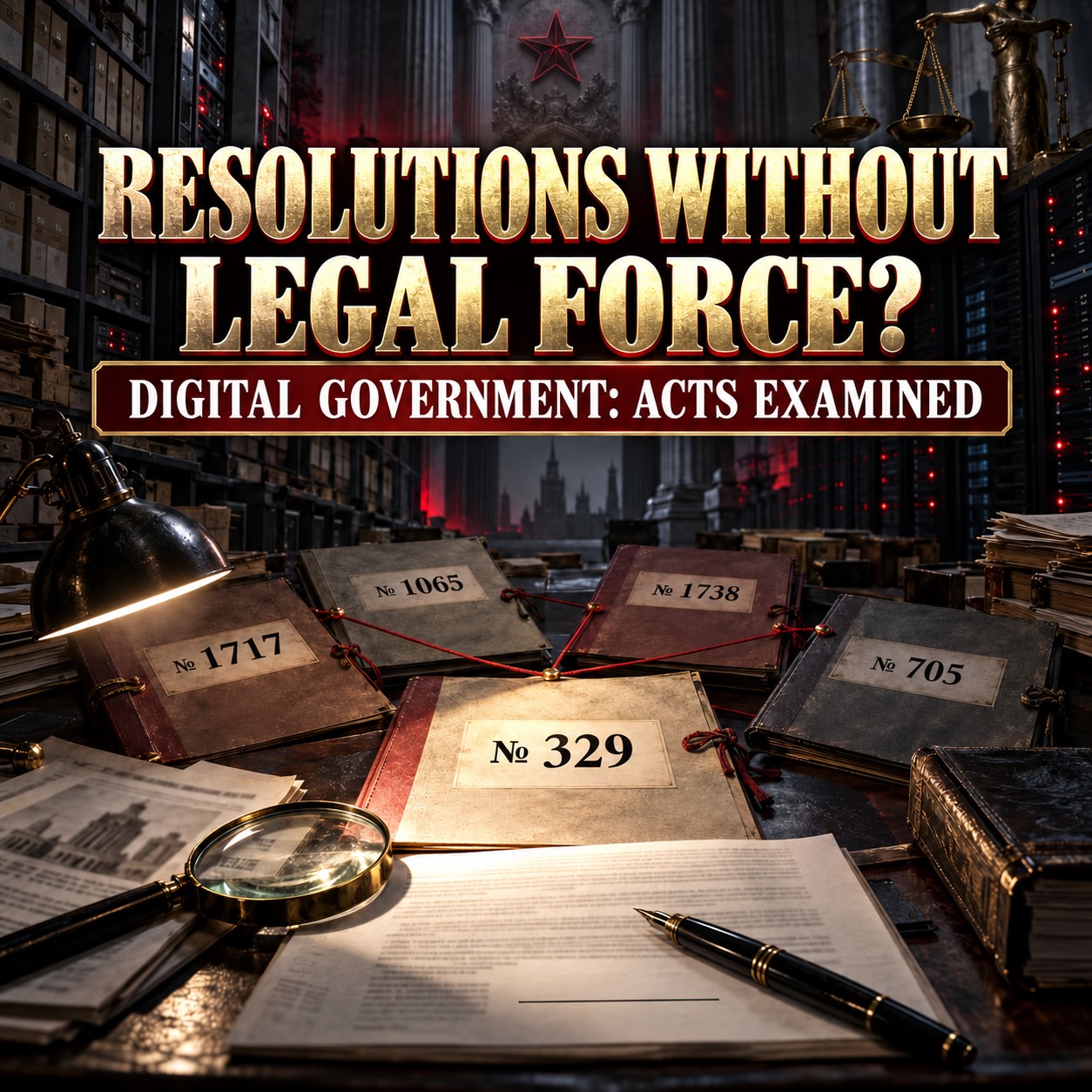
The documents retain their separate subjects: Nos. 329 and 1717 concern the regulations governing the Ministry of Finance; Nos. 1065 and 1738 concern those governing the digital development commission. Resolution No. 705 and Bill No. 1194918/8 appear in the concluding passage. The Academy assesses these documents adversely without establishing a single chain of regulatory dependence among all five resolutions.
The lecture calls the RF Accounts Chamber’s opinion on the bill to legalise digital currencies fabricated and unlawful. It links that criticism to the claim that the bill was not duly introduced and calls for the Accounts Chamber to be dissolved in favour of the work of the USSR Control Chamber.
The RF Accounts Chamber and Its Opinion on the Bill
The criticism of the Accounts Chamber concerns its opinion on Bill No. 1194918/8, “On Digital Currency and Digital Rights.” The lecture maintains that the bill was not introduced by an entitled party and that the opinion issued on it is fabricated and unlawful.
The discussion of the bill’s non-introduction appears alongside the assessment of Resolution No. 705, but the bill and the resolution remain separate documents. The Academy’s demand to the chambers of the Federal Assembly concerns recognition of the bill as unlawful and fabricated.
The criticism rests on the claim that this particular bill was not duly introduced. It is not simply a complaint that a bill has not yet become law: the issue is its introduction and the opinion issued on it.
In connection with that opinion, the Academy calls for the RF Accounts Chamber to be dissolved in favour of the work of the USSR Control Chamber. The lecture states a demand; it does not describe a separate transfer procedure, a list of future oversight powers or a dissolution that has already taken place.
The Academy’s analysis thus brings together the publication of Resolution No. 329, the amendments under No. 1717, the digital commission’s regulations under Nos. 1065 and 1738, and the concluding passage concerning No. 705. Bill No. 1194918/8 and the Accounts Chamber’s opinion remain a distinct issue. The lecture’s final demand is dissolution of the RF Accounts Chamber in favour of the work of the USSR Control Chamber.