






















1. The situation: figures that do not lie
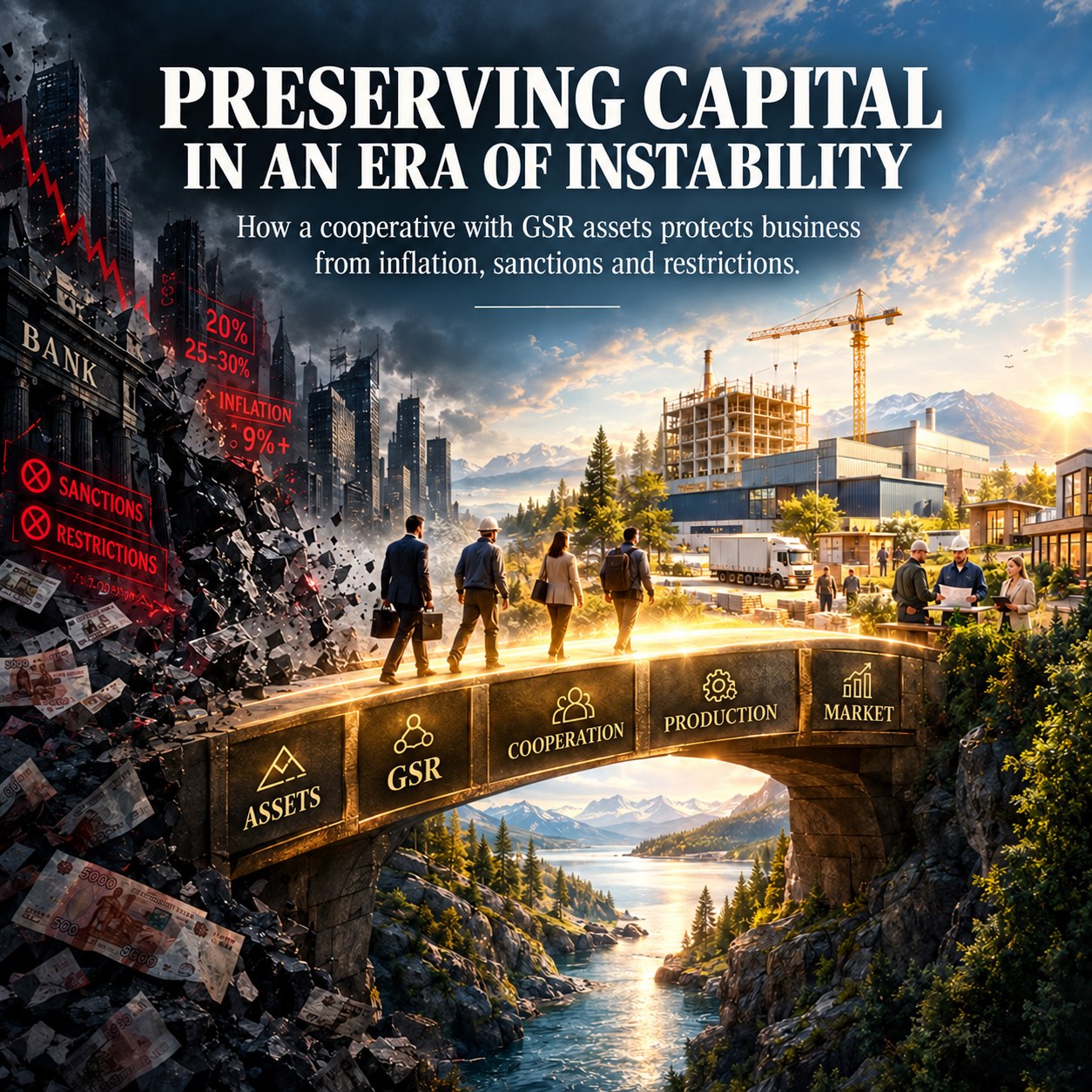
Preserving capital is the foremost task for business. In 2026, Russian businesses are operating in conditions that, just five years ago, would have seemed like the plot of an economic thriller.
The Central Bank’s key interest rate remains at around 20% per annum. Mortgage rates are 25–30%. Official inflation is around 9%, but the rouble’s actual purchasing power is falling faster. The tax burden is growing: since 2025, a progressive personal income tax scale has been introduced, corporation tax has been increased, and scrutiny of transactions has tightened.
For the construction business—and above all for developers, who currently face the greatest difficulties—this means:
- demand is falling: buyers cannot take out mortgages at 30%;
- costs are rising: materials, logistics, wages;
- working capital is being eaten away: money that should be going towards growth is being spent on covering running costs;
- inventory is becoming illiquid: completed houses are not selling, and plots stand idle.
And most of all: no one believes tomorrow will be better. Businesses understand that the climate is deteriorating, and will remain that way for a long time. That is precisely why preserving capital is becoming a matter of survival for businesses, rather than an abstract task.
2. The diagnosis: what is happening to capital
Every entrepreneur who thinks two steps ahead asks one question: how can I preserve what I have earned? Preserving capital is about keeping the model working.
Because unless it is preserved, the model will stop working. There will be no capital for growth. Everything will be tied up in excess stock, surplus warehouse space and property that does not sell. In illiquid assets.
Three strategies businesses choose:
| Strategy | What the business does | Result |
| Hide | Holds money in fiat currency and waits | Fiat currency depreciates. 9% inflation means losing 9% of capital a year |
| Wait | Does nothing and hopes for the best | Waiting kills. While you wait, competitors adapt |
| Adapt | Looks for new models | The only strategy that works. But it requires tools |
The first two lead to losses. The third leads to survival.
It is important to understand that a business operating in a competitive market naturally strives to grow at all times and in whatever circumstances it faces. It cannot do otherwise—otherwise it ceases to be a business. This is its main distinction from those that live off military, government or other patronage-based contracts: those businesses will die in any event, because their existence depends on the budget rather than the market. A competitive business will survive, because it knows how to adapt. The only question is what tools it uses.
3. What is wrong with fiat currency
A Bank of Russia note is a means of payment, but not a store of value. Nor is it even a medium of exchange in the full sense of the term.
It is weak. Its exchange rate does not reflect the true state of the market—it reflects the regulator’s decisions, the political climate and external restrictions. Today’s rouble exchange rate is not the rouble’s market price, but an administratively determined figure. The market has long since ceased to set it—it merely adjusts to it.
It is not a medium of exchange. Try exchanging a large sum of roubles for something outside Russia. Try taking them out of the country. Try paying with them abroad. Even within the country, large payments require explanations: where the money came from, where it is going, and why. The rouble is not a currency in the full sense. It is a means of payment within a domestic circuit—a circuit that is shrinking.
It is unbacked. Neither by gold nor by a real asset. Its purchasing power rests on trust in a state whose own capabilities are limited. As soon as that trust falls, so does the rouble.
It is losing purchasing power. Official inflation is 9%. Actual inflation is higher. Every year the rouble sits idle, it loses part of its value. This is not temporary. It is systemic.
It can be blocked. An account, by a bank’s decision. A card, under 115-ФЗ. A transfer, under sanctions. Money held within the system is not your money. It is an entry that can be closed.
People went through this in the 90s. Savings were wiped out. Vouchers lost their value. Money “disappeared”.
Today the situation is different, but the risk is the same: fiat currency is unstable, lacks independence and offers no protection. It does not solve the problem of preserving capital. It makes it worse. It operates within a system that is shrinking. And as time goes on, it becomes less and less capable of even serving as a means of payment.
4. The market will not disappear
There is an illusion that if the system collapses, everything will collapse. That is not so.
Market relations are not something the state creates. They are something that exists between people. Even if the rouble collapses, the government changes and the borders close, people will continue exchanging the products of their labour. They will continue building, producing, selling and buying.
The question is not whether there will be a market. The question is what will serve as the means of payment during the transition.
Money is only a tool. It does not determine market relations. Market relations determine what the tool should be.
5. Preserving capital: the cooperative as a bridge to protection and stability
Preserving capital is possible—if there is a tool that works outside the fiat system. What if there is a tool that allows you to:
- preserve capital without losing liquidity;
- invest it in a productive asset rather than an illiquid one;
- make a profit now, without waiting;
- have its return guaranteed at any time—in *GSR, in fiat currency or as a stake in the business?
That tool is a cooperative with a loaded balance sheet provided by СМПК “Bright Great Rus”.
It is not a bank. Not a fund. Not an investment platform. It is a cooperative—a structure in which people pool assets for a common purpose and retain control over them.
Not an “alternative to the market”. Not an “escape from reality”. But a structure that sustains the market while the old system collapses. It gives rise to new market relations extending beyond the fiat circuit—and makes the offering more predictable and attractive.
6. How it works
6.1. The company joins
The company joins the cooperative as an associate member (or a full member, if it chooses).
What the company contributes:
- technology,
- a business model,
- equipment,
- production lines,
- its reputation.
What the cooperative contributes:
- an environment beyond the reach of sanctions,
- an asset in GSR,
- risk minimisation and the safekeeping of assets
- an autonomous market environment,
- legal protection.
6.2. Fixing the cooperative share’s value
The company’s cooperative share is fixed in GSR at the exchange rate on the date it joins. This is not “freezing”—it is a depository arrangement. The company transfers the asset, and the cooperative ensures its safekeeping and use for the intended purpose.
6.3. A productive asset
The contributed asset (technology, equipment) does not sit idle. It is put to work in the project:
- houses are built,
- buyers are attracted,
- fiat currency comes in,
- the cooperative makes a profit now.
6.4. Buyers
The homebuyer:
- pays part of the price in fiat currency,
- opens an account with the USSR State Bank,
- pays off the balance in GSR (or in fiat currency at the exchange rate).
This gives the buyer:
- protection against inflation,
- independence from mortgages at 30%,
- the ability to pay in gold-equivalent terms.
6.5. The company exits
The company can exit the project and receive its share:
- in GSR—into an account with the State Bank;
- in fiat currency—at the exchange rate on the exit date;
- as a stake in the business—if it wishes to continue;
- in the products of labour—if it wishes to receive goods.
7. What this gives businesses
Preserving capital is the primary concern of business. But not the only one.
| Business concern | What the cooperative provides |
| Capital protection | The cooperative share is fixed in GSR (gold) |
| Liquidity | Exit at any time—in GSR, fiat currency or a stake in the business |
| Profit now | A productive asset generates income |
| Market access | The region, buyers, infrastructure |
| Tax savings | Cooperative share contributions are not subject to VAT and are not treated as income |
| Security | A promissory note in your possession—not in an account, not subject to sanctions |
| Inheritability | The cooperative share can be inherited |
8. The internal financial circuit
The bank within the cooperative is not a commercial bank in the usual sense. It does not lend to anyone, issue mortgages or serve external customers. It is an internal settlement centre for cooperative members.
What it does:
- opens and maintains GSR accounts for members;
- settles transactions between members without intermediary banks;
- holds assets in GSR;
- records cooperative shares and obligations;
- issues promissory notes;
- converts fiat currency into GSR through the treasury;
- provides guarantees for members.
This makes it possible to create a closed financial circuit in which payments pass directly between the producer, the buyer and the cooperative—without SWIFT, without Visa, without external banks.
The key point: these are not “banking services” for external customers. This is infrastructure for members. A cooperative member gets a GSR account, transfers funds to another member, pays off a cooperative share, receives a promissory note—all within one system. External fiat currency comes in only at the point of entry; thereafter, the internal circuit operates.
This is precisely what makes the model resilient: the more members there are, the less it depends on the external system.
9. Tax advantages
A cooperative is a non-profit organisation. This means:
- cooperative share contributions are not subject to VAT (they are investments, not sales);
- cooperative share contributions are not treated as income when used for their intended purpose;
- separate accounting for earmarked receipts and business activities;
Savings can reach 20–30% compared with a commercial property developer.
10. Conclusion: preserving capital is a prerequisite for prosperity
The market will not disappear. People will continue building houses, producing goods and exchanging the products of their labour.
The only question is who will survive the transition.
Those who hide in fiat currency will lose.
Those who wait will be too late.
Those who adapt will win. Preserving capital is not a luxury. It is a prerequisite for both survival and prosperity.
The first step is not money. The first step is to understand what asset you have and how to secure its value. Then comes the conversation.
The cooperative is infrastructure for adaptation. The transition has already begun. The question is who will make it in time.
__________________________
*GSR (Gold Soviet Ruble / Gold Soviet Rouble) is a unit of account backed by physical gold. One GSR is equivalent to one gram of banking gold (XAU). It was introduced into international circulation by Resolution No. 001/RES2020 of the Sovereign International Treasury M1 dated 07.04.2020 as part of the global financial system’s transition to the Gold Standard (Basel III). Issuance is backed by banking gold recorded on the system’s balance sheets and is recorded in treasury accounts at the USSR State Bank. GSR is not subject to inflation, does not depend on central bank decisions, and is not subject to sanctions or blocking. It is used for settlements, asset preservation, compensation and pension payments, and the formation of cooperative shares within the cooperative system. The GSR exchange rate is fixed: 1 GSR = 1 gram of gold.
_________________________
Join the discussion of this and other topics on the world’s first sovereign social network Soyuz Portal: https://social.governmentussr.com
New sovereign resources of the USSR State Committee for the State of Emergency (GKChP)