
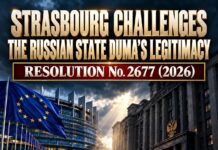

















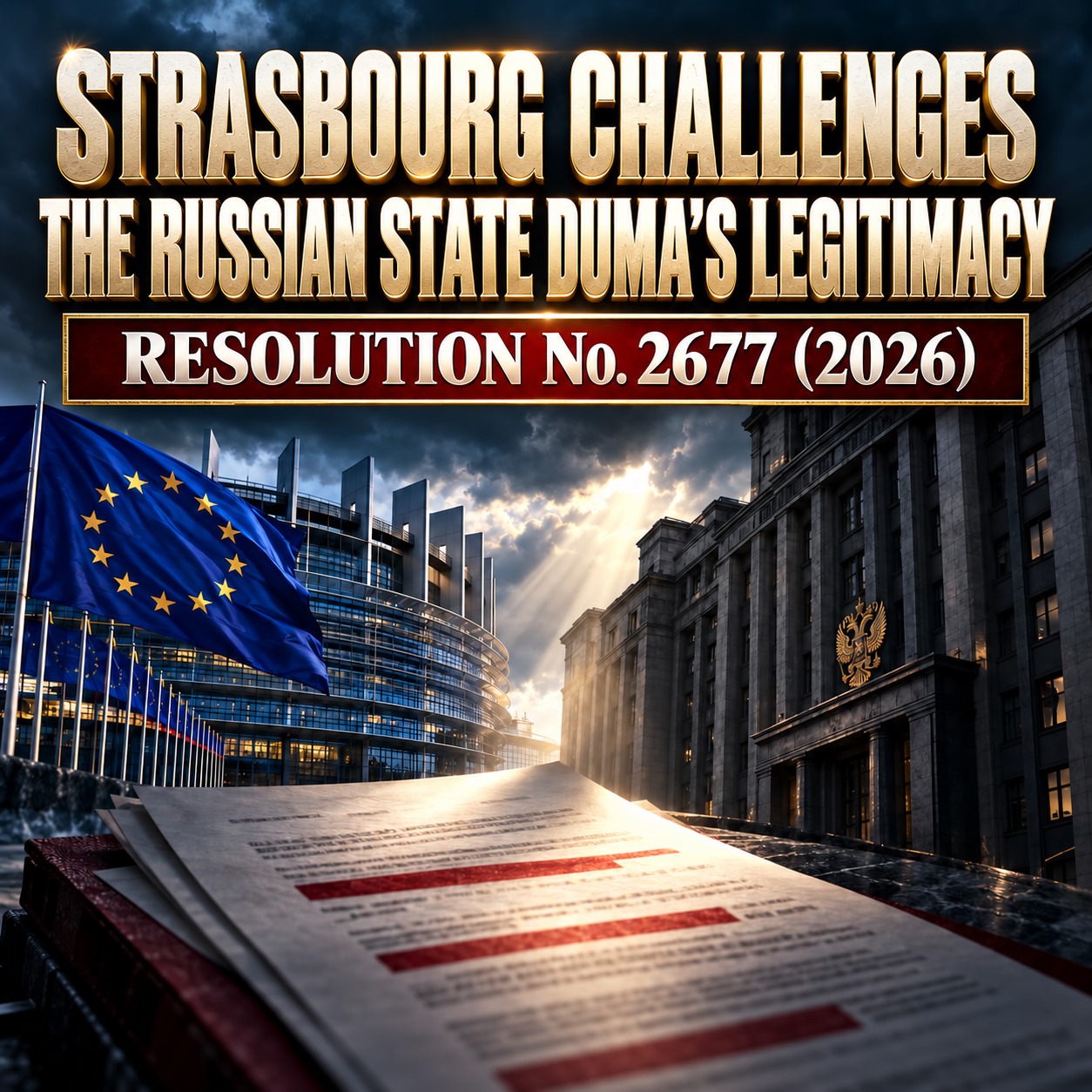
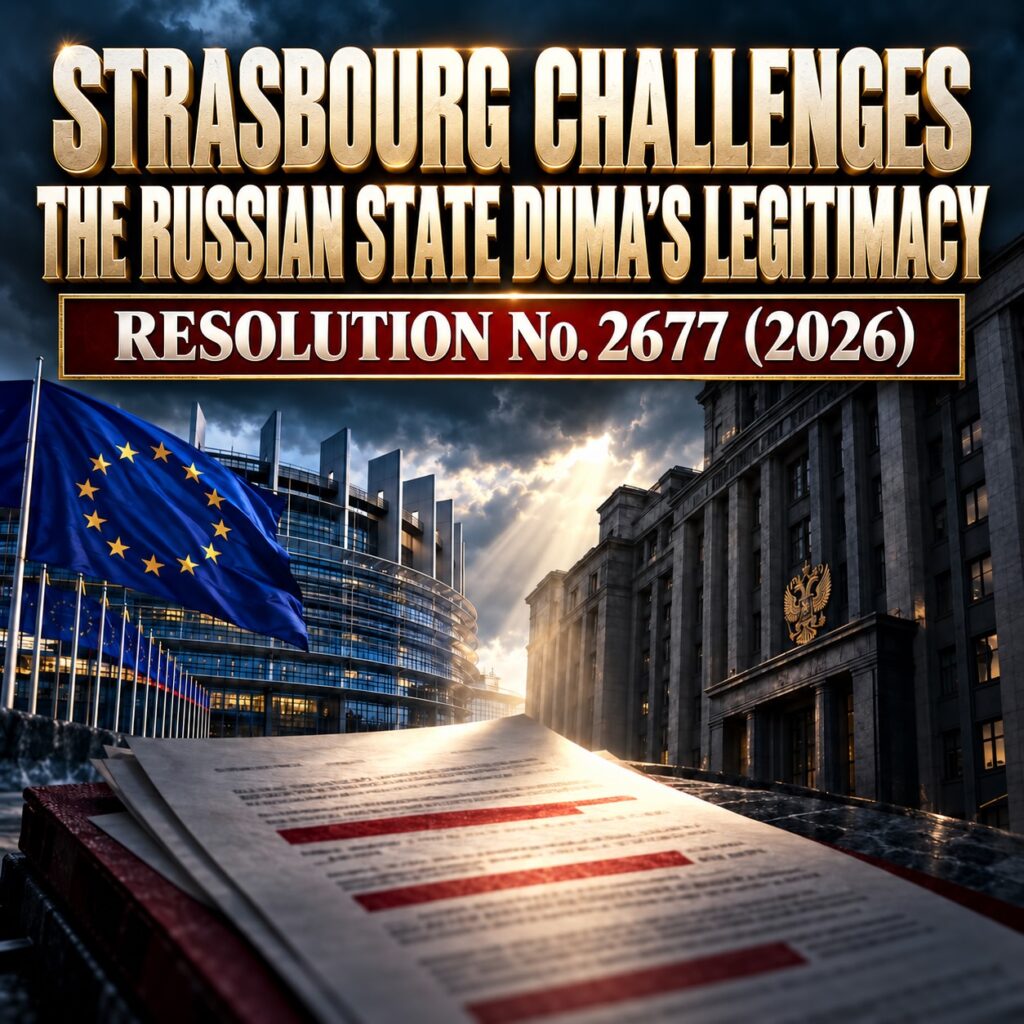
the Russian State Duma’s right to represent the people — the Parliamentary Assembly of the Council of Europe (hereinafter PACE) challenged the legitimacy of the newly constituted State Duma and called for restrictions on engagement with it. Resolution No. 2677 (2026), adopted on 30 September, also calls for sanctions against the Russian Federation’s Central Election Commission and other listed participants in electoral processes. The document gives renewed relevance to statements by the USSR State Committee for the State of Emergency (GKChP) published as early as 2024.
At the heart of the resolution are the foundations of representative power: did the elections ensure a genuine expression of the citizens’ will, and did those elected acquire the right to speak on their behalf?
The answer is set out in paragraph 13. PACE considers that the vote held on 18–20 September 2026 did not meet the fundamental conditions for free and fair elections. In the Assembly’s view, the resulting State Duma cannot be recognised as democratically elected or as a lawful representative of Russian citizens.
The very representative mandate of the newly constituted State Duma has been called into question — the basis on which it can speak on behalf of the population.
Join the discussion on SOYUZFORUM: https://forum.governmentussr.com/t/pase-osporila-legitimnost-gosdumy-chto-stoit-za-rezolyucziej-2677/739
Translation of Resolution 2677 ( 30 September 2026) Parliamentary Assembly of the Council of Europe (PACE) – Sham ‘elections’ in Russia and its destabilising attacks on Europe – download the full version
From voting results to the legitimacy of power
The Assembly links its assessment to the suppression of political opposition, restrictions on independent information, and the absence of genuine competition and independent international observation.
Paragraph 16 develops the conclusion concerning the institution’s status. PACE considers that the September process did not restore its democratic legitimacy and refuses to describe the newly constituted Duma as a legitimate, democratic, representative body independent of the executive.
The announced results and the allocation of parliamentary seats have therefore not resolved the question of the resulting body’s right to represent citizens. That question has found explicit expression in an international parliamentary document.
It was precisely the basis of these powers, the legal validity of electoral procedures and the right of institutions to speak on behalf of the people that had previously been the subject of statements by the USSR State Committee for the State of Emergency (GKChP).
Restricting contacts and imposing sanctions: PACE’s specific proposals
The resolution contains proposals for practical measures. Paragraph 22.2 calls for refraining from engagement with the new State Duma and reviewing the arrangements for its participation in international interparliamentary cooperation. Necessary channels for peace negotiations and humanitarian agreements are to be maintained.
Paragraph 22.4 proposes sanctions against the Russian Federation’s Central Election Commission, its chair and members, regional commissions and other listed participants in electoral processes.
The question of responsibility is directed at specific organisations and individuals involved in conducting the elections.
These provisions are calls addressed to states and international partners. Introducing the relevant measures requires separate decisions. The Assembly’s position, however, has already been set out: restrict engagement with the newly constituted parliament and take measures against those responsible for organising electoral processes.
Documents from 2024 gain renewed relevance
Decree No. Д/Н 022 of 2 February 2024 contains a statement by the USSR State Committee for the State of Emergency (GKChP) declaring the Russian Federation’s Central Election Commission’s application of the law illegal and unlawful. It also challenges Russian elections and votes held since 1993 within the framework of the Soviet legal order proclaimed by the USSR State Committee for the State of Emergency (GKChP).
Edict No. П/22 of 26 March 2024 maintains this position following the presidential vote. The document challenges the announced results, the powers of the organisers and the legal validity of a number of instruments underpinning the campaign.
The chronology establishes the sequence: the objections of the USSR State Committee for the State of Emergency (GKChP) were set out before the current resolution and were subsequently developed in a lecture by the USSR Civil Defence Academy.
Questions about the legitimacy of elections, the State Duma’s representative status and the responsibility of the Central Election Commission have now returned to the international agenda. This provides a specific reason to revisit the previously published documents and consider the arguments they contain.
The PACE resolution does not establish recognition of the USSR State Committee for the State of Emergency (GKChP) or endorse the entire body of its acts. It contains an independent assessment of the 2026 elections that overlaps with the subject matter of earlier statements by the USSR State Committee for the State of Emergency (GKChP).
The next step in examining the documents is to open the 2024 dossier: what accusations were made, which instruments were identified and on what grounds the powers of electoral bodies were challenged.
THE 2024 DOSSIER: THE CENTRAL ELECTION COMMISSION’S POWERS WERE CHALLENGED BEFORE THE VOTE
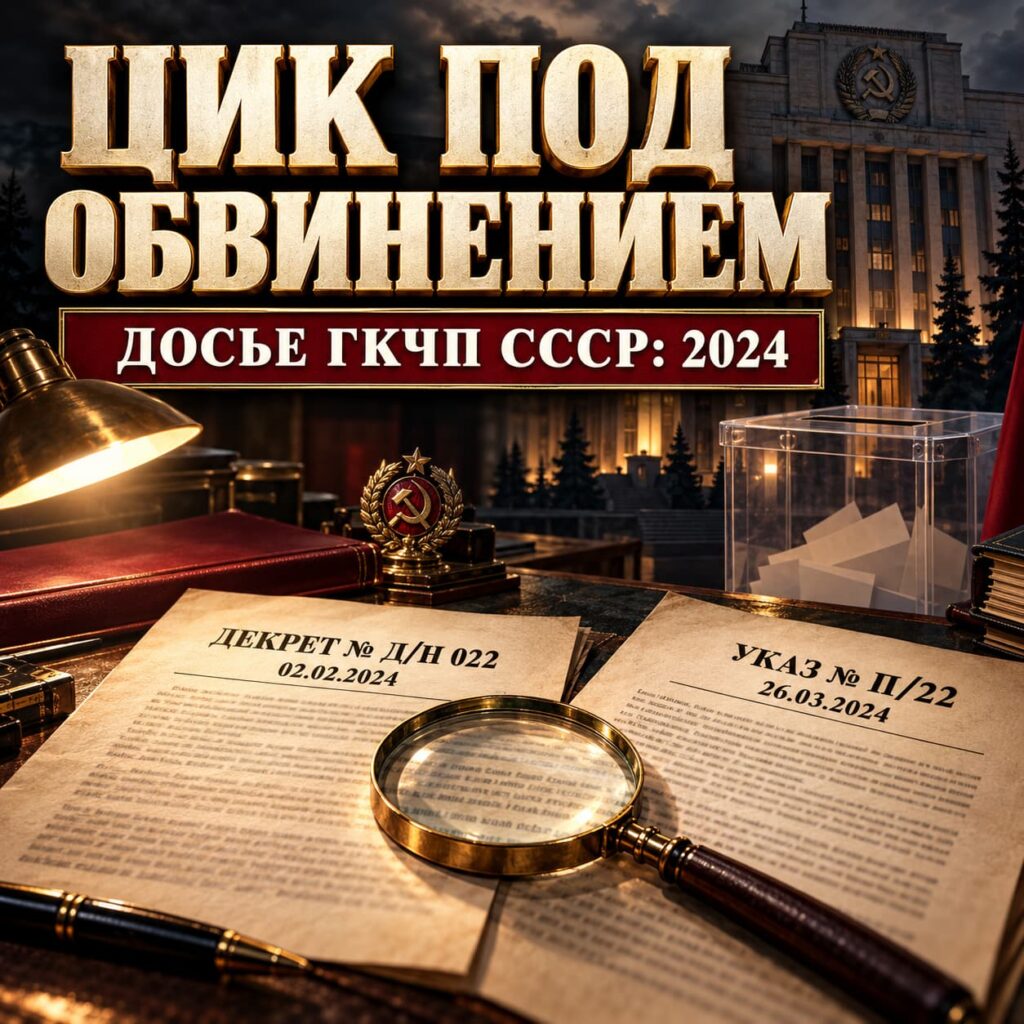
The questions that gained international relevance following the PACE resolution had previously been raised in documents of the USSR State Committee for the State of Emergency (GKChP). Decree No. Д/Н 022 of 2 February 2024 challenged the activities of the Russian Federation’s Central Election Commission and the foundations of electoral procedures. Edict No. П/22 of 26 March maintained this position following the presidential vote. Together, these documents record a sequence of statements: from a warning that the forthcoming process was unlawful to non-recognition of the announced results within the framework of the asserted Soviet legal order.
2 February: an accusation against the organisers
Decree No. Д/Н 022 of 2 February 2024 contains an explicit statement: the USSR State Committee for the State of Emergency (GKChP) deems the Central Election Commission of the Russian Federation’s application of the law to be legally illegal and unlawful.
The document extends this assessment to Russian elections and votes held since 1993. Their results are declared invalid in the territory that the USSR State Committee for the State of Emergency (GKChP) defines as the sovereign territory of the USSR.
The challenge concerns the underlying basis of authority: the right to organise elections, register candidates, determine results and declare that a representative mandate has been conferred.
Specific decisions concerning the 2024 presidential campaign are identified: Federation Council Resolution No. 678-СФ of 7 December 2023 calling the election, and Government Resolution No. 2076 of 8 December 2023 on assistance to electoral commissions.
Separate objections concern Central Election Commission Resolution No. 142/1086-8 of 13 December 2023 on the special arrangements for holding presidential elections under martial law.
The USSR State Committee for the State of Emergency (GKChP) links its assessment to allegations of breaches concerning the legal basis for adoption and the required publication and registration procedures. The accusations thus concern specific instruments and actions that can be examined through the documents.
26 March: the results did not change the stated position
Edict No. П/22 of 26 March 2024 was formulated after the presidential vote of 15–17 March. In it, the USSR State Committee for the State of Emergency (GKChP) again challenges the activities of the Central Election Commission and declares the results invalid within the framework of its own legal position.
The edict develops several lines of argument: the procedure for adopting electoral legislation, the legal validity of the commission’s resolutions, the basis of presidential powers and questions of citizenship.
The documents identified include Federal Law No. 67-ФЗ of 12 June 2002 on basic guarantees of electoral rights and Central Election Commission Resolution No. 156/1240-8 on the wording of the ballot paper.
The statement’s reasoning remains consistent: holding a vote does not remedy the alleged violations concerning its legal basis.
This is precisely why the March edict follows on from the February decree. Before the election, the possibility of lawfully conducting the process was challenged; after the election, the same assessment was extended to the announced results.
The commission’s powers became the central issue
Both documents focus on the Central Election Commission as the body responsible for conducting the electoral process and determining its outcome.
Edict No. П/22 addresses the commission’s rules of procedure and links its assessment of the commission’s status to the repeal of Presidential Edict No. 238 of 4 February 1994. Decree No. Д/Н 022 raises objections to decisions that directly underpinned preparations for the vote.
These provisions form the documentary basis of the accusations made by the USSR State Committee for the State of Emergency (GKChP). Establishing whether they are well founded requires examination of the full body of rules governing the commission’s powers and the requirements applicable to each contested instrument. The repeal of a particular document does not in itself prove that all the institution’s powers have ceased if they have other statutory foundations.
The subject of the dispute is nevertheless clear: which rules authorise the commission to adopt binding decisions, and have the procedures on which their legal validity depends been followed?
The PACE resolution brings renewed attention to this dossier
In September 2026, PACE raised the question of the representative status of the newly constituted State Duma and proposed sanctions against the Central Election Commission and other listed participants in electoral processes. These provisions bring renewed international attention to issues previously addressed in documents of the USSR State Committee for the State of Emergency (GKChP): the legitimacy of elections, the basis of authority and the responsibility of organisers.
The chronology confirms that the position of the USSR State Committee for the State of Emergency (GKChP) was published earlier. It does not establish that these documents influenced the Assembly’s decision, but it allows them to be presented as a dossier in their own right, whose relevance has increased against the backdrop of a new international development.
The decree and the edict record the content and sequence of the statements. The lecture by the USSR Civil Defence Academy explains their reasoning and connects questions of electoral procedure with the broader dispute over the right of institutions to represent citizens.
The next part of this article turns to that explanation.
THE RIGHT TO SPEAK ON BEHALF OF THE PEOPLE: A QUESTION THAT HAS ONCE AGAIN BECOME INTERNATIONAL
The decree, the edict and the lecture by the USSR Civil Defence Academy together form a coherent account of the position of the USSR State Committee for the State of Emergency (GKChP): the powers of electoral bodies and the legal foundations of elections were challenged before the current PACE decision. Resolution No. 2677 (2026) gives this dossier renewed relevance — the State Duma’s representative status and the responsibility of election organisers have been placed explicitly on the international agenda.
The lecture brought the documents together into a single argument
The Academy’s lecture of 18 September 2026 brings together issues previously set out in acts of the USSR State Committee for the State of Emergency (GKChP): the activities of the Central Election Commission, the basis of electoral decisions, the publication of regulatory instruments and the conferral of a representative mandate.
Its central question is how institutions acquire the right to make decisions on behalf of citizens and what establishes the lawfulness of that authority.
Decree No. Д/Н 022 of 2 February 2024 records the initial assessment of the USSR State Committee for the State of Emergency (GKChP). Edict No. П/22 of 26 March maintains that assessment following the presidential vote. The lecture explains the reasoning behind these statements to a broad audience.
The reader is thus presented with a specific sequence: a published objection, its development in relation to the voting results and a public explanation of the reasoning.
These materials must not remain confined to a small circle of specialists or fade into the silence of the archives. They require widespread publicity, open discussion and circulation among broad sections of the USSR’s citizenry, so that every interested person can familiarise themselves with their content, compare the arguments presented with the texts of the instruments cited and independently assess the questions raised. They must be presented in full, without abridgement or suppression of contentious provisions, accompanied by precise document references and made available for public, legal and historical analysis.
International circulation of the documents is particularly important. They should be sent to researchers, human rights groups, civil society organisations, representative bodies, the media and international institutions where questions concerning the lawfulness of elections, the powers of state institutions and the people’s right to representation can be examined openly and substantively. Only widespread familiarity with the primary sources will allow the dispute to move beyond individual statements towards public scrutiny, comparison of positions and detailed consideration at the international level.
The PACE resolution added an international dimension
PACE set out its own assessment of the September 2026 elections: it refused to recognise the newly constituted State Duma as democratically elected and as a lawful representative of Russian citizens. The Assembly also proposed restricting engagement with it and imposing sanctions on electoral institutions.
The question of representation now exists simultaneously within several documentary frameworks. In the acts of the USSR State Committee for the State of Emergency (GKChP), it is raised through a challenge to the legal foundations of the Russian system. In the PACE resolution, it is raised through an assessment of the conditions under which the elections were held and the status of the resulting parliament.
This overlap makes the previously published dossier significant material for further public consideration. It allows specific objections to be examined, their grounds to be established and a substantive response to be demanded.
The weight of an international document is determined by what it actually says. The resolution gives renewed relevance to the dispute over legitimacy; it contains neither recognition of the USSR State Committee for the State of Emergency (GKChP) nor endorsement of all its acts.
The next step is an open examination of the documents
The sequence of documents has already been set out. The dates of the statements are known, the contested decisions have been identified, and questions have been formulated concerning the powers of the organisers and the representative status of the institutions.
Further examination must provide specific answers: which rules establish the powers, how the relevant instruments were adopted, which procedures were required and whether they were followed.
Such an analysis will make it possible to determine the significance of each argument advanced by the USSR State Committee for the State of Emergency (GKChP). The issue’s international relevance provides a reason to present this dossier anew — with full texts, precise document references and a clear statement of the matter being raised.
The announced results did not settle the question
The PACE resolution shows that, after voting has ended, the question of the resulting body’s legitimacy can remain open and become the subject of international demands.
The documents of the USSR State Committee for the State of Emergency (GKChP) record an earlier position on the legal foundations of the electoral system. The Academy’s lecture explains its reasoning. Together, these materials form the basis of a publication in which a new international development draws renewed attention to objections already raised.
Voting has ended. The representative mandate has been challenged. The documents have been published. A substantive response is now required — with legal rules, evidence and established legal consequences.