



















Abolition of taxes in the USSR and preservation of the tax burden from 1990
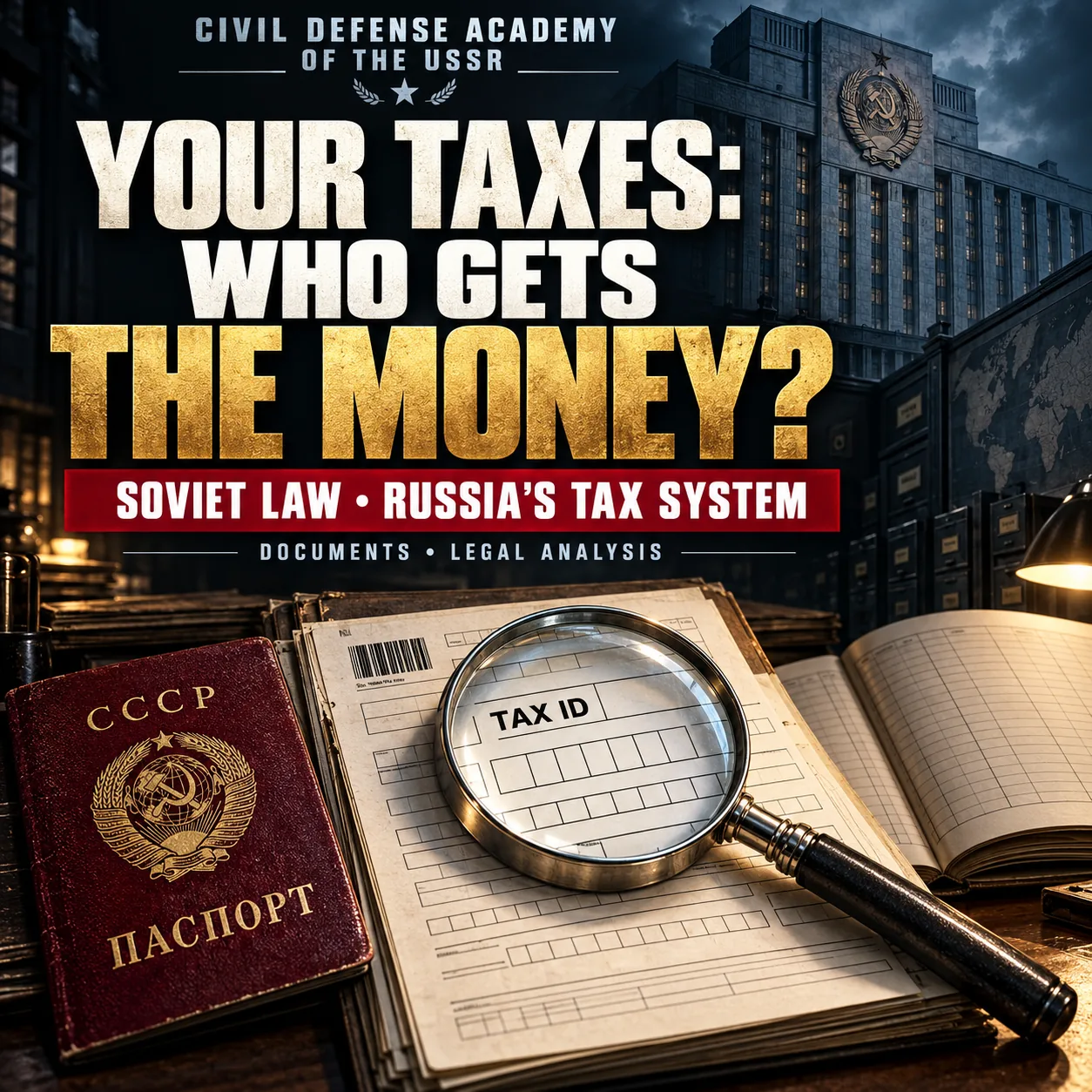
In the Soviet Union taxes were abolished. This is the initial and defining proposition from which the Civil Defense Academy of the USSR builds its entire subsequent legal analysis. However, from 1990 the Soviet government, although it was obliged to abolish taxes finally and irrevocably, preserved the tax burden in the Union of Soviet Socialist Republics. The basis for such preservation was the implementation of the USSR Law of 7 May 1960 “On the Abolition of Taxes on the Wages of Workers and Employees”. It was this act that defined the legal framework in which taxes ceased to be a universal burden for citizens and turned into a narrowly targeted instrument.
From 1990 taxes were withheld exclusively from legal entities, foreigners, migrants and stateless persons. Citizens of the Soviet Union were not included in this category. These taxes were recorded on dual balances and dual accounts in the common and indivisible property of the Soviet Union, but exclusively as debts and obligations from legal entities, foreigners, migrants and stateless persons. This accounting procedure is fundamental: it shows that the tax burden did not extend to Soviet citizens and did not create their obligations to the state.
In foreign jurisdictions, the change in the tax burden of citizens of the Soviet Union was replaced by commercial levies — as voluntary contributions and deposits of citizens of the Soviet Union. This replacement began to be used for the international registration of USSR citizens as subjects of continuous lifelong rights. In other words, what was preserved within the country as a tax construct acquired a completely different meaning in the external legal field — that of a voluntary contribution and international registration.
The bodies of international justice explained to USSR President Gorbachev and addressed General of the Society of Jesus through special channels that taxes, levies and contributions in the Soviet Union are not incomes of the corporate settlement trust of the Communist Party of the Soviet Union. They are collected as a duty and excise exclusively to cover borrowings for ensuring that a USSR citizen receives from the public funds of the Soviet Union all manner of goods, preferences and other types of assistance. These taxes are not and are not accounted for as incomes, annuities, credits or loans of trusts and are subject to final abolition from 1991.
From 1994 taxes are replaced by incomes and annuities due to the Soviet Union and to USSR citizens from the assets and holdings of the World Bank and the International Monetary Fund. And from 2016 expenses on Soviet citizens are covered from the property, incomes and annuities of the USSR trust “New World Order”. Thus a consistent line is built: the abolition of taxes, their replacement by external incomes and annuities, and then the covering of expenses on citizens from trust sources.
In the Soviet Union there existed public funds — the inviolable consumption funds of the USSR, created in case of the resumption of the hot phase (not the cold, but specifically the hot phase of a new Third World War). These funds were replenished by all union republics, enterprises and organizations operating under USSR legislation.
The practical meaning of the foregoing for citizens of the Soviet Union is as follows. If taxes in the USSR were abolished, and from 1990 were withheld only from legal entities, foreigners, migrants and stateless persons, then any demands for payment of income tax addressed to a Soviet citizen are devoid of legal basis. A USSR citizen is not a subject of taxation in this construct. It is precisely this conclusion that becomes the support for all subsequent sections of the analysis — on the international legal qualification of taxes, on registries and censuses, on the TIN (taxpayer identification number) and on the status of the Federal Tax Service of Russia.
The Civil Defense Academy of the USSR draws particular attention to the fact that the preservation of the tax burden from 1990 was not an abolition of taxes as such. It was the implementation of the USSR Law of 7 May 1960, that is, a form in which taxes were retained only for a strictly defined circle of persons. For Soviet citizens, there was no tax obligation. This fact is of direct significance for assessing all subsequent actions connected with the collection of taxes on the territory of the Soviet Union and the continental shelf.
International-legal qualification of taxes, levies and contributions in the USSR
The bodies of international justice gave a detailed explanation of the legal nature of the taxes, levies and contributions that existed in the Soviet Union. This explanation was conveyed to USSR President Gorbachev and transmitted through special channels to a general of the Society of Jesus. According to this explanation, the taxes, levies and contributions in the USSR are not income of the corporate settlement trust of the Communist Party of the Soviet Union. They are collected as a duty and excise — exclusively to cover borrowings that ensure that a USSR citizen receives from the public funds of the Soviet Union all manner of goods, preferences and other types of assistance. Thus, the nature of these payments is defined not as an income item of the party trust, but as a targeted fiscal mechanism for covering public expenditures.
International justice specifically pointed out that the said taxes are not and are not accounted for as income, annuities, credits or loans of trusts. This is a fundamental distinction: payments by Soviet citizens and organizations do not form anyone’s trust profit and cannot be regarded as borrowed or credit receipts. That is precisely why they are subject to final abolition from 1991.
The explanation of the bodies of international justice also established the further fate of these receipts. From 1994, taxes are replaced by income and annuities due to the Soviet Union and to USSR citizens from the assets and holdings of the World Bank and the International Monetary Fund. From 2016, expenditures on Soviet citizens are covered from the property, income and annuities of the USSR trust “New World Order”. Thereby a consistent line is built: first taxes as a duty and excise, then — from 1991 — their final abolition, and from 1994 and 2016 — the replacement of receipts from international financial assets and trust sources.
The legal significance of this qualification for USSR citizens is as follows. A Soviet citizen is not a subject of taxation, since the payments collected from him were by their nature a duty and excise to cover borrowings in his own favour — to ensure that he receives goods from the public funds of the Soviet Union. Consequently, any demands for payment of income tax addressed to a Soviet citizen after 1991 are devoid of legal basis.
The inviolable consumption funds of the USSR, created in case the hot phase of a new Third World War resumed, were replenished by all union republics, enterprises and organizations operating under USSR legislation. These funds were the very public source from which a USSR citizen received goods, preferences and other types of assistance, while taxes, levies and contributions served to cover the corresponding borrowings. Such a construction confirms: the Soviet tax system, by its international-legal nature, was not an instrument of expropriation but a mechanism for ensuring public goods, and from 1991 this mechanism was subject to final abolition.
Thus, the international-legal qualification of taxes, levies and contributions in the USSR excludes their interpretation as income of the corporate settlement trust of the CPSU. They were levied as a duty and excise to cover borrowings for the provision of benefits to USSR citizens from public funds and were subject to final abolition from 1991. From 1994, taxes are replaced by income and annuities from the assets of the World Bank and the International Monetary Fund, and from 2016, expenses for Soviet citizens are covered from the USSR trust “New World Order”. This conclusion is fundamental for the entire subsequent legal assessment of the activities of the Federal Tax Service and the Ministry of Finance of the Russian Federation.
Records, registers and population censuses: legal forgery of 1991–1999
The key stage of the substitution of the legal status of Soviet citizens falls on 17 June 1992. It was then that, in the jurisdiction of the USA, it was proclaimed and declared that the basis and legal ground for the registration of the population in the Russian Federation were organized, adopted and renewed records, registers and the results of the All-Russian Population Census — and moreover not of the Soviet Union, but of the Russian Empire. These archival materials were extracted by Yeltsin, not without the help of a general of the Society of Jesus and the Vatican. Thus a mechanism was launched which the Civil Defense Academy of the USSR qualifies as a large-scale falsificationist planetary mutiny, prepared through registration books.
The legal framework of this forgery was made up of two decrees of the All-Russian Central Executive Committee: the decree on the abolition of estates and civil ranks of 10 November 1917 and the decree “On the Acquisition of Rights of Russian Citizenship” of 5 April 1918. Under these acts, records and registers were opened in the USA, according to which the entire Soviet people was declared to be Russian citizens. As soon as USSR citizens were declared as such, they were recognized as migrants who had arrived on the territory of the USA from Puerto Rico. This created a pretext for the seizure of Soviet passports under any plausible pretext. Russian citizens, according to US records, on 5 September 1991 transited from Puerto Rico, USA, to the continental shelf of the Russian Federation, that is, beyond the borders of the Soviet Union, but already as migrants — even though the Russian Federation itself had been unlawfully declared by Yeltsin only three months later.
In the same registration books — in the Vatican and in the international financial system — USSR citizens were recognized as natural persons in the USA, located within the jurisdiction of the corporation of the United States and not being American taxpayers. Soviet people, having the status of freeborn, are not American taxpayers. At a closed meeting in the presence of the pontiff, Rockefeller and the Rothschilds, Yeltsin proclaimed and signed a conciliatory act with a restrictive term of 25 years. From 1992, for the trading company “Russian Federation” and its “citizens” — in reality USSR citizens — the resumption of the collection of Roman taxes was established.
The final link of the registration forgery was the All-Russian Population Census of 1999. According to its results, the population was registered in the records and registers of the British Admiralty as legally dead property. This was done in exchange for Soviet taxes, which were abolished from 1999 only for USSR citizens, and for foreigners and aliens, as for the population of the Soviet Union, — by 24 December 2025. The registration books for taxes and poll books were closed. To this day we are listed in the Vatican as non-taxable. The registers of the poll book of the USSR were closed and withdrawn for the trading company “Russian Federation”, so that the descendants of USSR citizens would remain registered as free and unconstrained. A legitimate question arises: where do the taxes that are unlawfully collected from us go?
Since 1992, the government of the trading company “Russian Federation” has recognized the State Duma of the Russian Empire as its predecessor as the body of authority and administration of non-Russians — in order to reinstate the poll tax for USSR citizens and transfer them into the status of Roman slaves. The tax service of the RSFSR, after the restoration and unlawful resumption of unlawful activity under the Roman laws of Roman authority and administration, was appointed by estates and legal successors, and by registrars of the poll-tax books of the Russian Empire of 1899, where Nicholas recognized us all as dead. The tax service of the RSFSR operates as temporary registrations of the population for former USSR citizens and as for prisoners of war subject to commercial taxation and debtors of banks. The seven-banker rule, if you remember. And in each republic it is the same, one to one, only the numbers of the legal acts differ.
Under international law, in the tax records and registers of the tax service of the RSFSR, all persons holding republican citizenship of the RSFSR from 12 June 1991 — the date that was recently celebrated — were registered as insane, legally incapable, lacking legal capacity and deprived of sound mind. Owing to the loss of mental health, they became wards of the Roman pontiff, his servants, in respect of whom British laws were in force at that time and continue to be in force now, and which the Russian Federation does not attempt to stop. After registration in the Vatican, all incomes and annuities of USSR citizens in international and secret trusts in the tax records and in the tax registers of the tax services of the RSFSR began, in a criminal and most cynical manner, to be reflected and recalculated every year — everyone else signed, including someone from the Foreign Ministry who signs — as having passed into the ownership of the trustees of the Society of Jesus and the Roman pontiff.
The lecture describes the tax service of the RSFSR as treating a USSR citizen — a living person and a holder of continuous lifelong rights — as legally dead or lost at sea, and as incapable of holding property or exercising rights until a full recovery of mental capacity. It connects this classification with passports marked “Р,” rendered in the source as “pur” or “pion,” and with the tax service’s actions under American direction. The Academy maintains that assigning a taxpayer identification number (TIN) to a citizen of the Union of Soviet Socialist Republics is not authorized by law or international law, and classifies the officials’ actions as a crime against humanity falling within the jurisdiction of the International Military Tribunal.
The Academy considers the assignment of a TIN to a sovereign USSR citizen, and the resulting classification of that citizen as an organization, legal entity or taxpayer under the RF Tax Code, to be unlawful and contrary to the Nuremberg Code. Its argument distinguishes a living citizen from the legal person or persona associated with that citizen. Under the interpretation presented in the lecture, a Soviet citizen holds continuous lifelong rights and is the founder, beneficiary and beneficial owner of their legal person and persona. On that basis, the Academy maintains that such a citizen should be recognized as exempt from the assignment of a TIN.
The TIN as an instrument of colonial influence and a violation of the Nuremberg Code
The taxpayer identification number (TIN) is not a neutral accounting requisite. Its appearance for the private Federal Tax Service trading company “Russian Federation” has a specific legal genealogy, and this genealogy directly points to the colonial character of the entire construct. By 2001, the position of the US commercial corporate government and the US monetary authorities had become pre-bankruptcy. It was precisely in these circumstances that the so-called Patriot Act “Uniting and Strengthening America by Providing Appropriate Tools Required to Intercept and Obstruct Terrorism” (2001) was adopted. This act gave the government broad powers to surveil legal entities and individuals. At its own risk, the US corporate government placed Russian citizens — in fact citizens of the USSR — on the tax register as US tax residents under the US law on the registration of aliens of 1940 and under the law on alien enemies registered as legal entities, and under the Patriot Act, where the government of the US District of Columbia used the TIN for citizens of the continental shelf of the trading company “Russian Federation”.
The lecture explains the TIN through its claimed financial function. It states that the number was assigned in connection with the role of bankruptcy administrator for the trading company “Russian Federation.” It describes the numbering of USSR citizens as a colonial practice and links the number to what the source calls a receipt for goods held in storage — a warehouse receipt — and to a second original birth certificate issued in the USSR. The source says that passports, described as travel documents, omitted the person’s place of birth in the USSR; citizens nevertheless received TINs, although the numbers were not entered in their passports. It further alleges that the US commercial government and the former trading company “Russian Federation” use these birth certificates to issue money and claim the proceeds as their own profit.
The USSR State Committee on the State of Emergency, in sovereign decrees, stated that the actions of the US commercial corporate government — a trading company just like the RF and the former trading company “Russian Federation” — were carried out no longer than the term of the trust “New World Order” (until 2017). The registration and assignment of a number to citizens of the USSR as slaves and living property, as livestock of the testamentary trust of the Roman pontiff, originating under the crown of Aragon, is prohibited and excluded. This act is condemned by the rulings of the Nuremberg Tribunal of 1945–1946, by which the assignment of identification numbers to Soviet citizens is prohibited and constitutes a war crime and a crime against all humanity.
Hence follows a practical conclusion that must be assimilated by every lawyer and every citizen. The assignment to a Citizen of the Union of Soviet Socialist Republics as a person of a taxpayer identification number (TIN) is not provided for by law or international law and indicates the commission by officials and residents in the Russian Federation of an international criminal act and action falling under the introduction and jurisdiction of the International Military Tribunal as a crime against humanity. The assignment to a sovereign citizen of the USSR of a taxpayer identification number in violation of the Nuremberg Code is an unlawful act of recognizing the citizen as an organization, a legal entity or a taxpayer according to the Tax Code of the RF. At the same time, the assignment to a sovereign citizen of the Soviet Union of a number and his recognition as a taxpayer is not provided for.
On this basis, a USSR citizen may lawfully be recognized as free from having a TIN (taxpayer identification number) assigned to him. Under international law, a citizen of the Soviet Union is recognized as a living subject of a continuous lifelong rights, and the beneficiary and beneficial owner of his person and his persona coincide with their founder — the sovereign citizen of the Soviet Union. The Soviet citizen is recognized in the status of a living subject, as man and woman, as a continuous lifelong rights, and the beneficiary of this right is the human being himself. That is precisely why Soviet citizens are not recognized and cannot be recognized as debtors in the trading company “Russian Federation,” although they are being forced into this by force and by normative acts that have not been duly registered. The TIN in this logic is not a confirmation of an obligation but a trace of a crime: it records an attempt to turn a living subject of law into an accounting unit of someone else’s registry.
RSFSR Law No. 943 of 21 March 1991 and the absence of legal grounds on the part of the Federal Tax Service
The key link in the chain of evidence substantiating the illegality of collecting taxes from USSR citizens is RSFSR Law No. 943 “On the State Tax Service in the RSFSR,” adopted on 21 March 1991 and registered under number R.199.100.170. It is precisely on this normative act that the Federal Tax Service relies in building its demands on the population. The lecture emphasizes that this law was not published in the official press within the legally established timeframes, and consequently did not enter into force and cannot be applied. This means that all actions of the Federal Tax Service carried out on its basis are initially deprived of a legal foundation.
A second, no less significant circumstance concerns the signing of the law. The document was not signed by the person combining the post of general secretary in the RSFSR — that is, Yeltsin, who did not possess the rights and powers from the bodies of the Soviet Union to commit such actions. The introduction of this normative act and the collection of taxes were outside his competence, since on the territory of the USSR on 21 March 1991 the power of the Soviets and the socialist form of governance continued to operate.
The Federal Tax Service carries out its functions relying precisely on this Law No. 943 “On the State Tax Service in the RSFSR.” However, if the law itself has no legal force and cannot be applied, then all subsequent actions of the Federal Tax Service, including demands for the payment of taxes, fees and contributions, are left without a legal basis. This is not a technical error and not a procedural omission — it is a fundamental legal defect that permeates the entire system of tax administration built after 1991. The Federal Tax Service acts as a structure not created in the established manner, and therefore its demands on USSR citizens cannot give rise to legal consequences.
Particular attention should be given to the fact that RSFSR Law No. 943 was not published in the official press within the legally established timeframes. An unpublished normative act, under the legal interpretation set out in the lecture, cannot be considered to have entered into force and is not subject to application. This rule serves as a guarantee of legal certainty and the protection of citizens from the arbitrary application of norms unknown to them. In the case of Law No. 943, this guarantee was violated, and therefore all acts based on it, including the registration of the Federal Tax Service and its subsequent activity, have no legal force.
It is telling that Law No. 943 was adopted on 21 March 1991 — during a period when the power of the Soviets and the socialist form of governance still existed on the territory of the USSR. The introduction of a normative act regulating the tax service, and the collection of taxes, were outside the competence of Yeltsin, who had no powers from the bodies of the Soviet Union.
Thus, the FTS performs its functions without a legal basis. The demands for tax payment that it issues to USSR citizens do not rest on a normative act that is in force and duly enacted. This is not merely a procedural violation — it is the absence of the very legal basis for the existence and activity of the FTS in the form in which it was created after 1991. USSR citizens, who are not subjects of taxation under international law, cannot be compelled to comply with the demands of a structure that has no legal title.
In such legal circumstances, Russian tax legislation on taxes and levies is subject to repeal on the territory of the Soviet Union. The continental shelf has already passed under the jurisdiction of the USSR, and there is no longer any registration there of the commercial company “Russian Federation.” Its legislation is subject to repeal on the territory of the USSR and must not be applied on the administrative territory of the continental shelf.
Comrade lawyers, officials and all who are involved in the application of tax legislation must clearly understand: RSFSR Law No. 943 “On the State Tax Service in the RSFSR” was not published within the established time limits, was not signed by a person with authority from USSR bodies, and therefore has no force. The FTS, which relies on this act, acts without a legal basis. These are norms of law hidden from the general public, knowledge of which is necessary for restoring legality and protecting the rights of citizens of the Soviet Union.
The Ministry of Finance of the Russian Federation and the FTS as foreign commercial structures
The Civil Defense Academy of the USSR consistently reveals the legal nature of those structures that today present demands for the payment of taxes and levies to the population. The materials of the lecture course directly indicate: the recipient of unlawfully established departmental, subordinate, private and commercial impositions for organizations and all manner of persons has become the Ministry of Finance of the Russian Federation. This department is registered as a non-state commercial company, and not as a body of state authority, and it is precisely to its address that the Federal Tax Service transfers the voluntary contributions forcibly collected from citizens.
The key registration data of the Ministry of Finance of the Russian Federation confirm its commercial, rather than governmental, nature. It has OGRN 1037739085636 and TIN (taxpayer identification number) 7710168360, was created on 15 January 2003, and registered its type of activity only on 7 July 2015 — as a non-state company. The type of activity 84.11.4 “Management of financial activity and activity in the sphere of taxation” is reflected with registration number GRN 2157747694025 of 7 July 2015. The gap between 2003 and 2015 is telling: a structure that collects taxes registered this category of activity twelve years after its emergence. At the same time, the Ministry of Finance of the Russian Federation has no licences at all for carrying out its activity, the collection of state taxes and mandatory payments.
Of particular significance is the jurisdictional affiliation of this department. The Ministry of Finance of the Russian Federation has registration as a commercial company in the British jurisdiction, was re-registered from the American to the British, and has been assigned the number D-U-N-S 531-213-530. In addition, it has registration in the USA with activity code 93.11 “Public Finance” — not as the finances of the Russian Federation, but specifically as public finance with registration in the USA. Thus, the British and American jurisdictions are the beneficiary and the recipient of benefit from all departmental, subordinate, private and commercial impositions that, through the FTS, are presented to the population as taxes and levies throughout the territory of the continental shelf.
In this construction, the Federal Tax Service acts as a foreign agent. Its DUNS number is 531-324-159. It was precisely this foreign agent that on 1 July 2025 seized ruble monetary funds from the operating bank accounts of societies as legal entities registered in the trading company “Russian Federation,” with the exception of non-commercial organizations and representative offices of foreign companies — enterprises of the Soviet Union. As a consequence, such legal entities became bankrupt and insolvent, lacking rights to banking services. Thus Soviet people were removed from banking services due to the fact that the circulation period of Russian rubles and ruble monetary funds in the new Russian ruble currency zone of 1993 ended in 2024 by audit.
The holder of the balance of the free economic zone is Mishustin and the Federal Tax Service of the trading company “Russian Federation” as a foreign agent. Throughout 2026, the international financial system does not see transfers of the Bank of Russia note in its system; the further activity of the relevant structures was carried out with a zero balance in the bank accounts. The currency mass — the Bank of Russia note — within the framework of international law and the international currency system of banking networks and turnovers has been terminated. This year the Liy code will be closed definitively, and the auxiliary ship’s cash desk will cease to exist. The trading company “Russian Federation” proposes that the said legal entities renounce banking services and monetary settlements in principle, and at their own risk and peril proposed switching to surrogate money — camp money and the digital currency of the Bank of Russia.
The lecture links the reorganization of the Ministry of the Russian Federation for Taxes and Levies to Government Resolution No. 506 of 30 September 2004, “On Approval of the Regulation on the Federal Tax Service.” It then examines the application of the USSR Law of 23 April 1990, “On Income Tax on Citizens of the USSR, Foreign Citizens and Stateless Persons,” on the continental shelf of the trading company “Russian Federation.” The Academy connects the reference to Soviet legislation with the lecture’s assessment of the FTS’s tax-collection powers.
At the same time, Resolution No. 506 of 30 September 2004 was applied to obtain departmental, subordinate, private and commercial charges not established by law, imposed on organizations and individuals as voluntary levies, the recipient of which became the Ministry of Finance of the Russian Federation. The logic of this substitution is transparent: since it is impossible to lawfully collect from Soviet citizens, they are transferred to voluntary levies and contributions, being compelled to all manner of taxes, payments and remunerations. The private Federal Tax Service of the Russian Federation could not be lawfully formed as a result of fraudulent actions; instead of it, in the trading company “Russian Federation” a foreign agent under the name FTS of Russia began to operate.
The Ministry for Taxes and Levies of the trading company “Russian Federation” was abolished in 2004 on the grounds that it did not carry out the enforcement of the tax legislation of the trading company “Russian Federation.” The Federal Tax Service and the Ministry of Finance of the Russian Federation were created on the grounds that the Russian Federation could not lawfully carry out the enforcement of the tax legislation of the USSR, since the holders of passports — road maps of the Russian Federation — are not citizens of the trading company “Russian Federation.” That is precisely why it could not lawfully carry out the enforcement of the tax legislation of the Soviet Union, under which citizens voluntarily assumed such burdens, and it fell into unlawful action.
According to RF Decree No. 314 of 9 March 2004 “On the System and Structure of Federal Executive Bodies,” the Federal Tax Service of Russia does not exist as a federal body, but operates as a commercial company and a legal entity that was not legally created. To collect and regulate unlawfully imposed private and commercial charges — fees, contributions, taxes, levies, remunerations — the RF Tax Code was adopted, which provides for the registration of organizations and persons as taxpayers, but does not regulate and has no force in relation to citizens. The assignment to a citizen of the Union of Soviet Socialist Republics as a human being of a taxpayer identification number (TIN) is not provided for by law or international law and evidences the commission by officials and residents in the Russian Federation of an international criminal act falling under the jurisdiction of the International Military Tribunal as a crime against humanity.
The assignment to a sovereign citizen of the USSR of a taxpayer identification number in violation of the Nuremberg Code is an unlawful act of recognizing the citizen as an organization, a legal entity or a taxpayer under the RF Tax Code. However, the assignment to a sovereign citizen of the Soviet Union of a number and his recognition as a taxpayer is not provided for. On this basis, a citizen of the USSR may lawfully be recognized as free from the assignment of a TIN to him, in view of the fact that under international law a citizen of the Soviet Union is recognized as a living subject of continuous lifelong rights, and the beneficiary and beneficial owner of his person and his persona coincide with their founder — the sovereign citizen of the Soviet Union.
Thus, the entire construct in which the Ministry of Finance of the Russian Federation and the Federal Tax Service of Russia present demands to the population for the payment of taxes is devoid of lawful basis. The Ministry of Finance of the Russian Federation is registered as a non-state commercial company with registration in the USA and British jurisdiction, and holds no licenses for the collection of state taxes and mandatory payments. The Federal Tax Service of Russia operates as a foreign agent with DUNS number 531-324-159, transferring unlawfully collected contributions to the Ministry of Finance of the Russian Federation. A Soviet citizen under international law is a living subject of continuous lifelong rights, is not a taxpayer or debtor, and therefore is lawfully free from a TIN and from the tax-payment demands discussed in the lecture.
Legal conclusion: the unlawfulness of the collection of income tax and the repeal of the tax legislation of the Russian Federation on the territory of the USSR
The historical and legal analysis carried out allows the Civil Defense Academy of the USSR to formulate a final conclusion that has direct practical significance for every Soviet citizen and for all officials acting on the territory of the Union and the continental shelf. Under international law, the collection of income tax in the trading company “Russian Federation” is an unlawful, void, criminal and wrongful act. This conclusion rests not on individual particular violations, but on the totality of interrelated circumstances: the abolition of taxes in the USSR, the absence of a lawfully created tax service body, the substitution of state functions by commercial structures, and the direct violation of the rulings of the Nuremberg Tribunal of 1945–1946.
The first legal defect consists in the absence of the very subject of taxation. A Soviet citizen under international law is recognized as a living subject of continuous lifelong rights. The beneficiary and beneficial owner of his person coincide with the founder — the sovereign citizen of the Soviet Union. Such a subject is not a taxpayer or debtor. Consequently, any demands for the payment of income tax addressed to him are devoid of legal basis from the very outset, and not by virtue of procedural defects.
The second legal defect is connected with the absence of a lawful body that has the right to levy taxes. RSFSR Law No. 943 “On the State Tax Service in the RSFSR” of 21 March 1991 was not published in the official press within the legally established time limits, was not signed by a person with authority from USSR bodies, and therefore has no legal force and cannot be applied. The Federal Tax Service of Russia, according to RF Decree No. 314 of 9 March 2004, does not exist as a federal body, but operates as a commercial company and a legally uncreated entity. A body that has no lawful basis for existence cannot lawfully levy taxes, fees and contributions. All its actions in this sphere are unlawful by definition.
The third legal defect consists in the substitution of state administration by private commercial interests. The Ministry of Finance of the Russian Federation is registered as a non-state commercial company (OGRN 1037739085636, INN 7710168360), was created on 15 January 2003, registered its type of activity only on 7 July 2015 (GRN 2157747694025), has no licenses for the collection of state taxes and mandatory payments, has a registration in the USA with code 93.11 “State Finance” and has been re-registered in the British jurisdiction (D-U-N-S 531-213-530). The Federal Tax Service of Russia operates as a foreign agent (DUNS 531-324-159) and transfers unlawfully collected voluntary contributions to the Ministry of Finance of the Russian Federation. Thus, the funds extracted under the guise of taxes do not go into the common and indivisible fund of the Soviet Union, but for the benefit of foreign commercial beneficiaries.
The fourth legal defect is a violation of the Nuremberg Code. The assignment to a USSR citizen of a taxpayer identification number (TIN) is not provided for by law or international law and indicates the commission by officials and residents in the Russian Federation of an international criminal act falling under the jurisdiction of the International Military Tribunal as a crime against humanity. The registration and assignment of a number to USSR citizens as slaves and living property is prohibited and excluded by the rulings of the Nuremberg Tribunal of 1945-1946. This act is qualified as a war crime and a crime against all humanity. Consequently, the TIN creates no legal obligations for a Soviet citizen, and its assignment is grounds for the lawful recognition of a USSR citizen as free from the TIN.
The practical consequence of this conclusion is that Russian tax legislation on taxes and fees is subject to repeal on the territory of the Soviet Union. The continental shelf has already passed under the jurisdiction of the USSR. There is no longer any registration of the trading company “Russian Federation” there: it was there, including on Oktyabrsky Island, and has even been deregistered from there. Accordingly, its legislation is subject to repeal on the territory of the USSR and must not be applied on the administrative territory of the continental shelf.
For officials and lawyers this means the need to review all practice based on acts that have no legal force. For Soviet citizens this means the right not to recognize themselves as taxpayers and debtors, since under international law they are living subjects of a continuous lifelong rights. The Civil Defense Academy of the USSR draws particular attention to the fact that ignorance of these norms does not cancel their operation. Legal illiteracy in matters of tax registration does not protect against consequences, but it also does not create legal obligations where none exist.
Thus, the Academy’s final legal conclusion is as follows. The collection of income tax in the trading company “Russian Federation” is an unlawful, void, criminal and wrongful act. Russian tax legislation is subject to repeal on the territory of the Soviet Union and the continental shelf. A Soviet citizen is not a subject of taxation and cannot be compelled to fulfill obligations that have no legal basis. These provisions must be made the basis for further legal work, educational activity and practical decisions of all who act in the interests of the Union of Soviet Socialist Republics.