






















The LEI Code in the Academy’s Banking Chronology
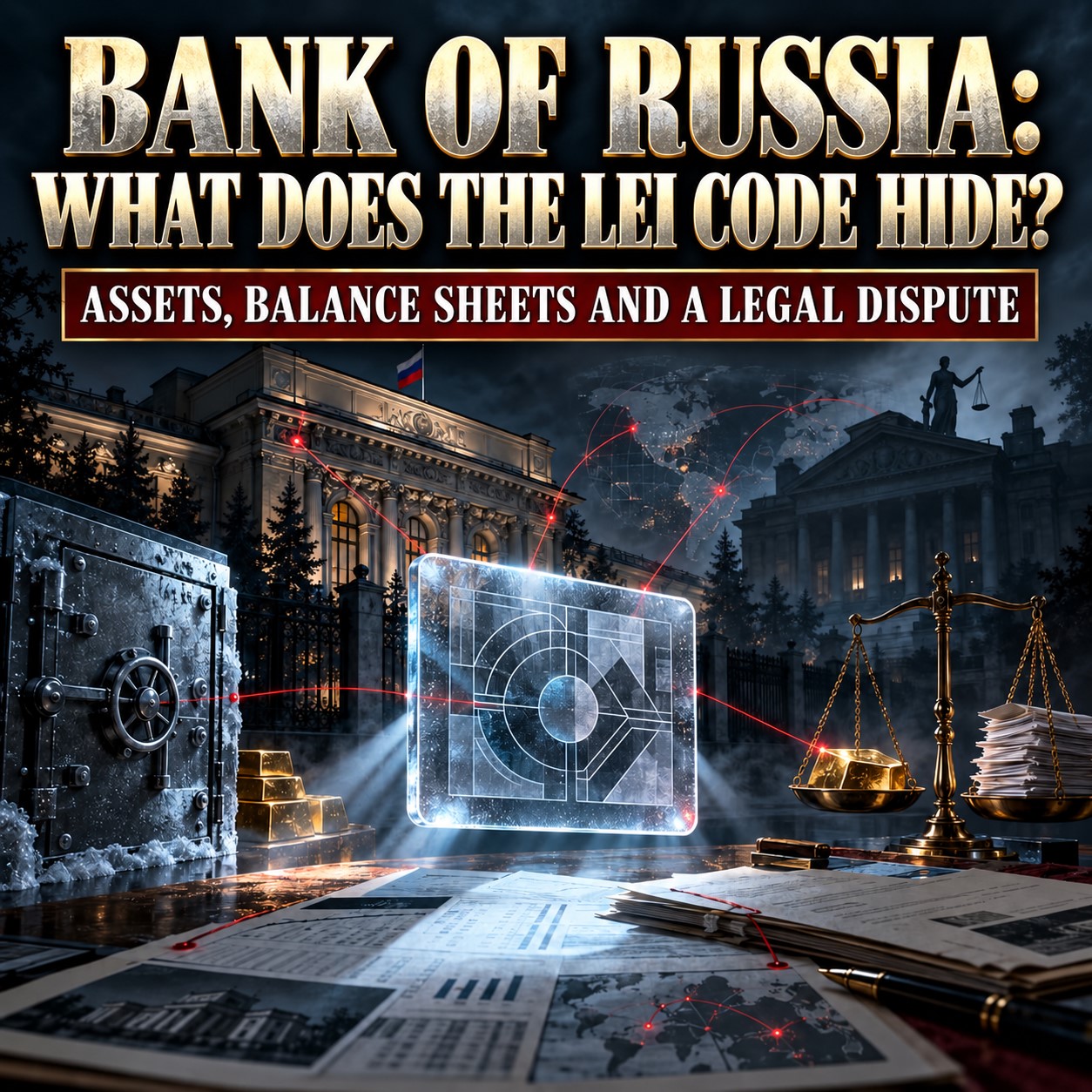
The lecture of 13 August 2026 discusses liquidation of the Bank of Russia by the end of 2026 alongside LEI identification, a liquidation balance sheet and the transfer of debts. The Academy links the bank’s cessation of operations to a refusal to renew its code and registration in the global banking and financial system.
The lecture states that the United States, described as the US corporation, and international regulators refused to renew the Bank of Russia’s LEI code and registration for financial market transactions and reporting. The source gives the standard number as “ISO 1744.” The lecturer links that refusal to the cessation of the bank’s operations.
The lecture gives LEI 253400EB56NKL2M3WT18 for the closed trading company “Russian Federation” and describes the code as withdrawn and closed. It discusses the code in assessing the Bank of Russia’s status without separately establishing that the company and the bank are the same legal entity.
The lecture discusses several connected banking episodes: re-registration under the LEI code, an external liquidation balance sheet, refusal to renew identification and an administrative period identified by the lecturer. These episodes have different dates; non-renewal is not established as the sole cause of every preceding operation.
Re-registration of the Bank of Russia under Its LEI Code and Preparation of a Zero Balance Sheet by 1 September 2025
The lecture cites an announcement dated 1 September 2024 that Ksenia Yudaeva, former First Deputy Governor of the Bank of Russia, could become the RF’s Executive Director at the IMF. The Ministry of Finance proposed her nomination; the lecturer names support from the Bank of Russia, the Ministry of Finance and the Ministry of Foreign Affairs, and agreement by Mikhail Mishustin. The discussion then turns to the Bank of Russia’s LEI re-registration through Yudaeva’s accounts and records as balance-sheet holder of the International Investment Bank.
A key element of this arrangement was the accounts, balance sheets and records of Ksenia Yudaeva herself as the balance sheet holder of the International Investment Bank—an organisation registered since 1991. The Bank of Russia’s re-registration under its LEI code was an operation based on these balance sheets and records, which existed until 2 September 2025. This arrangement made it possible to establish a debt balance sheet and ensure the Bank of Russia’s existence in the Russian Federation on an external liquidation balance sheet. The aim was to draw up a zero balance sheet for the Bank of Russia by 1 September 2025
The lecture connects settlements of creditor and debtor claims with IMF capital and VEB.RF as a development corporation. It separately identifies accounts of the USSR’s Vnesheconombank, which the lecturer says were used in shifting the Bank of Russia’s debts to the International Investment Bank registered in 1991. It also refers to the closure of the IMF depository.
The purpose of this entire multi-stage arrangement was to use the accounts of the USSR’s Vnesheconombank while assigning and transferring the Bank of Russia’s debts to the International Investment Bank, established in 1991. This bank was founded as an international non-governmental organisation to pay, service and discharge obligations—and this is fundamentally important: the institution in question is not a state institution, but a body unconnected with statehood. Thus, the holder of the free economic zone’s title to debts and obligations, Viceroy Mishustin, had been using Soviet assets throughout all these years while simultaneously issuing decrees declaring legal acts of the Union of Soviet Socialist Republics invalid. The Soviet Union, which exists in law, covered all legal domains with its assets and gold backing, whereas these bodies never had the authority to close the legal domains of the land of the Soviets.
The European Union’s Administrative Deadline: Recognition That the Trading Company ‘Russian Federation’ Ceased to Exist on 12 December 2023 and Liquidation of the Bank of Russia by the End of 2026
The European Union adopted a position towards the closed trading company ‘Russian Federation’ and its banking institution—the Bank of Russia—that has direct legal consequences. Under this position, the trading company ‘Russian Federation’ is considered to have ceased to exist in the global banking and financial system as of 12 December 2023. This date is the starting point for subsequent administrative and liquidation procedures, since it is from this date that the trading company loses its status as an active participant in international financial relations, while its bank—the Bank of Russia—loses the legal basis for continuing to operate in its previous capacity.
The lecturer connects 12 December 2023 with a three-year administrative period and describes the Bank of Russia as subject to liquidation by the end of 2026. This is the timeline set out in the lecture, not an account of a liquidation already completed.
The same passage assigns remaining balances, balance sheets, accounts and records to auditors from 2023 and to policyholders from 2025. It identifies these participants without setting out a separate procedure for their oversight or management of the balances.
From 2026, in the Academy’s account, the Bank of Russia’s debt balance is transferred to its shareholders as a debit and a debt. The statement concerns the debt balance; it does not set out a separate procedure converting each bank obligation into a claim against an individual shareholder.
The European Union’s position that the trading company ‘Russian Federation’ ceased to exist as of 12 December 2023, and its establishment of a three-year administrative time limit for the liquidation of the Bank of Russia by the end of 2026, are directly linked to the Bank of Russia’s own actions. On 12 December 2025, the Bank of Russia filed a claim against ‘Evroklik’ in the Moscow Arbitrazh Court seeking damages of 201 billion euros, equivalent to approximately 18 trillion roubles. This claim was filed when the administrative period was already running and the European Union’s position on the trading company’s cessation of existence remained unchanged.
According to the lecturer, on 3 March 2026 the Bank of Russia announced an application to the EU General Court challenging a regulation imposing an indefinite freeze on its assets. The lecture also identifies a claim filed with the Moscow Arbitrazh Court on 12 December 2025 for €201 billion in damages, approximately 18 trillion roubles.
Thus, by the end of 2026, a complete legal picture emerges. The trading company ‘Russian Federation’ has been recognised as having ceased to exist in the global banking and financial system as of 12 December 2023. Under the three-year administrative time limit, the Bank of Russia is to be liquidated and cease to exist by the end of 2026. Balances, balance sheets, accounts and records are transferred in sequence: from 2023, to auditors; from 2025, to policyholders; and from 2026, the debt balance sheet is transferred to shareholders as a debit and a debt.
Winding Down the American Bank of Russia in 2015–2025: Withdrawal of Charter Capital, Redemption of the Issue and Reduction of the M0, M1 and M2 Aggregates to Zero
Between 2015 and 2025, the operations of the American Bank of Russia, which served the interests of the closed trading company ‘Russian Federation’, were progressively wound down and ultimately terminated. This was a process extending over time rather than an isolated administrative episode, during which all the key elements of the banking mechanism were dismantled: capital, issuance and monetary aggregates. It was this ten-year interval that prepared the legal and balance sheet foundations for the subsequent liquidation of the Bank of Russia discussed in the previous sections.
The lecture describes the Bank of Russia’s charter capital as withdrawn and unpaid. This is one of its claims about the winding down of operations in 2015–2025, alongside redemption of the issue and the reduction of monetary aggregates to zero.
The lecturer next states that the Bank of Russia’s entire issue has been redeemed. This is discussed alongside the placement of convertible ordinary shares, also described as Bank of Russia notes, with RF passport holders as debt obligations.
The lecture describes monetary aggregates M0, M1 and M2 for the United States and the RF as reduced to zero. It then discusses an expected cash balance relating only to M0. Monetary aggregate M1 in this passage is distinct from the International Sovereign Treasury M1.
The lecture describes convertible ordinary shares, also called Bank of Russia notes by the lecturer, as having been handed to RF corporate employees—passport holders—as debt obligations. The lecturer summarises this episode as debts being assigned to the people who received passports.
Finally, it is important to specify the institution concerned. The discussion concerns the American Bank of Russia, which operated for the trading company ‘Russian Federation’. This clarification is fundamental: the winding down concerns a specific banking institution that served the interests of a closed trading company, rather than an abstract ‘banking system’ in general. Understanding which institution is involved allows us to assess the scale of what happened correctly: what was dismantled was no ordinary bank, but the settlement centre through which the trading company ‘Russian Federation’ sustained its existence in the global banking and financial system.
Thus, by 2025, a complete picture had emerged: capital had been withdrawn and left unpaid, the issue had been redeemed, the M0, M1 and M2 monetary aggregates had been reduced to zero, and the Bank of Russia’s convertible ordinary shares had been turned into debt obligations of corporate employees—holders of passports of the RF trading company. This picture leads directly to the question of the cash balance of 15 trillion roubles, which, as the global audit showed, proved to be fictitious and falsified. The logic here is straightforward: if the monetary aggregates have been reduced to zero, any declared cash balance requires separate verification and a separate legal justification.
The cash balance of 15 trillion roubles: found to be fictitious and falsified following the global audit
A cash balance totalling 15 trillion roubles in Bank of Russia notes was supposed to have remained in the Bank of Russia’s cash holdings, as in a pirates’ mutual aid fund. This balance covered the M0 monetary aggregate and represented returned cash proceeds from preferences and concessions, seized as ‘duplicate roubles’ of the Economic Security Council of the Russian Federation’s special service. This is the body responsible for the balance sheet and the recovery of debts from shareholders of Trust Bank and Otkritie Bank to buy back Bank of Russia shares. Thus, from the outset, the cash balance was built into an arrangement involving share buybacks and the servicing of debt obligations to shareholders.
However, when the global auditors completed their report on the already closed trading company ‘Russian Federation’, it emerged that, at the conclusion of the global audit, this cash balance of 15 trillion roubles was fictitious and had been falsified by the RF trading company. This means that the declared sum had no real backing and was not substantiated by actual assets. The auditors recorded a discrepancy between the accounting records and the actual cash holdings, which provided grounds for declaring the balance invalid.
In explaining the claimed fictitious balance, the lecturer separately identifies the RF banking payment system’s annual limit of 35 trillion roubles, default and bankruptcy, and an off-balance-sheet limit of 10 trillion roubles for the Russian Orthodox Church. These are different positions; the lecture supplies neither a calculation combining them nor a demonstrated amount by which the payment limit was exceeded.
An additional factor was that the trading company ‘Russian Federation’ had failed to pass an international audit for 30 years. Under USSR Council of Ministers Resolution No. 633 of 29 June 1979, ‘Regulations on Accounting Records and Balance Sheets’, and also taking into account registration No. С-790-01-54 of 3 November 2008, confirmed by the Ministry of Justice, the absence of an audit for such a long period indicates systematic disregard for accounting and reporting requirements. All of this was denominated in the state currency of the Union of Soviet Socialist Republics under code 810 SUR, which underscores the scale of the distortion of financial reporting.
The 15 trillion roubles is therefore an expected cash balance relating only to M0, which the lecture says was found fictitious in the audit. It is not described as a genuine asset that disappeared after inspection: the lecturer challenges the authenticity of the recorded balance itself. Separately, he cites USSR Council of Ministers Resolution No. 633 of 29 June 1979 and registration No. С-790-01-54 of 3 November 2008.
Two Court Proceedings and a Separate Settlement Timeline
The lecture identifies two Bank of Russia proceedings: a Moscow arbitration claim of 12 December 2025 seeking €201 billion in damages, and an application challenging the indefinite freezing of assets, announced on 3 March 2026. The Russian transcript renders the defendant’s name in the first claim as “Евроклик.” It gives no outcome for either proceeding.
Alongside the court proceedings, the Academy sets out its assessment of a three-year administrative period ending in 2026. The lecture cites no separate court ruling on whether those applications suspend, or leave uninterrupted, a liquidation process.
A separate settlement passage concerns the KGB USSR balance sheet and a conditional letter of credit which, according to the lecturer, Donald Trump issued for 45 days to purchase the nominal value of that balance from the RF trading company. The dates given are an initial deadline of 26 August 2025, an extension to the end of 2025, and five days for effective settlement.
For the same balance, the lecturer identifies confirmation by 16 September 2025 and return to Soviet jurisdiction within 360 days, with final settlement in 2026. These terms are described separately from the administrative period and the Bank of Russia’s court applications; the lecture does not calculate an exact calendar date for performance.
The interests of China and the People’s Bank of China in the context of the Bank of Russia’s closure in 2026
The closure of the Bank of Russia in 2026, already discussed in the preceding sections, raises the question for foreign financial centres of who will fill the emerging vacancy in the banking system on the territory of the Soviet Union. The Chinese side wished, on its own military and political terms, to open a representative office of the People’s Bank of China in Moscow in place of the Bank of Russia. This is not an abstract wish, but a specific bid to replace one institution with another: the Chinese side regards the People’s Bank of China as the successor to and depository of Russian capital. The well-known events surrounding Wildberries are connected with precisely this, although that is a separate story.
The lecturer connects the historical background of these claims with Russian-origin capital in China, Harbin roubles, the Russo-Asiatic Bank’s balance sheets in China and France, and the Banque de Paris et des Pays-Bas. The discussion concerns the named banking institutions and the alleged movement of their assets.
The lecture describes 99 years of use of Russian-origin assets in China and a demand for their return within an administrative period ending in 2026. The lecturer connects this with an alleged instruction from international auditors to prepare a demerger balance sheet and separate a banking institution in Moscow.
In the Academy’s account, the Chinese side intended to use the establishment of a Moscow bank to lease US$3 trillion from the RF for repayment of its debts. At the time of the lecture, attempts to establish that institution had not succeeded. The lecturer refers to attempts continuing until the end of September, not to a bank already established.
In the same passage, the lecturer accuses the alleged negotiating parties of planning the forced exploitation of Soviet civilians and territory, including forced labour and the use of people as donors. He links these plans to a proposed new 99-year agreement and restrictions on repatriation. The lecture does not report that such an agreement was concluded.
A monopoly over the digital sector, electronic communications, the internet, platforms and marketplaces is discussed as part of alleged plans and negotiations. The lecturer links it to replacing Russian private federal structures with electronic equivalents. He describes the negotiations as ongoing and doubts that the attempts will succeed.
The Academy rejects the treatment of the victorious Soviet people and their descendants as no longer living. The lecturer connects that treatment with UCC records and black ribbons on portraits carried on 9 May. His objection is that the descendants are alive and preserve continuity; red borders around the portraits are proposed in opposition to that symbolism.
The lecturer describes a proposed transfer of the Bank of Russia’s balance sheet as a global IMF depository to the People’s Bank of China as an attempted takeover of financial control. The lecture concerns intentions and attempts, not a confirmed completed transfer of Soviet rights or balance sheets.
The chronology includes an invitation dated 2 September 2025 to attend the Beijing parade on 3 September marking 80 years since the end of the Second World War. The lecturer connects the visit with his assessment of plans to make China a global depository. The invitation itself is not presented as a document completing a transfer of banking assets.
The lecturer continues the historical account with a 2007 episode: issuance of Harbin roubles against a Sberbank share, their recording in a People’s Bank of China sub-account, and their alleged exchange for a special military occupation issue of US dollar cash. Separately, he links US doctrine and the construction of the RF with the 1991 coup.
The Academy’s conclusion connects the demand for the return of assets with the banking chronology of 2026 and criticises an alleged attempt to take over financial and digital control. Negotiations and attempts to establish a new Moscow banking institution remain unfinished at the date of the lecture.