






















The Potsdam Foundations and the Confiscation of ‘Golden Lily’ Assets
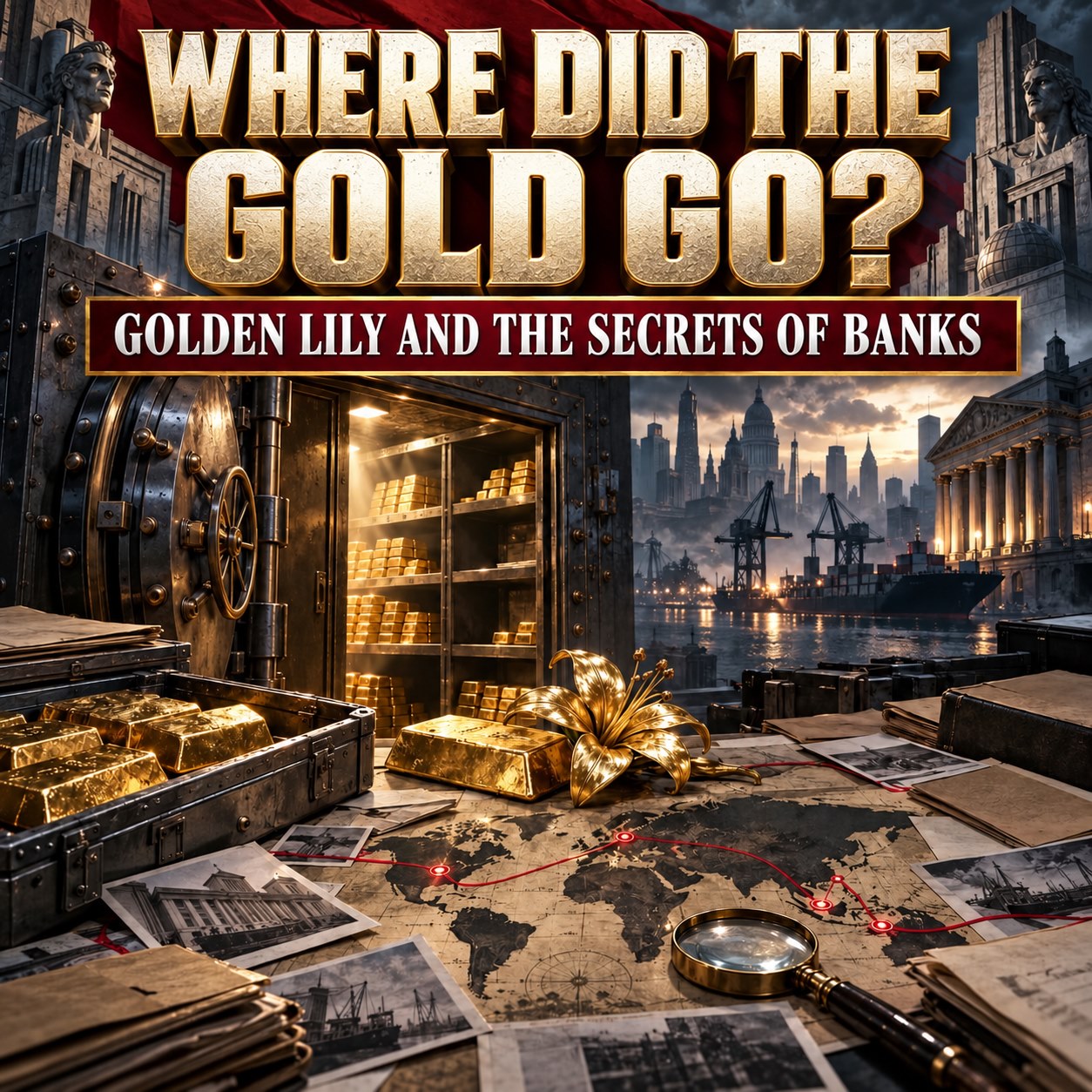
The historical and legal origins of the entire system for moving confiscated assets examined by the USSR Civil Defence Academy date back to the decisions of the Potsdam Conference of 1945. Under its terms and requirements, gold and other valuables were confiscated from Japan and China in Southeast Asia for settlements between the United States of America and the Soviet Union. This treasure was given the name ‘Golden Lily’ — this is precisely how all enquiries and questions relating to that designation should be understood. Confiscation was not confined to Asia: the United States also confiscated gold from the German Reich.
The lecturer connects the seized valuables with the reserves of the Black Eagle trust. He separately identifies gold from the German Reich. These points form the lecture’s historical opening before its discussion of Philippine gold and banking institutions.
The lecture links the confiscation of gold and other valuables in Southeast Asia to US settlements with the USSR under the terms and requirements of the 1945 Potsdam Conference. This is the connection the lecturer draws between the historical episode and interstate settlements.
The Academy then moves from Golden Lily and the Black Eagle reserves to the seizure of Marcos’s gold, followed by Enron, Barrick Gold, UBS and Alex. Brown & Sons. This sequence does not establish that all the episodes involved the same contract, shipment of metal or regulatory basis.
Marcos’s Philippine Gold: The 1986 Seizure and Transfer to Citibank, Chase Manhattan and the Depository in Klotten
According to the lecture, Philippine gold was seized from Marcos and his fund in 1986 and transferred to Citibank, Chase Manhattan and a depository in Klotten, Switzerland. These are the recipients and location identified in the source; it does not trace subsequent individual shipments.
Citibank and Chase Manhattan are identified as recipients of the gold. The lecturer then describes Enron as the main Swiss channel for distributing gold futures. These are different functions: receiving metal and distributing financial instruments.
The Klotten depository is identified as the Swiss location where the Philippine gold was placed. The lecturer uses this episode to explain the origin of the valuables under discussion; the article does not supply a separate documentary examination of bank vault records.
In the Academy’s account, Enron is associated with gold futures and oil and gas contracts, Barrick Gold with gold deliveries, and UBS with all documentation for those deliveries. UBS is also identified as another principal recipient of Marcos’s gold.
Enron’s role as the main channel for distributing gold futures in Switzerland deserves particular attention. The corporation also became an intermediary for concluding contracts and laundering money worldwide from oil and gas supplies, including supplies from the Soviet Union.
Control of Trust Bank passed to Alex Brown & Sons, a corporation that went bankrupt after 1993 while issuing loans to gain control over Soviet industry. This fact, mentioned in the Academy’s materials, shows that the system for transferring assets and resources out was not confined to gold: it also included lending mechanisms aimed at establishing control over industrial assets.
The opening part of the lecture brings confiscated valuables together with the named recipients, banks and corporations. Its key distinctions are the functions identified: placement of gold, distribution of futures, deliveries, documentation and lending to gain control over industry.
Enron as a Channel for Gold Futures and an Intermediary for Contracts and the Laundering of Money from Oil and Gas Supplies from the USSR
The lecture names Enron as the principal channel for distributing gold futures in Switzerland. This describes the corporation’s role; the lecturer does not list individual futures contracts or identify Klotten gold as collateral for each of them.
Enron’s second stated role is intermediation in contracts and, in the lecturer’s accusation, laundering proceeds from oil and gas supplies worldwide, including supplies from the USSR. This role is discussed alongside gold futures but is not identical to it.
The lecture distinguishes three roles: Enron handles futures and intermediation, Barrick Gold delivers gold, and UBS handles delivery documentation. The lecturer also places UBS among the principal recipients of Marcos’s gold.
Enron’s description thus brings together two subjects: distribution of gold futures in Switzerland and intermediation in worldwide oil and gas contracts, accompanied by an accusation of money laundering. The source does not describe a technical arrangement by which those operations secured one another.
Barrick Gold and UBS: Gold Deliveries and Documentation
The lecture assigns Barrick Gold the role of gold supplier. UBS took responsibility for the delivery documentation and is identified as another principal recipient of Marcos’s gold. The supplier of the metal and the bank handling the documents have distinct roles.
This account distinguishes physical deliveries from documentation. It does not establish that UBS replaced the supplier’s corporate reporting, concealed every record of the metal’s origin, or held a special legal title over every movement of valuables.
Enron, Barrick Gold and UBS appear in the same passage of the lecture. Their functions remain distinct: financial instruments and oil and gas intermediation, metal deliveries, and documentation, respectively. The source does not set out a specific contractual arrangement involving all three.
The Barrick Gold–UBS pair therefore retains the distinction stated by the lecturer: the corporation supplied gold, while the bank handled documentation and was a recipient of Marcos’s gold. The Academy places these points within a broader discussion of valuables and financial instruments.
Trust Bank and Alex. Brown & Sons: Control, Loans and Bankruptcy after 1993
In the lecture’s account, control of Trust Bank passed to Alex. Brown & Sons. The lecturer then describes the corporation as having gone bankrupt after 1993 while issuing loans to gain control over Soviet industry. The corporation is the subject of the bankruptcy statement; the statement does not automatically apply to Trust Bank itself.
Let us turn to a specific example cited in the lecture. Resolution №1717 of the digital government of the Russian Federation, dated 22 October 2020, ‘On Amendments to the Regulations on the Ministry of Finance of the Russian Federation’, placed the Roman consul, as chair of the digital government, in a legal position similar to that of the deputies and representatives of the fraudulent federal assembly, which, under their own law, had neither been constituted nor established. These individuals attempted to amend the Regulations on the Ministry of Finance, purportedly approved by the equally void Resolution №329 of 30 June 2004, ‘On the Ministry of Finance of the Russian Federation’. Thus, the very structure of financial administration was built on acts known to be invalid.
What, then, constituted the fraud, falsification and fabricated circumstances through which all citizens of the Soviet Union were misled? It was the failure to publish Resolution №329 in the official press within the period prescribed by private federal law — 10 days. They should have met the deadline of 10 July 2004. The first publication appeared only in Rossiyskaya Gazeta of 31 July 2004, №162, on page 15. Thus, this resolution is not recognised as an operative and duly approved regulatory legal act. Consequently, the Ministry of Finance of the Russian Federation is recognised as a private federal executive body that has existed since 2004 within the former closed trading company ‘Russian Federation’, which has existed since 2004 as a non-state institution engaged exclusively in commercial business activities in the interests of its foreign founders, beneficiaries and beneficial owners.
Subsequently, on 11 April 2022, the Ministry of Finance of the closed trading company Russian Federation stated that it was prepared to prove in court that the Russian Federation had taken all necessary steps to make payments on Eurobonds. But international financial regulators notified private creditors that no courts at any level or in any jurisdiction had been found that would agree to consider orders issued by the Ministry of Finance of the trading company RF as evidence and as steps towards making payments on Eurobonds. The courts found no legal grounds for treating these acts as regulatory and operative, since from the moment of issue they constituted evidence and decisions known to be void and invalid. The courts recognised them as serving only reference and information purposes.
The Trust Bank and Alex. Brown & Sons episode concludes the opening list of foreign banking and corporate institutions. It does not establish that the Ministry of Finance resolutions of 2004 and 2020 documented lending mentioned in connection with a bankruptcy after 1993.
From Historical Assets to the Ministry of Finance and Banking Settlements
After historical assets, the lecture turns to the Ministry of Finance, Eurobonds and contemporary banking settlements. These subjects form part of the Academy’s financial analysis, but their juxtaposition does not establish a single documentary mechanism for events in 1945, 1986, 1993 and 2020.
In the Ministry of Finance passage, the lecturer cites Resolution No. 329 of 30 June 2004, a publication deadline of 10 July, and first publication on 31 July 2004 in Rossiyskaya Gazeta, issue No. 162, page 15. The Academy links failure to meet that deadline to its refusal to recognise the document as a valid, duly approved regulatory act.
Resolution No. 1717 of 22 October 2020 is discussed as an amendment to the regulations governing the Ministry of Finance approved by Resolution No. 329. The Academy examines that connection in its criticism of the digital government’s and Federal Assembly’s status.
The lecture describes the Ministry of Finance from 2004 as a private federal body and non-state institution. It identifies a claimed cessation of operations de jure in 2021 and settlements through a “ship’s cash fund” from February 2022. April Eurobond payments of US$649 million are linked to accounts of Israel’s Ministry of Finance and US financial structures.
According to the lecture, on 11 April 2022 the Ministry of Finance said it was prepared to prove in court that Eurobond payments had been made. The lecturer then describes courts declining to accept ministry orders as evidence of those payments and treating them as reference and informational material. This passage concerns proof of particular settlements, not the cause of the Alex. Brown & Sons bankruptcy.
A separate historical passage alleges secret US bonds worth US$240 billion to gain control over the USSR and finance the 1991 coup. The lecturer describes their replacement after the events of 11 September with US Treasury tax certificates and the assignment of payments to Russian citizens given taxpayer status in both the RF and the United States. These are distinct from the gold futures discussed earlier.
The lecturer links correspondent relations between BES and Sberbank PJSC from 2018 with interest on Soviet treasury bonds, interest-free targeted loans, and bonds of the USSR and RSFSR finance ministries. For the RSFSR domestic loan, he gives 97,600 billion gold roubles and payment deferred until 2026. Interest income of up to 8% is described as a limit and an interest-free Sberbank deposit. Separately, he alleges that deposits were recorded as profit following the 2014 conversion from a closed to a public joint-stock company without transfer of the former company’s debts. The Academy cites auditors’ allegations concerning operations through accounts of the USSR’s Vnesheconombank and VEB.RF, which remain distinct named institutions.
In settlements with citizens, the lecture distinguishes account 47422—bank liabilities from other transactions—from account 47423—bank claims from other transactions. The lecturer connects them with the value of payments in SUR, currency code 810, and bearer deposits from 2018. He then names payments in currency code 643 to accounts 40817 and 40820, and use of account 438. The argument also juxtaposes a currency code and an OKEI units-of-measurement code, “one thousand units,” non-monetary payment of up to 20%, and an estimate of 0.01% actually received. These are separate elements of the lecturer’s calculation; the source does not supply a derivation arithmetically connecting all of them.
Continuing the Sberbank discussion, the lecturer separately mentions 200- and 2,000-rouble notes, recording value in BES transferable roubles in yuan, and writing off the gold equivalent as profit in Chinese yuan. He then discusses 1982 treasury obligations and calls for liability under the named Administrative Offences Code and Criminal Code articles: 15.1, 15.11, 15.27, 315, 187 and 172. A demand for liability is not a report of a final criminal conviction.
Read related articles in this section: https://tass.news/category/economy/