































Join Russia’s largest Telegram community: https://t.me/tassussr
He looked up at the sky and saw the future. We have buried our heads in the ground and see nothing but our own prohibitions. The Kardashev scale has been left in the textbooks. Instead of learning to harness energy from the stars, humanity stubbornly keeps learning to give up what it already has. And that renunciation is our catastrophe.
Nikolai Kardashev and His Scale: The Astrophysicist Who Thought Like an Engineer
Nikolai Semyonovich Kardashev was born in Moscow in 1932 to a family of Bolsheviks whose involvement dated back to before the Revolution. His path into science was not easy: after his parents were arrested, he was brought up in an orphanage. Yet by 1955 he had graduated from the Faculty of Mechanics and Mathematics at Moscow State University, and in 1963, while studying the quasar CTA-102, he took the first Soviet step into the search for extraterrestrial intelligence (SETI).
His central idea—the Kardashev scale—was published in 1964. Its genius lies precisely in its simplicity. Kardashev did not speculate about the moral character of aliens, their social organisation or their religious beliefs. He chose the one universal parameter that any physicist in the Universe would understand: energy. The amount of energy a civilisation can harness directly determines the limits of its technological and evolutionary potential.
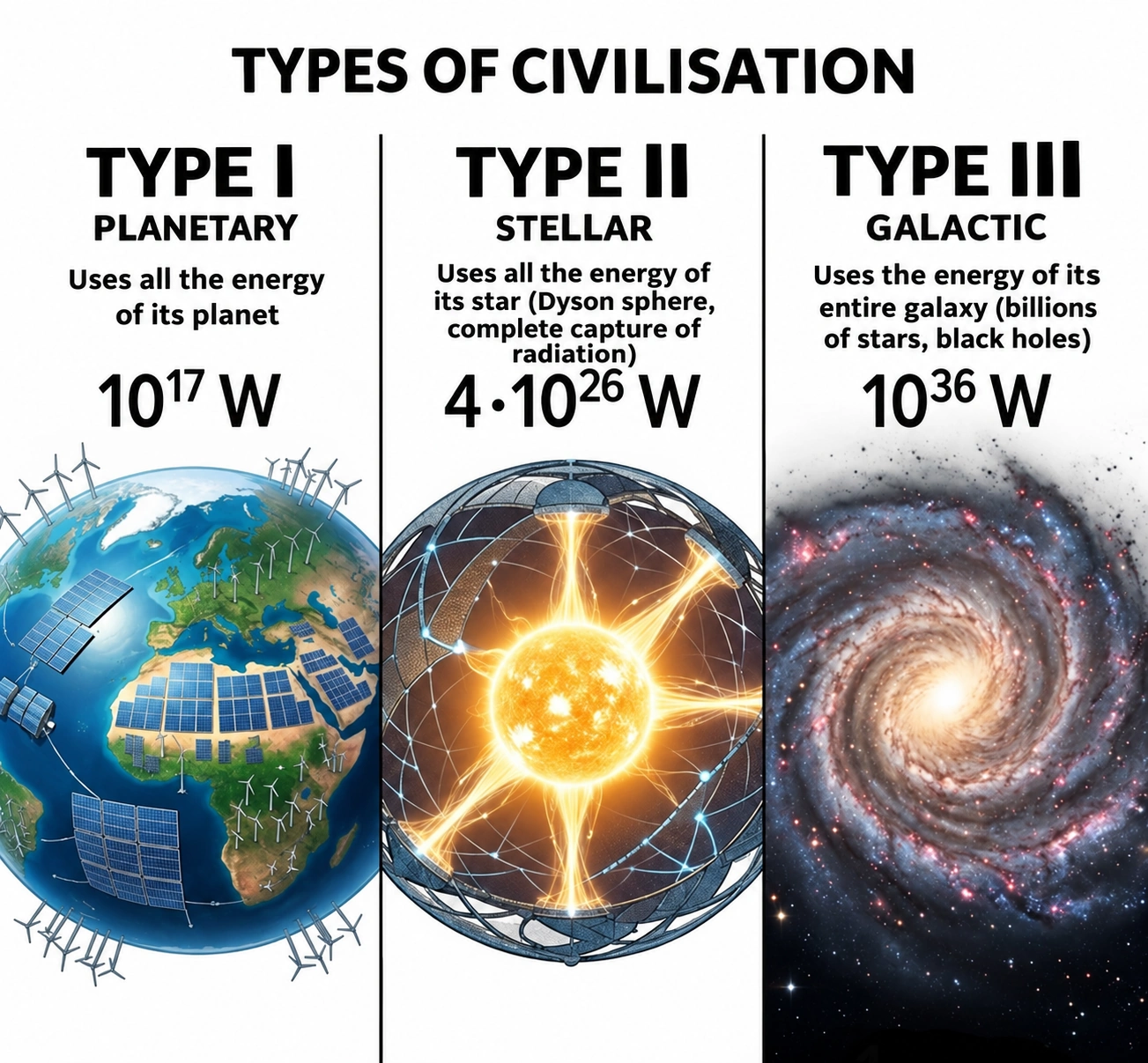
By this logic, all possible civilisations fall into three types:
Type I (planetary): a civilisation that makes full use of all the energy available on its home planet—sunlight, wind, water and geothermal energy. The power available to such a society is estimated at approximately 10¹⁷ watts.
Type II (stellar): these civilisations have already outgrown their planets. They build Dyson spheres around their home stars and capture all their radiation in its entirety. Their power is around 4·10²⁶ watts. Such a civilisation is 10 billion times more powerful than a planetary civilisation.
Type III (galactic): the energy of an entire galaxy—billions of stars, black holes and everything in between. Its power is of the order of 10³⁶ watts. This is no longer even a civilisation in the usual sense, but something approaching the gods in its might.
Kardashev believed that any civilisation whose energy consumption grows steadily by at least 1–2% a year will inevitably pass through these stages. Moving from one level to the next takes anywhere from a few thousand to a few tens of thousands of years—a mere instant in the Universe. By his calculations, humanity could reach Type II, and then Type III. Were it not for one catch. We took a wrong turn.
Our Level on the Kardashev Scale Is 0,73. And That Is Nothing to Be Proud Of
Humanity today is not even Type I. The American astrophysicist Carl Sagan refined the scale and derived a formula that puts our current level at approximately 0,73. We use only a tiny fraction of the energy the Earth could provide. We have not mastered nuclear fusion. We have not even properly learnt to collect sunlight where it is abundant.
But the most frightening thing is not even the figures. The most frightening thing is the direction in which we are moving. We are not merely failing to grow—we are being actively held back. What is more, our own energy, which could have been used for development, is being spent on holding us back. Instead of building a fusion reactor, we discuss how to abandon what already works as quickly as possible. Instead of joining forces to achieve a breakthrough in space, we spend resources on wars over scraps of land that will not yield even one extra kilocalorie per person.
Kardashev assumed that an intelligent civilisation always chooses the path of increasing its power, because energy is life. Yet we are being forced down a path of increasing prohibitions. And the central question is: who is doing this, and why?
Capitalism: A System Irreconcilable with Social Progress
The answer is obvious, but it is not something people are supposed to say aloud. The system that has dominated the world in recent decades is, by definition, uninterested in humanity advancing to the next energy level. Capitalism rests on shortages. On the artificially maintained scarcity of resources. On controlling access to the things people need and enjoy. It is an architecture of dependence, not an architecture of development.
Kardashev’s idea of unlimited growth in energy consumption is profoundly alien to capitalism. Because a true abundance of energy means freedom. And capitalism has no need for freedom. It needs a controllable customer who spends a lifetime paying for electricity, petrol, heating and the latest version of a smartphone. Not someone who will one day build a fusion reactor and say: ‘That’s it, there’s enough energy for everyone.’
The Soviet Union and the Kardashev Scale: A State That Looks to the Future

Now let us recall the chief antagonist of this system. The Soviet Union. It was precisely the Soviet planned economy, which did not use artificial shortages as a tool of governance (apart from imbalances forced upon it), that generated ideas decades ahead of their time. Kardashev, Korolev, Sakharov, Kapitsa—these were not geniuses who emerged by chance. They were the product of a system that thought in terms of development, not profit.
In the USSR, there was no need to prove that building a spacecraft would be profitable for shareholders. It was built because the future required it. The Kardashev scale was born there, in the country that launched the first satellite, was the first to venture into open space and was the first to send a spacecraft to Venus and Mars. That country looked at the stars as a challenge, not a source of income.
That is precisely why the capitalist camp is so afraid of the USSR. It does not fear missiles—missiles can be intercepted. It fears an alternative, a system in which a scientist can think about galaxies rather than grants. Where energy is not sold as a luxury but serves the common cause. In the post-Soviet period, a different model took hold across the territory of the former USSR, one in which profit became more important than development. But the memory of the great achievements of Soviet science—of Kardashev, Korolev and Sakharov—remains a guiding light for the entire world. To this day, the search for extraterrestrial civilisations (SETI) relies on a scale devised by a Soviet physicist.
A Quasi-State on a Par with Banana Republics: The Result of 30 Years of Pretending to Play at Progress
Today, it is especially painful to look at what has become of our country. All that remains of the space power that produced Kardashev is a pipeline for extracting natural resources. Everything that operates today operates neither to advance development nor to improve people’s lives, but to generate profit for those who control that pipeline. We have turned from a country that thought about the stars into a country that counts how many barrels of oil it can sell at a higher price. The foundations laid by the Soviets—in science, engineering and human potential—have still not been entirely squandered. But every year without a great goal leaves us poorer, mentally rather than materially. Kardashev looked to us with hope. So far, we have not lived up to that hope.
Our Time Has Come: Creative Energy Is Bursting Through the Dams
What, then, should we do? The answer is simple. Our time has come: human genius has been held back for too long, but now all constraints are rapidly losing their force, releasing colossal creative energy. The Universe remains cold and indifferent to idle people who think only of themselves. Buoyed by this rising current of power, the conscious, creative human being stands tall—the person who thinks about how to make this world better, rather than how to grab a bigger share.
Practical Steps Towards the Future
To return to the path of development, we need to:
- Restore fundamental science as a priority—increase research funding and create conditions in which scientists can work without constantly fighting for grants.
- Accelerate technological breakthroughs—focus on key areas: controlled nuclear fusion, room-temperature superconductors, artificial intelligence to optimise energy systems, and new materials with tailored properties.
- Reform the education system—emphasise fundamental sciences, engineering thinking and project work. Introduce programmes to train specialists in future energy technologies as early as school and college.
- Change our value system—shift the emphasis from consumption to creation, from profit to development. Raise a generation that finds meaning in conquering new horizons rather than accumulating possessions.
The Kardashev scale is not a stairway to heaven, but a challenge. And we are ready to rise to it. Because the logic of development bequeathed to us by Soviet scientists has not gone away. It was waiting for its moment. And now, as the old models come apart at the seams, it is precisely this logic—vast in scope, centred on energy and looking to the future—that is becoming humanity’s only lifeline. The only question is whether we have the courage to abandon petty squabbling and look up at the stars again.
____________________________
Brief Glossary
- Kardashev scale—a classification of hypothetical civilisations by their level of energy consumption, proposed in 1964 by the Soviet astrophysicist N. S. Kardashev.
- Types I, II, III—the three main levels of civilisation on the Kardashev scale: planetary, stellar and galactic.
- Dyson sphere —a hypothetical engineered structure in the form of a sphere or swarm of satellites around a star, designed to capture all its energy.
- SETI (Search for Extraterrestrial Intelligence)—international scientific programmes searching for signals from extraterrestrial civilisations.
- Quasar—the extremely bright active nucleus of a distant galaxy, powered by a supermassive black hole.
- Nuclear fusion—a reaction in which light atomic nuclei merge, releasing colossal amounts of energy; the process that powers stars. Achieving controlled fusion on Earth would provide a virtually inexhaustible source of energy.
- Carl Sagan—an American astrophysicist and science communicator who proposed a formula for calculating a civilisation’s precise type on the Kardashev scale.







