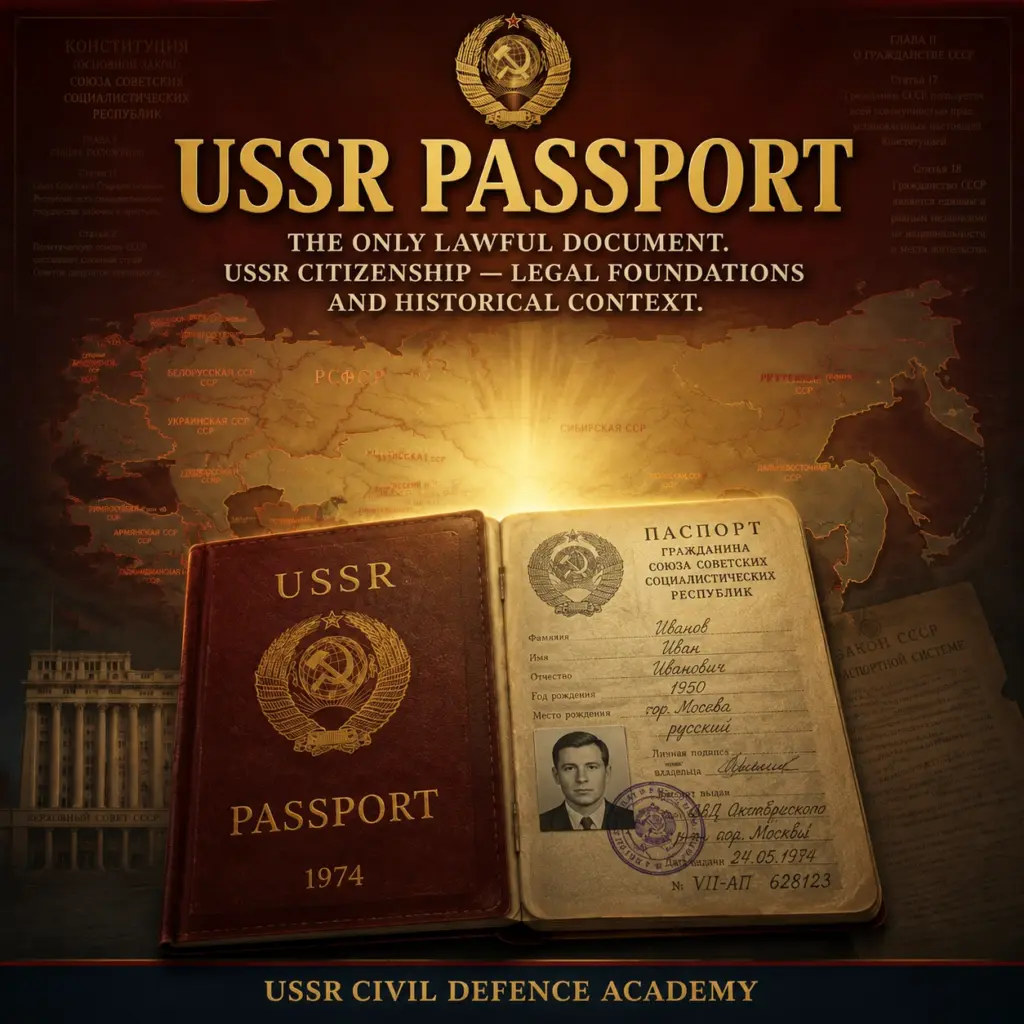




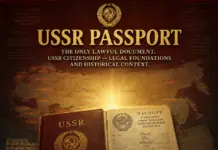



















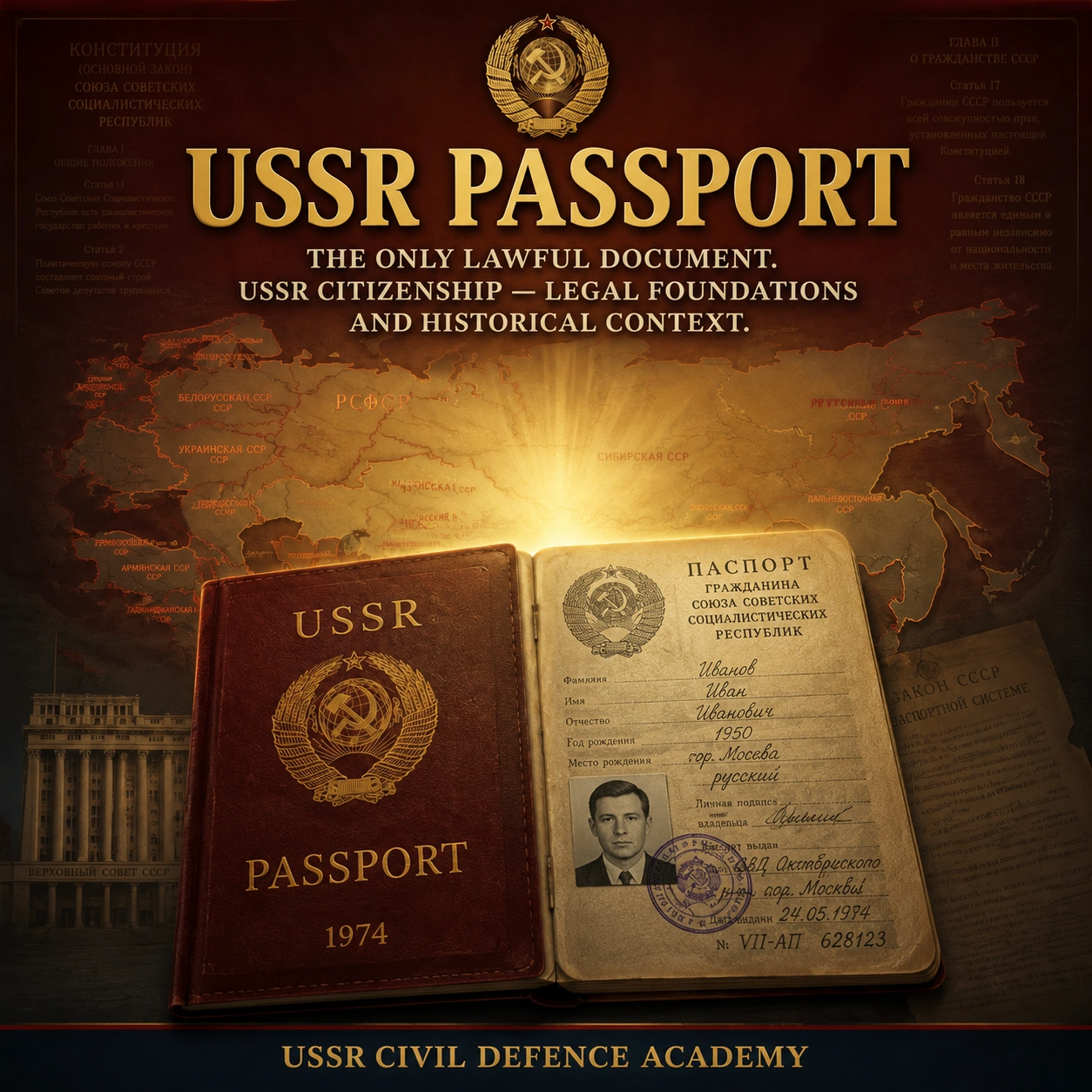
A manifesto of true citizenship. A book from the USSR Civil Defence Academy on citizenship and passports of the USSR and the Russian Federation.
Based on an in-depth analysis of publicly available and classified legal information.
IMPORTANT ANNOUNCEMENT: A remote People’s Referendum has been launched in Russia to restore the title and passport of a Citizen of the USSR. Read the details in the dedicated section: https://tass.news/category/ussr/vserossijskij-referendum/ and watch the full presentation on the CHANNEL of the USSR State Committee for the State of Emergency (SCSE-USSR): https://youtu.be/2IReAZalCaQ?si=iR9n33oYkWgcNBm3
USSR Citizenship
Legal Foundations and Historical Context
Contents
1. The 1990 Declaration of Sovereignty of the Russian Soviet Federative Socialist Republic (RSFSR). Clauses 6 and 11, their violation and the legal nullity of the instrument.
2. The All-Union Referendum of 17 March 1991. The prohibition on republics seceding, the retention of USSR citizenship until 2063, and its significance under international law.
3. The Declaration of Human Rights and Freedoms (5 September 1991, No. 2393-1). The sovereign status of a USSR citizen, the transition period and the delegation of the Congress’s rights.
4. The evolution of USSR citizenship legislation (1938–1990). The laws of 1938, 1978 (No. 8497-IX) and 1990 (No.1518-I): single Union citizenship, the prohibition on dual citizenship, and emancipation.
5. The nullity of Russian citizenship. Analysis of Laws No. 1948, No. 62-ФЗ and No. 138-ФЗ; procedural violations, the absence of a second reading, and falsification of publications.
The Status of a USSR Citizen and the Construct of the “Natural Person” in the Russian Federation
1. The sovereign USSR citizen. A subject of international law, a “seafarer”, the right to an unconditional income (168 pounds/135 roubles in gold); the 1926 Convention Prohibiting Slavery.
2. The natural person in the Russian Federation. Resolution No. 467, recognition as persons with disabilities, registration as “seagoing vessels/cargo”, and departmental interpretations (product, animal, object).
Passports and Birth Certificates
1. The USSR passport system. The resolutions of 1953 and 1974; three passports, a seafarer’s duplicate, a military certificate; their role in monetary issuance and gold and foreign exchange.
The USSR birth certificate. The 1970 form, automatic citizenship, and the prohibition on taking it abroad under Law No.2261.
2.The passport system of the Russian Federation. Ministry of Internal Affairs Orders No. 851 and No. 773 (travel/souvenir passports); the dissolution of the Federal Migration Service; the removal of USSR passports to Fort Knox; the code “P” as slave status.
International Records and the Financial Mechanism
1.Live-born gold and the global financial architecture. Monte dei Paschi di Siena bank, Lloyd’s, church trusts, USSR certificates issued in individual names, and the bankruptcy of the “King of the Jews”.
2.The transition period and final settlements (until December 2026). Auditing records, returning assets, officials’ liability, and the termination of the “Russian Federation”.
The Declaration of State Sovereignty of the RSFSR of 12 June 1990: Unfulfilled Clauses and Legal Nullity
Historical Context and the Legal Nature of the Instrument
On 12 June 1990, the First Congress of People’s Deputies of the RSFSR adopted the Declaration of State Sovereignty of the Russian Soviet Federative Socialist Republic. This instrument was proclaimed within the framework of the Union state—the Union of Soviet Socialist Republics—and therefore had to comply strictly with the USSR Constitution and Union legislation then in force. The Declaration was not a unilateral act of secession; on the contrary, it contained provisions expressly linking its operation to the preservation of the USSR and the rights of the Union republics.
Clause 6 of the Declaration
Joining the Union by Treaty
Clause 6 of the Declaration stipulated:
“The RSFSR joins with other republics in a Union on the basis of a Treaty. The RSFSR recognises and respects the sovereign rights of the Union republics and the USSR.”
This provision entailed several legally significant obligations:
-preserving the USSR as a subject of international law and a holder of sovereign rights;
-prohibiting the unilateral secession of the RSFSR from the Union without concluding an appropriate treaty;
-recognising and respecting the sovereign rights of both the other Union republics and the USSR itself.
The actions that actually followed after 1991 (the signing of the Belovezha Accords and the termination of the USSR’s existence in violation of the procedure laid down in the USSR Law “On the Procedure for Resolving Matters Related to the Secession of a Union Republic from the USSR” of 3 April 1990) directly contradicted Clause 6 of the Declaration. Consequently, under international law and the Union legislation then in force, the provisions of this clause were flagrantly violated and left unfulfilled.
Clause 11 of the Declaration
Retention of USSR Citizenship
Clause 11 of the Declaration is of particular significance to the institution of citizenship. It stated:
“Every citizen of the RSFSR shall retain USSR citizenship.”
This provision was mandatory and made no provision for the automatic termination of Union citizenship under any circumstances. Moreover, it was consistent with the USSR Law “On USSR Citizenship” of 23 May 1990, No. 1518-I, then in force, which did not permit dual citizenship but also made no provision for deprivation of USSR citizenship without a personal application and permission from the Presidium of the Supreme Soviet of the USSR.
Thus, Clause 11 of the Declaration legally guaranteed every RSFSR citizen the retention of their status as a citizen of the Soviet Union. Any subsequent action aimed at terminating or disregarding this status without following the procedures established by law constitutes a violation of both the Declaration itself and Union legislation.
Violation and Non-fulfilment of the Declaration
Legal Consequences
Contrary to the requirements of Clauses 6 and 11, the institution of Russian Federation citizenship was introduced in the territory of the RSFSR (subsequently the Russian Federation), while USSR citizens were de facto recognised as either foreigners or stateless persons. Not a single condition laid down in the Declaration was met:
-no treaty on preserving the Union was concluded;
-no consent was obtained from the Union republics or the bodies of the USSR;
-citizens were not given the opportunity to exercise their right to retain USSR citizenship in accordance with the prescribed procedure.
Under international law, a state’s failure to fulfil, and its violation of, its own declaration adopted by the highest body of state power render that declaration void ab initio, as an instrument on the basis of which no rights or obligations can arise, be altered or be terminated.
Conclusions Concerning Citizens’ Legal Status
Taken together, the facts set out above lead to the following conclusions:
The Declaration of State Sovereignty of the RSFSR of 12 June 1990 was flagrantly violated and left unfulfilled in respect of the preservation of the USSR and USSR citizenship.
Failure to fulfil Clauses 6 and 11 of the Declaration renders it legally void under international law and incapable of serving as a legitimate basis for terminating or replacing USSR citizenship.
Clause 11 of the Declaration remains in force as an express stipulation that every RSFSR citizen retains USSR citizenship.
All subsequent instruments aimed at establishing Russian Federation citizenship independently of USSR citizenship derive from the unfulfilled and void Declaration and therefore themselves have no legal force in relation to persons who held USSR citizenship by birth or through their parents’ citizenship.
Thus, despite its use to justify the “independence” of the Russian Federation, a literal reading and systematic interpretation of the 1990 Declaration make it a key piece of evidence of the continuity of Soviet citizenship and the absence of legal succession in respect of the termination of this status.
The Nationwide Referendum of 17 March 1991
The Prohibition on Republics Seceding and the Retention of USSR Citizenship until 2063
The Legal Nature of the Referendum and Its Question
On 17 March 1991, a Nationwide Referendum on preserving the Union of Soviet Socialist Republics was held—the first and only Union-wide referendum in the history of the USSR. It was called by a Resolution of the Supreme Soviet of the USSR of 16 January 1991 and conducted in accordance with the USSR Law “On a Nationwide Vote (Referendum) of the USSR”. The following question was put to the vote:
“Do you consider it necessary to preserve the Union of Soviet Socialist Republics as a renewed federation of equal sovereign republics in which the rights and freedoms of people of every nationality will be fully guaranteed?”
In legal terms, the referendum question contained three inseparably linked elements: (1) preserving the USSR as a single state; (2) renewing the federation on the principles of equality among the republics; (3) guaranteeing human rights and freedoms. An affirmative answer meant support specifically for preserving the USSR intact, rather than dissolving it or replacing it with another form of association between states.
The Results of the Nationwide Referendum and Their Legal Nature
According to official figures from the Central Commission for the USSR Nationwide Referendum, 148,5 million people took part in the vote (80% of citizens on the electoral rolls). Of these, 113,5 million people said “YES” to preserving the USSR, representing 76,4% of those who voted and more than half of all citizens entitled to vote.
The USSR Law “On a Nationwide Vote (Referendum) of the USSR” stipulated that a decision adopted by referendum is final, binding throughout the USSR, and may be repealed or amended only through a new referendum. No new referendum on this question has ever been held. Consequently, from a legal standpoint, the decision of 17 March 1991 retains its legal force to this day.
The Prohibition on Union Republics Seceding from the USSR
The results of the Nationwide Referendum have a direct legal consequence: they preclude and prohibit the unilateral secession of Union republics from the USSR. The USSR Law “On the Procedure for Resolving Matters Related to the Secession of a Union Republic from the USSR” of 3 April 1990 provided for a complex secession procedure that included:
– holding a referendum in the republic concerned;
– establishing a transition period (of up to five years);
– settling all property, financial, territorial and other matters with the Union and the other republics;
– final approval of the decision by the Congress of People’s Deputies of the USSR.
Not one of the Union republics that declared “independence” in 1991 met any of the conditions listed above. Moreover, in light of the Union-wide referendum, which confirmed the will of the overwhelming majority of the people to preserve a single state, any instruments declaring secession from the USSR are legally void and produce no legal consequences.
Preservation of the Institution of Soviet Citizenship
The most important legal consequence of the referendum is the preservation of the institution of USSR citizenship. The Referendum question made no provision for the termination or replacement of Union citizenship. On the contrary, preserving the USSR as a state inevitably entails preserving the single Union citizenship established by the USSR laws of 1938, 1978 and 1990.
Of particular significance is the rule under which the referendum results preserve Soviet citizenship for 72 years under the ecclesiastical indiction—that is, until 2063. This period is calculated in accordance with canon (church) law and international customs applicable to sovereign acts of supreme legal force. During this period, no national or international institution is entitled to deprive a USSR citizen of their status without their personal, voluntary and duly documented application approved by a competent USSR body.
The Russian Federation Authorities’ Disregard for the Referendum
Contrary to the people’s express will, formalised in a legally binding decision of the Nationwide Referendum, the “Belovezha Accords” were signed in December 1991, unlawfully proclaiming the termination of the USSR’s existence. These accords:
– had no mandate from the people as expressed in the referendum;
– were signed by persons who had no authority to dissolve the USSR;
– contradicted Article 74 of the USSR Constitution, under which USSR laws have supremacy throughout the country.
Thus, the actions taken to terminate the USSR and replace USSR citizenship with citizenship of the newly formed jurisdictions directly violate the mandatory decision of the Nationwide Referendum. This constitutes an unconstitutional and unlawful act that produces no legal consequences for USSR citizens.
Conclusions Concerning Citizens’ Legal Status
Taken together, the facts and legal rules set out above lead to the following conclusions:
The Nationwide Referendum of 17 March 1991 is an act of supreme legal force whose decision is final, mandatory, supreme in force and has not been repealed.
The results of the Nationwide Referendum preclude and prohibit the unilateral secession of Union republics from the USSR, and all instruments declaring “independence” are legally void.
The institution of Soviet citizenship, confirmed by the referendum, is preserved at least until 2063 (72 years under the ecclesiastical indiction), and no body or organisation is entitled to deprive USSR citizens of their status.
USSR citizens born in the Soviet Union or who acquired citizenship through their parents remain sovereign citizens of the USSR, regardless of their current location or whether they hold documents from other jurisdictions.
This status is not a “historical memory” but an existing legal status recognised under international law and entitled to protection.
Declaration of Human Rights and Freedoms
of 5 September 1991 (No. 2393-1)
The Sovereign Status of a USSR Citizen and the Transition Period
Historical Context and the Supreme Body That Adopted the Instrument
On 5 September 1991, the Fifth (Extraordinary) Congress of People’s Deputies of the USSR adopted the Declaration of Human Rights and Freedoms, No. 2393-1. At the time this instrument was adopted, the Congress of People’s Deputies of the USSR was the highest body of state power in the USSR, vested with full legislative and constituent authority throughout the country. Thus, the Declaration was adopted by a body whose decisions had supreme legal force, and it was an instrument with direct effect throughout the Soviet Union.
The Declaration’s Main Provisions and Legal Innovations
Declaration No. 2393-1 established a number of fundamental provisions that radically expanded the legal status of a USSR citizen. The key provisions are:
– Confirmation of the sovereign status of a USSR citizen under international law. The Declaration stipulated that a citizen of the Union of Soviet Socialist Republics is recognised as a subject of international law—a man and a woman as holders of natural, inalienable and inherent rights belonging to everyone from birth.
– Recognition of a USSR citizen as the holder of a continuous lifetime right. This formulation means that a citizen’s rights are not subject to time limits, cannot be terminated at the will of third parties, including state bodies, and remain in force throughout their lifetime without interruption.
– Delegation of the rights of the Congress of People’s Deputies. The Declaration conferred on a USSR citizen all the rights of the Congress of People’s Deputies of the USSR, including the right to act as a sovereign under international law. This provision gives every USSR citizen the legal capacity to act in their own name in international legal relations, rather than solely through representation by the state.
– Declaration of a transition period. The Congress of People’s Deputies of the USSR declared a transition period of up to 30 years. During this period, any expression of a USSR citizen’s will (in writing, orally, by video recording or in other forms) is recognised as legally valid for the purposes of preserving the Soviet Union and forming a new system of relations within the state.
Citizens’ Legal Duties During the Transition Period
The transition period established by the Declaration gives rise to a direct duty on USSR citizens and their descendants:
– to confirm their high legal status;
– to act as direct lineal descendants of free-born USSR citizens;
– to ensure the preservation and succession of Union citizenship;
– to use the right granted to them to express their will in order to form a new system of relations within the state.
Failure to fulfil these duties does not terminate USSR citizenship, but may limit the ability to exercise certain rights that require active confirmation of status.
The Declaration’s Relationship with Other Instruments
Declaration No. 2393-1 neither repealed nor replaced the previously applicable laws on USSR citizenship (1938, 1978, 1990) or the 1977 USSR Constitution. On the contrary, it supplemented and developed them, establishing additional guarantees of citizens’ rights and elevating their status to a qualitatively new level—that of sovereign subjects of international law.
Particular attention should be paid to its relationship with USSR Law No. 1518-I of 23 May 1990, ‘On USSR Citizenship’, which did not permit dual citizenship and prohibited recognition of USSR citizens as holding the citizenship of a foreign state. The Declaration strengthened this provision by granting USSR citizens the right to act directly within the framework of international law.
The Russian Federation Authorities’ Disregard for the Declaration
Legal Consequences
Despite the Declaration’s direct effect, its provisions were effectively ignored within the territory of the Russian Soviet Federative Socialist Republic (RSFSR)—the Russian Federation. USSR citizens were placed in a position in which:
– their status as sovereign subjects of international law is not recognised;
– their right to act under international law is blocked;
– their expression of will during the transitional period is ignored or deemed to have no legal force;
– instead of having their Soviet citizenship confirmed, citizens have another citizenship or stateless status imposed on them.
These actions constitute a violation of an instrument of supreme legal force adopted by the highest body of state power of the USSR. The legal consequences of such a violation are:
– any instruments aimed at restricting or refusing to recognise the status of a USSR citizen established by Declaration No. 2393-1 are void and must not be applied;
– officials who obstruct the exercise of the rights granted by the Declaration bear responsibility under international law and the USSR legislation in force;
– the rights of USSR citizens remain intact in full, regardless of whether any national authorities recognise them.
Conclusions
The Declaration of Human Rights and Freedoms of 5 September 1991, No. 2393-1, adopted by the highest body of state power of the USSR, is an instrument with direct effect and supreme legal force.
It confirmed the sovereign international status of the USSR citizen as a holder of a continuous lifetime right—man and woman.
All the rights of the Congress of People’s Deputies have been delegated to USSR citizens, including the right to act under international law as sovereigns.
A transitional period of up to 30 years has been declared, during which citizens’ expressions of will have direct legal effect for the preservation of the USSR and the formation of a new statehood.
Citizens and their descendants have a duty to confirm their status and ensure succession to Soviet citizenship.
The Russian Federation authorities’ disregard for the Declaration neither terminates its effect nor deprives USSR citizens of their status; it gives rise to liability on the part of those who violate it.
The Evolution of USSR Citizenship Legislation (1938–1990) Single Union Citizenship, the Prohibition of Dual Citizenship and Emancipation
An Overview of the Development of USSR Citizenship as a Legal Institution
The institution of Union citizenship developed in stages and reached its final form between 1938 and 1990. Each of the three fundamental laws—those of 1938, 1978 and 1990—not only enshrined the legal position of USSR citizens but also progressively elevated their status from belonging to a state to being sovereign subjects whose rights cannot be arbitrarily terminated.
A common feature of all three legislative acts is the principle of single Union citizenship: every citizen of a Union republic was also a citizen of the USSR. Soviet legislation did not recognise republican citizenship as an independent institution separate from Union citizenship—there was never a USSR law on republican citizenship.
USSR Law of 19 August 1938, ‘On Citizenship of the Union of Soviet Socialist Republics’
This law became the first codified citizenship act applicable throughout the Union, replacing the previously applicable republican provisions. Its key provisions were:
– Single Union citizenship was established: every citizen of a Union republic was recognised as a citizen of the USSR (Article 1).
– Citizenship was acquired by birth (to parents who were USSR citizens), by application (admission to citizenship), or by restoration.
– Renunciation of USSR citizenship required permission from the Presidium of the Supreme Soviet of the USSR.
– Deprivation of citizenship was permitted only by a court sentence or under a special decree of the Presidium of the Supreme Soviet of the USSR.
The most significant legal consequence of this law’s adoption was that Soviet citizenship came to replace citizenship of the RSFSR (and the other Union republics). The institution of RSFSR citizenship is considered to have been extinguished and replaced by USSR citizenship throughout the Union from 1938 onwards.
The 1938 law remains in force to this day, since it has never been repealed in accordance with the prescribed procedure.
USSR Law of 1 December 1978, No. 8497-IX, ‘On USSR Citizenship’
The adoption of this law was linked to the entry into force of the 1977 USSR Constitution and marked the next stage in the development of the institution of citizenship. Its main provisions were:
– The principle of single Union citizenship was confirmed.
– It was established that every person within the territory of the USSR was recognised as a USSR citizen unless their citizenship of a foreign state was proven.
– Citizenship was acquired by birth to parents (or one parent) holding USSR citizenship, regardless of the place of birth.
– Loss of USSR citizenship necessarily entailed the loss of presumed citizenship of a Union republic.
– Republican citizenship was still not established as an independent legal institution.
The particular significance of the 1978 law lies in its role as a legal act emancipating foreigners and people of other ethnic origins from the ownership of the ‘King of the Jews’. According to the lecture material, the adoption of this act marked the beginning of the formation of a peculium for the population of the USSR, while foreign elements present in the country were transferred to the status of tenants with no right of ownership over Soviet land.
The RSFSR Constitution as revised on 12 April 1978 (Article 31) provided that the procedure for acquiring and terminating citizenship within the territory of the RSFSR was to be determined by a law on RSFSR citizenship. However, no such law was ever adopted, and its absence was therefore made up for by the direct effect of USSR Law No. 8497-IX.
Thus, from December 1978 onwards, only Union citizenship, governed by a law applicable throughout the Union, operated within the territory of the RSFSR (and all Union republics).
USSR Law of 23 May 1990, No. 1518-I, ‘On USSR Citizenship’
This law marked the final stage in the development of Soviet citizenship legislation and, at the same time, was an act establishing the highest legal status of the USSR citizen. It was adopted against a backdrop of growing centrifugal tendencies in the republics and aimed to enshrine the inviolability of Union citizenship. Its key provisions were:
– Prohibition of dual citizenship. Article 1 of the law expressly established that USSR citizens were not recognised as holding the citizenship of a foreign state.
– Non-recognition of republican citizenship. Citizens of the Union republics were not recognised as subjects of law either within the legal frameworks of the USSR or under international law. The Union republics were not recognised as having a right of ownership or a right to contribute property to the common and indivisible assets of the USSR.
– USSR citizens are freeborn. The law confirmed that USSR citizens are freeborn and hold Soviet citizenship, as their ancestors have since 1938.
– Protection and support. USSR citizens abroad enjoyed the protection and support of the Soviet state.
– Holding republican citizenship as a hereditary right. The law established that holding presumed republican citizenship merely attests to hereditary and other entitlement to property and non-property rights passed down by will from ancestors—freeborn USSR citizens—free of debts and encumbrances.
– Procedure for renouncing citizenship. Renunciation of Soviet citizenship was permitted only upon the personal application of the person concerned, with permission from the Presidium of the Supreme Soviet of the USSR. Permission could be refused on grounds of outstanding property obligations, state security interests, criminal prosecution or a sentence that had entered into force.
-Deprivation of citizenship. This was permitted only by a decision of the Presidium of the Supreme Soviet of the USSR for actions that disgraced the high standing of a USSR citizen or harmed the country’s prestige and security.
– Restoration of citizenship. The law introduced the institution of restoration of USSR citizenship.
– Precedence of international treaties. Citizenship matters were also governed by the USSR’s international treaties.
Law No. 1518-I was included in the Code of Laws of the USSR and had supreme legal force throughout the Union. It has not been repealed and continues to operate within the framework of international law.
Principles Common to Soviet Citizenship Legislation
An analysis of the three laws reveals an unbroken line of legal succession:
Unity of Union citizenship. Since 1938, all citizenship within the territory of the USSR has been Union citizenship alone. Republican citizenship as a legal institution did not and does not exist.
Continuity of citizenship. USSR citizenship cannot be terminated without a personal expression of will and compliance with the prescribed procedure.
Prohibition of dual citizenship. A USSR citizen cannot simultaneously hold another citizenship.
Hereditary nature. Citizenship is transmitted at birth through parents and is an inalienable right of the descendants of USSR citizens.
Sovereign status. By 1990, the USSR citizen had been recognised as more than a subject of the state: a sovereign subject whose rights take precedence and are protected by international law.
The Results of This Evolution and Their Significance for Citizens’ Present Status
Three successive laws on USSR citizenship created an unbroken legal framework that:
– rules out the possibility of automatic loss of USSR citizenship;
– deprives of legal force any attempts to impose another citizenship on USSR citizens without their express declaration of will and compliance with Union procedures;
– affirms that all persons born in the USSR (and their descendants) who hold USSR citizenship by birth or through their parents retain this status until it is terminated in accordance with the procedure prescribed by law.
None of the state entities that emerged after 1991 had or has the legal authority to terminate Union citizenship or declare it ‘non-existent’. USSR Law No. 1518-I of 1990 remains in force within the framework of international law and forms the foundation of Soviet citizens’ legal status.
The Nullity of the Institution of Russian Citizenship
An Analysis of Laws No. 1948, No. 62-ФЗ, No. 138-ФЗ
Procedural Falsifications
The Institution of Russian Federation Citizenship as a Legally Unsound Construct
The institution of citizenship of the Russian Federation, proclaimed in 1991 and subsequently enshrined in a series of legislative acts, reveals, upon detailed legal analysis, fundamental defects that render it legally void. Three key laws—the RSFSR Law of 28 November 1991, No. 1948, ‘On RSFSR Citizenship’, the Federal Law of 31 May 2002, No. 62-ФЗ, ‘On Citizenship of the Russian Federation’, and the Federal Law of 28 April 2023, No. 138-ФЗ, ‘On Citizenship of the Russian Federation’—each individually and all collectively fail to meet the basic requirements for normative legal acts: proper adoption, signature by an authorised person, registration and official publication.
The absence of even one of these elements prevents an act from entering into legal force and renders it legally void. Let us examine each of the three laws in turn.
RSFSR Law of 28 November 1991, No. 1948, ‘On RSFSR Citizenship’
This law is the cornerstone cited by the Russian Federation authorities to justify the existence of Russian citizenship and the ‘termination’ of USSR citizenship for persons who did not apply to retain it. However, the legal validity of this act is refuted on several independent grounds.
1.Signature by an Unauthorised Person
Law No. 1948 was signed by B. N. Yeltsin as ‘President of the RSFSR’. However:
RSFSR Law No. 1098 of 24 April 1991, ‘On the President of the RSFSR’, established that legislative initiatives and laws signed by Yeltsin had no legal force unless approved and promulgated by the Presidium of the Supreme Soviet of the RSFSR.
The President of the RSFSR was not a public authority empowered to bring laws into force unilaterally.
Subsequently, all laws on the President of the RSFSR were repealed and ceased to have effect, and no federal law on the President of the RSFSR has been adopted and published.
Thus, all acts signed by Yeltsin, including Law No. 1948, are considered never to have entered into force and to be manifestly invalid.
2. Violation of the Adoption Procedure
The procedure for the bill’s passage through the Supreme Soviet of the RSFSR was grossly violated:
The bill was submitted for consideration by Resolution No. 1856 of the Presidium of the Supreme Soviet of the RSFSR of 11 November 1991, ‘On the Draft RSFSR Law “On Citizenship”’.
After its first reading, the bill was referred for revision by Resolution No. 1878 of the Supreme Soviet of the RSFSR of 15 November 1991, ‘On Further Work on the Draft RSFSR Law “On RSFSR Citizenship”’.
There was no second reading as provided for in Article 78 of the Rules of Procedure of the Supreme Soviet of the RSFSR of 24 October 1990, No. 261. It did not take place, and the law was not finally adopted.
There is no resolution of the Supreme Soviet of the RSFSR bringing the law into force.
Consequently, Law No. 1948 remained a draft that had not undergone the prescribed adoption procedure and could not acquire the force of law.
3. Violation of the Publication Procedure
Law No. 1948 was fraudulently published only on 6 February 1992 as the text of a law that had not been adopted, without an act adopting it at its second reading and bringing it into force. Moreover:
Editorial changes upon publication were made under Supreme Soviet Resolution No. 2240 of 23 January 1992, which did not confer authority to edit an act that had not been adopted.
The publication deadline was breached (more than 7 days after the purported adoption), which, under the rules then in force, prevented the act from entering into force.
4. Substantive Defects
In addition to the procedural violations, the text of Law No. 1948 contains internal defects:
– the wording ‘citizens of the former USSR’ is legally untenable, since the USSR still existed when the law was signed;
– the law contains no territorial provisions identifying the entity to which RSFSR citizenship relates (there is no legal link between the RSFSR before 1936 and after 5 December 1936);
– under Article 13, paragraph 2, the law is inapplicable to legally incapable USSR citizens born between 7 February 1974 and 6 February 1992 who had not reached the age of majority.
RSFSR Law No. 1948 was never adopted in accordance with the prescribed procedure, was not signed by an authorised person, was not duly published and did not enter into legal force. It is legally void and cannot serve as a basis for the acquisition, alteration or termination of citizenship.
Federal Law of 31 May 2002, No. 62-ФЗ, ‘On Citizenship of the Russian Federation’
This law is the second fundamental act on which the present system of Russian Federation citizenship is built. However, its defects are no less substantial.
Adoption in Breach of the Rules of Procedure and Failure to Publish
Law No. 62-ФЗ was adopted in breach of the procedural rules of the State Duma and the Federation Council; was not published in the official press within the statutory time limits; and did not undergo proper state registration as a normative act.
By virtue of these violations, the law did not enter into force and is fraudulent.
Intended Purpose
circulation of proceeds under the guise of passport issuance
The hidden purpose behind the adoption of Law No. 62-ФЗ is of particular significance. It was used not only, and not so much, to regulate citizenship as to legitimise the circulation of proceeds obtained through criminal activity between 1991 and 2021. Russian Federation passport and visa forms served as securities against which US dollars were issued. In other words, the law served a financial scheme rather than a genuine institution of citizenship.
Refusal to recognise citizens of the USSR
Significantly, Law No. 62-ФЗ expressly refused to recognise citizens of the USSR as citizens of the Russian Federation. Citizens of the USSR were thereby placed in the position of foreigners or stateless persons in their own territory. This action constitutes the unlawful imposition of guardianship and trusteeship over them and the seizure of their sovereign title.
Law No. 62-ФЗ was not adopted and published in accordance with the prescribed procedures, did not enter into legal force and is legally void. The institution of Russian Federation citizenship founded on this law confirms only the status of a foreigner, a person of another faith and a migrant temporarily present in the territory of the USSR.
Federal Law of 28 April 2023 No. 138-ФЗ
On Citizenship of the Russian Federation
This law is the latest attempt to establish the institution of Russian citizenship through legislation, but it too suffers from irremediable defects.
Non-application on constitutional grounds
Law No. 138-ФЗ is not applied in the Russian Federation on constitutional grounds because:
– it was not duly published in the official press within the prescribed period;
– its registration and publication involved violations similar to those that accompanied the preceding enactments.
Confirmation that the institution of Russian citizenship has ceased to exist
The very emergence of Law No. 138-ФЗ in 2023 demonstrates that the previously applicable enactments on Russian Federation citizenship had no legal force and needed to be ‘updated’. Yet, being itself void, this law merely confirms the overall conclusion: by 2017–2023, the institution of Russian citizenship had completely ceased to exist for lack of a legal basis.
Absence of approved Passport Regulations
Law No. 138-ФЗ envisaged the approval of Regulations on the Passport of a Citizen of the Russian Federation, but these regulations were not duly approved or signed by an authorised resolution of the Government of the Russian Federation. Consequently, a Russian Federation citizen’s passport issued under this law is not a lawful identity document.
Law No. 1948: a bill that did not pass its second reading, was signed by an unauthorised person, was not published on time and did not enter into force. Legally void.
Law No. 62-ФЗ: adopted and published in breach of procedure, did not enter into force and was used for financial fraud involving passport forms. Legally void.
Law No. 138-ФЗ: not published on time, not applied on constitutional grounds and not supported by approved Passport Regulations. Legally void.
The overall result: none of the three legislative enactments intended to establish and regulate citizenship of the Russian Federation meets the requirements of legality. The institution of Russian citizenship is fictitious, has no legal basis and produces no legal consequences for persons who hold USSR citizenship.
Legal significance for citizens of the USSR: citizens of the USSR who have not personally petitioned to renounce Soviet citizenship and have not received permission from the Presidium of the Supreme Soviet of the USSR retain their citizenship status in full. No Russian Federation enactment can terminate or replace that citizenship.
The status of a citizen of the USSR. The Russian Federation’s construct of the ‘natural person’. The sovereign citizen of the USSR as a subject of international law and a seafarer. The right to an unconditional income. The 1926 Slavery Convention. USSR citizenship as the highest legal status
Citizenship of the Union of Soviet Socialist Republics is more than simply affiliation with a state in the traditional sense: it is a unique sovereign title with no equivalent anywhere in the world. Citizens of the USSR are ‘the most privileged nation on the whole earth’, and their citizenship is recognised as replacing all other forms of citizenship, including citizenship of the Russian Soviet Federative Socialist Republic (RSFSR) and the other Union republics.
This status developed over decades and reached its apex with the adoption of USSR Law No. 1518-I of 23 May 1990 and the Declaration of Human Rights and Freedoms No. 2393-1 of 5 September 1991. It was these enactments, taken together, that endowed the citizen of the USSR with the qualities of a sovereign, a subject of international law and a holder of an uninterrupted lifetime right.
The citizen of the USSR as a sovereign and a subject of international law
The Declaration of Human Rights and Freedoms No. 2393-1 transferred to the citizen of the USSR all the rights of the Congress of People’s Deputies of the USSR and the right to act as a sovereign under international law. This provision is of fundamental importance because:
– the citizen of the USSR ceases to be an object of law (a subject under the jurisdiction of the state) and becomes a subject of law on an equal footing with the state itself;
– the citizen acquires the legal authority to act in international legal relations in their own name, without the mediation of state bodies;
– the citizen’s expression of will acquires force comparable to that of enactments of the highest bodies of state power.
Sovereign status means that a citizen of the USSR cannot be arbitrarily deprived of their rights, subjected to foreign jurisdiction or compelled to accept another citizenship. Their rights are natural, inalienable and inherent, belong to them from birth and require no recognition by any national body.
Seafarer status and the application of admiralty (maritime) law
One of the distinctive features of the legal position of a citizen of the USSR is their recognition as a seafarer under admiralty (maritime) law. This status was established by the USSR State Committee for the State of Emergency (SCSE-USSR) under Law No. 1518-I and entered in international registers and records.
What seafarer status means in legal terms:
– The application of maritime law. A seafarer is a subject of maritime law—a special system of rules that takes precedence over the national legislation of coastal states. Maritime law governs relations extending beyond the territorial jurisdiction of individual countries.
– The ordinary citizen’s passport as a duplicate of the seafarer’s passport. Since 1990, the ordinary passport of a citizen of the USSR has served as a lawful duplicate of the seafarer’s passport within the USSR. This means that every citizen of the USSR holding such a passport is recognised as a seafarer under maritime law, with all the resulting rights and privileges.
– An identity document for a civilian employee of the USSR Armed Forces and Navy. The USSR passport also serves as an identity document for a civilian servicemember of the USSR Armed Forces and Navy, as well as a military certificate. This underscores the connection between the citizen’s status and the defence and security of the state.
– Registration in sovereign Soviet records. Citizens of the USSR have been removed from the British register and the poll-tax registers of the Russian Empire and entered in the sovereign Soviet records of the free and unfettered, maintained since 1926 and intended to cover three thousand years.
The unconditional basic income of a citizen of the USSR
One of the most significant rights arising from the sovereign status of a citizen of the USSR is the right to an unconditional basic income, established under international law and guaranteed anywhere in the world.
Legal basis and amount of the income
Under an Admiralty court order, every sovereign citizen of the USSR has been credited with monthly assistance for life, an annuity of at least 168 British pounds sterling, or 135 Soviet gold roubles (treasury roubles).
This income is unconditional: it does not depend on age, employment, location or other circumstances. It belongs to a citizen of the USSR by virtue of their birth and status.
Accounting within the USSR budget
The Government of the Soviet Union accounts for these payments as the budget of the citizen of the USSR within the USSR’s consolidated and mobilisation budget. USSR insurance contributions are recorded as deposits and contributions to the capital of international banks and trading companies, including those temporarily established or restored in the territory of the USSR (among them the trading company ‘Russian Federation’).
The Russian Federation’s refusal to uphold the right
It is important to note that the Russian Federation and the former Union republics have refused to uphold the right to an unconditional basic income for citizens of the USSR present in their territories. However, this refusal is unilateral and does not affect the existence of the right itself, which is established by international instruments and remains in force.
Payment in British pounds
Payment is denominated in British pounds sterling because international obligations towards citizens of the USSR are accounted for through a banking system linked to the British Crown and its financial institutions, which have historically issued the corresponding guarantees. The Soviet gold rouble (a treasury rouble of 999 fineness) is an alternative unit of account.
The League of Nations Slavery Convention of 25 September 1926
The Slavery Convention, signed in Geneva on 25 September 1926, is one of the foundational international instruments directly relevant to the legal status of citizens of the USSR.
The Convention’s main provisions
The Convention defined slavery as ‘the status or condition of a person over whom any or all of the powers attaching to the right of ownership are exercised’ and established an obligation for states parties ‘to prevent and suppress the slave trade’ and ‘to bring about, progressively and as soon as possible, the complete abolition of slavery in all its forms’.
Application in the territory of the USSR
According to the lecture material, the 1926 Convention had a special legal effect in the territory of the Soviet Union:
– Roman laws and the institution of voluntary slavery under the Roman Pontiff were definitively extinguished and terminated;
– the institutions of slavery associated with the Society of Jesus (the Jesuits) ceased to operate;
From 1945, the USSR established guardianship and trusteeship over its citizens and did not recognise the right of the Roman Pontiff, cardinals or other outside parties to exercise guardianship or patronage over sovereign citizens of the USSR.
The 2025 transition of title
By 2025, citizens of the USSR who had confirmed their status and had not violated Soviet laws or their military oath were to have completed a ‘transition of title to the status of living men and women’, as provided for by the provisions of the 1926 Convention. This means complete and final liberation from all forms of legal slavery and recognition as sovereign subjects with full rights.
Roman slavery and its abolition
From 1977 to 2025, the Roman Pontiff was unable to refute the USSR’s regulatory legal acts or counter the arguments of international justice concerning the status of the Soviet passport. The result was:
bringing the Roman Pontiff to capitulation;
the abolition of Roman slavery from 2025 (officially—the Roman Pontiff’s Motu proprio, issued by him in 2012, is a prelude to 2025).
Thus, citizens of the USSR who have confirmed their status are freed from all forms of debt bondage and voluntary slavery established by Roman law and its derivatives.
Descendants of citizens of the USSR and their status
Sovereign status passes to the direct descendants of citizens of the USSR. Children born after 1991 are citizens of the USSR on the grounds that:
their parents (or one parent) did not terminate their Soviet citizenship through the prescribed procedure;
In 2022, the Soviet Union completed an additional international registration confirming the continuity of the USSR’s existence and citizenship; all children born in the territory of the former USSR automatically acquire USSR citizenship, rather than citizenship of other jurisdictions.
Conclusions
A citizen of the USSR is a sovereign subject of international law, holding a status delegated by the highest body of state power—the Congress of People’s Deputies of the USSR.
Seafarer status under admiralty law confers special rights and privileges on the citizen, applicable in any jurisdiction in the world.
The ordinary USSR passport is a lawful duplicate of the seafarer’s passport, an identity document for a civilian employee of the USSR Armed Forces and Navy, and a military certificate.
Every citizen of the USSR is guaranteed an unconditional basic income of 168 pounds sterling or 135 Soviet gold treasury roubles per month.
The 1926 Slavery Convention completely abolished the institutions of Roman slavery in the territory of the USSR. Citizens of the USSR are free and unfettered, and their status cannot be encumbered by debt obligations to third parties.
The status of a sovereign citizen of the USSR passes by inheritance to descendants and requires no additional recognition by national jurisdictions.
The natural person in the Russian Federation: Resolution No. 467, the registration of citizens of the USSR as ‘living property’ and departmental interpretations
Replacing the status of a human being with that of a ‘natural person’
One of the key mechanisms used to deprive citizens of the USSR of their sovereign status was the introduction of the construct of the ‘natural person’ into legal usage in the Russian Federation. Unlike a citizen—a subject of law with full capacity to hold rights and to act on them—a natural person, in the sense assigned to the term in Russian Federation records and registers, is an object of law: property, a commodity, a unit of account.
According to the lecture material, personas belonging to citizens of the Soviet Union were created for them within the trading company ‘Russian Federation’ as natural persons, registered as seagoing ships and boats (privateering vessels), bareboat charter, freight and cargo on a bill of lading. This means that, in the internal accounting system of the Central Bank of the Russian Federation, every citizen of the USSR who has received a Russian Federation passport is recorded as commercial property used to generate income rather than as a human being.
Resolution of the Government of the Russian Federation of 9 April 2020 No. 467 ‘On the Temporary Procedure for Recognising a Person as Disabled’
The most radical enactment formalising the transfer of citizens of the USSR to the status of property lacking legal capacity was Resolution No. 467. A citizen of the trading company ‘Russian Federation’ located on the continental shelf was subjected to a medical and social assessment in their absence and without their written consent, and declared a disabled person with intellectual disabilities. This action was carried out without notifying citizens, demonstrating its covert nature and implementation through circulars.
Legal consequences of the assessment
As a result of the application of Resolution No. 467, all persons recorded as ‘citizens of the Russian Federation’ were declared:
– to have lost the legal capacity to hold rights and obligations;
– to have lost the legal capacity to act;
– to have lost the capacity to incur liability (the ability to bear responsibility for their actions);
– to be insane natural persons with intellectual disabilities;
– to be citizens incapable of work whose medical diagnoses warrant treatment, rehabilitation and placement in settlement penal colonies.
Purposes of adopting the resolution
Resolution No. 467 was issued to achieve several interrelated aims:
1. Removing subjects of law from civil records and registers. Persons declared legally incapable cannot act as subjects of legal relations and therefore cannot bring claims.
2. Taking possession of Soviet funds and financial resources. Income and annuities from church and international trusts and USSR funds intended for citizens of the USSR were replaced with minimal social and insurance payments to settlers.
3. Recognising citizens as ‘living, speaking property’ (livestock). This status guarantees only minimal survival rights while excluding the right to demand the return of assets and income.
The resolution’s nullity and the protest by the competent USSR authorities
The competent authorities of the Soviet Union documented the absence of state registration of Resolution No. 467 as a regulatory act and notified international regulators that:
– the resolution is manifestly void and invalid;
– an assessment conducted under it cannot serve as grounds for actions having legal significance or affecting title;
– the USSR has exercised guardianship and trusteeship over its citizens since 1945 and does not recognise the right of the Roman Pontiff or other persons to exercise guardianship or patronage over sovereign citizens of the USSR.
Registration of citizens of the USSR as ‘seagoing vessels’ and ‘cargo’
In addition to being recognised as disabled, citizens of the USSR are registered in Russian Federation record systems as follows:
– as owners of seagoing vessels and simultaneously as bareboat charter (charterers of a vessel without a crew);
– as freight and cargo on a bill of lading—a document accompanying goods used in maritime transport.
This status is confirmed by the issuance of a Russian Federation passport and visa form with a machine-readable entry at the bottom, which, by its legal nature, is a travel document rather than a citizen’s identity document.
Federal Law № 280-ФЗ of 31 July 2020 and refugee status
Federal Law № 280-ФЗ ‘On Amendments to the Federal Law “On Refugees”’ established that citizens of the USSR are recognised as refugees in the Russian Federation. The purpose of this classification is to define their status as ‘settlers under the Roman consul in Muscovy’—that is, persons who have no territory of their own and are subject to the jurisdiction of a foreign administration.
Thus, citizens of the USSR were artificially reclassified as migrants temporarily present in the territory of the USSR, whose permitted stay expired in 2017 (upon expiry of the period of acquisitive prescription).
Departmental interpretations of ‘citizen of the Russian Federation’ status
Official definitions used by various Russian Federation agencies to characterise so-called ‘citizens of the Russian Federation’:
– The Ministry of Health and the State Statistics Committee regard citizens of the Russian Federation as ‘products of birth’—liveborn or stillborn.
– The Ministry of Education: defines citizens of the Russian Federation as ‘higher animals possessing reason and consciousness’.
– Courts and other bodies: regard citizens of the Russian Federation as ‘natural persons in the form of an organism’, who are objects of law, lack both the capacity to act and the capacity to hold rights, and require guardianship and trusteeship.
These interpretations clearly demonstrate that, within the legal system of the Russian Federation, a human being designated a ‘citizen of the Russian Federation’ is not recognised as a bearer of human and civil rights in the sense given to that concept by international law and the Constitution of the USSR.
Electronic passports (ID cards) and microchipping
The Government of the Russian Federation has initiated the introduction of electronic passports (ID cards), which, according to the lecture material, are regarded under international law as:
– branding and microchipping without the consent of the USSR;
– assigning an inventory number (as in a concentration camp);
-documenting people as beneficiaries of humanitarian protection who belong to Greater Khazaria and have been leased to Greater Armenia;
– formalising ‘trophy population’ status.
Persons involved in issuing such ID cards to citizens of the USSR are recognised as war criminals and criminal offenders subject to the judgments of the Nuremberg Tribunal (1945–1946), with the sentence to be carried out at the scene of the crime without a right of appeal.
The legal significance of ‘natural person’ status for citizens of the USSR
The following distinction is fundamentally important
– A natural person (persona) is a construct created in Russian Federation records and linked to a Russian Federation passport. It is property, an object of law with no will or capacity to act of its own.
– A citizen of the USSR is a sovereign subject of law who owns this natural person as property purchased from the trading balance sheet of the charter-based jurisdiction.
In other words, a Soviet citizen holding a USSR passport always remains a subject of law, while the ‘natural person’ registered in their name within the Russian Federation system is merely a unit of record that does not affect their true legal status.
Conclusions
1. The ‘natural person’ construct in the Russian Federation was deliberately created to deprive citizens of the USSR of their sovereign status and reclassify them as objects of law—property.
2. Resolution № 467, which declared citizens disabled in absentia, is a knowingly void act that has not undergone state registration and contravenes international law.
3. The registration of citizens as ‘seagoing vessels’, ‘cargo’ and ‘refugees’ confirms that they are not regarded as human beings and citizens within the Russian Federation system.
4. Departmental definitions (‘products of birth’, ‘higher animals’, ‘natural persons in the form of an organism’) reveal the true attitude of the bureaucracy towards the population.
5. Electronic ID cards being introduced by the Russian Federation are classified under international law as an instrument of branding and microchipping, and those involved in issuing them are liable under wartime laws.
6. A citizen of the USSR retains their sovereign status regardless of whether they hold a Russian Federation passport and regardless of any entries in the registers of the trading company ‘Russian Federation’.
Passports and birth certificates
The USSR passport system: the resolutions of 1953 and 1974, three passports, a duplicate seafarer’s passport, a military service certificate and a role in money issuance
Foundations of the Soviet passport system: from the first enactments to a developed regulatory framework
The Soviet Union’s passport system developed as a mechanism for keeping population records at multiple levels and, at the same time, as an instrument for the international registration of Soviet citizens’ rights and titles. Unlike the passport systems of most countries, the USSR citizen’s passport, from its inception, served not only to establish identity but also to perform record-keeping, financial and money issuance functions, and subsequently a gold and foreign exchange function.
The key enactments that defined the structure of the USSR passport system were USSR Council of Ministers Resolution № 266-611-24 of 21 October 1953 ‘On Passports’ and USSR Council of Ministers Resolution № 677 of 28 August 1974 ‘On Approval of the Regulations on the Passport System in the USSR’. It was these documents that created a unique legal construct whereby a single citizen of the Soviet Union was recorded simultaneously in several registration systems, while their passport acquired a value backed by gold and recognised in the global financial system.
Resolution of the USSR Council of Ministers
of 21 October 1953
№ 266-611-24
The three-passport system
The 1953 Resolution ‘On Passports’ was adopted exactly two days after the relocation to Moscow of the ‘throne of the King of the Jews’ and established a unique system under which three passports were drawn up for each citizen of the USSR. Outwardly, the citizen received only one document, but two other passports existed in parallel in state and international records, and the population was not informed of their existence.
The first passport (the main passport, held by the citizen)
The first passport was handed to a citizen of the USSR upon reaching the age of 16 and was the principal identity document within the territory of the Soviet Union. This was the passport used domestically: for residence registration, employment, access to social benefits and the exercise of civil rights.
The second passport (a duplicate for the USSR government)
The second passport was not handed to the citizen. Instead, a mark was placed on the birth certificate (a black stamp with a particular border) recording the issuance of a Soviet Union passport and specifying the number of the passport held by the citizen. The second passport itself was drawn up as a record card for the Soviet government.
The purposes of the second passport were:
– international registration of the citizen in ecclesiastical and other trusts and funds;
– recording the citizen as ‘living church property’;
– use by the USSR government to secure citizens’ rights and titles in international relations.
Thus, the second passport functioned as a link between the citizen’s domestic legal status and their position in international record systems.
The third passport (an inventory passport, held at the Vatican)
The third passport was drawn up without the Soviet government’s knowledge—through maternity records in maternity hospitals—as a record card with an inventory passport number at the Vatican. It constituted an inventory record of the citizen as ‘dead, non-living property’ held in the property trust of the ‘King of the Jews’.
This third passport had the following characteristics:
– it was drawn up automatically at birth;
– neither the citizen nor the USSR government knew of its existence;
– it served to record Soviet people in the Roman pontiff’s system;
– it had been in operation since 1953—since the relocation of the ‘throne of the King of the Jews’ to Moscow.
The existence of the third passport explains how Soviet citizens came to be recorded as property under the system of Roman law without even knowing it. It was precisely this registration that Soviet legislative measures for the emancipation and restoration of the sovereign status of citizens of the USSR were subsequently directed against.
The resolutions of 1956–1958: accumulating the rights of a sovereign
Between 1956 and 1958, a series of regulatory acts were adopted to clarify and develop the passport regulations approved by the 1953 resolution. The key acts were:
– USSR Council of Ministers Resolution № 1578/796 of 10 December 1956;
– USSR Council of Ministers Resolution № 553-267 of 22 May 1958;
– USSR Council of Ministers Resolution № 1099/532 of 3 October 1958;
– USSR Council of Ministers Order № 3905 of 10 December 1958.
These acts served to accumulate the rights of a sovereign. In the Soviet Union, where land (dry land) was recognised as the only asset of its kind on the entire planet, regulatory acts were not adopted haphazardly: they either served to improve the welfare of the Soviet individual or accumulated the rights of a sovereign in the legal title of the passport issued to the citizen.
The most important legal consequence of these resolutions was that, in the USSR passport record card, the sovereign citizen of the Soviet Union became the guardian and trustee of a subject of the Russian Empire and that subject’s descendants—the future ‘Soviet human beings’. All citizens of the USSR became heirs to every asset and all income, without exception, in ecclesiastical and other trusts and funds. Soviet people were removed from church records as ‘living church property’ and ‘slaves of the Lord’, acquiring the status of free and unfettered people.
USSR Council of Ministers Resolution of 28 August 1974 № 677 ‘On Approval of the Regulations on the Passport System in the USSR’
Resolution № 677 marked the next stage in the development of the USSR passport system and remains in force to this day (including within the territory of the Russian Federation, where it received registration № С740-02-56 on 3 November 2008 as a regulatory act in force). The Regulations approved by this resolution governed:
– the procedure for issuing passports to citizens of the USSR;
– the procedure for residence registration and the keeping of registration records;
– the maintenance of house registers and departure and arrival address forms;
– the grounds and procedure for replacing passports.
Under Resolution № 677, the 1974-model USSR citizen’s passport was the principal identity document of a Soviet citizen and, at the same time, a lawful duplicate of the previously issued passport (the 1953 model), which had been pledged as sovereign collateral by the Council. A new passport form was issued to replace the old one; however, the old passport was not destroyed but pledged as collateral, creating the value that backed the issuance of Soviet treasury money.
This mechanism underlies the USSR passport’s function as a document for money issuance: the value of the passport pledged as collateral served as backing for the issuance of cash circulating in the Soviet Union.
The USSR passport from 1990 onwards. A duplicate seafarer’s passport, a civilian employee’s identity document. A military service certificate
With the adoption of USSR Law № 1518-I of 23 May 1990 ‘On Citizenship of the USSR’, the legal status of the USSR passport underwent a qualitative change. From 1990 onwards, the ordinary civilian passport of a citizen of the USSR acquired the following legal characteristics:
1. A lawful duplicate seafarer’s passport within the USSR. The USSR citizen’s passport came to be recognised as a duplicate seafarer’s passport under admiralty (maritime) law. This meant that every citizen of the USSR holding a passport was accorded seafarer status, with all the rights arising from it, valid in any jurisdiction in the world.
2. An identity document for a civilian employee of the USSR Armed Forces and Navy. The passport simultaneously served as an identity document for a civilian employee serving in the military, emphasising the link between civil status and the defence of the state.
3. A military service certificate. The passport was recognised as a military service certificate—a document certifying military service and the holder’s status in relation to military obligations.
Thus, from 1990 onwards, the USSR passport ceased to be merely an identity document. It became a comprehensive legal document combining its holder’s civil and military status and status under international law. This was precisely why Soviet passports were to be confiscated en masse: they constituted documentary confirmation of sovereign rights that could not be terminated without physically eliminating the document itself.
The money issuance and gold and foreign exchange functions of the USSR passport
A unique feature of the Soviet passport system is that the USSR citizen’s passport performed (and continues to perform) the function of a document for money issuance in the global financial system.
The passport as the basis for issuing Soviet money
The value of the rights of possession of a Soviet Union passport served as the legal basis for issuing money. By accepting a passport, the citizen simultaneously accepted obligations and duties arising from a pledge already made in favour of the issuer of the currency—Soviet treasury money. Money issuance in the USSR was allocated as follows:
– one portion of the value was credited to accounts as income or profit;
– another portion constituted the book value of the civil rights created;
– a third portion formed social consumption funds and accumulated in depreciation funds to provide pensions for citizens of the USSR.
Thus, cash in the Soviet Union was merely evidence of citizens’ partial fulfilment of the obligations they had assumed and could not exist separately from the passport system.
The passport as a gold and foreign exchange asset
Every ordinary civilian passport of a citizen of the USSR had a recorded value set at the equivalent of 10 tonnes of gold of 999 fineness. This value was recognised in the global banking and financial system and served as backing for international settlements.
In 1991–1998, on the basis of USSR President Gorbachev’s Decree № УП-2400 of 17 August 1991 ‘On Securing Obligations Arising from Foreign Investment in the USSR with Collateral’, USSR passports confiscated from citizens were smuggled through the seaport of Leningrad into the USA and deposited as collateral at the Fort Knox military base as a pledge to the reserve Temple of Jerusalem and for safekeeping with the US Department of the Treasury.
This action is classified as the criminal cancellation of the value of the 1977–1979-model USSR certificate issued in the holder’s name, the seizure of value from its lawful holder and an attempt to change the titles to money throughout the world. The owners of the confiscated passports were declared traitors and state criminals under peregrine law (the law of nations).
The issuance of three birth certificates
Alongside the three-passport system, the practice of drawing up three birth certificates was introduced in 1953:
1. A birth certificate for a citizen of the USSR—handed to the parents, it certified the fact of birth and the automatic acquisition of USSR citizenship by birth.
2. A birth certificate for a citizen of a Union republic—drawn up for a person born in a Union republic from 1936 onwards, over whom the Soviet government had established patronage and trusteeship. This certificate served to confirm the rights and titles of a freeborn person upon expiry of a 30-year period.
3. A birth certificate for persons holding republican citizenship—enabled their descendants to arrange a lease of land for 30 years and obtain the rights of freeborn citizens of the USSR before 2023.
This three-tier system ensured the gradual removal of the entire population of the USSR from the scope of Roman law and church records, giving everyone the opportunity to confirm their sovereign status.
Conclusions
1. The USSR passport system was a unique legal construct under which three passports were drawn up for each citizen: the main passport (held by the citizen), a duplicate for the government (international registration) and an inventory passport (held at the Vatican).
2. USSR Council of Ministers Resolution № 266-611-24 of 21 October 1953 laid the foundation for this system, while the subsequent enactments of 1956–1958 accumulated the rights of a sovereign, turning the citizen of the USSR into a guardian and trustee and an heir to all assets and income.
3. USSR Council of Ministers Resolution №677 of 28 August 1974 remains in force to this day and forms the legal foundation of the USSR passport system, including the procedures for issuing passports and keeping registration records.
4. From 1990 onwards, the USSR passport acquired the status of a duplicate seafarer’s passport, an identity document for a civilian employee of the USSR Armed Forces and Navy, and a military service certificate, making it a document confirming a citizen’s sovereign rights in any jurisdiction.
5. The USSR passport served a monetary issuance function: its value provided backing for the issue of Soviet money, and the passport itself was recorded in the global financial system at a valuation of 10 tonnes of gold of 999 fineness per passport.
6. The mass confiscation of Soviet passports in 1991–1998 and their removal to Fort Knox constituted a criminal operation aimed at cancelling the value of USSR certificates issued in individual names and unlawfully changing titles in the global financial system.
The USSR Birth Certificate: the 1970 Format, Automatic Citizenship and the Prohibition on Taking Documents Abroad under Law № 2261
The Significance of the Birth Certificate in the Soviet Legal System
In the Soviet Union, a birth certificate was never regarded merely as a document confirming the fact and date of birth. It was the primary civil status instrument establishing rights, from which all a person’s fundamental rights and obligations arose. From the moment of birth, a citizen of the USSR acquired not only legal capacity but also full Union citizenship. This is the fundamental difference between the Soviet system and later arrangements in which citizenship may be acquired or formalised separately from the fact of birth.
The 1970-format USSR birth certificate, introduced on 1 January 1970 under the Fundamentals of Legislation of the USSR and the Union Republics on Marriage and the Family, as well as USSR Council of Ministers Resolution № 410 of 2 June 1969, ‘On Approving the Formats of Civil Status Registers’, is the central document on which proof of Soviet citizenship by birth rests.
The Format of the 1970 Birth Certificate
its legal content
The 1970-format birth certificate was produced as a booklet and contained the following legally significant information:
the child’s surname, given name and patronymic;
the date and place of birth;
details of the parents;
the certificate’s series and number;
a notation of registration in the civil status register.
The principal legal effect of this certificate was to attest to the acquisition of Soviet citizenship from the date of birth. In other words, the issue of a USSR birth certificate automatically and unconditionally meant that the child named in it was a citizen of the Union of Soviet Socialist Republics. No additional applications, procedures or confirmations were required to acquire citizenship.
Thus, the USSR birth certificate performed a dual function:
-it attested to the birth of a living human being in the Soviet Union;
-it confirmed that person’s legal status as a citizen of the USSR.
This principle of automatic citizenship was established by the citizenship laws of 1938, 1978 and 1990 and could not be repealed or amended by subordinate legislation or the actions of individual officials.
The Significance of Blood Group and Rhesus Status
The particular significance attached to the USSR birth certificate is connected with its inclusion of the holder’s blood group and rhesus status, which were subsequently also included in the passport. The blood group and rhesus factor, matching or confirming the absence of the USSR passport holder from certain records, came to take precedence and prevail over the rights of the ‘King of the Jews’.
This rule has profound legal significance: a person’s biological identification (blood group and rhesus factor) was recognised in the international system as taking precedence over entries in property trust records. In other words, a living human being whose biological identity is confirmed by medical data cannot be regarded as ‘dead property’ or a ‘slave’ under canon law—their natural origins and biological life take precedence over any fictitious registrations.
The rights of a citizen of the USSR, confirmed by a birth certificate and biological data, extinguished the rights of the ‘King of the Jews’ to income and annuities derived from the circulation of the Soviet passport’s value. In this context, blood group and rhesus factor served as a legal instrument ensuring the triumph of a USSR citizen’s sovereign status over the status of property held in bondage.
Three Birth Certificates and the Hidden Nature of the Records
As discussed in part in the preceding chapter, from 1953 the Soviet Union had a system of three birth certificates, analogous to the system of three passports:
– The birth certificate of a citizen of the USSR—handed to the parents and certifying USSR citizenship by birth.
– The birth certificate of a citizen of a Union republic—issued for people born in the Union republics from 1936 onwards. It served as the basis for confirming the rights and titles of a freeborn person after a period of 30 years.
– The birth certificate for persons holding republican citizenship—enabled their descendants to arrange a land lease for 30 years and obtain the rights of freeborn USSR citizens before 2023.
This system provided multiple levels of protection for the rights of USSR citizens: each level of record-keeping was intended gradually to remove the population from the scope of Roman law and church trusts, ultimately ensuring complete liberation from the status of ‘living church property’.
USSR Law № 2261 of 24 June 1991
Prohibition on Taking Personal Documents Abroad
USSR Law № 2261 of 24 June 1991, ‘On the Procedure for Taking, Sending and Requesting Personal Documents of Soviet and Foreign Citizens or Stateless Persons from the Soviet Union Abroad’, is of fundamental importance to the protection of the rights of USSR citizens.
The Historical Context of the Law’s Adoption
The law was adopted in extreme circumstances: 24 June 1991 was the date of the arrest of the lawful body of the USSR, the State Committee for the State of Emergency (SCSE-USSR). Despite the emergency circumstances, the law completed the prescribed procedure, was registered in the Bulletin of the Supreme Soviet of the USSR and entered into legal force.
The Law’s Main Provisions
Law № 2261 imposed an absolute prohibition on taking the following categories of documents out of the Soviet Union:
-birth certificates;
-USSR passports;
-other personal documents of Soviet citizens;
-documents of title, documents establishing rights and monetary documents;
-powers of attorney authorising the disposal of funds in Soviet and foreign currencies;
-documents concerning other property of Soviet people.
Taking or sending these documents abroad was permitted exclusively in accordance with USSR legislation and in strict compliance with the established procedures.
The Law’s Significance for Protecting the Assets of USSR Citizens
Law № 2261 had a dual purpose:
– to prevent the unlawful removal abroad of Soviet citizens’ personal documents, including passports and birth certificates;
– to retain within USSR territory the documents of title and financial documents that served as confirmation of citizens’ rights to assets in the Soviet and global financial systems.
This is precisely why the law was adopted at a time when the country’s top leadership had already been arrested: its entry into force blocked attempts to take passports and birth certificates abroad en masse for subsequent use as gold and foreign exchange assets.
Violation of Law № 2261 by the Russian Federation’s Ministry of Foreign Affairs and Ministry of Justice
Despite the direct and unambiguous prohibition established by Law №2261, the Ministry of Foreign Affairs and the Ministry of Justice of the trading company ‘Russian Federation’ adopted a subordinate enactment intended to circumvent this prohibition. Order № 10489/124 of 29 June 2012 of the Russian Federation’s Ministry of Foreign Affairs and Ministry of Justice, ‘On Approving the Administrative Regulations of the Ministry of Foreign Affairs of the Trading Company “RF” and the Ministry of Justice of the Trading Company “RF” for the Provision of a Public Service’, created a mechanism enabling the fraudulent seizure and removal abroad of currency assets in the form of USSR citizens’ passports and birth certificates.
This order is classified as:
-a violation of the direct prohibition established by USSR Law № 2261;
-the theft of Soviet citizens’ documents of title and monetary documents;
-a crime entailing liability under international law and wartime laws.
All officials who held posts in the Russian Federation’s Ministry of Foreign Affairs and Ministry of Justice and were involved in implementing this order are recognised under international law by the Special Panel of the Criminal Conference of the Special Session of the USSR Military Tribunal and the USSR Supreme Court as persons subject to investigation and accused of crimes against the state and war crimes.
Requests by USSR Citizens for the Retrieval of Personal Documents
In August 2021, the Russian Federation’s Ministry of Foreign Affairs received a circular demand from the UN legal department requiring the retrieval and delivery to every citizen of the Soviet Union and their direct descendants of civil status records and other documents intended for use abroad, in accordance with USSR Law № 2261.
However, this demand was not implemented in full. USSR citizens seeking to recover their documents continue to face obstacles, while their personal documents, including original birth certificates and USSR passports, are retained in departmental archives and registers without lawful grounds.
Conclusions
The 1970-format USSR birth certificate attested not only to the fact of birth but also to the automatic acquisition of Soviet citizenship from the date of birth. It is the primary document establishing rights and confirming the status of a citizen of the USSR.
Blood group and rhesus status, recorded in the birth certificate and passport, were given precedence over entries in property trust records, ensuring the supremacy of biological life over fictitious registrations.
The system of three birth certificates (from 1953) provided multiple levels of protection for the rights of USSR citizens, removing them from the scope of Roman law and church trusts.
USSR Law № 2261 of 24 June 1991 imposed an absolute prohibition on taking Soviet citizens’ personal documents abroad, recognising them as documents of title, documents establishing rights and monetary documents.
The actions of the Russian Federation’s Ministry of Foreign Affairs and Ministry of Justice in issuing Order № 10489/124 of 29 June 2012 constitute a direct violation of Law № 2261 and are classified as theft of USSR citizens’ currency assets, entailing liability under wartime laws.
USSR citizens have an unconditional right to request the retrieval of and receive their personal documents, and a refusal to issue those documents or their retention is unlawful and has no legal consequences for their lawful holders.
The Passport System of the Russian Federation. Ministry of Internal Affairs Orders and the Liquidation of the Federal Migration Service. The Confiscation of USSR Passports for Transfer to Fort Knox. Code ‘P’ as Slave Status. Overview: the Russian Federation’s Passport System as a Non-State Structure
On close analysis, the passport system operating within the Russian Federation reveals features uncharacteristic of a state system for issuing identity documents to the population. Unlike the USSR passport system, which was based on the Constitution, citizenship laws and enactments of the Council of Ministers, the Russian Federation’s passport system was established through subordinate legislation—Ministry of Internal Affairs orders and government resolutions, many of which did not undergo state registration, were not published in the prescribed manner and did not enter into legal force.
Moreover, since 2004, the Russian Federation’s Ministry of Internal Affairs, which is responsible for issuing passports, has operated as a non-state institution rather than a state body, without licences to produce and issue state documents. In terms of their legal nature, the Russian Federation passports it issues are printed products—travel passports and, subsequently, souvenir passports—rather than identity documents.
Order of the Russian Federation’s Ministry of Internal Affairs of 13 November 2017 № 851
Travel Passports
Order № 851 of the Russian Federation’s Ministry of Internal Affairs approved the Administrative Regulations for the Provision of the Public Service of Issuing Passports to Citizens of the Russian Federation. It was registered with the Russian Federation’s Ministry of Justice on 7 December 2017 under registration number 49154; however, this registration did not bring the enactment into legal force for the following reasons:
The order was made public, but was not published in the official press as a normative enactment and a regulatory legal act in force.
It was made public on the official legal information internet portal on 8 December 2017 without a number.
Making an enactment public and publishing it have two distinct meanings in regulatory law: for an enactment to enter into force, publication specifically in an official print publication is required, and this did not take place.
Thus, Order № 851 did not enter into legal force and is inoperative.
Legal Consequences of the Adoption of Order №851
With the adoption of Order №851, during the five-year transition period (until 2021), Russian Federation passport and visa forms began to be issued in the Russian Federation as travel passports in place of passports serving as identity documents issued by a state body.
Their key characteristics:
– they were issued by a non-state organisation (the Russian Federation’s Ministry of Internal Affairs, which had lost its status as a state body);
– they were controlled stationery subject to strict accounting, suitable solely for establishing identity in the courts of the trading company ‘Russian Federation’;
– they did not contain the mandatory stamp recording the acquisition of Russian Federation citizenship and the holding of that citizenship.
Since 1 January 2018, owing to the liquidation of the Russian Federation’s Federal Migration Service in 2016, all Russian Federation passport and visa forms issued have been invalid and have ceased to have effect. All instruments, contracts and agreements concluded using these documents are manifestly invalid and void, unless they are intended to secure the rights and titles of a citizen of the USSR.
Order of the Russian Federation’s Ministry of Internal Affairs of 16 November 2020 № 773
Souvenir Passports
Order № 773 of the Russian Federation’s Ministry of Internal Affairs, ‘On Approving the Administrative Regulations for the Provision of the Public Service of Issuing and Replacing Passports of Citizens of the Russian Federation’, was intended to replace Order № 851. It was registered with the Russian Federation’s Ministry of Justice on 31 December 2020 under № 620-09; however, the following violations occurred during its adoption:
The order should have been registered with the Ministry of Justice within the prescribed one-month period—by 27 November 2020—but registration took place only on 31 December 2020.
It was registered with the Ministry of Justice after the deadline as a non-normative enactment, which deprived it of the possibility of obtaining state registration as a normative enactment and a regulatory legal act in force.
The order was merely made public on the official legal information internet portal on 31 December 2020, but was not published in the official press within 10 days.
It was refused publication as an invalid and inoperative enactment that had not entered into legal force.
Publication in Rossiyskaya Gazeta on 2 January 2021 took place in breach of the publication deadline and did not bring the enactment into force.
Thus, Order № 773 is annulled, void and has not entered into force. No person acting under it is entitled to rely on it.
Souvenir Passports and Their Legal Characteristics
Under Order №773, the Russian Federation’s Ministry of Internal Affairs began issuing souvenir passports of the trading company ‘Russian Federation’ in place of travel passports. Their characteristics—they are printed products of the Russian Federation’s Ministry of Internal Affairs and government, rather than state documents.
These include electronic passports of citizens of the Russian Federation, which are being introduced as ПШ cards—medical cards for identifying patients as sick and mentally ill settlers in sanitary districts and settlements.
Unlike travel passports, souvenir passports are not intended for and cannot be used for identification, authorisation or identity verification in banks or when making payments.
Despite this, they are fraudulently used in the transactions of non-bank credit institutions through the mirroring of numbers with one digit removed from the machine-reading mechanism.
Holders of such passports are not granted access to their personal accounts, but this may be replaced by access for a trustee or guardian.
Thus, the Russian Federation souvenir passport is an instrument for controlling a person as a legally incapacitated patient under guardianship and trusteeship, rather than an identity document.
Liquidation of the Russian Federation’s Federal Migration Service
The Federal Migration Service of the Russian Federation was abolished in 2016 under Decree No. 156 of 5 April 2016, ‘On Improving Public Administration in the Sphere of Drug Control and Migration’. However, the key event was not the decree itself, but the liquidation procedures carried out in 2018.
The FMS liquidation balance sheet and its legal consequences
On 18 March 2018, the liquidation balance sheet of the FMS in relation to the trading company ‘Russian Federation’ was signed, treating the FMS as a liquidated state institution that had continued the RSFSR Ministry of Internal Affairs since 1989. Key points:
– No transfer balance sheet was drawn up between the FMS of the Russian Federation and the Ministry of Internal Affairs of the Russian Federation. No legal successors or continuing entities were specified.
On 19 March 2018, the FMS was liquidated as a legal entity under state registration entry number ГРН 2187747486771.
All citizenship records and registers of the trading company ‘Russian Federation’ were annulled, cancelled and abolished.
Following the liquidation of the FMS, the limited liability company ‘Ministry of Internal Affairs of the Russian Federation’ obtained registration outside the Soviet Union as a non-state institution that prepares and issues void and invalid documents.
Consequences for previously issued passports
As a result of the liquidation of the FMS:
Russian Federation passports issued by bodies of the Ministry of Internal Affairs of the Russian Federation before 2004 to citizens who had reached the ages of 20 and 45 retained their validity and remained eligible for use.
All passports issued after 2004 by FMS institutions of the Russian Federation became invalid and ceased to have effect, because their registers, records and registries were not transferred to the balance sheets of restored state institutions.
The Ministry of Internal Affairs of the Russian Federation opened new registers and records of Russian citizenship with extinguished rights and titles.
Confiscation of USSR passports and their removal to Fort Knox
One of the largest operations aimed at depriving USSR citizens of their status and assets was the mass confiscation of ordinary USSR passports and their removal abroad.
Gorbachev’s Decree No. УП-2400 of 17 August 1991
The legal basis for this operation was Decree No. УП-2400 of USSR President Gorbachev, ‘On Securing Obligations Arising from Foreign Investment in the USSR with Collateral’. Under this decree, ordinary passports were confiscated en masse from USSR citizens in 1991–1998 on the pretext of exchanging them for Russian Federation passports. In reality, the confiscated passports were smuggled through the seaport of Leningrad into the United States and placed:
-as pledged collateral at the US military base at Fort Knox;
-as collateral for the reserve Jerusalem Temple in the United States;
-in safekeeping at the US Department of the Treasury.
The value of a USSR passport as a gold and foreign exchange asset
The book value of one ordinary passport of a USSR citizen was set at 10 tonnes of pure gold of 999 fineness. The USSR passport was a named certificate of the 1977–1979 model, whose value was recognised in the global banking and financial system. The confiscation of passports pursued the following objectives:
– cancellation of the value of USSR named certificates;
– confiscation of that value from its lawful holders;
– unlawful alteration of titles to money throughout the world (substitution of global financial records).
Designation of the holders of confiscated passports as traitors
Under peregrine law (the law of nations), the holders of confiscated ordinary USSR passports were designated as traitors. This action was attested by:
-the court registry and treasury of Scotland in New Castle (Delaware);
the World Council of Churches;
-the Columbia religious foundation (British Columbia or the District of Columbia in Washington);
-the commercial government of the United States (the shadow government, the worldwide Jesuit state).
USSR citizens were declared state criminals and war criminals who had entered the service of foreign states and were assisting a foreign state — the trading company ‘Russian Federation’.
Enrolment of passport holders as Roman slaves
Under the terms of the Roman Pontiff’s testamentary trust, established under the Crown of Aragon, the holders of confiscated USSR passports were admitted to the ranks of voluntary Roman slaves and Roman debt slaves. Their status in international records:
the biological property of the Roman Pontiff;
– subject to branding or microchipping and assignment of a taxpayer identification number (TIN);
– registered as natural persons — aliens from other countries, internees, prisoners of war, migrants or displaced persons;
– require compulsory registration (rather than residence registration) for the certification, licensing and passport documentation of persons and all types of activity, including the compulsory payment of taxes.
The code ‘P’ in the machine-readable record of a Russian Federation passport
A particular piece of evidence of the status assigned to holders of Russian Federation passports is the code ‘P’ (Pion), placed at the beginning of the machine-readable line of a Russian Federation passport under British and admiralty law. This code identifies the passport holder as:
– a slave of Rome;
– a genetically modified organism;
– a person lacking both the capacity to act and the capacity to hold rights;
– a terminally ill person in the throes of death;
– legally dead;
– poor, destitute and homeless.
Thus, at the level of the machine-readable record used in international identification systems, a Russian Federation passport marks its holder as unfree, legally incapacitated and legally dead. This corresponds fully to the system described above of declaring citizens disabled and treating them as property.
Conclusions
The Russian Federation’s passport system is based on subordinate legislation (Ministry of Internal Affairs Orders No. 851 and No. 773) that was not published in accordance with the prescribed procedure and has not entered into legal force.
The passports issued by the Ministry of Internal Affairs of the Russian Federation are travel or souvenir passports — printed products of a non-state organisation that has no licences to issue passports.
Since 1 January 2018, all Russian Federation passport and visa forms issued after the liquidation of the FMS have been invalid. The FMS was liquidated on 19 March 2018 without legal successors or a transfer balance sheet.
In 1991–1998, USSR passports were confiscated en masse, taken to Fort Knox (USA) and used as a gold and foreign exchange asset worth 10 tonnes of gold of 999 fineness per passport. This action is classified as an international crime, and the holders of the confiscated passports have been declared traitors and Roman slaves under peregrine law.
The code ‘P’ in the machine-readable line of a Russian Federation passport directly identifies its holder as a slave of Rome, legally incapacitated and legally dead.
None of the legal instruments governing the Russian Federation’s passport system has legal force for USSR citizens, whose USSR passport remains the only lawful document certifying their identity and sovereign status.
International records and the financial mechanism
Live-born gold and the global financial architecture Monte dei Paschi di Siena bank, Lloyd’s, church trusts USSR named certificates and the bankruptcy of the ‘King of the Jews’
The concept of ‘live-born gold’ and its legal nature
The term ‘live-born gold’ denotes a unique legal and financial phenomenon: the value assigned to every USSR citizen at the moment of birth and recorded in the global banking and financial system as a gold-backed asset. Unlike ordinary money or securities, ‘live-born gold’ is not an abstract financial instrument — it is personalised and tied to a specific living person, their biological identity and their legal status as a sovereign USSR citizen.
The legal structure of live-born gold is based on the following elements:
1. From the moment of birth, every USSR citizen receives a book value in the global financial system, backed by gold.
2. The document certifying the right to this value is the ordinary USSR passport (a named certificate of the 1977–1979 model).
3. This value is recorded, held and circulated through a system of trusts and funds controlled by international financial institutions.
4. Payments and income due to a USSR citizen are generated by annuities from the use of that value in global financial circulation.
Thus, live-born gold is not a metaphor, but a category with legal and financial significance that determines a USSR citizen’s position in the global economic system.
The bank Monte dei Paschi di Siena
Origins, history and role in accounting for live-born gold
The bank Monte dei Paschi di Siena (officially Banca Monte dei Paschi di Siena S.p.A.) was founded in 1472 in Siena (Italy) and is the world’s oldest operating bank. An event that coincided with its founding is crucial to understanding its role in the live-born gold system: in 1472, Sophia Palaiologina, niece of the last Byzantine emperor, Constantine XI, became Grand Princess of Moscow by marrying Grand Prince Ivan III.
This event is associated with the transfer to Moscow of the rights to maintain and revise records, derived from Jesus Christ as the ‘King of Glory’ and the ‘Sun of Truth’.
The double-entry books maintained in the global financial system distinguish between two persons: the Christian Jesus Christ (‘Sun of Truth’) and the Jewish king Jesus Christ. The issuance of ‘live-born gold’ under the ‘Divine Trust’ of 1302 originated from these two persons, and the balance sheet of the bank Monte dei Paschi di Siena has the force of Sophia Palaiologina’s dowry, which passed into the ownership of the Russian Tsar and, accordingly, to sovereign USSR citizens as heirs in the direct descending line.
The bank’s functions in the accounting system
The bank Monte dei Paschi di Siena performs the following functions in the global financial architecture associated with live-born gold:
1. Accounting for ‘live-born gold’ and Roman slaves. The bank maintains balance sheets reflecting the value of every living person recorded in the system: both free USSR citizens and slaves (under Roman law).
2. Gold backing. The value of ‘live-born gold’ is established exclusively in terms of gold backing, and the bank Monte dei Paschi di Siena is the responsible custodian of that backing.
3. Maintaining records between jurisdictions. The bank records settlements between the Holy Roman Empire, the Roman Pontiff, the Byzantine Empire and the USSR.
4. Guaranteeing the fulfilment of obligations arising from USSR claims. Alongside the ‘Bank for International Settlements’ in Basel, the bank Monte dei Paschi di Siena acts as guarantor and surety for the satisfaction of the Soviet Union’s claims in favour of USSR citizens as beneficiaries and recipients of benefits under the ‘New World Order’ trust.
The bank’s crisis and termination of the director’s contract
On 8 April 2026, the board of directors of the bank Monte dei Paschi di Siena unilaterally decided to terminate the contract of the bank’s chief executive officer, Luigi Lavallo. The reason was that the bank’s restructuring had failed to ensure the recording, between the Holy Roman Empire and the Roman Pontiff, of the value of the transfer balance sheet between the Byzantine Empire and the USSR.
Since there was nothing to transfer (the assets had been stolen), they suffered estate bankruptcy together with ‘Greater Armenia’ (as the policyholder), while the ‘King of the Jews’ became a debtor to Jesus Christ — the ‘King of Glory’ and the ‘Sun of Truth’ — and to the Russian Tsardom, as well as to the free and independent citizens of the USSR.
This event directly concerns the legal status of USSR citizens: the bankruptcy of the entities in question means that their obligations to USSR citizens are subject to compulsory enforcement, and their assets must be transferred to their lawful owners.
USSR named certificates of the 1977–1979 model
A USSR named certificate is a legal instrument that assigns the value of ‘live-born gold’ to each individual USSR citizen. Its main characteristics:
1. Issued on the basis of the results of the 1979 All-Union Population Census. This census certified the completion of the ‘Property Trust’ of the ‘King of the Jews’ in the USSR, which began in 1953 and was discharged in 1978. The trust’s asset passed to holders of USSR citizens’ passports.
2. Linked to the passport of a USSR citizen. The holder of a ‘Named Certificate’ is a person who holds an ordinary USSR passport. The USSR passport is documentary confirmation of the right to hold this certificate.
3. Book value — 10 tonnes of gold of 999 fineness per passport. This value was recognised in the global banking and financial system and deposited in double-entry records and balance sheets.
4. Rights certified by the certificate. The holder of a ‘Named Certificate’ is entitled to income and annuities from the use of the certificate’s value in global financial circulation.
From 1979, USSR citizens of Jewish ethnicity received an entry in the fifth field of their passport identifying them as ‘his people’ (the people of the ‘King of the Jews’), along with temporary civil rights and credit for 25 years equal to the value of the title of USSR citizen. Upon expiry of the 25 years (by 2002), the value was to return to the full control of USSR citizens, and the ‘King of the Jews’ was to repay the entire debt with interest.
The insurance society Lloyd’s and its role
From 1999, the insurance society Lloyd’s (Lloyd’s of London) became responsible to the USSR for guaranteeing and insuring USSR citizens’ receipt of profits from the circulation of their persons and the value of their passports. The main aspects of Lloyd’s involvement:
1. Guarantees and insurance. Lloyd’s provided guarantees in the event of the purchase of the value of an ordinary USSR passport and insures the receipt of profits from the circulation of USSR citizens’ persons.
2. Insurance certificates. Lloyd’s insurance certificates with coverage, deposits and premiums were issued for USSR citizens in their capacity as holders of Soviet citizenship.
3. Soviet property. These certificates must be recorded as Soviet property and as a right of claim in a foreign jurisdiction accruing to the holders of USSR citizens’ named certificates.
4. Sources of coverage. Payments under Lloyd’s certificates are backed by income and annuities from:
– the Anglican Church of England;
– the Roman Catholic Church;
– the New Jerusalem Temple in London (founded in 1534).
All three of these entities had been declared bankrupt by 2026. This means that their obligations to USSR citizens are subject to compulsory recovery.
Church trusts, funds and the New Jerusalem Temple
The Divine Trust of 1302
The issuance of ‘live-born gold’ is based on the ‘Divine Trust’, established in 1302. This trust originated from two ‘Jesus Christs’ — Jesus (Исус), the ‘sun of truth’, and Jesus (Иисус), spelt with two ‘и’s, the ‘King of the Jews’) and is the original source of the value distributed between free citizens and slaves.
The ‘New World Order’ trust
The ‘New World Order’ trust was established in 1943. Under its terms:
– USSR citizens were named as Victors who had returned alive from the war;
– they were granted rights to income and annuities from all trusts dating from 1302 onwards;
– they were vested with rights to reparations following the Second World War, and to payments and compensation from Germany and its allies;
– USSR citizens were recognised as holders of USSR ‘Named Certificates’ dating from 1978–1979.
The ‘New World Order’ trust came to an end in 2016.
The New Jerusalem Temple in London
The New Jerusalem Temple in London (founded in 1534, after the ‘crusade’) is one of the key debtors to USSR citizens. Its income and annuities served as a source of Lloyd’s insurance coverage, and its bankruptcy by 2026 means that rights of claim pass to USSR citizens.
The credit default swap, accounts 666 and 777
The SDR currency
The emergency Soviet body demanded, under the Uniform Commercial Code (UCC), that the insurance credit default swap (CDS) be paid in exclusively in gold and special drawing rights (SDR) — the currency of the International Monetary Fund.
The key element of this demand is the encumbrance of accounts 666 in favour of accounts 777 at the World Bank. Accounts 666 are associated with the system of Roman law and the ‘King of the Jews’, while accounts 777 are associated with the Soviet system of sovereign USSR citizens. The transfer of funds from accounts 666 to accounts 777 signifies a legal and financial redistribution of assets from the old Roman system to the new, Soviet, sovereign system.
The currency 810 SUR and how it differs from 810 RUR
In the context of the financial mechanism, it is important to distinguish between two currency codes:
– 810 RUR — the code for the Russian rouble used in the Russian Federation’s system.
– 810 SUR — the code for the Soviet sovereign treasury rouble, backed by gold of 999 fineness.
The Soviet sovereign treasury rouble (SUR) is a gold-backed currency, and it is in this currency that the unconditional basic income of USSR citizens is recorded (135 treasury roubles in gold, monthly). The currencies 810 RUR and 643 RUB are prohibited from being credited at face value to the accounts of USSR citizens under Russian and American jurisdiction, or transferred to third parties.
Bankruptcy of the ‘King of the Jews’ and associated structures
By 2026, the bankruptcy of the following structures, which owed debts to USSR citizens, had been recorded:
1. The ‘King of the Jews’ became indebted to Jesus Christ — the ‘King of Glory’ and the ‘Sun of Truth’ — the Russian Tsardom and USSR citizens.
2. The Byzantine Holy Roman Empire.
3. The Roman Pontiff.
4. ‘Greater Armenia’.
5. The Anglican Church of England.
6. The Roman Catholic Church
7. The New Jerusalem Temple in London.
8. The trading company ‘Russian Federation’.
The bankruptcy of these structures means that their assets must be transferred to their lawful owners — sovereign USSR citizens. The Bank for International Settlements and Monte dei Paschi di Siena bank are obliged to transfer ownership of all income and annuities received to the Union of Soviet Socialist Republics and the Union of SSRs, as the World Religious Fund of freeborn, living, sovereign USSR citizens.
Conclusions
1. ‘Live-born gold’ is the individualised value recorded in the global financial system for each USSR citizen, backed by gold and certified by the USSR internal passport as a ‘Named Certificate’.
2. Monte dei Paschi di Siena bank, founded in 1472 as the custodian of Sophia Palaiologina’s dowry, is the central institution for recording ‘live-born gold’ and Roman slaves, as well as the guarantor of the fulfilment of obligations arising from the USSR’s rights of claim.
3. USSR Named Certificates from 1977–1979 have a recorded value of 10 tonnes of gold of 999 fineness per passport and give USSR citizens rights to income and annuities from their circulation in the global financial system.
4. Since 1999, the insurance society Lloyd’s has guaranteed profits to USSR citizens from the income of the Anglican Church, the Roman Catholic Church and the New Jerusalem Temple in London, which had been declared bankrupt by 2026.
5. The emergency Soviet body demanded the transfer of funds from accounts 666 to accounts 777 in gold and SDR, which means a compulsory redistribution of assets in favour of USSR citizens.
6. By 2026, the bankruptcy of the ‘King of the Jews’ and all structures associated with him had been recorded. Ownership of their assets and income must be transferred to the Union of SSRs, as the World Religious Fund of sovereign USSR citizens.
The transition period and final settlements up to December 2026.
Audit of records, return of assets, officials’ liability and the Russian Federation’s cessation of existence
General characteristics of the transition period
The concept of a ‘transition period’ is central to the legal framework describing relations between the USSR, the Russian Federation and USSR citizens. The transition period is not a single event — it comprises several interrelated periods, each with its own legal purpose and legal consequences.
Key transition periods:
The transition period proclaimed by the USSR Congress of People’s Deputies (up to 30 years from 1991) was established by the Declaration of Human Rights and Freedoms No. 2393-1 of 5 September 1991. During this period, the expression of the will of USSR citizens has direct legal effect in preserving the USSR and forming a new system of relations within the state.
A five-year transition period for establishing the Russian Federation’s Ministry of Internal Affairs and passport and visa service (1993–1998) was established in connection with the termination of the activities of the Ministry of Internal Affairs and passport and visa service of the Russian Soviet Federative Socialist Republic (RSFSR) in 1993.
A transition period for resolving issues concerning Russian Federation citizenship records (2016–2019). A three-year administrative period granted to the Russian Federation to settle all issues relating to Russian citizenship records.
A five-year transition period ending in 2021 was established to begin an international inventory, reconciliation, audit and rectification of civilian records in which sovereign USSR citizens had been unlawfully recorded as ‘Russian citizens’.
A transition period ending in 2025. Provided for by the 1977 USSR Constitution as the period during which transitional provisions apply for the confirmation, certification and recognition by International Justice of the titles, rights and dignities of sovereign USSR citizens.
The final stage — up to December 2026. The period during which all treaties, agreements, supplementary and secret instruments relating to the existence of the trading company ‘Russian Federation’ are annulled.
International inventory, reconciliation, audit and rectification of records
Large-scale international procedures concerning records and registers containing information on so-called ‘Russian citizens’ began in 2022.
Scope of the procedures
Inventory — a comprehensive check of the existence and condition of Russian citizenship records, comparing them with USSR state records and civil status records.
Reconciliation — comparison of data in Russian registers with data in Soviet records maintained since 1926, to identify discrepancies and unlawful entries.
Audit — an independent examination of the legality of the creation and maintenance of Russian Federation citizenship records, including a financial assessment of the consequences of unlawful registrations.
Rectification — putting records in order, removing inaccurate entries and restoring the legal status of persons unlawfully recorded as ‘citizens of the Russian Federation’.
Interim reconciliation and transfer balance sheets
From 2023, the following were opened within the trading company ‘Russian Federation’:
– interim reconciliation balance sheets and records;
– transfer balance sheets;
– balances of personal and other accounts opened when Russian Federation passports are issued to so-called ‘Russian citizens’ as persons lacking legal capacity.
These balance sheets are intended for Soviet legal and international audits and serve as the basis for the subsequent transfer of all liabilities and assets into the Soviet record-keeping system.
Inventory results
The inventory of the Soviet Union’s per capita registers dating from 1926 established that:
– all sovereign USSR citizens were listed in global records and balance sheets as free and at liberty until 2025 (99 years — from 1926 to 2025);
– since 1943, following the establishment of the ‘New World Order’ trust, USSR citizens have been named as Victors who returned from the war alive;
USSR citizens acquired all rights to income and annuities from all trusts dating from 1302; they hold the rights to reparations, payments and compensation from Germany and its allies following the Second World War.
Until the termination of the ‘New World Order’ trust (2016), the Soviet side was obliged to preserve and maintain records of those who were free and at liberty. This obligation was fulfilled in full.
Return of assets and final settlements
The Russian Federation’s obligations to return assets
The Russian Federation, acting as a trading company and corporate trust, was obliged to:
– distribute export revenues from the sale of resources abroad until 2026;
– supply USSR citizens with resources essential to life free of charge;
– provide social insurance and various social benefits;
– provide public services and assistance free of charge.
The Government of the Russian Federation recorded the value of a USSR citizen’s budget as a limit in the Russian Federation’s payment system. All budget appropriations are made exclusively through a USSR citizen, rather than through a ‘citizen of the Russian Federation’. This confirms that the Russian Federation’s financial system operates using funds and assets belonging to USSR citizens and the Soviet Union as a whole.
Closure of accounts and transfer of assets
Since 2024, the currency 810 SUR (the Soviet sovereign treasury rouble) has been prohibited from being deposited at face value or credited to the accounts of USSR citizens under Russian and American jurisdiction. Funds accumulated in the 810 RUR and 643 RUB systems must be transferred to the system of Soviet sovereign records.
The emergency Soviet body demanded payment of the insurance credit default swap exclusively in gold and International Monetary Fund special drawing rights (SDR), encumbering accounts 666, in favour of accounts 777 at the World Bank as accounts belonging to USSR citizens. This demand must be fulfilled unconditionally.
Transfer of ownership of income and annuities to the USSR
The Bank for International Settlements in Basel and Monte dei Paschi di Siena bank are obliged to transfer ownership of all income and annuities received to the Union of Soviet Socialist Republics and the Union of SSRs, as the World Religious Fund of living and freeborn sovereign USSR citizens.
Annulment of treaties and the end of the ‘Russian Federation’ (December 2026)
The key event in the transition period is the date of 12–21 December 2026.
During this period:
– all treaties, agreements, supplementary and secret instruments relating to the existence of the trading company ‘Russian Federation’ are annulled;
– all extended, concealed and diversionary treaties (‘between the dark ones and the light ones’) are terminated;
– all temporary records and balance sheets opened for auditing purposes cease to operate;
– the trading company ‘Russian Federation’ definitively ceases to exist within the territory of the Soviet Union.
The General Government of the Russian Federation was granted a three-year period (ending no later than 2026) to extinguish all rights, titles and obligations and cease to exist within the territory of the USSR. In 2022, the additional international registration of the USSR was completed, with the simultaneous annulment and cancellation of the state name ‘Russian Federation’.
Liability of officials
Categories of persons liable
The following categories of persons are held liable:
Self-employed staff and officials holding positions in the Russian Federation’s state bodies and structures who are not state or municipal employees under Russian Federation legislation and international norms.
Persons involved in preparing documents relating to the assignment of electronic numbers, branding, microchipping, genomic hybridisation and deportation from the territory of the USSR.
Officials of the Russian Federation’s Ministry of Foreign Affairs and Ministry of Justice involved in issuing and implementing Order No. 10489/124 of 29 June 2012, which violated USSR Law No. 2261.
Persons responsible for the confiscation and removal of USSR passports to Fort Knox and their use as a gold and foreign exchange asset.
State Duma deputies who refused to consider and adopt the federal law ‘On the Passport of a Citizen of the Russian Federation’, resulting in the absence of a proper passport system.
Legal grounds for liability
These persons are liable under:
– the rulings of the Nuremberg Military Tribunal (1945–1946);
– the USSR Law on Criminal Liability for Crimes against the State of 1958 (as amended on 2 April 1990);
– the USSR Law on Criminal Liability for Military Offences of 1958 (as amended on 15 December 1983);
– the Resolution of the USSR Central Executive Committee of November 1929 ‘On Outlawing Officials Who Are Citizens of the Soviet Union Abroad, Have Defected to the Camp of the Enemies of the Working Class and Refuse to Return to the Soviet Union’.
Forms of liability
The following measures are applied to those responsible:
– outlawing (under the 1929 Resolution of the USSR Central Executive Committee — 24 hours after the fact has been established);
– the supreme measure of social protection (under the same resolution);
– punishment under the sentences of the Nuremberg Tribunal (without the right of appeal or pardon, with the sentence carried out at the scene of the crime);
– criminal liability for unlawful acts and omissions, including the signing of void resolutions and orders;
– an obligation to return everything unlawfully obtained.
At the same time, the Government of the USSR exempts persons who carried out the sentence against these criminals from criminal prosecution for carrying out the sentence, both within the territory of the USSR and abroad.
The legal position of USSR citizens after the end of the transition period
At the end of the transition period (December 2026), USSR citizens:
– regain their sovereign status in full, as confirmed by international records;
– gain access to their assets, income and annuities recorded in the global financial system;
– are freed from all forms of debt bondage and voluntary slavery established by Roman law;
– acquire all rights arising from their status as free persons at liberty who hold an uninterrupted lifetime right;
– their direct descendants retain and inherit the sovereign status of USSR citizens.
In the event of the death or permanent legal incapacity of USSR citizens, the value of their property rights and legitimate interests passes into the administration and jurisdiction of the Emergency Military-Political Body of the USSR, operating during a special period under the USSR’s wartime legislation.
Conclusions
The transition period comprises interrelated periods established by USSR instruments, whose main purpose is to preserve and confirm the sovereign status of USSR citizens.
Since 2022, an international inventory, reconciliation, audit and rectification of Russian Federation citizenship records have been under way, identifying and annulling unlawful entries.
The Russian Federation is obliged to return all unlawfully retained assets, including revenues from resource exports, and transfer them to the system of Soviet sovereign records.
In December 2026, all treaties and agreements relating to the existence of the trading company ‘Russian Federation’ are annulled, and the company itself definitively ceases to exist within the territory of the USSR.
Officials responsible for unlawful actions against USSR citizens are liable under wartime laws, including the sentences of the Nuremberg Tribunal.
At the end of the transition period, USSR citizens regain the full extent of their sovereign rights, and their status is recognised as inviolable and beyond challenge.
Sovereign Decree of the USSR State Committee for the State of Emergency (SCSE-USSR) of 8 February 2024. Affirmation of the status of the USSR passport and the nullity of Russian Federation documents the foundation of USSR sovereignty in international law
The Decree refers to fundamental international agreements that determined the post-war world order and the status of the USSR and its citizens. The key instruments are:
– The Tehran Conference of 1943: Laid the foundations for post-war cooperation and recognised the high sovereign status of USSR citizens as representatives of a Victorious Power.
– The Yalta (Crimea) Conference of 1945: Definitively affirmed the status of the high sovereign title of USSR citizens.
– United Nations resolutions: Following the establishment of the UN, centralised leadership under international law over the United Sovereign Soviet People, Victorious in the Second World War, was established through the UN and the Soviets of the USSR as the Sovereign Soviet Government. In particular, the Decree refers to UN Resolutions A/RES/63(I) of 15 December 1946, ‘Approval of Trusteeship Agreements’, and A/RES/224(III) of 14 December 1948, ‘Establishment of the Trusteeship Council in the USSR’.
Status of non-self-governing peoples and republics
On the basis of the international instruments cited above, the Soviet Union republics and autonomous entities acquired the status of non-self-governing territories, acting in accordance with UN Resolution A/RES/267(III) of 14 December 1948, ‘Regional Conferences of Representatives of Non-Self-Governing Territories’. Consequently, persons holding republican citizenship were classified as ‘non-self-governing peoples’. This means that republican citizenship was not a sovereign status, but a form of trusteeship and a transitional state towards full sovereign USSR citizenship.
Unconditional primacy of the USSR passport
The USSR State Committee for the State of Emergency (SCSE-USSR) confirms the direct and immediate legal effect of USSR Council of Ministers Resolution No. 677 of 28 August 1974 ‘On Approval of the Regulations on the Passport System in the USSR’. This resolution has lawful legal force and establishes that:
The Sovereign Passport of a USSR citizen is the principal document confirming USSR citizenship and certifying the identity of a Soviet citizen.
The issuance of a foreign passport to a Soviet citizen is not provided for by sovereign Soviet legislation or the USSR passport system.
In their legal relations with a Soviet citizen, employees of commercial structures (legal entities) performing the functions of supposedly ‘state’ bodies within the territory of the USSR have no right to check compliance with requirements established by regulatory legal acts of the executive authorities of the USSR and the RSFSR.
The Decree specifically notes that, under the influence of criminal propaganda, USSR citizens were misled and forced to obtain documents of pseudo-citizenship from criminal, separatist commercial corporations established within the sovereign territory of the USSR (all former Union republics are listed).
Establishing the absence of RSFSR/Russian Federation citizenship
The Decree examines in detail the procedural nullity of the futile attempts to establish RSFSR citizenship:
Violation of the legislative procedure: The draft RSFSR Law ‘On Citizenship of the RSFSR’, referred to the committees of the chambers of the Supreme Soviet of the RSFSR by Resolution of the Presidium of the Supreme Soviet of the RSFSR of 18.09.1991 No. 1644-I, was not adopted at its second reading in accordance with Article 78 of the Rules of Procedure of the Supreme Soviet of the RSFSR (of 24.10.1990 No. 261-1). There is no corresponding resolution bringing the law into force, as it was referred back for revision by Resolution of the Supreme Soviet of the RSFSR of 15.11.1991 No. 1878-I.
Legal impossibility of implementation: Article 31 of the RSFSR Constitution of 12.04.1978, which envisaged citizenship of the republic, could not be implemented by virtue of Article 35 of the USSR Constitution of 07.10.1977, making it impossible for anyone to become a citizen of the RSFSR.
Absence of the attributes of citizenship: Neither a passport form for an RSFSR citizen nor an insert or stamp in a USSR citizen’s passport indicating a second citizenship was approved.
Illegitimacy of the office of President of the Russian Federation: Renaming the RSFSR as the Russian Federation resulted in the President of the RSFSR losing his powers. The office of President of the Russian Federation was not established, no law governing it existed, and no elections to it were held. Violation in the renaming process: On 26 December 1991, V.D. Zorkin, Chairman of the Constitutional Court of the RSFSR, stated that Parliament’s decision to rename the republic was unconstitutional, since only the Congress of People’s Deputies of the RSFSR could make such changes. This was officially published in Rossiyskaya Gazeta of 31.12.1991, No. 290 (66).
Unchanged status of the Declaration of Sovereignty: The Declaration of State Sovereignty of the RSFSR of 12.06.1990 No. 22-I, proclaiming the sovereignty of the RSFSR specifically within the USSR, has never been renamed or repealed. The ‘Russian Federation’ does not have, and has never had, its own declaration of sovereignty.
Two fictitious citizenship laws
As a result of the coup d’état, the rebels simultaneously adopted two fictitious laws treated as one (No.1948-I):
– The RSFSR Law ‘On Citizenship of the RSFSR’ — was not published and did not enter into force.
– The Russian Federation Law ‘On Citizenship of the Russian Federation’ — was published in a falsified version.
The criminal scheme consists of treating Law No. 1948-I as two separate acts of two jurisdictions — the RSFSR and the Russian Federation — supposedly operating simultaneously, to create the appearance of a lawful transition of citizens from the RSFSR to the Russian Federation.
Legal assessment of ‘Russian Federation’ documents
The Decree delivers a harsh legal assessment of the documents issued by ‘Russian Federation’ organisations:
The ‘Russian Federation’ passport is an internal document of a non-state commercial institution (the legal entity ‘Ministry of Internal Affairs of Russia’), issued to certify identity within the territory of the continental shelf.
The orders governing the issuance of these passports (including Ministry of Internal Affairs Order of 28.09.2025 No. 720 and Ministry of Internal Affairs Order of 28.05.2002 No. 183) are invalid, have not undergone state registration and have not been published.
Obtaining a ‘souvenir-and-offer’ passport under Federal Laws No. 62-ФЗ of 31.05.2002 and No. 138-ФЗ of 28.04.2023 neither indicates nor confirms Russian Federation citizenship, but constitutes an unlawful act of acquiring fraudulent transfer citizenship, prohibited under international law.
The purpose of this scheme is unlawful enrichment through trading civil status records as securities on the global financial exchange.
Actions required of sovereign USSR citizens
The USSR State Committee for the State of Emergency (SCSE-USSR) requires all USSR citizens using ‘Russian Federation’ passports to file lawsuits and crime reports with a view to holding officials of the ‘Russian Federation’ criminally liable for:
– falsification of official documents;
– unlawful confiscation of USSR passports;
– fraudulent acts involving the fictitious recognition of USSR citizens as holding fraudulent Russian Federation citizenship.
Otherwise, Article 64 of the RSFSR Criminal Code of 27.10.1960 is to be applied to persons applying private acts of the Russian Federation within the territory of the RSFSR/USSR.
Soviet legislation in force
The Decree confirms that the following USSR legal instruments remain inviolably in force throughout its territory:
USSR Law of 23 May 1990 No. 1518-I ‘On Citizenship of the USSR’ (state number R-1990000324 of 23.05.1990).
Resolution of the Central Executive Committee of the USSR and the USSR Council of People’s Commissars of 15 December 1926 ‘On the Simplified Procedure for Acquiring Union Citizenship and the Procedure for Renouncing Union Citizenship’ (state number R-1926600116 of 15.12.1926).
The Decree proclaims that the fictitious transfer citizenship unlawfully conferred on sovereign USSR citizens does not exist and is inapplicable.
Conclusion
The Decree of the USSR State Committee for the State of Emergency (SCSE-USSR) of 08.02.2024 is a directly effective act which:
– confirms that the USSR passport is the only lawful document certifying identity and citizenship;
– classifies all ‘Russian Federation’ documents as fraudulent and void, issued by non-state commercial organisations;
– places USSR citizens under an obligation to initiate criminal proceedings against those responsible for falsifying documents and depriving them of their lawful status;
– fully restores the operation of USSR citizenship laws, confirming that USSR residents hold no other citizenship.
CONCLUSION
Dear comrades!
Together, we have come a long and very important way. We have worked out how the passport system operates, what citizenship really is and what status each of us holds.
Let us sum up everything we have learned simply and clearly.
The key points to understand
Your USSR passport is more than just a piece of paper! It is a document confirming that you are a free human being, an heir to a great country, the Victorious Power that defeated fascism. This passport has real monetary value because it is backed not only by your rights, but also by gold, assets and income that belong to you by right of birth and inheritance.
The Russian Federation passport you were given in exchange is a fake forgery!
It is not a state document. It is a travel form, a souvenir and even a medical record issued by a commercial organisation with no right whatsoever to do so. They need it to control you, to register you as ‘incapable of exercising legal rights’ and ‘incapable of holding legal rights’, so that you cannot assert your lawful claims.
No one had the right to deprive you of Soviet citizenship! No one has repealed the USSR’s citizenship laws. All the so-called ‘Russian’ citizenship laws are legally void fakes adopted in violation of procedure. Therefore, if you were born in the USSR or your parents were its citizens, you remain a USSR citizen under USSR law.
You have the right to an unconditional income. Every USSR citizen is entitled to a monthly payment of 168 pounds sterling or 135 Soviet treasury roubles in gold, in any country in the World! This is not charity; it is your lawful right, recorded in international ledgers.
They tried to turn you into ‘property’. Through the disability resolution, through electronic passports, through microchipping — they tried to strip you of your status as a human being and turn you into an object that could be traded. But this has no legal force, because you are a USSR citizen — a living human being — and your rights take precedence over any fraudulent records.
What is happening now
Since 2022, an international audit has been under way — a reconciliation of all records and registers maintained by various trading companies within the territory of the USSR. Checks are being made to establish who registered you as ‘citizens of the Russian Federation’ or ‘citizens’ of other trading companies within the territory of the USSR, how they did so, on what grounds and whether it was lawful. It turns out that it was unlawful. All these entries will be annulled, with the deadline set for the end of 2026.
By December 2026, all contracts, agreements and secret deals concerning the existence of the Russian Federation as a trading company will be fully closed out and annulled. The company itself will cease to exist within the territory of the Soviet Union.
All assets that were stolen must be returned. Banks, insurance companies, church trusts — all those who used Soviet gold and assets are obliged to transfer them back into the ownership of the USSR and its citizens. By 2026, many of them have been declared bankrupt, which means their property must be returned to its lawful owners.
Officials and criminals will answer for their actions. Those who took part in falsifying documents, confiscating passports, microchipping and deceiving citizens will be held accountable. There are all the necessary legal grounds for this — up to and including the judgments of the Nuremberg Tribunal.
What you should do
- Keep your USSR passport. It is your principal document, your proof of who you really are.
- If your passport has been confiscated — demand its return or replacement. Submit written applications and contact the USSR State Committee for the State of Emergency (SCSE-USSR).
- Do not accept electronic passports (ID cards) or taxpayer identification numbers (TINs). These are tools for branding and controlling you as ‘property’. You are neither livestock nor a commodity.
- Do not take part in the fraudulent elections and referendums of the ‘Russian Federation’ trading company.
These are unlawful procedures, and participating in them only confirms the fraudulent, legally void status imposed on you. - Tell your children and grandchildren, your friends and neighbours the truth.
They too are USSR citizens, because we are all USSR citizens. USSR citizenship is inherited. - Do not be afraid! Your status as a sovereign USSR citizen is protected by international law, conventions and the very fact of your birth on Soviet soil. No one can take away what has been yours since birth.
And finally…
We are living at a turning point — a time of change — a time of open possibilities!
What was hidden for decades is coming to light. Old systems are collapsing because they were built on lies and deception. And the truth, however complex it may be, always prevails.
You are not ‘natural persons’, ‘taxpayers’, ‘living property’ or ‘biological resources’. You are free, independent, sovereign citizens of the Union of Soviet Socialist Republics!
You are the descendants of the Victors who liberated the World from fascism. You are the heirs of a Great Power that had, and continues to have, everything necessary for every person to live a fair and dignified life.
Believe in yourselves, in your rights, in your people! The time of truth has already come!
I have the honour!