


























Join Russia’s largest Telegram community: https://t.me/tassussr
The Twentieth Century: An Era We Spent Arguing about the State
Social synthesis is the only alternative to the age-old dispute over who takes precedence: the state, the church or society. Throughout the twentieth century, humanity was gripped by a feverish search for the ‘ideal’ model of governance. Fascism and socialism, anarchism and communism — two opposing yet equally state-centred frameworks sought to answer the central question: how can power be made to serve the individual?
Under fascism (or National Socialism), the state was elevated to an absolute. It was to be preserved and strengthened for ever. Under socialism, by contrast, the state was regarded as a temporary instrument that was supposed to ‘wither away of its own accord’ after the transition to communism.
Yet both models, for all their differences, shared one premise: the state is the principal, and often the sole, creator of social life. Society, the church and communities remained either appendages or forces of opposition.
Today we understand that both extremes have led to a dead end. The state cannot and must not be the ‘master of the nation’. It is merely one of three equally significant forces, alongside the Church (the spiritual community) and Society (secular non-profit organisations).
The Tragedy of Division: Why People Found Themselves Caught between Kin and State
Since ancient times, people have been learning to relate to others: first to their relatives and nature, then to strangers and fellow citizens. The state gradually assumed the role of the ‘fatherland’, displacing ties of blood. The church offered the human being to a ‘Higher Father’. Secular society remained the third, often forgotten, element.
‘In a certain sense, the whole history of humanity is an ongoing tragedy in which human life is divided between the circle of blood relatives and the wider social environment.’
Neither the State, nor the Church, nor Society ever established clear limits to its influence. They competed fiercely for people’s souls and time. Individuals, meanwhile, found themselves ‘extracted’ from an intact circle of kinship, yet never received a meaningful replacement.
Social synthesis is an attempt to create that replacement. It envisages coordinated action rather than conflict among three forces: the state, the church (the spiritual sphere) and society (the secular sphere).
From a ‘Strong State’ to a ‘Strong Country’ — the Central Outcome of the Twentieth Century
By the end of the last century, it had become clear that no form of statism (the primacy of the state) could meet the challenges alone. Even the most efficient bureaucratic machines suffer from the costs of hierarchy, slowness and an inability to address the full diversity of local problems.
At the same time, new social structures emerged that were neither pro-state nor anti-state. They are quasi-neutral towards the existence of governing authority, but use network technologies, decentralisation and international integration. They take over those spheres — finance, the economy and culture — that the state, by its very nature, cannot control completely.
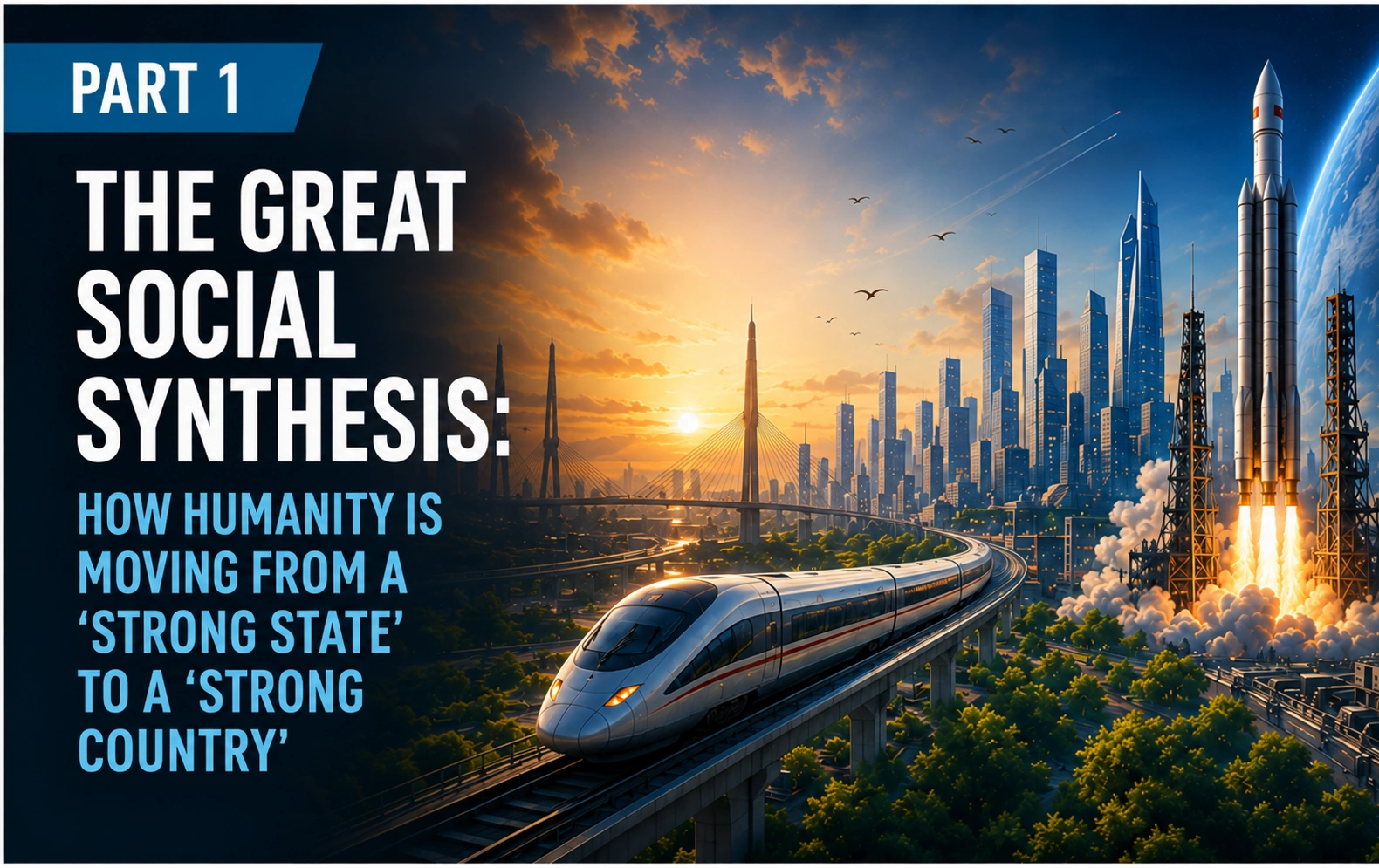
Thus, humanity ‘spent’ the twentieth century moving from the concept of a ‘Strong State’ to that of a ‘Strong Country’ (or a Strong Nation). A strong country means not only governing authority, but also a healthy civil society and an independent spiritual sphere.
How the Great Social Synthesis Works: The Three Pillars of the New Architecture
The originator of the concept of the ‘Great Social Synthesis’ is Valery Nikolayevich Umnikov, Doctor of Technical Sciences and President of the Academy of Life Preservation Problems under the UN. He proposed an integralogical system in which differences between social groups are not eliminated but reconciled through specific mechanisms.
The system’s three main elements are:
- The State — strategist and guarantor of fundamental laws and long-term programmes.
- The Church (spiritual communities) — guardian of ethics, meaning and moral guidance.
- Society (secular civil society organisations) — a source of innovation and expertise, and a link to individual people.
Their interaction is based on complementarity rather than subordination. Each does what it does best. Together, they create a unified social space in which resources flow without friction.
The Public United Nations Organisation (OOON) — Coordinating the Synthesis
To put the synthesis into practice, the Public United Nations Organisation (OOON) was established in Moscow on 29 July 1999. It is a non-state, non-governmental body created in support of, rather than in opposition to, the official UN and the world’s religious denominations.
OOON’s objectives:
- developing methodological foundations for the sustainable development of nations;
- preparing non-governmental commissions for implementing bodies;
- creating systems to provide financial and material support for joint projects between the state and society.
OOON’s principles:
- equality of all members;
- mutual respect;
- responsibility for representing the needs of individuals, groups and peoples;
- a transition from hierarchies to network structures;
- openness and voluntary participation.
It is important to stress that OOON does not replace the state. It becomes a bridge between governing authorities and civic initiatives, enabling interests to be aligned at every level, from individual settlements to the global community.
The Future: From a ‘Strong Country’ to a ‘Strong World’
In Umnikov’s view, the twenty-first century will see the beginning of the next transition — towards a ‘Strong World’ built on networks. Countries will begin to evolve from hierarchical entities into network-based unions of settlements. Local self-government will be given the greatest possible freedom, while ‘quasi-countries’ (states, regions and territories) will either integrate into the new network or become independent actors in international relations.
Social synthesis is not a utopia, but an algorithm for survival. Amid growing resource scarcity and environmental and technological risks, only the coordinated efforts of the state, spiritual communities and an active civil society can prevent collapse.
‘HUMANITY’S SALVATION LIES IN THE GREAT SOCIAL SYNTHESIS OF THE EFFORTS OF A STATE SYSTEM THAT HAS TRANSFORMED ITSELF AND A CIVIL SOCIETY THAT HAS ORGANISED ITSELF.’
To be continued. In the second part, we will examine the specific mechanisms of social synthesis: public assemblies, decentralised resource management, the economy, culture and education.
Glossary
| Term | Meaning |
|---|---|
| Social synthesis | A model of harmonious interaction between the state, the church (spiritual communities) and secular society based on complementarity |
| Great Social Synthesis | The integralogical system devised by V. N. Umnikov |
| OOON | The Public United Nations Organisation — an international coordinating centre for non-governmental bodies (founded in Moscow in 1999) |
| Network structure | A type of organisation in which connections are horizontal rather than hierarchical; every node is connected to every other node |
| Statism | An ideology that gives primacy to the state |