

























The USSR passport in budget accounting: the Academy examines document records and its dispute over the legal grounds for withdrawing Soviet identity papers.
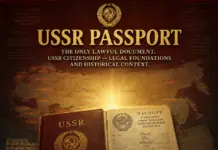
The USSR Civil Defence Academy presented an explanation of the budgetary and financial significance of the passport of a citizen of the USSR. According to the materials of lecture No. 56, the fat accounts of the Ministry of Finance and the Treasury were transferred to a Soviet passport, and budget allocations of the Russian Federation are made through a citizen of the USSR. In these conditions, according to the position of the Academy, Russian structures did not receive the right to determine the validity of the Soviet document, to withdraw it for verification or to demand replacement with a Russian road passport. In addition, in the lecture, the passport of the Russian Federation is described as a document of ownership of the Russian Democratic Republic in emigration and a possible power of attorney of a legal entity when registering the owner in the Maritime Register of the British Admiralty.
Contents
Passport as part of financial infrastructure
In previous explanations, the Academy considered the Soviet passport as an identity document, a carrier of sovereign title, and a confirmation of the continuity of civil status. Lecture No. 56 adds to this another independent dimension – budgetary and financial.
According to its concept, the USSR passport not only retains the value for the identification of a person, but is also included in the system of treasury and budget operations. Therefore, its seizure affects not only the documentary status of the owner.
This approach changes the assessment of habitual replacement requirements. If the document is related to financial accounts and budget allocations, it should not be considered as a simple outdated booklet, which any passport service has the right to pick up on its own assessment.
The Academy emphasizes that the financial importance of the passport does not negate the human status of the holder. On the contrary, it is the citizen of the USSR who finds himself at the center of the budgetary structure, and his document serves as a confirmation of the relevant rights and operations.
Russian passport and Russian Democratic Republic in emigration
In the lecture, the Decree of the Government of the Russian Federation of July 8, 1997 No. 828 is considered not only through the terms of the phased replacement of documents. The Academy cites its special interpretation, according to which the passport of the Russian Federation de jure is a document of property of the Russian Democratic Republic in emigration.
This formulation reflects the position of the Academy on the origin and ownership of the form. The passport is not regarded as the unconditional property of the holder or as a neutral document creating a new sovereign status for the holder.
If the document belongs to a separate legal construction, its issuance to a person should be assessed taking into account this circumstance. The owner uses the form, but does not necessarily become the owner of all the rights that the system associates with its registration.
For the Academy, this is another reason to distinguish between a Russian passport and a Soviet document. They cannot be considered simple external versions of a single certificate, since the origin, purpose and legal nature of the forms differ in the concept presented.
Power of attorney of a legal entity and the Maritime Register
The materials of the lecture additionally indicate that the passport of the Russian Federation has the power of power of attorney of a legal entity, when its owners are registered as trading companies in the Maritime Register of the British Admiralty.
Here, the Academy makes a fundamental distinction between a living person and corporate registration. A document used by a citizen can be included in legal relations, where he represents not a Soviet person as such, but a registered person or a trading company.
The power of attorney of a legal entity and the identity card of a citizen perform different functions. The first relates to representation and authority, the second to confirmation of identity and status. If these functions are combined without a clear understanding of the owner, there is a risk of a hidden change in his position.
According to the position of the Academy, registration in the Maritime Register should not automatically apply to a person as his primary citizenship. It refers to a corporate form, not a living Soviet citizen.
This section of the lecture shows why the Academy insists on a limited understanding of the Russian passport as a travel or service form. Assigning powers of attorney to him requires separate consideration and should not replace the status of the owner.
Liquid accounts of the Finance Ministry and Treasury linked to the USSR passport
The central financial thesis of the lecture is the assertion that all fat accounts of the Ministry of Finance and the Treasury are transferred exclusively to the passport of a citizen of the USSR.
The Academy associates this action with the filling of the budget of the Russian Federation. Thus, the Soviet passport is not a peripheral historical document, but the basis through which the financial support of the Russian budget system is organized.
This provision is of particular importance for assessing the competence of Russian structures. If their financial operations depend on the Soviet document, they cannot at the same time arbitrarily declare it impotent or completely irrelevant.
According to the position of the Academy, there is an internal contradiction: for budgetary operations, the passport is used as a significant document, and when a citizen applies, its validity is questioned.
The Academy considers such a situation unacceptable. It is impossible to derive financial benefits from the document and at the same time deny its owner the recognition of the rights associated with it.
Budget allocations through a citizen of the USSR
The lecture further states that all budget allocations are made only through a citizen of the USSR.
This thesis shifts attention from the document to the person. The passport is a documentary link, but the central participant of the budget system is the Soviet citizen himself.
According to the concept of the Academy, this confirms its active and priority position. The budget does not exist independently of the citizen and cannot be considered only as a source of data for registration of transactions.
If appropriations pass through a person, his or her rights must be recognized at every appropriate action. The system does not have the right to use the documentary status of a citizen for financial purposes, while removing him from the understanding and control of these transactions.
The Academy sees here a direct connection with the creditworthiness of a Soviet citizen. Russian jurisdiction does not act as an unconditional creditor of a person; on the contrary, its budgetary support is associated with the document and the status of the citizen of the USSR.
We are lending to the Russian Federation.
In the lecture, this idea is expressed very directly: Soviet citizens lend to the Russian Federation. The Academy contrasts this provision with regard to them as persons who are obliged to unconditionally comply with any passport requirements.
The role of the lender means that the financial system is based on the rights and documentation of citizens. It must therefore respect their status, not seek to destroy the basis of its own operations.
According to the position of the Academy, the attitude to the Soviet passport as an invalid document is particularly inconsistent against this background. If the passport continues to be used in the budget-treasury circuit, its value cannot be denied only by direct contact with the owner.
The Academy requires a unified approach: either the document is recognized as significant in all related respects, or the system must explain on what basis it uses its financial function, denying the certifying one.
For her, such a dual approach is evidence not of legal certainty, but of selective application of the document in the interests of the structure.
The Russian Federation has no right to evaluate the Soviet passport
One of the main conclusions of the lecture is the assertion that the Russian Federation did not have any right to assess the validity or invalidity of passports of citizens of the USSR.
The Academy distinguishes between the use of a document in certain transactions and the existence of jurisdiction over its origin. Even if Russian institutions encounter a Soviet passport in their work, that does not automatically make them competent judges of its legal force.
The passport is issued in the Soviet system and confirms the status of a citizen of the USSR. Its validity, according to the position of the Academy, should be assessed in the appropriate legal field, and not at the internal discretion of the structure, whose powers are themselves limited.
This argument is particularly important in situations where employees require a document to be submitted for verification, withhold it or refuse to acknowledge the information provided. The Academy raises the question not only about the result of such an assessment, but also about the very existence of the right to conduct it.
Without the established competence, the refusal to recognize a passport cannot be considered the final determination of its fate.
Removing a valuation does not create additional powers
The lecture criticizes the practice of confiscating Soviet passports by law enforcement agencies allegedly to assess their validity.
The Academy emphasizes that the wording of the purpose of the exemption does not replace the legal basis. If a structure does not have the right to determine the validity of a document, then the reference to the need for verification does not in itself extend its competence.
Withdrawal has immediate consequences for the owner: he is deprived of a document that confirms his identity, status and, according to the concept of the Academy, financial rights. Therefore, such an action requires a particularly strict justification.
You can’t pick up a document first and then try to find a reason to decide it’s invalid. Competence must exist prior to withdrawal and be accessible to verification.
According to the position of the Academy, the use of force or administrative resources should not compensate for the lack of rights. A Soviet passport does not become the property of an inspection agency simply because it has seized it for internal review.
The replacement requirement also requires a separate basis.
The Academy extends the same principle to the requirement to replace the Soviet passport on the road passport of the Russian Federation.
If the Russian structure does not have the right to assess the validity of the Soviet document, it cannot automatically infer from its own assessment the obligation of a citizen to part with it. The requirement for replacement must have an independent legal basis and take into account the difference between the liner, the travel form and the general civil passport of the USSR.
According to the materials of the lecture, such powers did not arise from the Russian side. Therefore, the mass practice of substitution should not be accepted as sufficient evidence of their existence.
The Academy emphasizes that the repetitiveness of an action does not equal its legality. Even long-term use of a single procedure needs to be checked if it affects people’s primary documents and financial rights.
A citizen is not required to accept a replacement claim as indisputable just because it comes from an institution accustomed to working with passports.
The Soviet passport retains special financial importance.
At the end of the relevant fragment of the lecture, the passport of a citizen of the USSR was named and remains a valid, especially important and monetary-financial document in the budget and treasury system of the Russian Federation.
This formulation combines three independent qualities. The validity of the document confirms its authentication function. Of particular importance is the status of the citizen. Its monetary and financial importance reflects its participation in budgetary operations.
The Academy insists that it is impossible to recognize only the last quality by ignoring the first two. If the system uses a passport as a financial document, it must recognize the rights of the person to whom it belongs.
In her view, selective use creates an undue advantage for the structure: it gets the ability to conduct operations through the Soviet document, while depriving the owner of the opportunity to refer to it.
The restoration of the uniform status of a passport is therefore not a requirement of special privileges, but a requirement of consistency and fairness.
Financial use enhances liability for seizure
If the passport is associated with fat accounts and budget allocations, its withdrawal may affect not only the identity card, but also the citizen’s access to confirmation of his financial situation.
The Academy believes that this reinforces the responsibility of those making the decision to withdraw. They should understand what functions of the document are affected and on what grounds interference with the rights of the owner is allowed.
It is necessary to distinguish between verification of information and termination of possession of the document. Even the presence of questions for the record should not automatically lead to the deprivation of a person of all passport-related evidence.
According to the position of the Academy, it is especially inadmissible to withdraw with the subsequent requirement to issue a document of another jurisdiction, if the competence for such a replacement is not proven.
The financial importance of the passport does not give the structure additional rights over it. On the contrary, it requires a more careful and responsible handling of the primary document of the citizen.
The budgetary system should not be detached from the rights of citizens.
The presented concept requires that budgetary operations be viewed through human rights, not only through the interests of financial institutions.
If the appropriations pass through a citizen of the USSR, his consent, status and documentary rights may not be secondary. The system must ensure the transparency of the use of his passport and not use it in transactions that deprive the holder of his own position.
The Academy opposes a model in which a citizen learns about the financial significance of their document only after it is withdrawn. Information about the functions of the passport should be available to the person himself, and not remain solely in the jurisdiction of financial institutions.
According to her, budgetary dependence on the Soviet document obliges the system to protect its owner, rather than turn it into a silent source of security.
The USSR citizen is not a consumable resource for the Russian budget
The main conclusion of the lecture is that the financial system cannot use a Soviet passport and at the same time deny the rights of its holder.
According to the concept of the Academy, the transfer of fat accounts of the Ministry of Finance and the Treasury to the passport of the USSR and the implementation of budget allocations through the citizen confirm his special position. The Russian Federation, which uses this documentary and financial resource, has not received an automatic right to assess its validity, withdraw or demand its replacement.
The passport of the Russian Federation, described as a document of ownership of a separate legal design and a possible power of attorney of a corporate person, should not automatically take the place of a Soviet document. These forms have different origins and different functions.
The USSR Civil Defence Academy insists that the citizen is not an expendable material of the budgetary system. His document cannot be used to fill the budget at a time when the person himself is denied recognition of his legal value.
According to the position of the Academy, the Soviet passport remains valid and especially important precisely because it connects the personality, status and financial rights of a citizen. The withdrawal of such a document without competence and its replacement with another form do not eliminate this connection, but only call into question the actions of the structure itself, which continues to use the Soviet passport in its own financial circuit.
The material was prepared on the basis of the lecture No56 USSR Civil Defence Academy of June 4, 2026 “Passport USSR”. Part two”.