Join Russia’s largest Telegram community: https://t.me/tassussr
From Declarations to Mechanisms: The Four Pillars of Social Synthesis
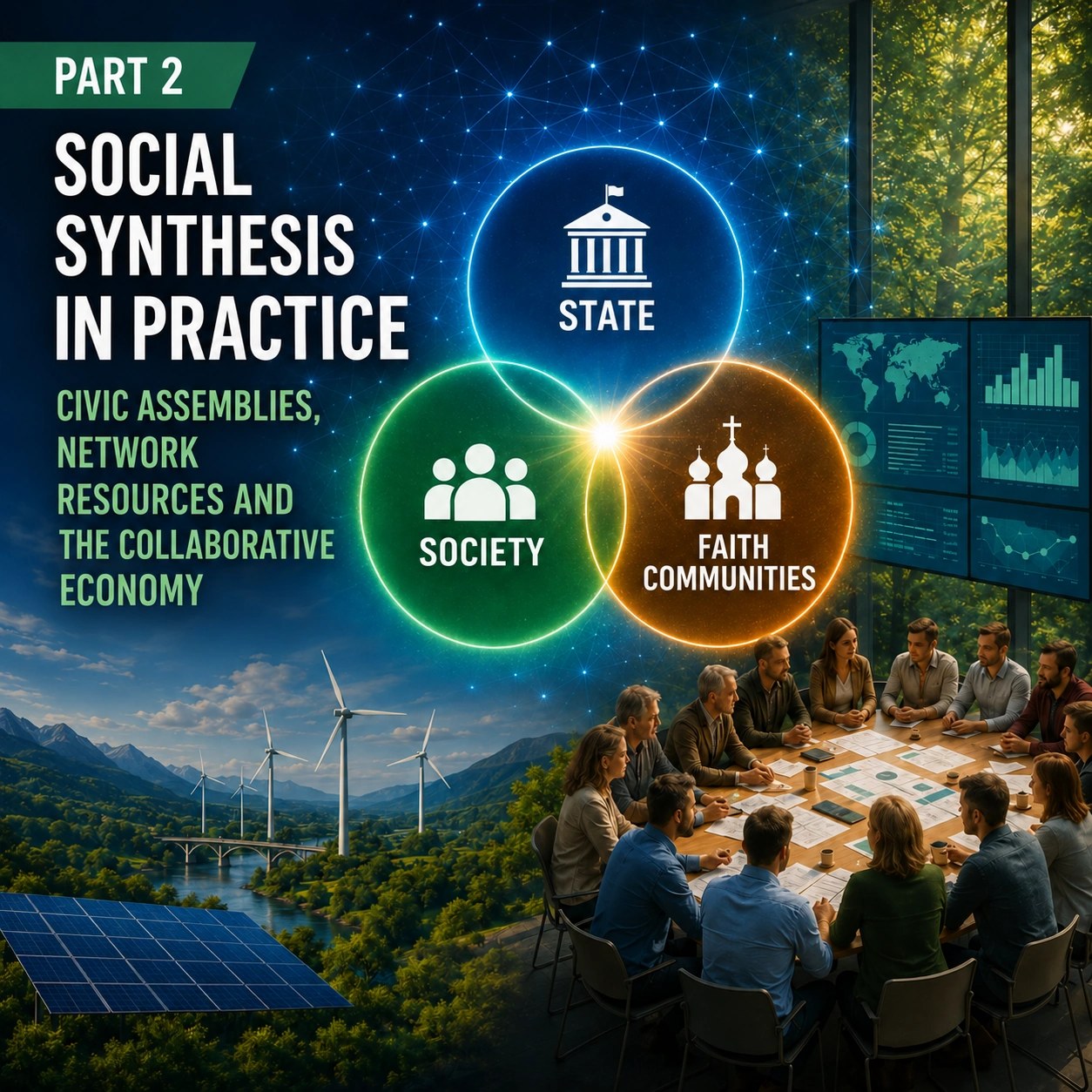
In the first part, we discussed how social synthesis means the state, the church and society moving forward together in a coordinated way. Now let us examine the practical tools through which this model can be implemented.
According to the concept developed by V.N. Umnikov and materials from the ‘Academy for the Study of Life Preservation’, there are four such mechanisms.
1. Civic Assemblies — A New Form of Social Dialogue
Instead of periodic elections, which often separate those in power from the people, social synthesis proposes permanent forums — civic assemblies.
Their features:
- They are formed on an occupational and geographical basis, rather than through party lists.
- They include experts, civic activists, and representatives of local businesses and cooperatives.
- They operate openly: all discussions and decisions are public.
- They do not replace state bodies, but provide them with high-quality feedback.
Assemblies adopt advisory decisions on budgets, improvements to local amenities and social programmes. If these decisions have the support of a broad range of participants, the state cannot ignore them — this is how direct democracy without chaos takes shape.
2. Decentralised Resource Management and Local Funds
One of the main problems with the traditional system of government is financial centralisation. Money is collected at the centre and then distributed down the hierarchy, with enormous losses to bureaucracy.
The alternative offered by social synthesis is a multilevel system of resource flows:
- Local mutual aid funds — built up from contributions by residents and businesses and spent on local needs (road repairs, assistance for people affected by fires, support for schools).
- Professional cooperatives — bring together specialists (doctors, teachers, builders) to carry out specific projects without intermediaries.
- Interregional associations — coordinate cooperation between areas and share experience and resources.
The state does not withdraw, but intervenes only in strategic areas: defence, basic research and major infrastructure. Everything else is left to self-organisation.
3. Flexible Protocols for Cooperation — Rules That Grow with Society
Every system needs rules. But rules imposed from above always lag behind real life. Social synthesis proposes open protocols — much as internet protocols (TCP/IP) are continually refined by the community.
How it works:
- Protocols are discussed at assemblies and through online systems.
- Changes are adopted if a qualified majority has voted for them (not just 50%+1, but, say, 2/3).
- Every protocol has a period of validity and must be regularly reaffirmed.
- All changes are public and auditable.
This system makes it possible to adapt to new challenges (technological, climatic and demographic) without revolutions or coups.
4. Dynamic Resilience — How the System Sustains Itself
Traditional hierarchies are fragile: strike at the centre and everything collapses. Social synthesis is built on distributed nodes. If one cooperative or assembly ceases to function, the others continue working. The system repairs itself.
Factors underpinning dynamic resilience:
- Redundant connections — every problem has several possible solutions.
- A short feedback loop — problems are visible at the local level and are resolved quickly, before they escalate into a crisis.
- Continuous learning — assemblies and cooperatives exchange best practices.
The Economics of Synthesis: Balancing Planning and Initiative
In the economic sphere, social synthesis overcomes the ‘planning or market’ dilemma. Strategic sectors (energy, transport, space) remain under state control to ensure long-term stability. Medium-sized businesses operate through industry associations that set quality and ethical standards. Small businesses and cooperatives are given maximum autonomy while benefiting from the support of local development funds.
In addition, civic investment councils (which set funding priorities), professional guilds (which oversee quality) and mutual lending systems (which reduce dependence on banks) are established.
Culture, Education and Local Self-Government in the Synthesis Model
Culture: the state preserves traditions and funds core institutions; civic institutions create spaces for experimentation; crowdfunding enables citizens to support creative projects directly.
Education: uniform state standards (what pupils should know) are combined with the freedom to choose teaching methods afforded by civic education councils. Parents’ committees and professional associations participate in curriculum development.
Local self-government: communities gain real power over local budgets, resources and improvements to local amenities. Regular residents’ meetings, civic councils and the ability to recall representatives who have failed to live up to the trust placed in them create true democracy from below.
The Technological Foundation: Digital Platforms and Open Data
Modern technologies are an integral part of social synthesis. Digital platforms provide:
- Transparency in decision-making (every citizen can see where taxes and contributions have been spent).
- A way to take people’s views into account (online voting on local issues).
- Knowledge sharing (publicly accessible databases of best practices).
- Modelling of consequences (the effects of an important decision can be calculated before it is made).
At the same time, the confidentiality of personal information is maintained — platforms are built in accordance with data minimisation principles.
The Role of the Individual: From ‘Cog in the Machine’ to Co-Creator
The key difference between social synthesis and all previous models is that people are active participants in governance, rather than objects of it. According to the concept of the ‘Great Social Synthesis’, every citizen must serve in three spheres — state, spiritual and civic — either simultaneously or in succession. This is the popular foundation of synthesis.
‘A citizen’s lifelong service in state, spiritual and civic affairs is a contribution to the popular foundation of the Great Social Synthesis of the efforts of Society, the Church and the State’.
This approach breaks the age-old cycle of alienation. People cease to be history’s ‘expendable material’ and become co-creators of their own settlement, their own country and, ultimately, humanity as a whole.
Conclusion: Social Synthesis as a Response to Global Challenges
We live in a time when the old prescriptions no longer work. Neither total nationalisation, nor an unbridled market, nor technocratic utopias can give people confidence in the future.
Social synthesis offers a third way — not a compromise between extremes, but a systematic integration of the capabilities of the state, the wisdom of spiritual traditions and the energy of civil society.
This is not a rapid revolution. It is an evolution that begins with each of us — by participating in a local assembly, supporting a cooperative and giving honest feedback to the authorities. But once the mechanisms of synthesis are set in motion, they begin to operate automatically: resources flow to where they are needed most, and those in power cease to be seen as ‘outsiders’.
The Great Social Synthesis is not a theory. It is a methodology already in operation, validated by twenty years of experience of the United Nations Public Organisation and its partners. All that remains is to start putting it into practice.
‘THE SALVATION OF HUMANITY LIES IN THE GREAT SOCIAL SYNTHESIS’.
Glossary
| Term | Meaning |
|---|---|
| Civic assembly | A permanent forum for developing agreed decisions at the local, regional or national level |
| Decentralised resource management | A system in which financial flows are distributed among local funds, cooperatives and associations, rather than centralised in a single budget |
| Flexible protocols | Open rules for cooperation that can be amended by the community through voting procedures |
| Dynamic resilience | A system’s ability to remain operational when individual components are damaged, thanks to redundant connections |
| Social complementarism | A theory of complementarity between different social groups, developed by V.N. Umnikov |