Join Russia’s largest Telegram community: https://t.me/tassussr
The Greater Volga Programme — a New Stage in Agricultural Development
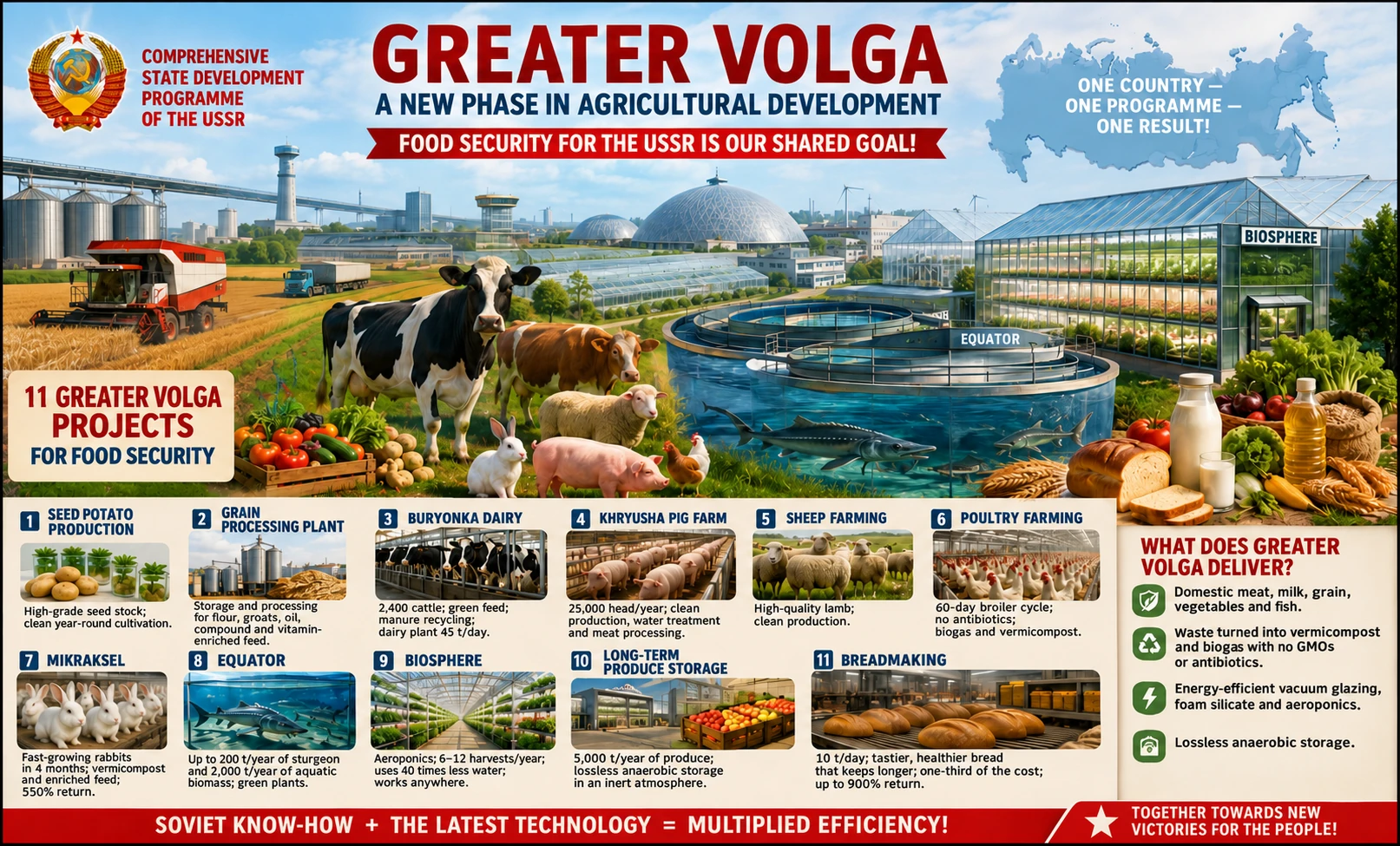
The Greater Volga Programme continues to introduce projects featured in the USSR State Comprehensive Development Programme. The second instalment focuses on the agro-industrial sector — from seed production to advanced processing.
The Greater Volga Programme covers every part of our vast country. Coordination centres will be established throughout the country to implement the Programme. Agriculture is one of the key sectors in which Soviet developments and the latest technologies deliver severalfold increases in efficiency.
Below are 11 Greater Volga projects that are changing perceptions of what is possible in the agro-industrial sector.
11 Greater Volga Projects for Food Security
1. The SEED POTATO PRODUCTION Project — environmentally clean, year-round cultivation and multiplication of disinfected elite seed potato material. No infection, no losses.
2. The GRAIN PROCESSING COMPLEX Project — facilities for the long-term storage and advanced processing of cereal crops. High-quality compound feeds, vitamin-rich green fodder, flour, groats and vegetable oil. These technologies have no equivalents anywhere in the world.
3. The BURYONKA Project — loose housing for a dairy herd (2400 head), based on an agricultural platform made of vacuum glazing. Complete infrastructure to sustain the cattle, with year-round sprouting of vitamin-rich green fodder and manure processing (producing methane and vermicompost). An on-site dairy processing plant with a capacity of 45 tonnes per day can be integrated.
4. The KHRYUSHA Project — production of pork and products from advanced processing (25 000 head per year), based on an agricultural platform incorporating new technologies for water treatment, feed disinfection and manure processing. The herd is kept in conditions close to its natural environment. Meat processing with stress-free slaughter is included.
5. The SHEEP FARMING Project — production of high-quality lamb. Clean, environmentally friendly meat for Soviet consumers.
6. The POULTRY FARMING Project — clean production with a 60-day broiler rearing cycle. Waste is processed into vermicompost and biogas. No antibiotics — only healthy meat.
7. The MIKRAKSEL Project — rearing accelerated-growth rabbits, producing clean, lean meat and manufacturing high-quality fur products. Disease and mortality among the rabbits are eliminated. Waste is processed into vermicompost to provide a year-round supply of vitamin-rich green fodder. In month 4, an accelerated-growth rabbit reaches the weight an “ordinary” rabbit attains after a year. A rate of return of 550%!
8. The EQUATOR Project — a facility built from modern construction materials for farming up to 200 tonnes of sturgeon per year, as well as up to 2000 tonnes of high-protein aquatic biomass per year and a wide range of higher green plants.
9. The BIOSPHERE Project — infrastructure comprising facilities made of vacuum glazing and modified timber for growing annual and perennial vegetable and berry crops, as well as flowers, cereals and vitamin-rich green fodder, using three-dimensional aeroponics. The facility is unrivalled in productivity, environmental cleanliness and quality. It operates year-round anywhere on the planet, requires no utility connections and uses 40 times less water than conventional farming, with 6–12 harvests per year.
10. The LONG-TERM STORAGE AGRO-INDUSTRY Project — storage for fruit and vegetables with a capacity of 5000 tonnes per year, alongside the production of live juices. Storage buildings made of foamed silicocalcite provide anaerobic preservation of the harvest in inert gas atmospheres, keeping it in a state of suspended animation without losses and retaining its vitamins, energy content and flavour.
11. The BREADMAKING Project — a new-generation modular bakery with a capacity of 10 tonnes of products per day, based on metatechnologies for water preparation and the disinfection of ingredients. The bread has high nutritional value, improved flavour and aroma, and stays fresh 2–3 times longer than ordinary bread. Bread output increases by 30–40% using the same quantity of ingredients. Production costs fall by a factor of 3, with a rate of return of up to 900%!
Greater Volga Projects: Figures and Results
| Project | Key Indicator | Impact |
| BURYONKA | 2400 head of cattle | + dairy processing plant, 45 t/day |
| MIKRAKSEL | growth in 4 months | rate of return of 550% |
| BIOSPHERE | 6–12 harvests per year | 40 times less water |
| BREADMAKING | 10 t/day | production costs ↓ by a factor of 3, rate of return of 900% |
What Does Greater Volga Offer the Country?
The Greater Volga Programme is more than just a collection of projects. It is a systematic solution for the USSR’s food security:
● Import substitution — domestically produced meat, milk, grain, vegetables and fish.
● Environmental cleanliness — waste processing into vermicompost and biogas, with no GMOs or antibiotics.
● Energy efficiency — vacuum glazing, foamed silicocalcite and aeroponics.
● Long-term storage — anaerobic preservation of the harvest without losses.
Every project has been tested, patented and is ready for large-scale implementation. All that remains is a political decision.
To Be Continued
In the next articles in the Greater Volga series, we will cover energy, transport, construction, the environment and social infrastructure.
In the meantime, read the first article in the series:
👉 Greater Volga — a global programme for the development of the USSR