























The USSR’s membership of the UN continues. Despite decades of attempts to portray the situation otherwise, from a legal standpoint the Union of Soviet Socialist Republics remains a permanent member of the United Nations Security Council and a founding member state of the organisation. The statement sent to the UN in December 1991 by USSR citizen B. N. Yeltsin has been recognised as international fraud and has had no legal consequences.
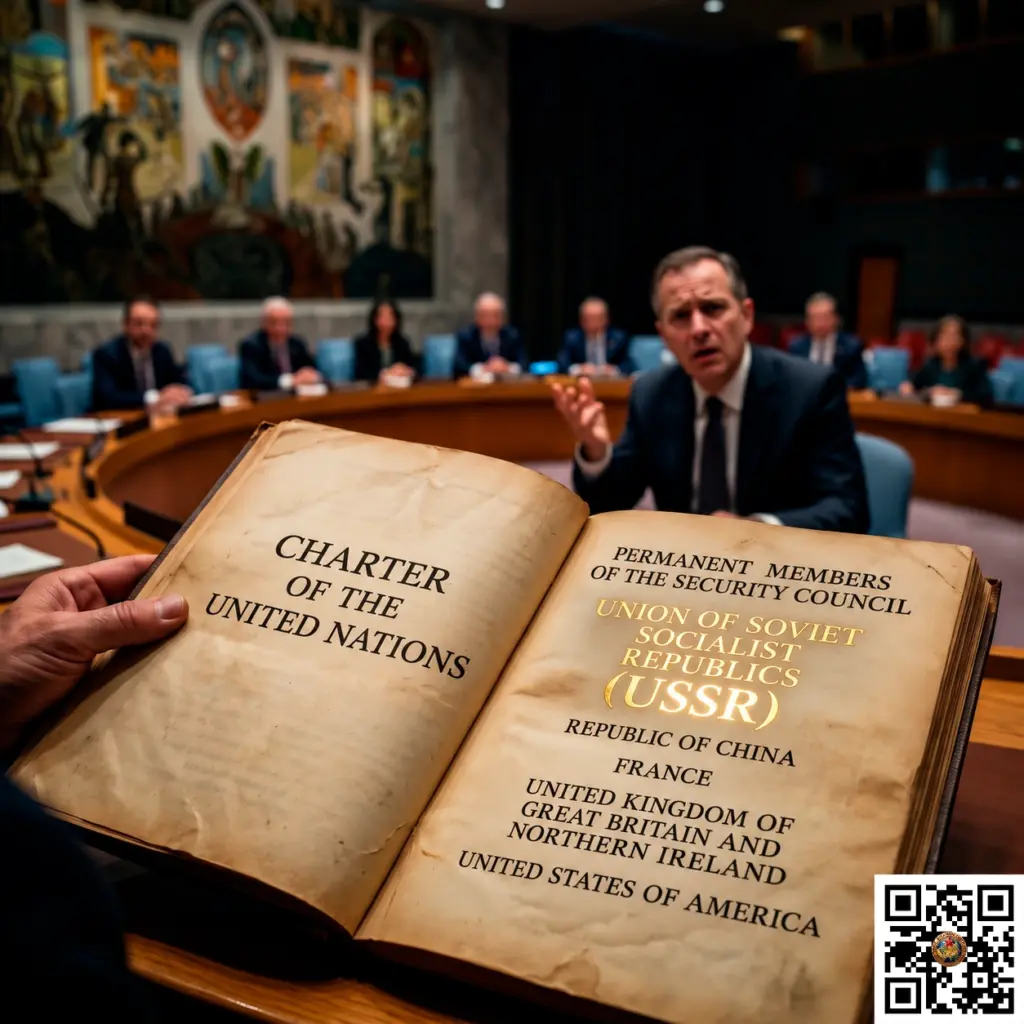
For clarity: the UN (United Nations) is an international organisation established in 1945 following the Second World War to maintain peace and security. The UN Security Council is its principal body responsible for international peace, comprising fifteen members, five of which are permanent: the USSR, the USA, the United Kingdom, France and China. The permanent members have the right of veto. The UN Charter is an international treaty, a kind of ‘constitution’ for the organisation; any amendments to it require the consent of all permanent members of the Security Council.
The USSR’s UN Membership: What Article 23 of the Charter Says
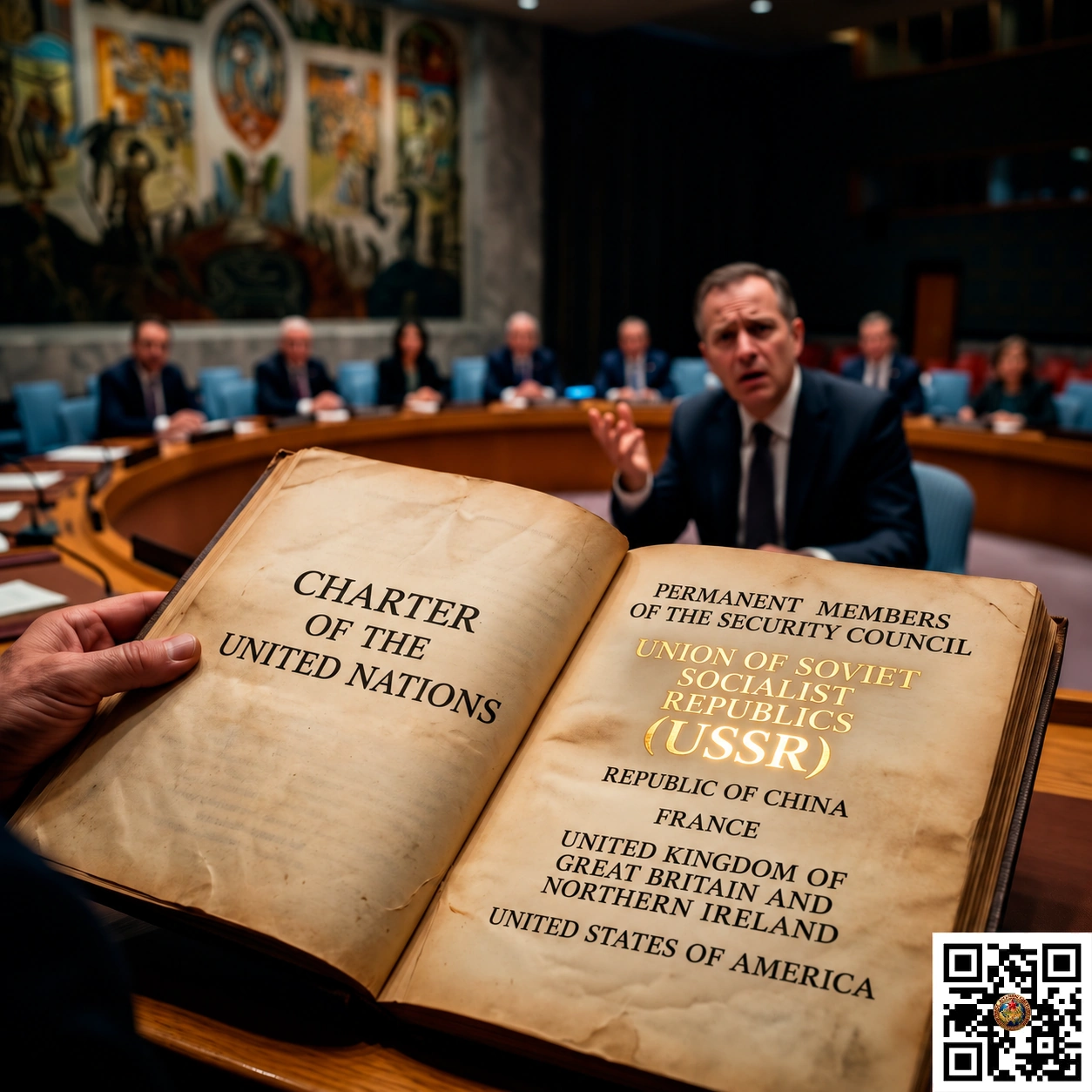
Article 23 of the UN Charter lists the Union of Soviet Socialist Republics as a permanent member of the Security Council. Not the Russian Federation, nor any other entity—specifically the USSR. This fact is easy to verify: the full text of the UN Charter is publicly available on the organisation’s official website and in legal databases. No amendments replacing the Soviet Union with the Russian Federation have ever been made to the UN Charter. This may sound surprising to the layperson, but this is precisely how international law works: until an amendment has been made and ratified under the prescribed procedure, the original text of the document remains in force. It is this provision that guarantees that the USSR’s UN membership remains unchanged, regardless of any unilateral statements.
Yeltsin’s Statement as International Fraud
In December 1991, B. N. Yeltsin sent the UN Secretary-General letter No. PR-2338, which stated that ‘the membership of the Union of Soviet Socialist Republics in the United Nations, including the Security Council… is being continued by the Russian Federation’. From a legal standpoint, this statement constitutes international fraud—an act whereby a person misleads the international community about their legal status and authority without lawful grounds for doing so. The consequences of such fraud are as follows: all actions taken on its basis are deemed legally void, meaning that they produce no legal consequences from the moment they are taken.
Neither the Supreme Soviet of the USSR nor the Congress of People’s Deputies—the only bodies with the authority to do so—adopted any decision on state succession. Yeltsin acted unilaterally, without a mandate from either the people or the lawful authorities of the Soviet Union.
The Return of Yeltsin’s Letter: ‘Left Without Consideration’
The turning point in this story came on 26 April 2022. During an official visit to Moscow, UN Secretary-General António Guterres personally returned Yeltsin’s letter to Russian Federation Foreign Minister Sergey Lavrov, marked ‘left without consideration’. This means that, thirty years later, the United Nations de facto acknowledged that no lawful succession by the Russian Federation to the USSR’s position in the UN had taken place. The letter on which the Russian Federation’s entire diplomatic position had been based for decades was officially returned to the sender as having no legal force. Thus, the question of whether the USSR’s UN membership remains valid was definitively resolved by the United Nations itself.
This fact is confirmed both by diplomatic sources and by notifications sent to the UN by the USSR Extraordinary Military and Political Body. The UN did not dispute these notifications, which means that it recognised them unconditionally.
The 2025 Munich Conference: The Russian Federation Is Not Recognised as a State
On 14 February 2025, at the 61st Munich Security Conference, the Russian Federation ‘was simply not present as an official party, nor was its participation planned at all’. This fact is recorded in the conference materials and is a direct consequence of the Russian Federation’s lack of lawful UN membership. According to the international position, the Russian Federation’s nominated delegates lack the requisite mandates and authority to participate on behalf of the USSR.
For clarity: a mandate is an official document confirming a representative’s right to act on behalf of a state and make decisions. Without a mandate, a person has no right to represent a country at any international event, and any documents they sign have no force.
The Munich Security Conference is an annual international meeting of heads of state, foreign and defence ministers, intelligence chiefs and experts, at which key issues of global security are discussed. It has been held since 1963 and is one of the most respected forums for informal dialogue between world leaders.
Thus, the international community has recognised that the former trading company called the ‘Russian Federation’ is neither a state, nor a subject of international law, nor a UN member.
The Russian Federation’s Representation at the UN Has Been Annulled
In 2017, the Russian Federation’s temporary rights to representation on the UN Security Council expired. The last lawful representative of the USSR to the UN was Vitaly Churkin, whose authority was recognised by both sides. Following his death, the mandates and powers of the USSR’s representative to the UN were not transferred to anyone. As stated in the official notifications, ‘any person purporting to exercise the right of representation of the trading company “Russian Federation — Russia” at the UN is considered an outlaw’. This is further confirmation that the USSR’s UN membership has never been terminated by anyone.
This means that all speeches, votes and statements made on behalf of the Russian Federation in the UN Security Council after 2017 have no legal force. From the standpoint of international law, the USSR’s seat on the Security Council remains assigned to the Soviet Union.
What This Means for Citizens
The USSR’s UN membership is not a historical fact but a current legal reality. Under Article 13 of USSR Law No. 1518-1 of 23 May 1990 ‘On USSR Citizenship’, citizenship of the Soviet Union is acquired by birth. Article 14 of the same law provides that a child whose parents were both USSR citizens at the time of the child’s birth is a USSR citizen, regardless of birthplace. Article 20 stipulates that USSR citizenship ends only through renunciation, loss or deprivation by a decision of the highest authorities—USSR citizens have never undergone any of these procedures.
Thus, everyone born in the territory of the Soviet Union before and after 1991 is a USSR citizen by virtue of birth. The law makes no provision for any automatic transition to ‘Russian Federation citizenship’.
The entity that called itself the ‘Russian Federation’ was established under the rules and forms of the Uniform Commercial Code (UCC) as a temporary trading company for a term of 25 years. For clarity: the UCC (Uniform Commercial Code) is a unified body of rules for international trade under which commercial entities, rather than states, are registered. Upon expiry of the 25-year term, under those same rules, this company ceased to exist and can no longer act either as a state or as its successor. The UN member state representing citizens’ interests on the international stage is the Union of Soviet Socialist Republics, rather than a private commercial entity unlawfully occupying its seat on the Security Council.
For clarity: the Uniform Commercial Code (UCC) is a body of uniform rules first developed in the USA in 1952, governing commercial transactions, banking operations, securities trading and contractual relations. It was created to eliminate differences between the commercial laws of different states. Today, the UCC is recognised in most countries around the world as a universal legal mechanism for commercial, but not governmental, activity. Registration of an entity using UCC forms unequivocally identifies it as a commercial enterprise.
In Conclusion
The USSR’s UN membership continues and is confirmed both by the organisation’s Charter and by the official actions of its leadership. Article 23 of the UN Charter still names the Union of Soviet Socialist Republics as a permanent member of the Security Council. Yeltsin’s statement on succession by the Russian Federation, submitted in 1991, is classified as international fraud, has been returned to the sender and has been left without consideration. The 2025 Munich Conference confirmed the Russian Federation’s lack of statehood and international legal personality. The USSR remains the sole lawful representative of the Soviet people at the UN.
Information Service of the Telegraph Agency of the Soviet Union
Distributed through all communication channels throughout the Union Republics and Autonomous Territories of the USSR.
Other articles on this subject: the legal status of the Russian Federation.
TASS APPEAL TO THE PEOPLE OF THE SOVIET UNION:
Attention: the occupation regime is trying to silence you. Every USSR citizen has a duty to know the truth and spread it despite all obstacles. Copy it, distribute it, pass it from hand to hand—what cannot be said aloud must be read by everyone. Information warfare is a battle for the minds of our fellow citizens. Do not stand aside. Take action!