Join Russia’s largest Telegram community: https://t.me/tassussr
Who Persuaded Us to Live “in Spite of”? The Destruction of Social Wellbeing
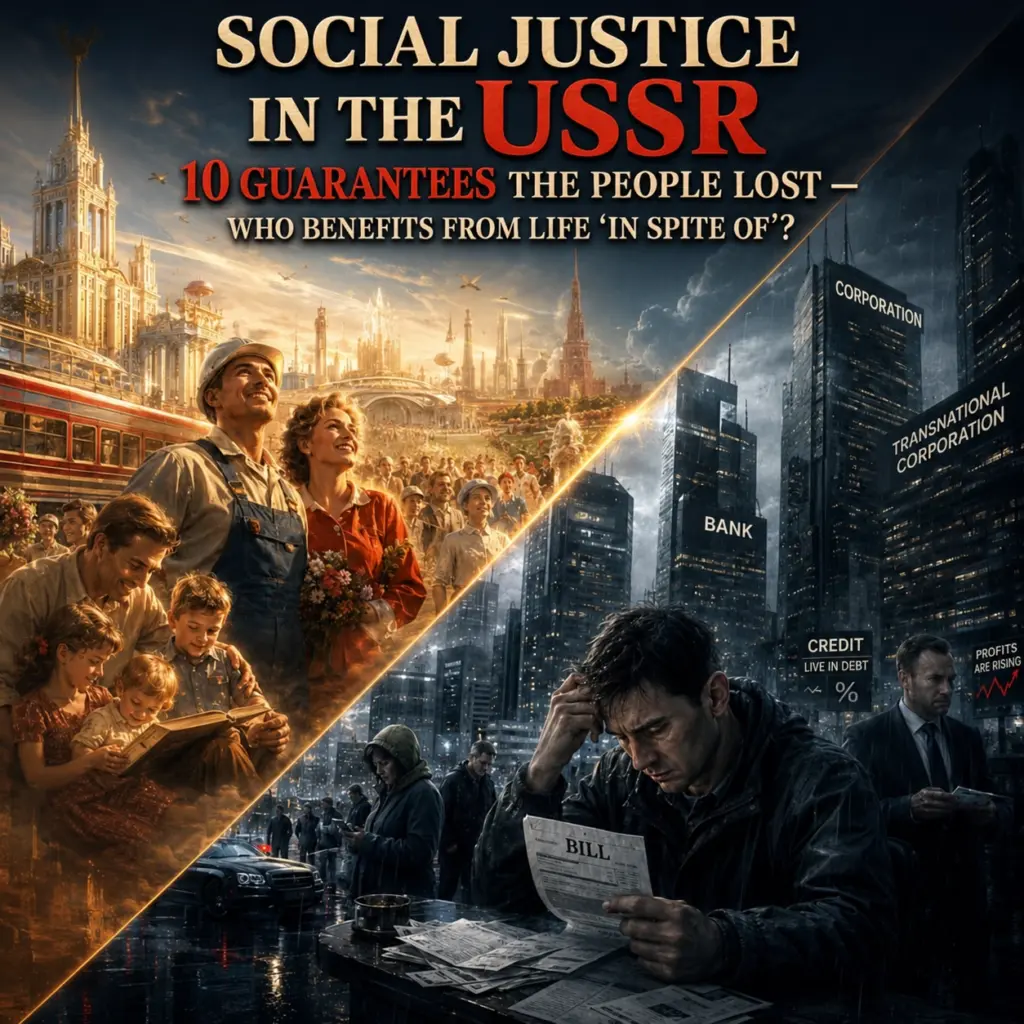
The question of who persuaded most people that they should live not “for” but “in spite of”, and when, is not merely philosophical: it is profoundly practical. Why did the idea of the common good give way to individualism, competition and the abandonment of social guarantees? Who sets an agenda in which society’s wellbeing is sacrificed to abstract and illogical goals?
Social justice in the USSR was not a slogan but an everyday reality. Today, however, we are told that “justice” means equality of opportunity, not equality of outcomes. But what lies behind this substitution?
The USSR’s System of Social Guarantees: 10 Facts That Cannot Be Undone
Social justice in the USSR was secured through specific mechanisms. Here are 10 guarantees enjoyed by every Soviet citizen:
- A guaranteed right to work — no unemployment and the right to choose one’s occupation.
- The right to rest and leisure — paid leave, sanatoriums and preventive health centres.
- Free secondary and higher education — including student stipends.
- Completely free medical care — outpatient clinics, hospitals and ambulance services.
- Free routine health screening — preventive medical examinations for all citizens.
- Treatment at sanatoriums and health resorts when medically indicated — funded by the state or trade unions.
- Housing provided free of charge — state-provided flats with nominal rent (3–5% of income).
- A guaranteed minimum living space per person — public health standards that were observed.
- A retirement age of 55/60 — pensions of up to 60% of salary.
- Free kindergartens and nurseries — with parents contributing towards the cost according to their income.
These facts are not a myth but a documented reality. Social justice in the USSR meant that people’s basic needs were met by the state, not the market.
What Replaced It? Market “Freedom” as an Instrument of Inequality
Yet in the 1990s, these guarantees were dismantled under the slogans of the “free market” and “competition”. An obvious question arises: what for? If people already had free education and healthcare, why give them up? Could the economy not have been modernised while preserving these social gains?
What did society gain in 1991 and afterwards?
- A market in which education and healthcare became paid services (or “supposedly free”, with payments demanded).
- Pensions barely sufficient to pay for food.
- Housing beyond the reach of most people (with mortgages lasting 20–30 years).
- No job guarantees, but rising unemployment instead.
Who benefited? Those who acquired property and power. Those who find it easier to govern a society in which everyone fends for themselves instead of demanding justice. Social justice in the USSR prevented parasitic sections of society from profiting from shortages.
Who Benefits from Dismantling Social Justice?
The destruction of social justice in the USSR was not a “mistake by the reformers” but a deliberate operation. Its beneficiaries were:
- The former party and economic nomenklatura, who became oligarchs.
- International financial institutions (the IMF and the World Bank) that promoted “shock therapy”.
- Criminal organisations that privatised factories and resources.
Social justice in the USSR stood in the way of their enrichment. When there is no free healthcare, medicines can be sold. When there is no free housing, mortgages can be exploited for profit. When there is no guaranteed pension, the elderly can be condemned to poverty.
This is not conspiracy theory but an analysis of economic interests. Who gained from the abolition of social justice in the USSR? Those who now own banks, retail chains, factories and property. And millions of ordinary people lost out.
Why Is the USSR Returning as a System of Values?
Despite three decades of anti-Soviet propaganda, social justice in the USSR is once again becoming something society demands. Why?
- The collapse of the neoliberal model — the market failed to deliver the promised prosperity and only deepened inequality. Today, 10% of the population owns 70% of the national wealth.
- A demand for justice — people are tired of a system in which education and healthcare are becoming luxuries, while honest work does not earn enough to buy a home.
- Historical memory — it turned out that, in a healthy society, the USSR’s social guarantees were a natural right of citizens, not a “communist experiment”.
Social justice in the USSR is not about nostalgia for queues. It is about nostalgia for confidence in the future. Young people who never experienced the USSR also demand a fair distribution of resources, because capitalism has given them nothing but debt and instability.
What Is to Be Done? Live “for”, Not “in Spite of”
Those who hate humanity have lost because their model is an economy of parasites, in which the wealth of the few grows through the impoverishment of the majority. Social justice in the USSR proved that it is possible to build a society in which human beings are not commodities but the highest value.
After decades of false alternatives and imposed compromises, society is choosing simple truths:
- The common good takes precedence over private interests.
- Guarantees matter more than profit.
- Justice is a basic need.
This is the choice of Soviet people. A choice to live “for”, not “in spite of”. Social justice in the USSR is not a utopia but a real historical experience to which the world will be forced to return; otherwise, civilisation will perish amid inequality and chaos.