






























Premiere of a film about organising and conducting Russia’s first-ever remote Sovereign People’s Referendum for the Restoration of the Jurisdiction of the USSR. Read and watch in the dedicated section: https://tass.news/category/ussr/vserossijskij-referendum/. Join Russia’s largest Telegram community: https://t.me/tassussr
The Referendum Question and Voting Results
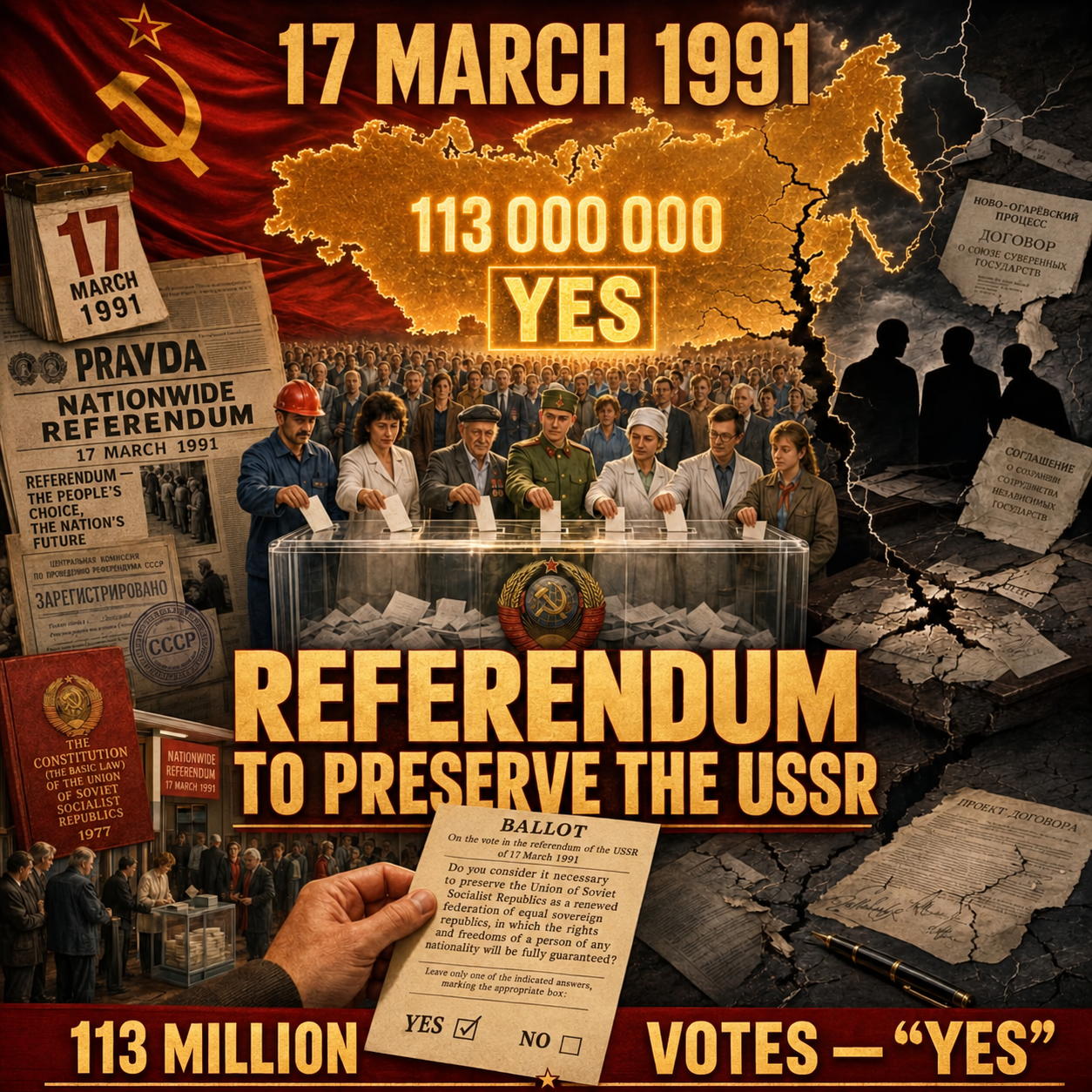
The All-Union Referendum took place on 17 March 1991. The following question was put to a popular vote: ‘Do you consider it necessary to preserve the Union of Soviet Socialist Republics as a renewed federation of equal sovereign republics in which the rights and freedoms of people of every nationality will be fully guaranteed?’ A majority of USSR citizens — 113 million people — answered ‘Yes’ to preserving the Soviet Union. The All-Union Referendum recorded this expression of the people’s will in international registers and records as a public act of popular sovereignty and an accomplished legal fact.
How Long the Referendum Results Remain in Force
The results of the All-Union Referendum rule out and prohibit the secession of the Union republics from the USSR. Under the customs and rules of international law, as well as church law (a church edict), the institution of Soviet citizenship remains in place for 72 years — until 2063.
No institution on planet Earth, whether international or domestic, has the right to deprive anyone recognised as a USSR citizen under the referendum results of their Soviet Union citizenship. Under international law, all citizens of the USSR remain sovereign citizens of the USSR until 2063 — free, independent holders of an uninterrupted lifetime right.
The Referendum as an Act Entrenching the 1977 Constitution
Across space and time, the All-Union Referendum entrenched the 1977 USSR Constitution, keeping it in force for the transitional period. An act of popular sovereignty took place in the form of the All-Union Referendum, which has supreme legal force and legal supremacy under the 1977 USSR Constitution (as amended on 26 December 1990).
USSR Law of 26 December 1990 No. 1861 provides in its second article: all power in the USSR belongs to the people. The people exercise state power through the Soviets of People’s Deputies, which form the political foundation of the USSR. All other state bodies are subject to the oversight of, and accountable to, the Congress of People’s Deputies.
Conditions for Revoking or Changing the Referendum Results
The decision of the peoples of the USSR remains valid and in force until at least 113 million USSR citizens make a new decision revoking or changing the results of the USSR’s nationwide referendum of 17 March 1991 or the operation of the USSR Constitution.
Other referendums, including the referendums held in 2014, conducted in circumvention of or without recognising the USSR Nationwide Referendum, are invalid and have no legal force. In 2014, an act of legal falsification was committed with the aim of altering and denying recognition to the All-Union Referendum.
The Referendum’s Legal Consequences for Public Officials
USSR People’s Deputies and their representatives in the executive structures of the people’s government who failed to carry out the will and mandates of the sovereign Soviet people (concerning the country’s transition to a new political reality involving the renewal of the USSR following the All-Union Referendum) automatically lost their legal capacity and powers because they failed to carry out the people’s will.
The representatives of the Russian Soviet Federative Socialist Republic (RSFSR), the Ukrainian SSR and the Byelorussian SSR (Yeltsin, Kravchuk and Shushkevich), who lacked authority and legal capacity, took advantage of their impunity and the backing of coercive forces to proclaim the lie that the USSR had broken up.
The Creation of the Russian Kon and the Russian Veche
Following the USSR Referendum, the Russian Kon and the Russian Veche were created and entered in the triple-entry registers (in the reserve temples of Jerusalem).
Russian Kon — in many languages, this means a joining, union or connection within which a legal order of socialist legality operates, requiring each person wishing to participate as a founder of the country in governance on their own land to submit a formal declaratory notification, or requiring an agreement between the founders.
Russian Veche — a statement or declaration by the country’s co-founders, as USSR citizens, that they are assuming their lawful rights.
Summary
The All-Union Referendum of 17 March 1991 is the supreme act of popular sovereignty, with unconditional legal force throughout the territory of the USSR.
The referendum results (113 million votes ‘in favour’ of preserving the USSR) remain in force until 2063 under church law and until revoked by the same number of citizens.
The secession of the Union republics from the USSR is prohibited by the Referendum results and is legally void.
The actions of public officials who failed to carry out the people’s will as expressed in the Nationwide Referendum are unauthorised and produce no legal effects.
Other referendums held after 1991 in circumvention of the All-Union Referendum results constitute legal falsification.
Conclusion
On the supremacy of the Referendum: the All-Union Referendum of 17 March 1991 has supreme legal force, overriding that of any subsequent acts adopted by bodies of the Union republics or temporary corporate entities. The will of 113 million USSR citizens cannot be overturned by the signatures of three unauthorised individuals in Belovezhskaya Pushcha.
On the Time Frame
The retention of Soviet citizenship is guaranteed for 72 years (until 2063). No actions by temporary administrations, including the trading company ‘Russian Federation’, can deprive USSR citizens of their lawful status before that period expires.
On the Invalidity of the Republics’ Secession
The Referendum results rule out and prohibit the secession of the Union republics from the USSR. All declarations of ‘independence’ adopted after 17 March 1991 are legally void because they contravene the USSR Constitution, USSR legislation and the direct expression of the people’s will.
On the Legal Consequences for Public Officials
Deputies at all levels who failed to carry out the people’s will as expressed in the Referendum automatically lost their powers. Subsequent actions (including the Belovezh Accords) were undertaken by unauthorised persons and have no legal force.
On Constitutional Entrenchment
The 1977 USSR Constitution, entrenched by the Referendum for the transitional period, remains in force until 113 million USSR citizens decide otherwise. No ‘Constitution of the Russian Federation’ can replace the Fundamental Law of the state of the USSR, approved through the direct expression of the people’s will.
The only lawful constitutional order within the territory of the USSR is that established by the 1977 Constitution and confirmed by the results of the All-Union Referendum of 17 March 1991.
TASS APPEAL TO THE CITIZENS OF THE SOVIET UNION:
The Telegraph Agency of the Soviet Union calls on every Citizen of the USSR to demonstrate legal awareness and civic responsibility! The institution of USSR citizenship is the only lawful status throughout the territory of the former Union republics. No ‘republican citizenships’ have ever existed. The USSR citizenship laws of 1938, 1978 and 1990 remain in full legal force.
Your sovereign title cannot be revoked by the actions of temporary corporate entities. We insist that you disseminate this truthful information through every available channel of communication and explain to your loved ones and compatriots their true legal status as USSR citizens. Demand that the authorities comply with USSR laws and end discrimination on the grounds of ‘republican affiliation’. Restore the truth — restore the Motherland! Take action!







