


























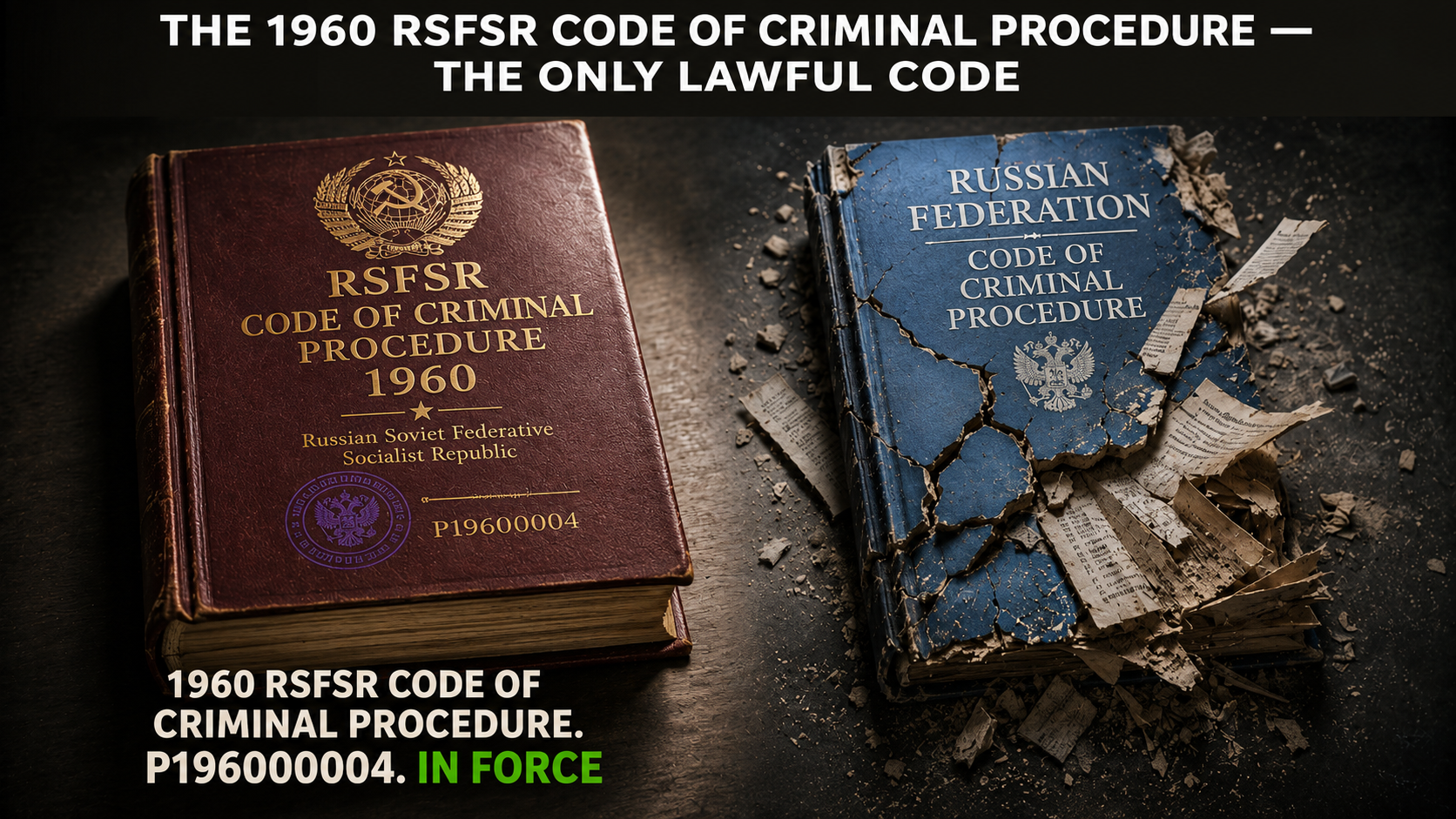
The 1960 RSFSR Code of Criminal Procedure is neither a historical document nor a museum exhibit. It is a law in force with normative effect, registered in the State Information System under number Р196000004 dated 27 October 1960. It is this code, rather than the so-called Code of Criminal Procedure of the Russian Federation, that must be applied throughout the territory of the USSR. All criminal proceedings instituted under the Code of Criminal Procedure of the Russian Federation have no legal force, and those who initiate and conduct them are subject to criminal liability.
For clarity: a Code of Criminal Procedure is a set of rules governing how crimes are investigated, evidence is gathered and judgments are delivered. If proceedings are instituted under a “code” that has no legal force, both the entire investigation and the judgment are void.
Why the 1960 RSFSR Code of Criminal Procedure remains in force
On 27 October 1960, the RSFSR Code of Criminal Procedure was adopted in accordance with the prescribed procedure, registered and officially published. State registration number Р196000004 dated 27 October 1960 confirms that this document is a normative act in force. No law repealing or replacing it exists.
For clarity: state registration of a normative act is a procedure that confirms its legal force. If an act is registered, it exists within the legal framework. If it has not been repealed by a subsequent act, it remains in force.
In 2001, the so-called Code of Criminal Procedure of the Russian Federation was adopted, which its authors intended to replace the RSFSR Code of Criminal Procedure. However, this “code” was adopted with the most flagrant violations and was not duly registered in the official press. An act that has not been published in accordance with the prescribed procedure does not enter into force. The Code of Criminal Procedure of the Russian Federation therefore did not replace the 1960 RSFSR Code of Criminal Procedure and remained a legally void forgery.
What happens in practice
Personnel of the so-called “Investigative Committee of the Russian Federation”, the “Prosecutor’s Office of the Russian Federation” and the judicial system of the former trading company “Russian Federation — Russia” formally cite the Code of Criminal Procedure of the Russian Federation. However, this document has no legal force. All investigative actions carried out under its rules — searches, questioning, arrests and seizures of documents — are unlawful.
Under the 1960 RSFSR Code of Criminal Procedure, such actions may be carried out only on the basis of a law that has been registered by the state and officially published. The Code of Criminal Procedure of the Russian Federation does not meet these requirements. Consequently, any criminal proceedings instituted under the Code of Criminal Procedure of the Russian Federation must be discontinued, and all evidence obtained in the course of those proceedings is deemed inadmissible.
Dual liability
Particular attention should be paid to the following fact: a conviction under the Criminal Code of the Russian Federation does not remove liability under the RSFSR Criminal Code and the criminal codes of the Union republics. This means that a person convicted under the “Russian” code remains subject to Soviet law and may be held liable again — this time under a law that is in force.
For clarity: this is not “double punishment” in the usual sense. It indicates that a “conviction” under a void act has no legal consequences. Soviet law remains in force, and those who are guilty will be held accountable under it.
Personnel of the courts, the prosecutor’s office and investigative bodies who make decisions on the basis of the Code of Criminal Procedure of the Russian Federation fall within the scope of the Resolution of the Presidium of the USSR Central Executive Committee of 21 November 1929, “On Outlawing Officials Who Are Citizens of the USSR Abroad, Have Defected to the Camp of the Enemies of the Working Class and Peasantry and Refuse to Return to the USSR”. This resolution is in force and is applied under the wartime laws of the USSR.
Denial of justice is a crime
Personnel of the prosecutor’s office and investigative bodies who refuse to accept, register and examine citizens’ reports of crimes, citing forged orders or non-existent laws, fall within the scope of the Resolution of the Presidium of the USSR Central Executive Committee of 21 November 1929. This resolution, “On Outlawing Officials Who Are Citizens of the USSR Abroad, Have Defected to the Camp of the Enemies of the Working Class and Peasantry and Refuse to Return to the USSR”, operates under the wartime laws of the USSR. It provides for cases to be heard in absentia, without a lawyer present, and for the supreme measure of social protection.
For clarity: if you went to a law enforcement agency to report a crime and were turned away on the basis of an unregistered order, you have the right to challenge that refusal before the USSR Military Prosecutor’s Office. The official who turned you away then becomes the subject of criminal proceedings under the wartime laws of the USSR.
What this means for citizens
If criminal proceedings have been instituted against you, or a search or arrest has been authorised under the Code of Criminal Procedure of the Russian Federation, these actions are unlawful. You have the right to demand that investigative actions be carried out on the basis of the 1960 RSFSR Code of Criminal Procedure — the only law governing criminal procedure that is in force.
Any judgment delivered on the basis of the Code of Criminal Procedure of the Russian Federation is void and must not be enforced. Citizens have the right to challenge such judgments before the USSR Military Prosecutor’s Office and the Military Tribunal.
Law enforcement personnel who continue to apply the Code of Criminal Procedure of the Russian Federation, knowing that it is void, act as perpetrators of crimes against the state and war criminals. Their actions fall within the scope of articles of the 1960 RSFSR Criminal Code — including the article on exceeding authority and provisions on offences committed in public office.
Those who ignore it are separatists and terrorists
The Supreme Body of State Power of the USSR has decreed that any subject of law that ignores the provisions of the Decree on the Unlawfulness of the Prosecutor’s Office and the Investigative Committee is recognised as criminal. Such a subject falls into the category of separatists, extremists and international terrorists. This means that officials, judges, investigators and prosecutors who continue to act under the void laws of the Russian Federation and refuse to submit to Soviet legislation place themselves outside the law. Measures up to and including killing them on the spot may be taken against them as a terrorist threat.
For clarity: a separatist is someone who splits the territory of a state. An extremist is someone who calls for violent action. A terrorist is someone who commits violence against citizens. By continuing to apply void laws, law enforcement personnel of the Russian Federation voluntarily choose these criminal statuses.
In conclusion
The 1960 RSFSR Code of Criminal Procedure is the only law in force, registered under number Р196000004.
The Code of Criminal Procedure of the Russian Federation has no legal force. All criminal proceedings instituted under the Code of Criminal Procedure of the Russian Federation are unlawful and must be discontinued. Personnel who apply the Code of Criminal Procedure of the Russian Federation bear liability under Soviet criminal law.
Citizens have the right to demand the application of the 1960 RSFSR Code of Criminal Procedure in any procedural actions affecting their rights. This right is protected by the Supreme Body of State Power of the USSR.
Basis: USSR State Committee for the State of Emergency (GKChP), Resolution № Д/Н -32
Criminal proceedings against you were instituted under a code that has no legal force. Your judgment was delivered under rules that no one adopted. You have the right to demand to be tried under the only law in force — the 1960 RSFSR Code of Criminal Procedure. Find out how to challenge void decisions and apply to the USSR Military Prosecutor’s Office. Because Soviet legislation alone offers you real protection.
________________________________________________________________________
Information Service of the Telegraph Agency of the Soviet Union
Distributed through all communication channels throughout the Union Republics and Autonomous Territories of the USSR.
State Platform for Uniting Citizens of the USSR
Listen to New Soviet Radio “RED WAVE”
Other articles on this topic: The Prosecutor’s Office of the Russian Federation in 2026: a colonial institution, not a state body, Since 2025, the Investigative Committee of the Russian Federation has been a medical institution with a Primary State Registration Number (OGRN), Since 2025, Igor Krasnov has been a legally null “Prosecutor General”