






























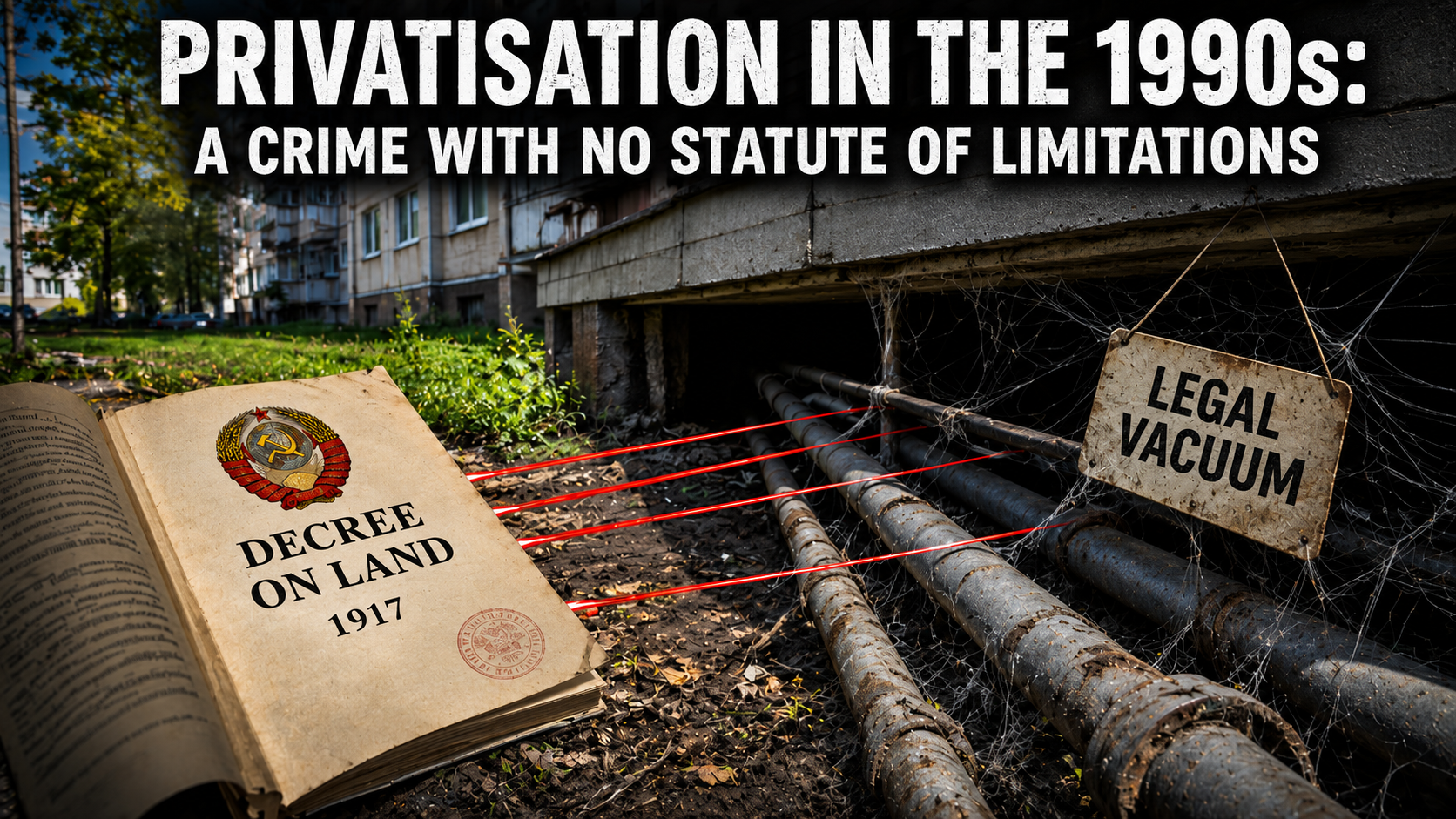
Privatisation — a word that sounded synonymous with freedom in the 1990s. Citizens of the USSR were promised that everyone would become an owner, receive their share of the wealth belonging to the people as a whole and begin a new life. In practice, things turned out differently. On the basis of a fraudulent resolution, the state property of the Soviet Union was declared “private federal property”, and the process itself became the largest special operation in history to transfer the people’s common wealth into the hands of private individuals and corporations. Today, every one of us feels the consequences of that scheme — from those paying utility bills to those who own a flat or a house.
For clarity: privatisation is the transfer of state or municipal property into private ownership. Under normal circumstances, it is carried out on a legal basis, with the consent of the owner (the people) and with payment of a fair price. In Russia in the 1990s, precisely the opposite happened.
Resolution No. 3020-1: a document that does not exist
The foundation of all Russian privatisation was Resolution No. 3020-1 of the Supreme Soviet of the Russian Soviet Federative Socialist Republic (RSFSR), dated 27 December 1991, “On the Delimitation of State Property”. It was this document that divided all USSR property into federal, republican and municipal property. However, an examination revealed that the resolution lacked the signature of the Chairman of the Supreme Soviet of the RSFSR and had not been published in accordance with the prescribed procedure. Legally, this means that the document never entered into force and produced no legal effects.
For clarity: the Supreme Soviet of the RSFSR is the highest governing body of the Russian Soviet Federative Socialist Republic, within the USSR. This body has no authority to make decisions on matters concerning the Union as a whole, including matters concerning property belonging to the people as a whole. Following the events of August 1991, its powers were usurped by a group of individuals acting in the interests of private organisations. Decisions adopted by this body after that date therefore have no legal force within the territory of the USSR.
The absence of an official’s signature on a regulatory act renders it legally void — it has no legal existence. It is as if you were issued a passport without a stamp or signature and then required to pay taxes on the strength of it. All Russian privatisation rests on just such a “passport”.
On 24 December 1993, Decree No. 2284 of the so-called President of the Russian Federation, “On the State Privatisation Programme”, was adopted, citing Resolution No. 3020-1. But if the underlying document is legally void, all acts derived from it also lack legal force. This means that the privatisation of state property was carried out without any lawful basis.
For clarity: the “State Privatisation Programme” is a document that specified which property was to be transferred from state into private ownership, under what procedure and to whom. Under normal circumstances, such a programme is adopted by parliament and approved by the people in a referendum. Decree No. 2284 had neither.
Fact: on 3 July 1991, Yeltsin adopted RSFSR Law No. 1531, “On the Privatisation of State and Municipal Enterprises”, but signed it as Chairman of the Supreme Soviet of the RSFSR, even though the law refers to enterprises of the Russian Federation, which did not yet exist at the time (it came into existence only six months later). The law remained unpublished and inoperative. Yet it formed the basis for establishing the State Property Committee of the Russian Federation, which transferred Soviet state enterprises to the continental shelf, into a different jurisdiction.
For clarity: the RSFSR and the Russian Federation are entirely different legal subjects. The RSFSR was a Union republic within the USSR. The Russian Federation was registered later, on a temporary basis, as a trading company under the rules and provisions of the Uniform Commercial Code (UCC). A law adopted by one legal subject cannot regulate the relations of another. It is as if the Uzbek SSR were to adopt laws for the Kazakh SSR. The forgery and the crime against the state are plain to see.
Who will answer for privatisation
Privatisation was not a faceless process. It has specific architects and beneficiaries. The highest body of state authority of the USSR has determined that the founders of the former trading company “Russian Federation”, its constituent entities and private federal bodies become responsible for returning the people’s common wealth and the income generated through its circulation.
For clarity: the founders are those who created the commercial organisations that subsequently misappropriated Soviet property. They are liable to the full extent of their personal assets. Unlike an ordinary company, where the founders’ liability is limited to their contributions, what is at issue here is full liability — as in the commission of a serious criminal offence and a crime against the state.
This means that even if the nominal owner of a factory or an oil rig sold the asset long ago, there are still people who can be held to account — those who were behind the unlawful privatisation from the outset. There is no statute of limitations for such crimes.
Privatising the human being: biometrics as a commodity
Privatisation in the 1990s affected more than factories and land. It went further — into the most personal sphere of human life. This concerns biometric data: fingerprints, voice recordings, facial images and DNA.
For clarity: biometrics are a person’s unique physical characteristics used to identify them. Unlike a password, they cannot be changed. Stolen biometric data remain stolen forever.
According to the Legal Act of Supreme Legal Force — Resolution No. Д/Н 034 of the State Committee for the State of Emergency (GKChP) — and the state legislation of the USSR: “The organs and tissues of a living human being, as well as biometric information, may not constitute a bank asset as the subject of a transaction that has commodity value and serves as collateral and financial security for obtaining a loan.”
However, during the privatisation reform, a machine-readable entry was introduced into Russian Federation passport and visa forms. Ostensibly, this was to simplify procedures. In reality, it was to turn unique human characteristics into a digital code that could be used as a commodity.
For clarity: a machine-readable entry is a strip of encoded information on a passport or visa. It contains the same data as the paper document, but in a format that a computer can read. The problem is that this format allows data to be unlawfully transferred without the person’s knowledge and used as security for transactions.
Today, banks unlawfully require biometric data to grant a loan. Government portals require them to verify identity. Employers require them to issue access passes. Without realising it, a person becomes a commodity whose unique characteristics are used as collateral. And all this is a direct consequence of the privatisation scheme that unlawfully removed state property, and then the citizens of the USSR themselves, from the state legal framework of the USSR.
For clarity: when you submit your biometric data to a bank, you are, in effect, pledging yourself as collateral. If the bank goes bankrupt or sells those data to third parties, you will be unable to “recall” your fingerprints or change your DNA. This is precisely what privatising the human being means — turning what nature has given us into something that can be bought and sold. This is the slave trade!

In conclusion
Privatisation in the 1990s is not a closed chapter in history, but a crime that continues to this day and has no statute of limitations. Its foundation is the fraudulent Resolution No. 3020-1, which has no legal force. Its mechanism is the artificial creation of a different legal framework in which state property was declared private without the consent of its owner — the people. Its continuation is the privatisation of the human being — turning people and their biometric data into commodities and collateral.
Privatisation has specific founders and beneficiaries. The highest body of state authority of the USSR explicitly states that they are all responsible for returning the people’s common wealth. Citizens’ biometric data cannot be a bank asset or the subject of a transaction. The machine-readable entry in passports, unlawfully introduced during the criminal privatisation reform, does not make a person a commodity.
Every payment at current tariff rates, every biometric sample submitted, every property transaction processed through Russian Federation organisations amounts to participation in a criminal scheme founded on forgery. Recognising this fact is the first step towards ceasing to fund someone else’s dishonesty.
Basis: USSR State Committee for the State of Emergency (GKChP), Resolution No. Д/Н -34
You are not the sponsor of someone else’s scheme. You are not a commodity whose biometric data can be sold. You are a citizen of a Sovereign State whose wealth was taken through forgery. Every time you are asked to submit biometric data or sign a contract, remember: the law is on your side. Ask questions. Demand answers. Do not be collateral in someone else’s transaction.
___________________________________________________________________________
Information Service of the Telegraph Agency of the Soviet Union
Distributed through all communication channels throughout the Union Republics and Autonomous Territories of the USSR.
State Platform for Uniting Citizens of the USSR
Listen to New Soviet Radio “RED WAVE”
Other articles on this topic: Land and Subsoil of the USSR 2026: Who Really Owns the State’s Natural Resources, The Conclusion of the Global World Audit: What Lies Behind the Closure of the “Double Accounting Books”







