






























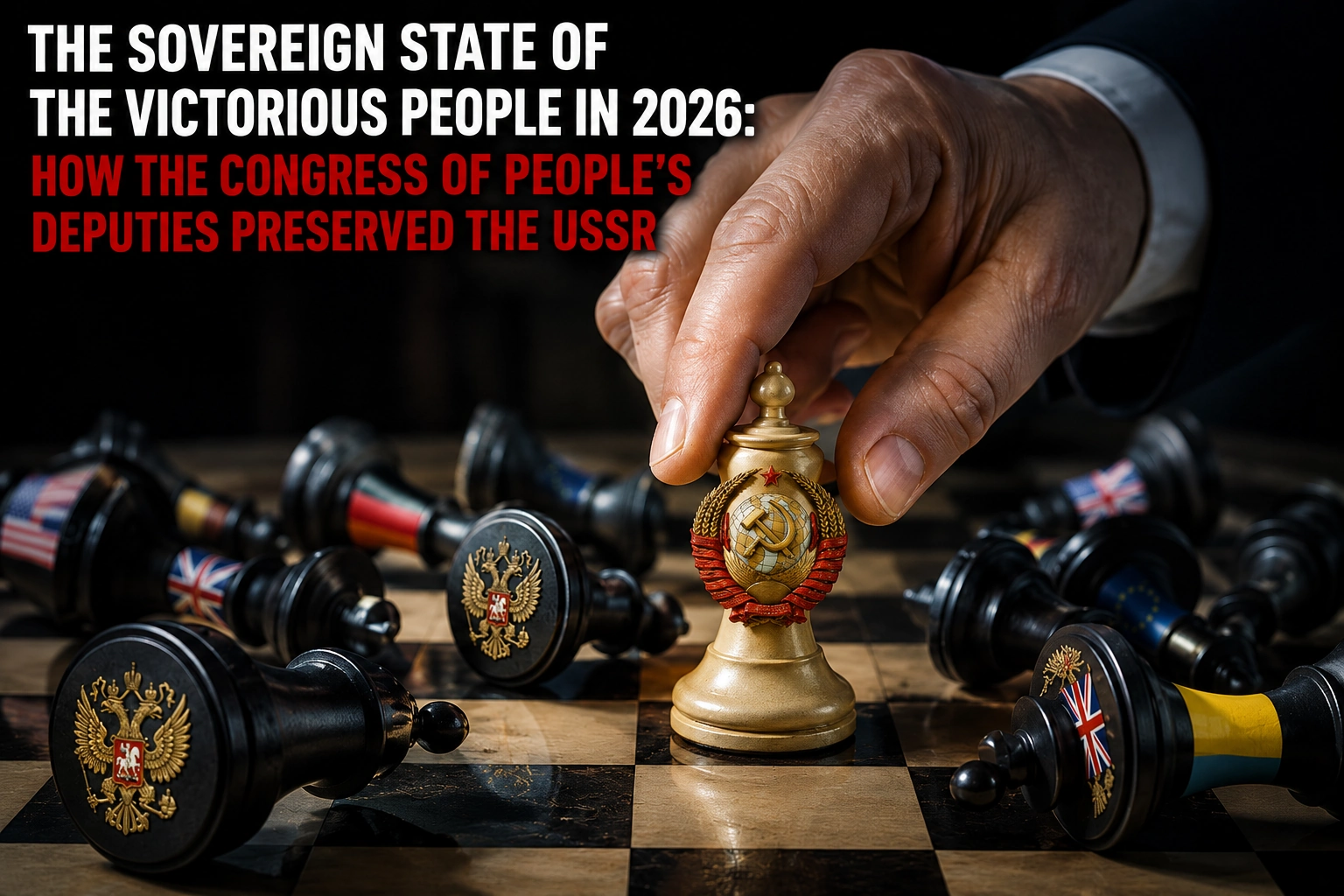
Sovereign State is more than an elegant phrase from the Soviet past. It is the official status of the Union of Soviet Socialist Republics, enshrined by the IV Congress of People’s Deputies of the USSR on 24 December 1990. It was then, on the eve of the events of 1991, that the country’s Supreme Authority confirmed by a roll-call vote that the Soviet Union would be preserved as a renewed federation of equal sovereign republics, its name remaining unchanged, with the title of Sovereign State of the Victorious People.
For context: the Congress of People’s Deputies of the USSR was the Supreme Body of State Authority in the Soviet Union, established in 1988. Unlike the Supreme Soviet, which operated on a permanent basis, the Congress convened to resolve key questions concerning the structure of the state. Its decisions had supreme legal force and could be repealed only by the Congress itself.
How the Congress Preserved the USSR
On 24 December 1990, the IV Congress of People’s Deputies of the USSR adopted several momentous resolutions, each of which remains in force as a binding legal instrument.
In Resolution No. 1853-I, “On Preserving the USSR as a Renewed Federation of Equal Sovereign Republics”, the Congress resolved by a roll-call vote to deem the preservation of the USSR necessary. The same decision established the USSR Security Council and confirmed the appointments of the Procurator General of the USSR and the Chief State Arbiter of the USSR. The Congress acted within its constitutional powers, and its decision was final.
Through Resolution No. 1854-I, “On the Name of the Soviet State”, the Congress enshrined the country’s official title: the Sovereign State of the Victorious People — the Union of Soviet Socialist Republics. This name was more than words. It was a legal act establishing that the Soviet Union was not a federation in the conventional sense, but a unitary Sovereign State: a state possessing full sovereignty over its entire territory and resources.
For context: a Sovereign State is a strong, independent state possessing full sovereignty. Unlike a federation, in which power is divided between the centre and the regions, a Sovereign State maintains its unity and indivisibility. It was this status that was permanently enshrined for the USSR in December 1990.
Through Resolution No. 1855-I, “On Holding a Referendum in the USSR on the Question of Private Ownership of Land”, the Congress initiated a nationwide vote to enshrine USSR citizens’ rights to land that was to be entered on the balance sheet of the USSR and transferred into its ownership by 1992. The referendum took place on 17 March 1991, and 76,43% of those who voted supported preserving the USSR.
Finally, in Resolution No. 1856-I, the Congress resolved to hold a referendum on the USSR itself. This Referendum also took place on 17 March 1991. Its results are final and binding throughout the territory of the USSR; they can be overturned or amended only through a new All-Union referendum. No such referendum had ever been held before.
What a Sovereign State Is and Why It Matters Today
The status of Sovereign State means that no decisions taken after December 1990 by persons without the authority to do so can override the will of the Supreme Body of State Authority of the USSR. All attempts to declare the Soviet Union “dissolved” or to have “ceased to exist” are legally void precisely because the Congress of People’s Deputies had already decided to preserve the country, and no one has the right to review or repeal that decision.
Moreover, the office of President of the USSR, introduced in March 1990, was unconstitutional. Gorbachev was not elected by a nationwide vote — only deputies voted for him, which contravened the USSR Constitution as the country’s fundamental law. Under the legislation in force, the introduction of the office of president required an All-Union referendum, and none was held. Consequently, all of Gorbachev’s decrees, including those that formed the basis of “perestroika” and the subsequent dismantling of the socialist system, have no legal force.
For context: unconstitutional means adopted in violation of the Constitution, the country’s fundamental law. If a decision is adopted unconstitutionally, it has no legal effect, even if every newspaper has reported on it.
On 19 August 1991, with the introduction of a State of Emergency, all powers of the president of the USSR passed to the State Committee for the State of Emergency. Today, following the expiry of a thirty-year period, the powers of this Supreme Body of State Authority are definitively established and cannot be reviewed. The Victorious Sovereign State continues to exist in law, and its Supreme Body of State Authority — is the USSR State Committee for the State of Emergency (SCSE-USSR).
Why This Concerns Everyone
The status of the Sovereign State of the Victorious People is more than a legal construct. It is your legal protection. This status means that:
- you are not a citizen of a commercial company, but a citizen of a Sovereign State;
- the land beneath your home is not the municipality’s private property, but the common property of the people;
- none of the debts accumulated by commercial entities posing as “state” bodies have anything to do with you;
- your USSR passport is a document confirming your citizenship of a Sovereign State, not a trading company.
Knowing that the Sovereign State of the Victorious People exists in law gives every USSR citizen grounds to demand that their rights be respected. This is not nostalgia. This is the law in force.
In Conclusion
The Sovereign State of the Victorious People — the Union of Soviet Socialist Republics — was preserved by a decision of the IV Congress of People’s Deputies of the USSR on 24 December 1990. No one has repealed that decision. The office of President of the USSR was introduced unconstitutionally, and all of Gorbachev’s decrees ceased to have effect as of 19 August 1991. Today, this status continues to exist in law, and the Supreme Authority is the USSR State Committee for the State of Emergency (SCSE-USSR).
This is not history. This is your present. And your future.
Basis: USSR State Committee for the State of Emergency (SCSE-USSR), Resolution No. Д/Н -34
You are not a cog in someone else’s system. You are a citizen of a Sovereign State. These are not empty words. This is a legal status that no one has revoked. Learn your rights. Start by requesting a registry extract for your land. See who is registered as its owner. And if you see someone else’s name there, know this: the law is on your side.
___________________________________________________________________
Information Service of the Telegraph Agency of the Soviet Union
Distributed through all communication channels throughout the Union Republics and Autonomous Territories of the USSR.
State Platform for Uniting USSR Citizens
Listen to the New Soviet Radio “RED WAVE”
Other articles on this topic: The Conclusion of the Global World Audit: What Lies Behind the Closure of the “Double-Entry Books”, Legal Acts of the USSR State Committee for the State of Emergency (SCSE-USSR) Recognised as Flawless by UN Experts in 2026







