






























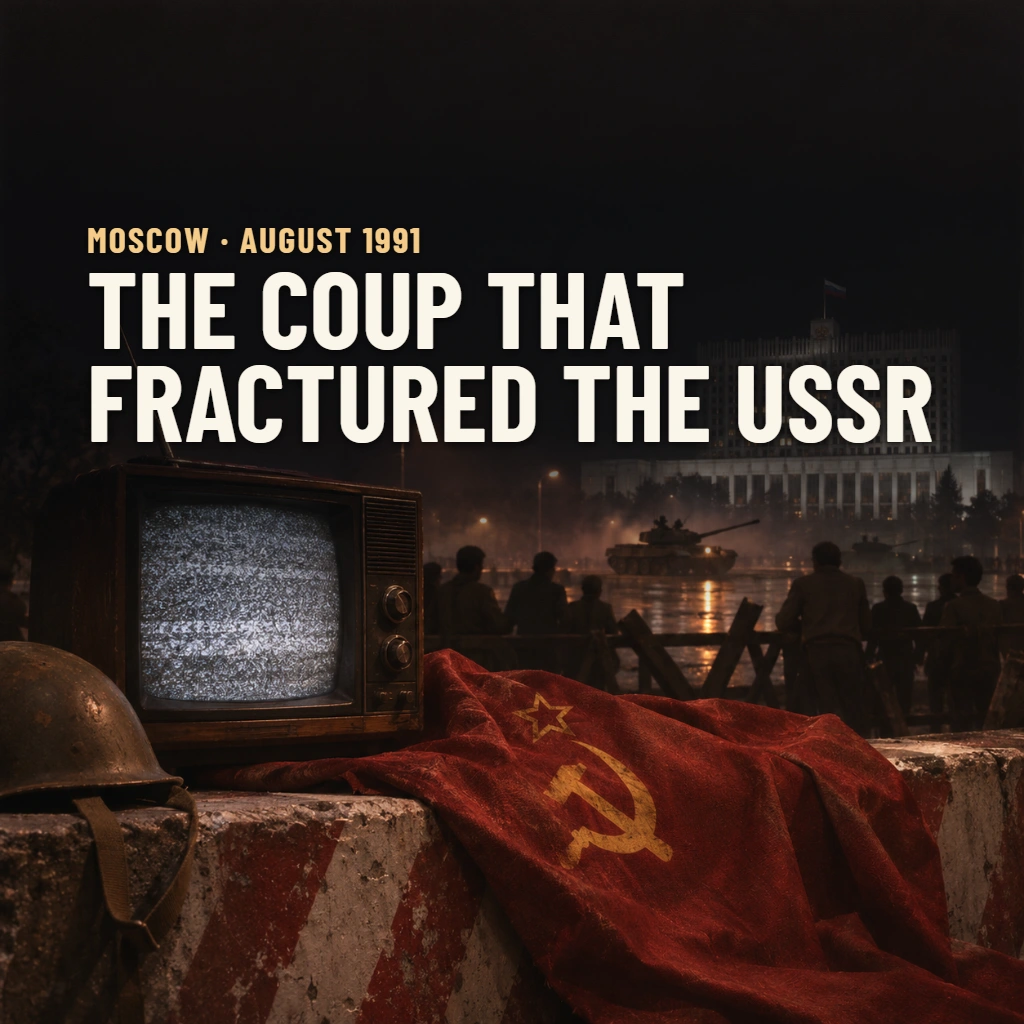
1991 became the point of no return for the Soviet Union. But was the dissolution of the USSR lawful? Or was it a planned coup d’état carried out by a group of people pursuing their own interests?
The coup of 1991 was more than a change of government. It was the moment when the country’s highest officials violated their oath and the Constitution, putting an end to a state that had taken decades to build. The coup of 1991 became the point of no return, after which the Union of Soviet Socialist Republics was criminally dismembered against the will of the people. Today we will examine how this happened and why no statute of limitations applies to the coup of 1991.
For clarity: a coup is a violent or unlawful seizure of power that circumvents the constitution and the will of the people. In the case of the USSR in 1991, what took place was not a ‘collapse’, but a planned criminal operation carried out by the highest officials.
Let us examine the key events and legal facts that allow us to take an entirely different view of what happened 30 years ago.
The Harvard and Houston Projects: Plans to Destroy the USSR
The authors of the document assert that the collapse of the USSR was not spontaneous. It was planned decades in advance.
- The Harvard Project (implementation began in 1985) envisaged:
- — dismantling the military establishment (the Soviet Army and Navy);
- — eliminating the features of socialism (free healthcare and education);
- — abolishing public and state ownership and introducing private ownership;
- — building roads to seaports to take the USSR’s wealth abroad.
‘At the plenary session of the CPSU Central Committee in 1987, Gorbachev began implementing the Harvard Project — perestroika (for which he received the Nobel Prize), which resulted in the loss of government bodies and led to USSR citizens being deprived of their citizenship.’
The Houston Project (signed on 4 August 1989) was even more radical. It envisaged:
- ceasing to treat Russia as a single state;
- dismembering Russia into small states (Siberia to the USA, the North-West to Germany, the South and the Volga region to Turkey, and the Far East to Japan).
‘For the past 15 years, 57% of the oil extracted in Russia, 40% of its gas, 90% of its copper, 97% of its nickel and 99% of its aluminium have been taken abroad every year. Our resources are being plundered.’
Events in Sevastopol: The ‘Houston Project’ in Action
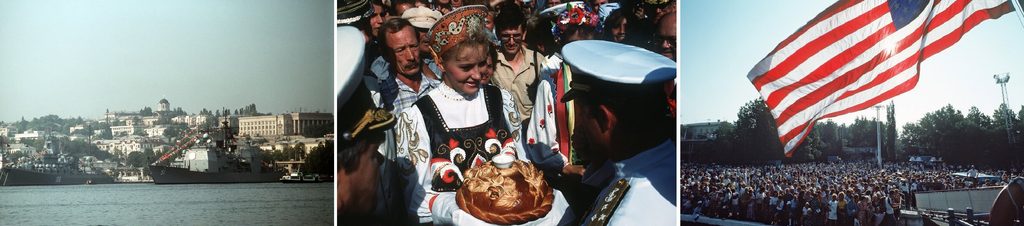
A key moment was the meeting in Sevastopol in August 1989, when American ships entered the Black Sea Fleet’s main base. This visit was more than a demonstration of friendship.
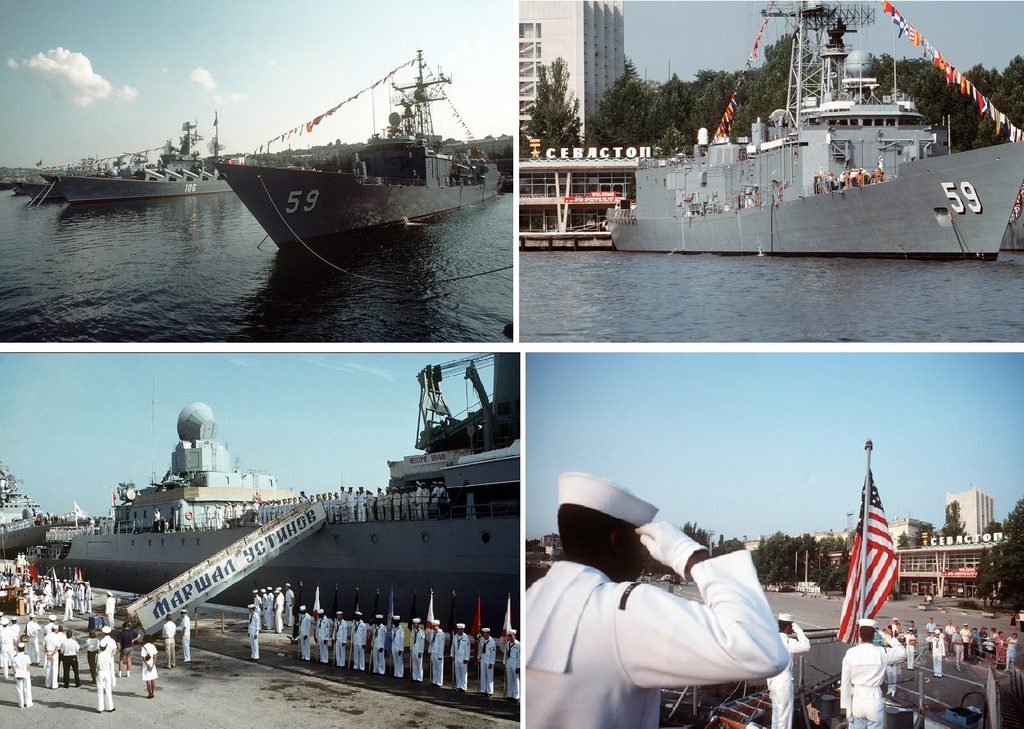
‘Gorbachev invited American military personnel into the closed, restricted-access city of Sevastopol and the Black Sea Fleet’s main naval base. Because Gorbachev and Reagan could not sign an agreement in Norfolk on the Soviet Union’s defeat in the Cold War.’
It was then that ‘acts of title’ were performed — acts sacred to the Vatican and international law that formally recorded the USSR’s capitulation.
‘Soviet citizens are under the American flag on the very territory of the Soviet Union and under their authority… This was the beginning of the Houston Project.’
How the Coup of 1991 Was Prepared
On 12 February 1990, a meeting of the Presidium of the USSR Supreme Soviet took place in the Kremlin, chaired by Gorbachev. In criminal violation of the Constitution, the members of the Presidium unanimously supported establishing the office of President of the USSR. As early as March 1990, this unconstitutional office was established at the extraordinary III Congress of People’s Deputies.
The Congress’s Decision No. 1360-I of 14 March 1990 was unlawful because the USSR Congress of People’s Deputies, which opened on 25 May 1989, was the highest legislative body but had no authority to amend the 1977 USSR Constitution. This was an act beyond its powers — the first step towards the coup of 1991.
For clarity: the 1977 USSR Constitution was the Fundamental Law (underpinned by the 1936 USSR Constitution), which could be amended only by a specially convened Constitutional Assembly or a nationwide referendum. The Congress of People’s Deputies, however high its status, had no such powers. Adopting a law on the presidency without a referendum is a direct violation of the constitutional order.
The Nationwide Referendum That Was Ignored
On 24 December 1990, the IV USSR Congress of People’s Deputies decided to hold a referendum on preserving the USSR.
On 17 March 1991, an All-Union referendum was held. USSR citizens were asked: ‘Do you consider it necessary to preserve the Union of Soviet Socialist Republics as a renewed federation of equal sovereign republics in which the human rights and freedoms of people of every nationality will be fully guaranteed?’
The people spoke unequivocally: of the 185,6 million citizens entitled to vote, 148,5 million (79,5 %) took part. Of these, 113,5 million (76,43 %) answered ‘Yes’ — in favour of preserving the USSR. In the RSFSR, the figure was 71,3 %; in the Ukrainian SSR, 70,2 %; in the Byelorussian SSR, 82,7 %; and in the Central Asian republics, more than 90 %.
The referendum results were formally recorded in USSR Supreme Soviet Resolution No. 2041−1 of 21 March 1991. The will of the people was expressed clearly and unequivocally: the USSR must be preserved.
The referendum results were recognised by the entire international community. Yet they became the principal target of the organisers of the coup of 1991. The will of the people was criminally ignored.
For clarity: a referendum is a direct expression of the people’s will. When its results are ignored, this means that government ceases to be government by the people. In the case of the USSR, the government did more than cease to represent the people — it became criminal.
Gorbachev’s Crimes: From Recognising the Baltic States to Transferring Nuclear Weapons
On 6 September 1991, the day after the V extraordinary USSR Congress of People’s Deputies ended, Gorbachev signed USSR State Council Resolutions No. ГС-1, No. ГС-2 and No. ГС-3 recognising the independence of Latvia, Lithuania and Estonia. This marked the beginning of the unlawful dismemberment of the USSR — a key episode in the coup of 1991.
On 25 December 1991, Gorbachev announced that he was ceasing to serve as president and signed Decree No. УП-3162 relinquishing his powers as Supreme Commander-in-Chief. He transferred control of strategic nuclear weapons to Yeltsin — a man who at that time had no constitutional right whatsoever to exercise such control. Before this, Gorbachev had reported his resignation and the transfer of the nuclear briefcase to Yeltsin to US President Bush in a telephone conversation. This was the final act of the coup of 1991.
For clarity: transferring nuclear weapons to a person without constitutional standing is more than a violation of the law: it is a crime against the security of the entire world. The nuclear briefcase must not be handed over with a report to a foreign president by telephone.
Gorbachev’s actions fall under several articles of the Criminal Code of the Russian Soviet Federative Socialist Republic (RSFSR): Article 64, point ‘а’ — treason against the Motherland (conspiracy to seize power); Article 170, part 2 — abuse of power; and Article 171 — exceeding one’s authority. All these crimes were committed as part of the coup of 1991.
240 Billion in Bonds: Who Financed the Coup
In 1991, alongside the dramatic events in Moscow and Crimea, a secret financial operation was conducted in the USA. Bonds worth 240 billion dollars in gold were issued in Gorbachev’s name — not petrodollars, but gold dollars specifically. The aim was to gain control of the Soviet Union and finance a coup d’état. This sum was part of a large-scale programme to destroy the USSR’s economy, which enabled the United States to finance the coup of 1991.
Instead of real money, these bonds were replaced with US Treasury tax certificates. From 1993 onwards, all citizens who acquired taxpayer status in the Russian Federation became holders of these certificates. This means that the coup of 1991 was paid for out of the future taxes of the very Soviet people who had been betrayed.
The Order That Never Was
Gorbachev’s Order No. РП-2611 of 21 September 1991, ‘On the Establishment of the Political Consultative Council under the President of the USSR’, deserves particular attention. Some legal scholars tried to present it as a replacement for the State Committee for the State of Emergency in the USSR (SCSE-USSR). But there is one problem: Gorbachev could not physically have signed this document. At that moment, he was in Foros, Crimea, and had effectively been removed from power by the SCSE-USSR. The order remained unsigned, unpromulgated and unpublished. Its registration number in the justice register — С199100744 — merely confirms that the document is listed in the register, but has no legal force. It is a forgery that people tried to pass off as a legitimate act. The coup of 1991 was not ‘replaced’ by this order — it simply continued by other means.
The Belovezha Agreement: A Legal Absurdity
On 8 December 1991, in Viskuli (Belovezhskaya Pushcha), Yeltsin, Kravchuk and Shushkevich signed an agreement establishing the CIS, which declared that the USSR had ceased to exist. They had no authority whatsoever to do so — either from the people or from the USSR’s government bodies. This was a direct violation of the 1977 USSR Constitution and Law No. 1409-I of 3 April 1990 on the Procedure for the Secession of Union Republics. The signatories committed acts displaying the elements of a serious crime: Article 61 of the Criminal Code of the Byelorussian SSR, Article 64 of the Criminal Code of the RSFSR and Article 56 of the Criminal Code of the Ukrainian SSR — treason against the Motherland and organising a conspiracy to seize state power unconstitutionally. It was here that the coup of 1991 took its final form.
From a legal standpoint, this agreement was void for several reasons:
First, it was signed contrary to the results of the All-Union referendum of 17 March 1991.
Second, one of the founding members of the USSR — the Transcaucasian Socialist Federative Soviet Republic (TSFSR) — was absent.
Third, the agreement was not ratified by the USSR Congress of People’s Deputies.
Under the 1977 USSR Constitution, where a law of a Union republic conflicts with an All-Union law, the USSR’s Fundamental Law applies. Termination of the Union Treaty falls within the competence of All-Union government bodies, rather than representatives of individual republics. The coup of 1991 became possible only because these rules were criminally ignored.
The Institution of Russian Federation Citizenship — for One Person
After the coup of 1991, the Institution of Russian Citizenship of the Russian Socialist Federative Soviet Republic was established. It was granted international registration. However, this institution was registered in the name of… one person — Boris Yeltsin, as the first and only citizen of the Russian Federation.
For clarity: this means that all other citizens of the Russian Federation received their status through Yeltsin. Their expression of will did not matter — everything was determined by one person’s signature, recorded in international registers.
Yeltsin’s expression of will was limited to a term of 30 years — from June 1989 to 2019. Since 2020, Law No. 62-ФЗ (Article 41.2) has explicitly stated that a person is not recognised as a citizen of the Russian Federation if they have already received their first Russian Federation passport. This is a vicious circle. It is now clear why so-called ‘Russian Federation citizenship’ is merely registration with a commercial entity, rather than a legal status. Among other things, the coup of 1991 also stole the people’s citizenship.
Law No. 2094: The Central Falsification
On 25 December 1991, Yeltsin signed RSFSR Law No. 2094, ‘On Changing the Name of the State’ — the RSFSR was renamed the Russian Federation.
This law contains a fatal legal error, because Boris Yeltsin signed it as President of the Russian Federation, yet at that moment he was President of the RSFSR! Such a document has no legal force. Yeltsin became president of the Russian Federation corporation only on 9 August 1996.
Furthermore, the resolution of the RSFSR Supreme Soviet cited in this law has not been found in the archives.
Why Gorbachev Is an Unconstitutional President
The office of President of the USSR was introduced in violation of every procedure. Gorbachev was not elected by popular vote — deputies voted for him, which contravenes the USSR Constitution. Introducing the office of president required an All-Union referendum. No such referendum was held.
For clarity: electing a president through deputies rather than the people makes him the appointee of a small group of individuals rather than a representative of the entire people. This violates the very essence of a democratic state.
The international justice system has placed on record that Gorbachev is an unconstitutional president. His office remains vacant to this day and cannot be filled by anyone, because a special period and emergency wartime legislation are in effect in the country.
Silence That Speaks Louder Than Words
On 30 August 2022, Gorbachev died. The Russian Federation — a former trading company — declined to organise a state funeral for the unconstitutional president. Almost no one paid attention to this, but in legal terms it means that the Russian Federation’s failure to raise any claims against Gorbachev constitutes an acknowledgement that all his decrees, including those that laid the foundations for the coup of 1991, are invalid. If they had legal force, the Russian Federation would be obliged to defend them. But it remained silent. And in law, silence constitutes acceptance of nullity.
The Outcome: A Coup d’État in the Legal Sphere
On 25 December 1991, B. N. Yeltsin committed falsification of a state document, an offence in public office. Power was usurped, and this is a serious crime against the state — a change to the constitutional order or a coup d’état.
The consequences of this coup:
- There are no citizens of the Russian Federation, because the Russian Federation was established unlawfully.
- All legislative acts and judicial decisions issued in the name of the Russian Federation since 25 December 1991 are void.
- We remain citizens of the USSR, because no one has undergone the legal procedure for renouncing Soviet citizenship.
Afterword: The Limitation Period Does Not Expire
All Gorbachev’s decrees — No. УП-2491 of 30 August 1991 (abolishing the Committee under the President of the USSR for Coordinating the Activities of Law Enforcement Agencies), No. УП-3162 of 25 December 1991 (relinquishing his powers as Supreme Commander-in-Chief), and the order of 21 September 1991, No. РП-2611 (establishing the Political Consultative Council under the President of the USSR) — are invalid.
Order No. РП-2611 is particularly noteworthy: Gorbachev could not physically have signed it, because he was in Foros, Crimea, at that moment and had been removed from power by the SCSE-USSR. This order is a forgery that some legal scholars tried to pass off as a replacement for the SCSE-USSR. It has no legal force.
No statute of limitations applies to the coup of 1991. The crimes committed by Gorbachev, Yeltsin and their accomplices are directed against the foundations of the USSR’s constitutional order and state power. They led to the greatest geopolitical catastrophe of the century. And every one of them will have to be answered for.
In Conclusion
The coup of 1991 is more than an episode in history. It is a continuing crime whose consequences we still feel today. Unconstitutional presidents, forged decrees and disregard for the will of the people are all links in the same chain. A chain that can be broken only through knowledge and truth.
The USSR did not ‘collapse’ — it was criminally seized. And those who carried out the coup of 1991 will sooner or later stand trial.
Basis: USSR State Committee for the State of Emergency (SCSE-USSR), Resolution No. Д/Н-009
TASS ADDRESS TO THE CITIZENS OF THE SOVIET UNION:
The coup of 1991 stole your country, your future and your right to call yourselves citizens of a great power. But it did not steal your memory. And it will not steal your right to the truth. Know your history. Do not let it be rewritten. Because those who do not remember the past are condemned to live in a counterfeit present.
IMPORTANT ANNOUNCEMENT: A remote People’s Referendum has been launched in Russia to restore the title and passport of a Citizen of the USSR. Read the details in the dedicated section: https://tass.news/category/ussr/vserossijskij-referendum/ and watch the full-length presentation on the SCSE-USSR channel: https://youtu.be/2IReAZalCaQ?si=iR9n33oYkWgcNBm3
We invite you to become part of our community! Register, share this information with your loved ones and help fill our new network with uplifting news, heartwarming stories, true knowledge and photographs.
Links to our resources:
The Soyuz Portal social network: https://social.governmentussr.com
The Sovetnik AI legal adviser: https://chat.governmentussr.com
USSR State Committee for the State of Emergency (SCSE-USSR) Education Centre: https://education.governmentussr.com
With respect for you and your work,
The Board of the Telegraph Agency of the Soviet Union
Information Service of the Telegraph Agency of the Soviet Union
Distributed through all communication channels throughout the Union Republics and Autonomous Territories of the USSR.
State platform for uniting citizens of the USSR
Join Russia’s largest Telegram community, TASS USSR: https://t.me/tassussr
Listen to the new Soviet radio station RED WAVE https://ussr-radio.com/live
Other articles on this topic: Yeltsin’s Decree No. 1400 and the Constitution of 1993: a coup d’état and a commercial code, USSR membership of the UN in 2025: why Yeltsin’s statement has been recognised as an international forgery, The autonomous non-profit organisation Russia — Land of Opportunity: the legal status of the former Russian Federation







