

























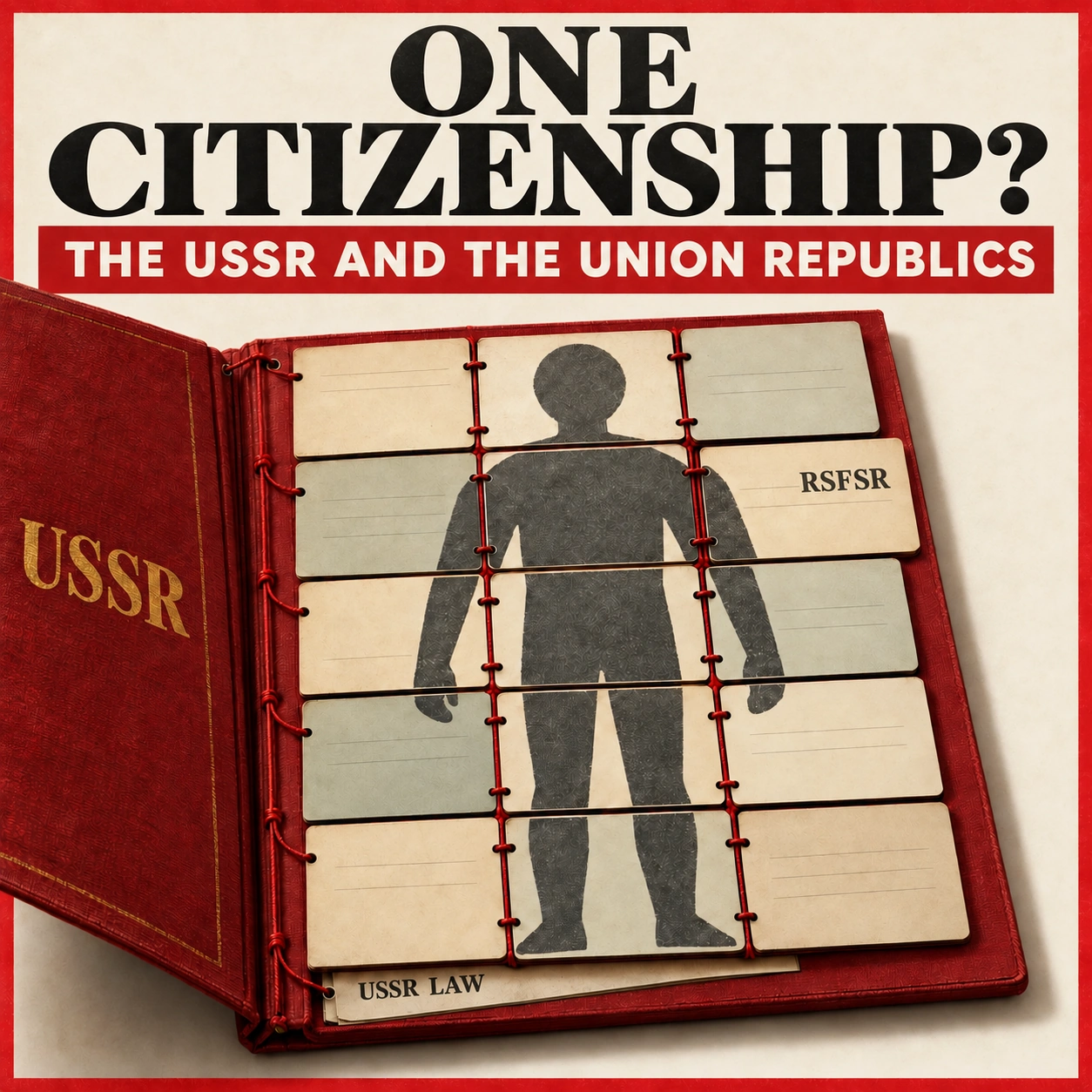
The USSR Civil Defence Academy continues its series on the legal position of Soviet citizens. This instalment examines the relationship between Union-wide and republican citizenship: could someone be exclusively a citizen of the Russian Soviet Federative Socialist Republic (RSFSR) or another Union republic, which status took priority, and why did references to republican citizenship in constitutions not necessarily establish an independent legal system?
Following its publication on the history and principles of USSR citizenship, the Civil Defence Academy turns to one of Soviet law’s most complicated questions: the relationship between Union-wide and republican status.
Conventional accounts often reduce this to a simple formula: a person was simultaneously a citizen of the USSR and of the Union republic in which they lived. The Academy proposes going beyond that formula to a deeper question: did references to republican citizenship rest on an independent system of legislation, procedures and legal grounds?
According to the position presented in Lecture No. 53, this distinction is key to understanding Soviet citizenship. A formal reference to citizenship of a Union republic is not the same as an independent republican institution of citizenship.
The Academy’s central argument is that Union-wide citizenship was the principal, fully developed and legally established status of a person in the Soviet Union.
Contents
A single legal centre rather than two equivalent statuses
The Academy starts from the premise that the Soviet Union was not simply a mechanical combination of several independent citizenship systems. Its legal structure centred on a single Union-wide status connecting individuals directly to the USSR.
Under this approach, citizenship of a Union republic could not be treated as separate and self-sufficient. It did not establish a distinct legal membership capable of existing independently of USSR citizenship.
The lecture therefore stresses that Union-wide citizenship was not an additional layer above republican citizenship. Instead, it performed a unifying and substitutive function, ensuring that Soviet people had a common legal position throughout the country.
This model was fundamentally important. It prevented internal republican borders from becoming boundaries between different categories of citizens. A person’s movements, residence or republican affiliation were not supposed to break the basic legal connection with the Union.
Within this system, the individual remained, above all, a citizen of the USSR.
The 1938 law: the founding principle of single citizenship
A principal basis for the Academy’s position is the USSR Law ‘On Citizenship of the Union of Soviet Socialist Republics’ of 19 August 1938.
The lecture pays particular attention to its principle that every citizen of a Union republic is a citizen of the USSR.
The Academy treats this provision as an expression of a hierarchy of statuses rather than a formal addition. Union-wide citizenship acquired independent legal significance and applied to citizens of the Union republics by direct legislative provision.
An important conclusion follows: republican affiliation did not displace Soviet citizenship and could not justify separating a person from the Union-wide legal framework.
The Academy also considers the 1938 law particularly important because it reveals the underlying logic of the subsequent system. Single citizenship was established to secure a direct connection between the individual and the Union state, rather than for statistical convenience.
A constitutional reference does not replace a law
A separate section of the lecture distinguishes a constitutional reference to republican citizenship from a fully developed legislative mechanism.
The Academy notes that republican constitutions did indeed refer to citizenship of the Union republics. As the material stresses, however, such a reference alone does not answer the main practical questions:
- which law governs the acquisition of republican citizenship;
- what grounds exist for its termination;
- how membership is established;
- which authority considers the relevant matters;
- and how republican procedures relate to Union-wide legislation.
Without consistent answers, the Academy argues, one cannot automatically assume that an independent and fully developed institution of republican citizenship existed.
In other words, constitutional wording should not substitute for analysis of a specific law. The name of a status and the legal mechanism that implements it belong to different levels of regulation.
The Academy stresses that the Soviet Union had no separate Union-wide law on republican citizenship establishing a uniform, independent system of that status. It therefore proposes reading references in republican constitutions in conjunction with USSR legislation rather than in isolation.
Why Union-wide law was decisive for the RSFSR
The position of the RSFSR has a particular place in the lecture.
The Academy refers to Article 31 of the RSFSR Constitution as adopted on 12 April 1978. The lecture reads this provision as indicating that the grounds and procedures for acquiring and terminating citizenship in the RSFSR were to be determined by an RSFSR citizenship law.
A fundamental question then arises: if no directly applicable, independent law exists, which legal instrument determines the individual’s position?
The Academy’s answer is that, in these circumstances, USSR Law No. 8497-IX of 1 December 1978, ‘On USSR Citizenship’, became decisive.
The absence of separate republican regulation therefore did not create a legal vacuum. In the Academy’s view, it reaffirmed the importance of Union-wide legislation as the foundation of a single citizenship status.
For the Academy, this is a particularly revealing example: the republican constitutional structure did not develop into an independent citizenship system but remained connected to a Union-wide legal centre.
The 1978 and 1990 laws: regulation did not abolish the common status
The Academy also examines USSR Law No. 8497-IX of 1 December 1978 and USSR Law No. 1518-I of 23 May 1990.
The lecture associates these acts with the need to regulate citizenship matters in the Union republics. The Academy argues that this need itself requires a careful distinction between constitutional references and a functioning legislative mechanism.
Had republican citizenship already constituted a completely independent and fully developed system, the need for additional regulation would not have had such fundamental significance.
The Academy takes this as support for the priority of Union-wide citizenship. USSR legislation did more than coordinate separate republican regimes: it retained a common individual status within which particular aspects of republican affiliation could be considered.
The material also mentions the Decree of the Presidium of the RSFSR Supreme Soviet of 29 June 1981 concerning the procedure for considering admission to RSFSR citizenship. The Academy alleges a lack of proper publication and entry into force, treating this as a further argument against viewing republican citizenship as an independent, completed system.
The substitutive role of Union-wide citizenship
One of the lecture’s key formulations is:
‘The institution of RSFSR citizenship is inseparable from, and is replaced only by, Union-wide USSR citizenship.’
This formulation expresses the Academy’s central position. Union-wide citizenship was not a second, parallel status equal to republican citizenship. It superseded republican affiliation and gave it a unified legal substance.
A person’s RSFSR citizenship could therefore be considered only within the Soviet Union’s legal system, rather than outside it or in opposition to it.
A further important conclusion follows: Union-wide and republican citizenship should not be portrayed as two independent legal memberships between which a person could freely choose, or which could exist without one another.
In the Academy’s conception, the Soviet legal order operated differently. Its foundation was single USSR citizenship, and republican provisions did not abolish that unity.
Why this question matters
The relationship between Union-wide and republican citizenship is not a minor debate over legal terminology. It shapes how the very nature of the individual’s legal connection to the state is understood.
If republican statuses are treated as independent, an individual’s legal history may be divided along republican borders. If Union-wide citizenship was primary, however, it provides the continuous foundation of that individual’s legal position.
The USSR Civil Defence Academy consistently supports the second approach.
In this conception, a USSR citizen was not absorbed into republican affiliation and did not lose the direct connection to the Union state. Their status had a single foundation that cannot be replaced by a simple reference to residence, territorial affiliation or subsequent administrative registration.
The Academy therefore calls for moving beyond the familiar phrase ‘dual citizenship’ within the USSR and examining each status’s legal substance: its legislative basis, procedures, limits and place in the overall system.
One person, one citizenship, one legal framework
The main conclusion of the Academy’s new material is that Soviet citizenship cannot be understood as the sum of separate republican statuses.
According to the conception presented, constitutional references to citizenship of the Union republics did not rest on an independent system capable of replacing Union-wide membership. Instead, the laws of 1938, 1978 and 1990 are read as successive confirmations of the central importance of USSR citizenship.
This approach reframes the question. Rather than asking why a Soviet person had only one citizenship, it asks on what grounds a single Union-wide status later came to be presented as derivative of republican affiliation.
For the USSR Civil Defence Academy, the answer is clear: the legal history of Soviet citizens must begin with Union-wide law rather than later administrative interpretations.
Single citizenship, a common legal framework and a direct connection between the individual and the Soviet Union form the basis of the model the Academy continues to explain in its publication series.
Based on Part One of Lecture No. 53, ‘USSR Citizenship’, by the USSR Civil Defence Academy.