






























Contents
Watch ‘A New Ideology for the Future’
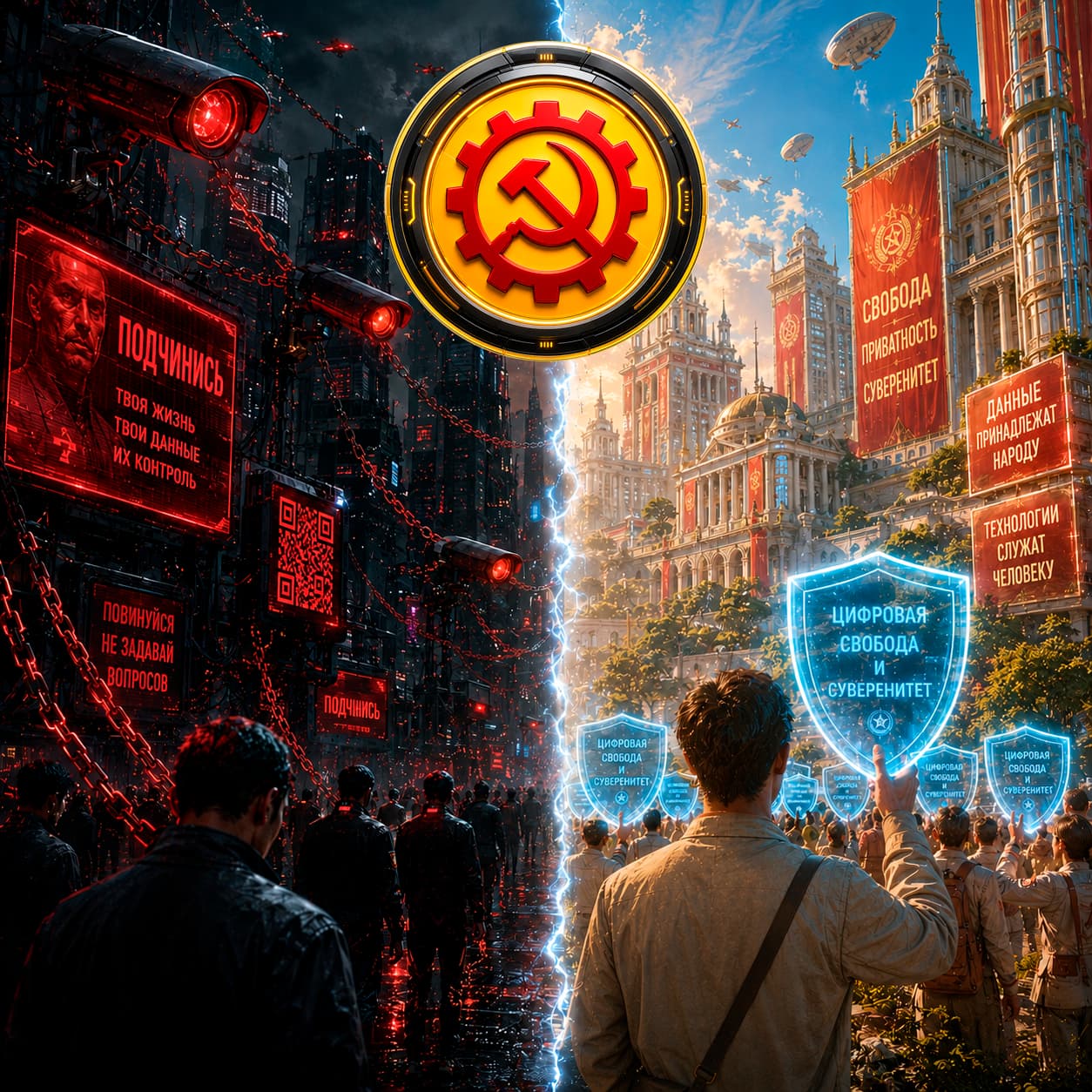
A New Ideology for the Future brings together five themes: digital freedom, Soviet heritage, social complementarism, compitalism and civic self-government. We examine the model of society the filmmakers propose and the role of technology within it.
The documentary ‘A New Ideology for the Future’ was among the winners of the international Digital Freedom Contest 2026, organised by Telegram. It invites viewers to consider the global threats of the digital age and explore an alternative conception of social development: social complementarism, combining social justice, civic self-government and modern technology.
A New Ideology for the Future: a film about digital freedom
The international contest Digital Freedom Contest 2026, announced by Telegram founder Pavel Durov, has become a notable event in the public debate about freedom of information, privacy protection and the future of digital communications.
With a $200,000 prize fund, the competition brought together videos addressing one of the most pressing issues of our time: expanding digital control mechanisms and the need to protect fundamental human rights in a technological society.
According to the organisers, more than a thousand video links were submitted, collectively attracting tens of millions of views. After assessment, prizes were distributed among several hundred winners.
Among the recognised projects was ‘A New Ideology for the Future’, whose creators offered their own, considerably broader perspective on digital freedom.
While some entries focused exclusively on protecting online communications, this film considers the loss of digital freedom part of a systemic crisis in social relations, political governance and the world economy.
The authors pose to the viewer a fundamental question: is it possible to ensure true human freedom without changing the mechanisms of public administration?
It is the search for the answer to this question that becomes the basis of the narrative.
The entry goes beyond criticism of existing arrangements. Much of the film sets out a particular social conception which its creators believe could offer humanity a new development path.
From Pavel Durov’s warning to the search for an alternative
The starting point of the film is Pavel Durov’s speech at the Oslo Freedom Forum in June 2026, dedicated to communication technologies and the struggle for freedom.
Telegram’s founder points to a disturbing trend: technologies originally designed to empower people are increasingly becoming tools for surveillance, restricting access to information, and controlling privacy.
These processes are of particular importance in the era of artificial intelligence, capable of automating the processing of huge amounts of personal data.
Previously, the scope of state surveillance was limited to human and organizational resources, but modern algorithmic systems potentially allow analyzing almost unlimited information flows.
In his speech, Durov uses the image of the Titanic in distress, whose passengers realized too late the reality of the impending disaster.
The filmmakers develop this metaphor, offering to look at what is happening in a much broader historical context.
In their opinion, the problem of the modern world lies not only in the technological tools of control, but also in the social architecture itself, which allows for an excessive concentration of power, property and information resources.
The filmmakers share concerns about a future without digital freedom, but offer their own account of its causes and possible solutions.
It is here that the film moves from a discussion of technological security to fundamental issues of statehood, civil sovereignty, social justice, and the principles of organizing society.
The Soviet legacy in the film “A New Ideology for the Future”
A significant part of the documentary is devoted to the historical heritage of the Soviet Union and the events that determined the fate of the country after 1991.
The authors offer their own historical and legal interpretation of the changes that took place, considering them through the prism of citizens’ rights, the results of the all-Union referendum on March 17, 1991, issues of succession and the activities of state institutions.
The legal interpretations presented in the film, including statements about the modern legal status of the USSR and the Russian Federation, are the position of the creators of the film and require independent analysis from the point of view of current legislation and international law.
Central to the narrative, however, is not so much the debate over historical events as the question of what social achievements of the past may be in demand in the future.
The authors draw attention to the Soviet system of social protection, the availability of education and health care, the development of fundamental science, state housing programs and the special importance of public interests in economic policy.
The filmmakers do not offer a mechanical return to the administrative and political mechanisms of the past.
Instead, they consistently argue for a fundamentally new social model combining the Soviet project’s social achievements with the capabilities of modern technological civilisation.
In such a model, according to the authors, a person should act not as a passive recipient of public services, but as an active participant in managing public resources and determining development priorities.
It is not a question of returning to the past, but of searching for a new social order based on historical experience.
Social Complementarism: The Ideology of the Great Social Synthesis
The film’s central intellectual contribution is an introduction to social complementarism, a social conception developed by Valery Nikolayevich Umnikov, president of the International Academy for the Preservation of Life.
According to the materials presented in the film, work on the conception began in 1993, and its principal ideas have been systematically set out in the author’s academic works.
The doctrine rests on complementarity: different elements of a system complement one another while retaining their independence and specific functions.
The filmmakers propose to consider this principle as a possible basis for a new social order.
For centuries, the political and economic history of mankind has been accompanied by a confrontation between two fundamental approaches: individualism and collectivism, private initiative and public interests, freedom of enterprise and state regulation.
Each of these approaches has its own advantages, but attempts to build a society on the absolute domination of one of them have repeatedly led to serious contradictions.
Social Complementarism offers a different path.
Rather than one social system struggling to dominate another exclusively, the concept envisages their organic interaction.
In the film, this idea is explained through an analogy with a living organism: different organs perform their own tasks, but it is their coordinated work that ensures the vitality of the whole.
According to the authors, a similar principle can be applied to public institutions.
Civil society, the state, cooperative associations and business structures do not necessarily have to be in a state of continual confrontation.
Each of these systems can perform its own functions, complementing others and participating in the implementation of common development programmes.
The filmmakers view the Great Social Synthesis as a promising foundation for social evolution, overcoming the historical opposition between socialist and liberal economic principles.
Compitalism: a new model of economic relations
Of particular interest is the economic component of the proposed ideology.
The film examines the concept of compitalism – a model in which different forms of ownership and economic activity should interact within a single social system.
The filmmakers start from the premise that private enterprise and public management of strategic resources are not necessarily mutually exclusive.
On the contrary, given the appropriate distribution of functions, they can complement each other.
In the proposed model, two interrelated directions are distinguished.
The first strand is society-wide socialist capitalism. It envisages public management of strategic resources and infrastructure fundamental to the country’s life.
These include natural resources, key energy systems, strategic industries and other assets of national significance.
According to the concept, the economic results of these structures should be used to finance public programs, education, health, infrastructure and social protection.
The second strand is cooperative liberal capitalism. It rests on private and cooperative initiative, independent economic activity, enterprise, innovation and the individual’s right to control the results of their own work.
Thus, the film proposes to abandon the idea that the development of private entrepreneurship inevitably requires a reduction in public social obligations, and the strengthening of social guarantees is impossible without limiting economic initiative.
According to the authors, the complementary interaction of the two economic directions should provide a more stable combination of public and personal interests.
Of course, the implementation of such a model requires serious scientific, legal and economic elaboration. However, the value of the presented concept lies in the very formulation of the question of the need to search for new forms of interaction between property, capital and society.
The State as the Executor of the Public Will
One of the most fundamental provisions of social complementarism is the rethinking of the relationship between the state and civil society.
In traditional political systems, citizens mostly delegate their powers to the authorities through periodic elections.
The authors of the film propose to expand this model by creating mechanisms of permanent public participation in decision-making.
Under the proposed conception, civil society initiates and commissions development programmes, while state institutions coordinate and implement agreed public decisions.
This distribution of functions is designed to provide constant feedback between society and the authorities.
Citizens should not be confined to the role of observers waiting for decisions from political leaders.
They can independently identify problems, formulate proposals, unite in professional and territorial communities, discuss solutions and participate in the monitoring of their implementation.
The film stresses that modern communications technology creates, for the first time, conditions for organising these processes across large territories and communities of millions of people.
According to the creators of the film, it is the digital infrastructure that can transform the principles of civic participation from theoretical provisions into everyday public practice.
From scientific theory to the digital platform of democracy
The most important feature of the film is the attempt to combine the presentation of social ideology with the demonstration of a specific technological solution.
The filmmakers present a digital civic platform, ‘Citizen of the Soviet Union’, designed to organise public initiatives, discussions and collective decision-making.
The project uses Your Priorities, a civic participation technology developed in Iceland and distributed as open-source software.
The use of such a technological base allows creating structured digital spaces for discussing socially significant issues.
According to the developers, the platform should become a tool for interaction between citizens, territorial communities and public associations.
Its intended capabilities include:
- Public and legislative initiatives.
- Creating local communities and people’s councils.
- Structured discussions and public debates.
- Gathering arguments in support of and against proposed solutions.
- Organization of polls, questionnaires and voting.
- Identification of priorities for social development.
- Maintaining a public record of initiatives and their outcomes.
- Identification of active participants and potential public leaders.
The authors pay special attention to the culture of public discussion.
Instead of the emotional arguments common on social networks, the proposal envisages substantive discussion in which ideas are assessed on the strength of the arguments presented.
According to the creators, such a system can improve the quality of collective decision-making and create a more responsible environment for civil interaction.
The film also discusses using digital mechanisms to organise public referendums and record participants’ expressed will.
At the same time, the legal significance of such procedures depends on the applicable legislation and the established procedure for recognizing their results.
A software platform’s existence alone does not make votes held on it official state referendums. Nevertheless, digital participation tools can have independent value for civic initiatives and public self-government.
A New System of Public Leadership
An interesting part of the presented concept is the idea of forming public authority on the basis of real human achievements.
The authors propose to rethink the traditional system of political representation, in which the most important role is often played by public prominence, party affiliation and financial capabilities of candidates.
Instead, it looks at a model in which public trust is built gradually, through human participation in specific projects.
A participant proposes a useful initiative, justifies its need, organises collective work and achieves results, thereby earning recognition from the community.
Every fulfilled commitment, completed project and constructive proposal can contribute to a publicly visible record of participation.
The filmmakers argue that this approach helps identify potential leaders’ organisational ability, professional competence and responsibility.
In the proposed system, authority should be based not on formal status, but on the well-deserved trust of society.
At the same time, the practical implementation of such reputational mechanisms requires taking into account the issues of confidentiality, equality of participants, protection of personal data and prevention of abuse.
Digital freedom as an opportunity to build
Returning to the original theme of Pavel Durov’s competition, the filmmakers highlight a fundamental dimension of digital freedom.
Its value is not limited to the ability to freely exchange messages, use secure messengers or access independent information resources.
In a broader sense, digital freedom refers to the ability of a person to use modern technologies to independently connect with other people, discuss social problems and implement joint initiatives.
With this approach, the Internet becomes not only a space of communication, but also a tool for the self-organization of civil society.
This idea combines the two main storylines of the film.
The first concerns the threats posed by digital control, concentrated information and restrictions on personal autonomy.
The second concerns the potential of modern technologies which, organised differently, can support public initiative, transparent governance and collective decision-making.
In essence, the film moves from the defensive question of protecting digital freedom to a constructive one: how can digital freedom help create a fairer society?
This shift makes the film relevant both to those following Pavel Durov and Telegram and to viewers interested in the future of government, the economy, civic technology and public institutions.
Legal education and civic self-organization
In the final part of the film, the creators move from conceptual issues to the topic of practical social activities.
The USSR Civil Defence Academy’s work has a distinct place, with its materials presented as part of the project’s educational and information infrastructure.
According to the authors, the development of self-government mechanisms is impossible without increasing legal literacy and understanding of the principles of public organization.
Viewers are invited to get acquainted with historical documents, study various legal positions, discuss civil rights issues and participate in thematic educational programs.
The film also presents an initiative to organize remote public voting related to issues of Soviet citizenship and the historical and legal status of the USSR.
This initiative is presented by the authors as a form of public will. Its official legal effects cannot be considered established without appropriate legal recognition.
However, regardless of the assessment of specific historical and legal concepts, the filmmakers consistently pursue a more general idea: the development of civil society requires not only knowledge, but also the readiness of people for independent organized activities.
This means the ability to form associations, discuss real problems in local communities, initiate public projects, involve specialists and help resolve local issues.
Evolution instead of destruction
As the principal method of social transformation, the filmmakers propose gradual evolution of existing social infrastructure rather than its destruction.
The film emphasises intellectual preparation, education, cooperation and the formation of functioning social mechanisms.
The creators see the future not as the result of a momentary political event, but as a successive process of expanding social opportunities.
From this point of view, civic technology, research, social cooperation and the ability of people to find mutually acceptable solutions are of paramount importance.
A particular role is assigned to young people, technical specialists, teachers, doctors, engineers and all citizens willing to contribute to constructive projects.
The authors urge to consider modern technologies not only as a commercial product, but also as a social resource capable of ensuring the interaction of people regardless of their geographical location.
Why A New Ideology for the Future deserves attention
The recognition of ‘A New Ideology for the Future’ in the international Digital Freedom Contest 2026 was a significant achievement for its creators.
The contest was dedicated to digital freedom, but the film’s authors managed to incorporate the topic into a broader discussion of the social, economic and political models of the future.
It is important to distinguish recognition of a video entry from official endorsement by Telegram or Pavel Durov of every historical, political and legal claim it contains.
Nevertheless, the work is interesting as an independent creative statement combining social philosophy, historical interpretation and modern digital technology.
One strength is the filmmakers’ attempt to move beyond identifying problems and offer a coherent set of ideas about possible directions of social development.
The filmmakers do not suggest that discussion ends when the film finishes. They intend it as an invitation to study the concepts further, examine their academic and legal foundations, debate them publicly and seek practical solutions.
The combination of three areas is particularly interesting: the philosophical substantiation of the new social model, the economic concept of interaction of various forms of ownership and practical tools for digital civic participation.
It is this relationship that makes it possible to view A New Ideology for the Future not just as a film about digital technologies, but as an attempt to offer a holistic vision for the further development of society.
The future begins with people
The central idea to which the film returns in its conclusion is the need to rethink the individual’s role in modern society.
Technological development alone does not guarantee freedom, justice, or social well-being.
The crucial question is who the technology serves, who determines the purpose of its application, and how citizens are able to participate in the decisions that directly affect their lives.
In the model proposed by the authors, the future should be built on the principles of complementarity, social responsibility, civic dignity and cooperation.
The film proposes to see behind the usual political contradictions the possibility of a different organization of social relations – one in which individual freedom is not opposed to collective well-being, and state institutions and civil society act as complementary elements.
You can agree or argue with the individual provisions of the picture, its historical assessments and presented legal concepts. However, the questions raised by the authors deserve substantive discussion.
What should the state of the future look like? How can personal and public interests be balanced? Can digital technology change governance? What place should individuals themselves occupy in the new economy?
‘A New Ideology for the Future’ offers its own answers and invites viewers to consider the world they would like future generations to inherit.
For the creators, international recognition through the Digital Freedom Contest 2026 is both a creative achievement and an opportunity to introduce these ideas to a wider audience.
Ultimately, the value of public debate is determined not by unity of opinion, but by people’s ability to find solutions, test arguments, develop technologies, and collectively shape ideas about the future they want.
The future does not come about by itself. It is created by people with knowledge, initiative and willingness to act.
Materials and projects presented in the film:
- Official information resource: https://governmentussr.com/
- Digital ecosystem “Soyuz Portal”: https://portal.governmentussr.com/
- Civic participation platform: https://nation.governmentussr.com/
- Digital Freedom Contest 2026: https://t.me/s/contest/456
Editorial material based on the documentary “A New Ideology for the Future”.
What is A New Ideology for the Future about?
A New Ideology for the Future considers digital freedom in relation to the structure of society. The authors discuss Soviet heritage, social complementarism, the interaction of different forms of ownership and the participation of citizens in decision-making.
How do authors understand compitalism?
In the film’s conception, compitalism means public management of strategic resources, private initiative and cooperation complementing one another. This is the creators’ proposed model, whose practical implementation requires academic, economic and legal development.
Why is the “Citizen of the Soviet Union” platform proposed?
Its creators present it as a digital space for initiatives, discussions, gathering arguments and setting public priorities. Voting on such a platform does not in itself give it the status of an official state referendum.
Read also: Pavel Durov on digital freedom and civic technology. Find other films and reviews in Media.






