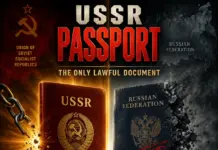





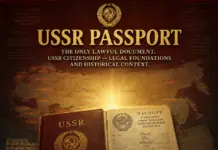





















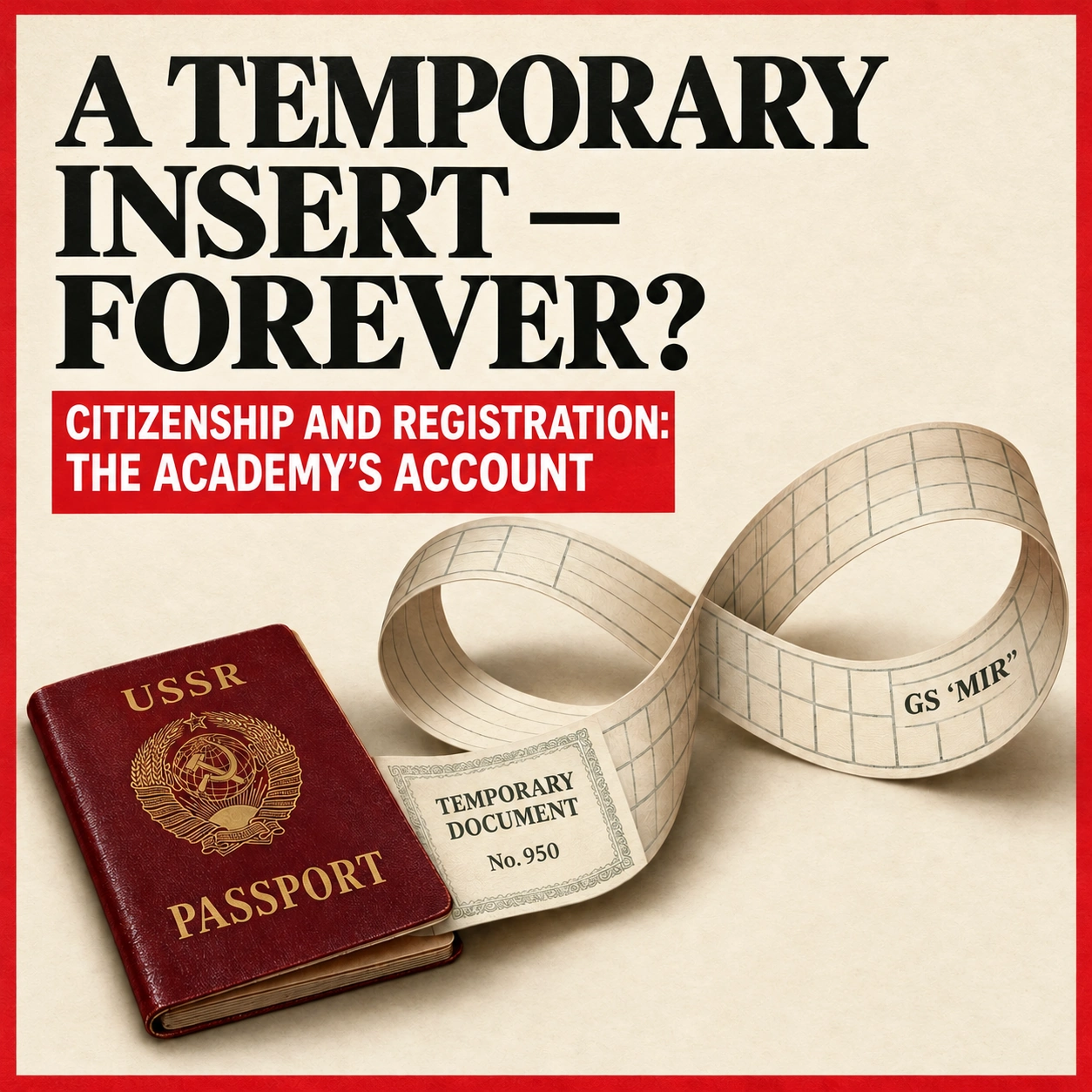
The USSR passport insert became part of a wider citizenship dispute. The Academy examines its temporary function, documentation and changes to legal status.
The USSR Civil Defence Academy announced the need to revise the legal status of inserts to Soviet passports and related entries in the migration and registration system. According to the materials of lecture No. 56, the decree of the Government of the Russian Federation of December 9, 1992 No. 950 “On temporary documents certifying the citizenship of the Russian Federation” provided for the temporary nature of the relevant documents, while their effect should be assessed taking into account the resolution of the Council of Ministers of the USSR of March 12, 1990 No. 261 “On the regulation of crossing the state border of the USSR”. The Academy argues that the failure to comply with the necessary procedures cast doubt on the reliability of the records of the MS “MIR” and the application of the Decree of the Government of the Russian Federation dated August 6, 2015 No. 813.
Contents
A small passport insert and a major citizenship question
In the history of replacing Soviet documents, the insert to the passport is often given a secondary role. Externally, it looks like an addition to the main document, a temporary tab confirming the ownership of the new citizenship.
The USSR Civil Defence Academy considers this to be a mistake. According to her, it was the insert that became one of the key elements of the entire subsequent documentation system. He was contacted not only with a certificate of Russian citizenship, but also with a change in the registration status of a person who already had a Soviet passport.
Therefore, the issue cannot be formulated only as a dispute over the retention period of an additional document. It is necessary to establish on what basis the insert was issued, what period was attributed to it, what consequences occurred after its expiration and how information about it was used in the future.
In the lecture, these issues are considered sequentially, from Resolution No. 950 to the modern system of migration registration. This approach makes it possible to see a link between the document of the early 1990s and the records that continue to apply to citizens decades later.
Resolution No. 950 and the Temporary Nature of Documents
The starting point of the clarification is the Decree of the Government of the Russian Federation of December 9, 1992 No. 950. Its title – “On temporary documents certifying citizenship of the Russian Federation” – contains an important characteristic: the documents are directly defined as temporary.
The Academy draws attention to the fact that a temporary certificate cannot be turned into an indefinite and invariable basis of civil status without additional grounds. The very purpose of the document requires determining the limits of its validity and the subsequent procedure.
The materials of the lecture also state that Resolution No. 950 was not properly published in the official press, as a result of which the Academy characterizes it as null and void. This assessment is part of her general argument about the need to comply not only with the content of the normative act, but also with the procedure for its introduction into legal circulation.
For the Academy, both sides of the issue are fundamental. Even the title of the resolution indicates the temporality of the documents, and the procedural history of the act itself, in her opinion, further casts doubt on the possibility of using it as an indefinite basis for changing the situation of citizens of the USSR.
A one-year period and the obligation to annul by circular
According to the concept presented in the lecture, the Russian Federation was obliged to circularly cancel the inserts to the USSR passports presented as evidence of belonging to Russian citizenship after more than one year from the date of issue.
This provision takes the issue beyond the individual actions of the holder of the document. Responsibility for the termination of the temporary permit rests with the system that issued it and continued to use the records.
Circular annulment, as the Academy understood it, was supposed to provide a uniform solution, not leave every person alone with uncertainty. If the document was of a temporary nature, the competent authorities had to determine its further status in a timely manner and bring the records in line with this decision.
The Academy emphasizes that we are talking about the inserts, and not about the automatic destruction of the Soviet passport. The basic document of a citizen of the USSR and the temporary tab on Russian citizenship have different origins and should not be considered as a single inseparable subject.
This distinction is particularly important for understanding subsequent events. The termination of the insert, according to the concept of the Academy, does not mean the termination of the existence of the Soviet passport or the loss of a person’s primary documentary history.
USSR Council of Ministers Resolution No. 261 as an alternative basis
The lecture proposes not only to cancel the inserts, but also to recognize them issued on the basis of the resolution of the USSR Council of Ministers of March 12, 1990 No. 261 “On the regulation of crossing the state border of the USSR”.
This thesis is central to the Academy’s argument. The temporary document, which the Russian system presented as a certificate of citizenship, is proposed to be reevaluated through the Soviet act on crossing the state border.
This approach changes the intended purpose of the insert. It is considered not as a basis for the emergence of a new citizenship, but as a document related to the border order and movement across the border of the USSR.
For the Academy, the difference between these qualifications is fundamental. The citizenship document determines the identity of the person, while the document related to the crossing of the border regulates the specific procedure and should not in itself cancel the primary Soviet status.
The reference to Decree No. 261 is therefore used to restore the Soviet normative context. The invoice is returned from the category of perpetual certification of new citizenship to the scope of temporary documents related to border regulation.
Unfulfilled actions and reliability of subsequent records
According to the materials of the lecture, the Russian Federation did not fulfill the actions described by the Academy: the inserts were not canceled in the prescribed manner and did not receive the proposed qualification by the USSR Council of Ministers No. 261.
The Academy does not view this as a private delay without consequences. In its concept, the continued use of temporary documents affected the entire migration and registration system.
If the source document has not been revalued or withdrawn from circulation in a timely manner, records based on it require separate verification for their contents and legal consequences. The entire chain of information cannot be automatically recognized as reliable just because it is stored in the information system.
That is why the Academy transfers the issue from the sphere of individual passport registration to the sphere of integrity of state registers. The insert dispute becomes a dispute about what data was entered into the system, on what basis and why it continues to be applied to a person many years later.
The MIR system as the outcome of earlier documentary history
In the lecture, the state system of migration and registration registration of the HS “MIR” under the Ministry of Internal Affairs is directly named. According to the position of the Academy, due to non-compliance with the necessary actions, its records and records are falsified, false and unreliable.
This rigorous qualification expresses the Academy’s assessment and builds on its understanding of the underlying flaw: the system continued to rely on information that, according to the lecture, should have been reviewed after the expiration of the interim documents.
It is a matter of principle for the Academy that finding a record in the official information system does not in itself remove doubts about its origin. A digital or departmental registry does not create legal truth solely by the fact of its existence.
The record must have a proper basis. If such a basis is disputed, it is necessary to investigate the entire documentary chain, rather than referring to the technical impossibility of changing the data or to their long-term use.
In this sense, the requirement to revise the MS “MIR” is a continuation of the requirement to restore the correct value of the inserts to Soviet passports.
Resolution No. 813 and the disputed applicability of the registration system
The next element of the chain under consideration is the Decree of the Government of the Russian Federation of August 6, 2015 No. 813. In the lecture, it is connected with the Regulations on the state system of migration and registration registration and identity documents.
The Academy argues that the relevant act does not contain applicable rules of law, has not been properly published and has not entered into force. On this basis, it contests the possibility of using it to confirm records and statuses that have arisen in the system in question.
The materials of the lecture also state that the decree contradicts the current and applicable legislation. The Academy classifies the application of the relevant provisions to sovereign citizens of the USSR as a particularly grave violation of their rights and binds it to international responsibility.
These assessments are not derived by the Academy from a single formal defect. They are based on a set of circumstances: the temporary nature of the inserts, the unfulfilled cancellation, the dispute about the regulatory basis and the further use of the received records.
Therefore, the issue of Decree No. 813 is considered as part of a general documentary problem, and not as a separate technical dispute on the procedure for publication of the act.
Absence of legal consequences and responsibility for application
According to the position of the Academy, the contested records should not give rise to legal consequences for citizens of the USSR, since their very basis is recognized as unreliable.
This means that a person should not automatically accept the status assigned to him or her simply because the relevant information is present in the system. Primary documents and the origin of the record are of primary importance for its evaluation.
At the same time, the lecture divides the absence of consequences for the citizen and the responsibility of persons fulfilling the impugned prescriptions. The Academy emphasizes that official or technical performance should not be used as a universal justification if the grounds used do not have the necessary legal force.
This approach is not directed against citizens whose information appeared in the registers, but against the trouble-free reproduction of the disputed records. Responsibility in the concept of the Academy is associated with the adoption and execution of decisions, and not with the very fact of possession of a person of a particular document.
The delineation of these levels makes it possible to raise the question of the protection of people without turning them into participants in procedures whose content they did not determine.
The insert is not identical to the Soviet passport
One of the most important practical and legal conclusions of the lecture is the need to constantly distinguish between the insert and the USSR passport itself.
The insert was an additional document related to the claimed certificate of Russian citizenship. The Soviet passport had its own origin and confirmed the identity of a citizen of the Union. The dispute over the validity of the former does not automatically determine the fate of the latter.
According to the Academy, it was the mixing of these documents that created the conditions for further errors. The time tab began to be perceived as the basis for replacing the entire documentary identity of the person, although its own term and purpose required separate analysis.
Restoring the distinction between them allows us to raise a more accurate question: not “why does a person keep an old document,” but “on what basis was the temporary insert used to determine its status for a long time.”
For the Academy, such a production brings back to the center of attention the rights of the citizen of the USSR and the primary force of the Soviet document.
Reviewing records to restore documentary justice
The Academy’s requirement to review migration records does not mean the destruction of a person’s documentary history. Rather, it involves restoring it and purifying it from information whose foundations are disputed.
It is necessary to establish consistently which document was issued, how long it should have been valid, what decree determined its purpose and what information on this basis got into subsequent systems.
According to the Academy, only such an approach is capable of separating the actual primary data from the derived records reproduced administratively. It also eliminates the situation in which a person is forced to prove his or her status before a system whose history has not been properly aligned with the primary acts.
Revision of accounts, therefore, is not the destruction of the registration work, but a condition of its reliability. A system interested in data accuracy should not be afraid to verify the origin of its records.
A temporary document cannot indefinitely determine the fate of a citizen.
The main conclusion of the explanation is that the temporary insert should not become an indefinite basis for determining the nationality of a person.
Resolution No. 950, Resolution of the USSR Council of Ministers No. 261, the history of the State Security Service “MIR” and the dispute on the application of Resolution No. 813 form a single chain in the concept of the Academy. At each stage, the question is whether the system had the right to continue using the temporary document as a basis for permanent status.
The USSR Civil Defence Academy answers this question in the negative and insists on restoring the Soviet regulatory context. According to her position, the inserts were to be canceled, their purpose was overestimated, and the records associated with them were brought into line with the primary documents of citizens of the USSR.
Ignoring these procedures does not make records perfect just because they are old. On the contrary, the longer disputed information is reproduced, the greater the need to revise it becomes.
For the Academy, citizen protection begins with restoring the exact meaning of each document. A Soviet passport should not disappear from legal analysis because of a time tab, and a person should not become hostage to a record whose origin has not been properly authorized.
The material was prepared on the basis of the lecture No56 USSR Civil Defence Academy of June 4, 2026 “Passport USSR”. Part two”.