




























Notarial identity certification in the Academy’s account: what a certificate of identity confirms and how it relates to documents and citizenship.
The USSR Civil Defence Academy presented an explanation of the documents that, in its opinion, were to be entered into the state information systems when registering Soviet citizens. In Lecture No. 56, a special place is occupied by a notarial certificate of identity, information about the reserve passport of the USSR and birth documents. The Academy claims that the relevant procedures were not carried out, and the prepared forms of Soviet passports with six-digit numbers were not transferred for issuance through the Ministry of Internal Affairs. At the same time, the five-digit number and Roman identification are called the appropriate format, and for citizens in the Union republics, the registration of a USSR passport of the 1974 sample with transfer through the Ministry of Foreign Affairs for delivery on demand.
Contents
Information system does not replace proof of identity
In modern administrative practice, the introduction of information into the information system is often perceived as the final stage of human documentation. After the appearance of the record, it begins to be used to verify the identity and confirm various statuses.
The USSR Civil Defence Academy considers it necessary to change the procedure of consideration of the issue. Before talking about the content of the record, it is necessary to establish what primary documents were presented, how the identity of the person was confirmed, and what information was generally subject to entry into the system.
A digital ledger can store and transmit data, but does not by itself confirm its origin. If the mandatory documents have not been drawn up or entered, the technical availability of the record does not eliminate the gap.
According to the position of the Academy, such a gap was formed in the documentation of citizens of the USSR. The lecture lists specific elements that should have been present in the state information system, but the relevant obligations have not been fulfilled.
This turns the topic from the technical issue of the number of forms into an independent problem of evidentiary completeness of registration.
Notarial Certificate of Identity
The first of these documents is a notarial certificate of identity of the Soviet person.
In the concept of the Academy, its purpose is to confirm that a specific living person is indeed the person whose documents are presented and whose information should be reflected in the registration system. It’s about connecting a person, a document and a record into a single chain of evidence.
The lecture separately indicates that the Soviet man allegedly was not represented by Russian citizens. Therefore, notarial confirmation acquires special importance: it was supposed to fix the identity of the person regardless of the alleged representation of the Russian statutory jurisdiction.
The Academy sees this requirement as a protection against replacing a person with a record of him. It is not enough to enter the name, date of birth and document number into the system. It is necessary to certify that the information presented relates specifically to the given Soviet citizen and does not create a separate registration person in his place.
Notarial certificate, therefore, is not an additional formality, but a mechanism for preserving the unity of a living person and his documentary history.
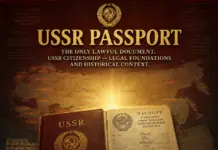
Birth certificate and reserve passport USSR
Along with the notarial certificate in the GIS, according to the materials of the lecture, the series and number of the reserve passport of the Soviet Union issued by the Russian Federation, as well as information about the birth certificate in the Russian Federation were to be entered.
This list shows that registration should not be limited to a single valid Russian passport. It included documents of different origin and purpose: confirmation of identity, primary birth document and reserve Soviet passport.
For the Academy, such a set is of fundamental importance. It does not make it possible to erase the distinction between a citizen of the USSR and a documentary form created within the Russian system. On the contrary, it was supposed to preserve the Soviet documentary outline and at the same time record the information necessary for the identification of a person.
The reserve passport in this design is not a random duplicate without an independent value. Its series and number were to be part of an official record, providing continuity between the primary documents and the subsequent identity card.
According to the position of the Academy, the absence of such information means incomplete registration and requires to consider the entire procedure anew, starting with mandatory documents.
The FMS obligation to issue a reserve passport
The lecture separately states that the USSR reserve passport was to be issued by the Federal Migration Service of the Russian Federation.
This puts the responsibility not on the citizen, but on the department that was supposed to ensure the documentary procedure. The Soviet people were not obliged to independently create the missing form or prove the necessity of its existence without access to the appropriate accounting mechanisms.
The Academy emphasizes that the obligation to issue a document and the obligation to enter its details into the GIS form two consecutive stages. First, a reserve passport must be issued, then its series and number are included in the information system together with a notarial confirmation of identity.
Violation of the first stage makes the second incomplete. If the agency has not issued a document, the citizen cannot fill the missing record with his own efforts. Therefore, the problem is seen by the Academy as institutional, not as the result of wrong actions of individuals.
The lecture states that the relevant norms regarding FMS were prepared, but their implementation was opposed by persons whom the lecturer figuratively calls “clear falcons”. For the Academy, this is an indication that the absence of the procedure cannot be explained solely by a lack of time or technical impossibility.
Prepared forms that were not issued through the Ministry of Internal Affairs
One of the most notable episodes of the lecture is the assertion that the Russian Federation printed the forms of passports of the Soviet Union, but never issued them to the Interior Ministry.
This fact has a special evidentiary significance for the Academy. The preparation of the forms itself is considered as evidence that the possibility of continuing the Soviet documentation was envisaged and was not technically impossible.
However, printing forms does not equal issuing passports to citizens. Between the production of a documentary form and its delivery to a person are the transfer to the competent authority, registration, registration and entry of information into accounting systems.
According to the materials of the lecture, this process was not completed. The prepared forms did not reach the stage of issuance through the Ministry of Internal Affairs, and the envisaged procedure remained unimplemented.
The Academy draws attention to the fact that in such a situation it is impossible to shift the consequences to citizens. The absence of a person with a reserve Soviet passport should not be interpreted as his refusal of the document, if the system itself did not ensure the transfer and issuance of prepared forms.
Five-digit and six-digit numbers: more than a technical detail
The lecture emphasizes the distinction between the six-digit numbers of the prepared forms and the five-digit number that should have been used for proper design.
The Academy does not regard the number of digits as a minor feature of printing. The document number is part of its identification and connects the form with a specific registration system. Therefore, a discrepancy in format may indicate a difference between the manufactured printing products and the document prepared for legal issuance.
The six-digit number in the submitted materials is associated with forms that have not been submitted for issuance. The five-digit number, on the contrary, is called the necessary requisite of the reserve passport of the USSR, which was obliged to issue the FMS.
Thus, the question of the number becomes a way to distinguish the very fact of printing forms from a full-fledged passport procedure. The presence of a series, number and printed form does not prove that the document has passed all the necessary stages and was lawfully put into circulation.
For the Academy, this is another confirmation of the need to analyze not the appearance of the document, but the entire system of its registration.
Roman-law identity as a mandatory attribute
An additional requirement in the lecture is called Roman identification. It is specified that Roman numerals should stand as an identifier.
This provision complements the distinction between five-digit and six-digit numbers. A proper reserve passport should not have an arbitrary set of details, but a certain system of designations that allowed it to be included in the Soviet documentary circuit.
According to the position of the Academy, the Roman identification has an independent meaning and cannot be replaced without consequences by another numbering. It is one of the signs that the document is designed as a Soviet passport, and not as a form, only outwardly reproducing its name.
In combination with a notarial certificate of identity and birth information, these details form a succession verification system. The person, document and number should correspond to each other, and the entry in the GIS should reflect the entire necessary set of information.
Ignoring individual identifiers breaks this link and turns a passport history into a collection of disparate data.
USSR passport of 1974 for citizens in the Union Republics
A special block of the lecture is devoted to the Union republics and statutory jurisdictions that have switched to the non-Soviet system of civil status acts.
According to the materials presented, a citizen of the USSR in such conditions was subject to registration of a general civil passport of the USSR of the sample of 1974. The document was then to be submitted to the Ministry of Foreign Affairs of the Russian Federation for notification and delivery to the citizen on demand.
This procedure has several important features. First, it preserves the very possibility of obtaining a Soviet passport, regardless of the transition of the republican system to other forms of acts of civil status. Secondly, it provides for a special channel for the transfer of the document through the Ministry of Foreign Affairs. Thirdly, the delivery on demand makes the receipt of the document dependent on the appeal of the citizen, and not on its automatic inclusion in the republican system.
For the Academy, this means that a change in the form of republican documentation should not leave a Soviet person without his own identity card. The existence of the special procedure confirms the need to maintain its separate status.
The Ministry of Foreign Affairs in this design does not perform the function of creating a new citizenship, but the role of a transfer link that provides notification and delivery of the already provided document.
The right to claim a document: it awaits the citizen rather than disappearing
The formula “on demand” has an important substantive value in the concept of the Academy. It assumes that the document should be prepared and stored for transfer to the citizen at his request.
This procedure is different from the irrevocable termination of passport registration. Even if the person did not receive the document immediately, the procedure itself provides for the possibility of subsequent delivery.
The Academy emphasizes that the responsibility for the safety and availability of such a mechanism lies with the institutions involved in the transfer. A citizen should not prove his right to the document again just because the relevant procedure was not communicated to him in a timely manner.
Notification, therefore, becomes no less important element than the production of a passport. If a person does not know about the prepared document and the procedure for its receipt, the right to demand remains unrealized.
This is in line with the general requirement of the Academy for openness of documentary procedures: the citizen must be informed of the existence of his documents and the method of obtaining them.
Registration should confirm identity rather than separate the individual from the document
All the elements of the presented scheme are aimed at solving one task – to prevent a gap between a living person, his primary documents and the record in the information system.
Notarial certificate confirms the identity of the person. The birth certificate provides the primary information. The USSR Reserve Passport ensures the continuity of the Soviet documentary status. The five-digit number and the Roman identification determine the proper details. The Ministry of Foreign Affairs and the demand mechanism provide for the transfer of the document to citizens in the Union republics.
According to the Academy, the exclusion of any of these links leads to incomplete registration. As a result, the information system may contain information about the person, but does not reflect all the necessary evidentiary basis of his status.
That is why the Academy does not agree to consider the issue closed only because the citizen received some other passport. It is necessary to establish whether the stipulated Soviet procedure was carried out and which documents remained unclaimed or unissued.
Restoring missing links in the documentary chain
The explanation presented in the lecture sets a specific program of analysis. It is necessary to find out not only the content of the current record, but also the presence of notarial confirmation of the identity, registration of a reserve passport, the correctness of its details and the performance of the duties of the FMS, the Ministry of Internal Affairs and the Ministry of Foreign Affairs.
This approach returns responsibility to the institutions that should have provided documentation. The citizen should not remain the only party obliged to eliminate the consequences of the unfinished procedure.
For the USSR Civil Defence Academy, the restoration of these links is part of the defense of the Soviet man. It allows you to separate the actual identity from the incomplete electronic record and restore the continuity of documents regardless of subsequent changes in the republican systems.
According to the concept of the Academy, the state information system should reflect the complete set of information, and not replace it with simplified identification. Prepared but unissued forms, inappropriate numbers and lack of notarial confirmation cannot be considered minor details.
The main conclusion of the lecture is that the documentary record has power only in connection with a person and properly executed evidence. A Soviet citizen should not disappear for incomplete registration, and his right to a document should not be lost due to the fact that the competent structures have not completed the prescribed actions.
The material was prepared on the basis of the lecture No56 USSR Civil Defence Academy of June 4, 2026 “Passport USSR”. Part two”.