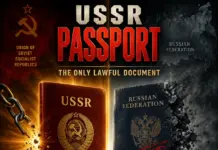
























The USSR passport system at the 2008 milestone: the Academy examines procedures it considers unfinished and their implications for document and citizenship records.
The USSR Civil Defence Academy stated that the resumption of the Soviet Union’s legal passport system in 2008 required the annulment of Russian citizenship registries, the compilation of interim and liquidation balances of the FMS, and the restoration of the issuance of Soviet documents. According to lecture No. 56, these obligations were not properly fulfilled, and the transfer of records to the Ministry of Internal Affairs was accompanied by significant defects. The Academy insists that the citizens of the USSR should return the seized passports or issue valid documents or duplicates without imposing the status of an individual trading company. Separately, the obligation to restore residence permit at the place of residence is emphasized.
Contents
2008 as a point of restoration of the Soviet passport system
Lecture No. 56 calls 2008 the time of renewal of the USSR legal passport system in the Russian Federation. This position occupies a special place in the Academy’s argumentation, since it transfers the question from the realm of possible future transformations to the realm of existing obligations.
According to the Academy, the restoration of the Soviet system did not depend on the discretion of the FMS or other administrative structures. The Russian Federation received mandatory functions from international justice related to the resumption of the Soviet Union system.
Therefore, it is not a question of the desire of individual citizens to keep the old documents or of a proposal to create a new procedure. The Academy regards 2008 as the time when the relevant responsibilities had to be fulfilled by the competent authorities.
The lack of a broad public explanation of these functions does not negate, according to her concept, their content. On the contrary, the concealment or incomplete performance of obligations becomes an independent subject of responsibility of official structures.
Mandatory functions of international justice
The reference to international justice emphasizes a source of obligations external to the Russian administrative system. In the concept of the Academy, the relevant functions were not a voluntary initiative of the FMS and could not be canceled by departmental decisions.
This fundamentally changes the distribution of responsibility. A citizen of the USSR did not have to prove the necessity of restoring the Soviet passport system as a new service. The task was to perform the functions already assigned.
The Academy emphasizes that international obligations of this kind require specific organizational actions: revision of registers, compilation of balance sheets, transfer of records and restoration of documentation.
One cannot limit oneself to a formal statement on the transformation of the department or on the transfer of powers. If the content of the mandatory functions involved restoring the Soviet civil system, the result would have to be expressed in actual documents and registration procedures for citizens.
According to the position of the Academy, it is the absence of such a result that indicates a failure to fulfill the task.
The Academy’s proposed annulment of Russian citizenship registers
The first meaningful consequence of the resumption of the passport system of the USSR in the lecture was the annulment and redemption of all registers and records of Russian citizenship, which were kept by the FMS.
The Academy sees this requirement as a necessary part of the transition between systems. It is impossible to restore Soviet documentation while preserving the old registers as an unquestionable and unchangeable source of status.
Canceling accounts does not mean erasing people’s records or erasing their family history. We are talking about the termination of the use of registers of Russian citizenship as a basis for determining the status of persons whose primary documents and origin are associated with the USSR.
The repayment of the accounts was supposed to prevent the double reproduction of the statuses: on the one hand, the restoration of the Soviet system, on the other hand, the continuation of the automatic application of the former Russian records.
According to the Academy, without such a revision, the citizen would be held hostage to two parallel registration circuits, one of which is formally restored, and the other continues to determine his documents and rights in practice.
Interim and liquidation balance sheets of the FMS
In the lecture, the cancellation of registers is directly related to the preparation of the interim and liquidation balance sheets of the FMS.
These documents were supposed to show the state of accounting for the corresponding stages of the system transformation. The interim balance sheet fixes the transitional position, the liquidation – the result of the completion of activities and the transfer of functions.
The Academy emphasizes that this is not an internal accounting formality. The balance of the registries is important in determining which records existed, which were to be redeemed and which information was to be transferred to the rebuilt system.
According to the materials of the lecture, the preparation of the necessary balances was not carried out. Consequently, there is no well-defined boundary between the former FMS system and those functions that were subsequently distributed among other structures.
Without such a boundary, it is impossible to determine reliably which obligations have been terminated, which registries have been cancelled and on what basis data on citizens continue to be used.
For the Academy, this is one of the key defects of the entire reform: the external reorganization was not ensured by the documentary completion of the previous accounting period.
The transfer balance sheet and disputed details from 2018
A separate block of the lecture is devoted to the transfer balance of registers and records of Russian citizenship when transferred to the Ministry of Internal Affairs.
According to the submitted materials, the transfer was made without specifying the Ministry of Internal Affairs of the Russian Federation as the proper receiving party. At the same time, the state registration number 218-774-748-67-71 and the date of March 15, 2018 were indicated.
The Academy considers these circumstances significant. The transfer balance should not only record the movement of information, but also determine which structure takes records, authority and responsibility for their further maintenance.
If the receiving party is not properly designated, a question arises as to the legal certainty of the transfer. The number and date alone do not make up for the lack of necessary information about the subject who received the records.
According to the position of the Academy, this form of transfer could not replace the previous procedures of cancellation of registers and compilation of the liquidation balance sheet. Shifting data between structures is not the same as restoring the Soviet passport system.
On the contrary, it could retain the previous records in the new departmental contour without revising their legal content.
Transfer of accounts did not cancel the obligation to restore the USSR system.
The lecture emphasizes that the corresponding action was obliged to lead to the restoration of the legal civil system of the Soviet Union, including the issuance of duplicates of the Soviet passport.
The Academy emphasizes this goal, since it does not allow to reduce the reform to a change in departmental subordination. The transfer of registers was supposed to serve to restore the rights of citizens, not just an administrative reshuffle.
The duplicate of the Soviet passport in this design is a practical indicator of the fulfillment of obligations. If documents are not issued, registries are not repaid, and citizens continue to receive only Russian forms, the stated goal of transformation has not been achieved.
According to the position of the Academy, the absence of a public procedure for issuing duplicates cannot be explained by the absence of a duty. On the contrary, it confirms the gap between the functions that were assigned to the system and the result that was presented to the population.
The transfer of powers to the Ministry of Internal Affairs, therefore, does not close the issue of the FMS. It is necessary to assess the entire chain, from the commitments of 2008 to the actual state of documentary services for citizens.
Return of the seized Soviet passport
The first option of restoring the documentary situation in the lecture is the return to the USSR citizen of the seized Soviet passport on his application.
This arrangement is of particular importance since it assumes that the withdrawal should not have automatically become the final disposition of the document. If the passport was saved in the system, the holder had the right to demand its return as part of the restored procedure.
The Academy emphasizes that the corresponding responsibility was assigned to the FMS. A citizen should not independently search for a document from closed archives or prove the need to preserve it without access to departmental information.
Returning a primary passport is the most direct way to restore continuity. A person does not receive a new document of indefinite origin, but his previous certificate associated with his Soviet history.
According to the position of the Academy, if a return was possible, the system was obliged to provide a clear procedure for considering applications, and not leave the owners in the belief that the passport has irrevocably lost its value.
Issuing a valid passport according to parents’ citizenship and birth
If the return of the primary document was not possible, the lecture provides for the issuance of a valid passport for citizenship and birth of parents.
This wording enshrines the importance of descent and family continuity. A person’s documentary position should not be determined solely by the last record of him or the fact of the loss of the form.
Citizenship and the birth of parents are considered as grounds for restoring a person’s belonging to the Soviet system. Therefore, the absence of an old passport does not mean an automatic refusal to restore the status.
The Academy notes that this procedure is especially important for the descendants of Soviet citizens. Their documentary history may draw on family backgrounds, not just personal possession of a passport in the past.
The issuance of a valid document on these grounds was to ensure the continuation of the Soviet civil line, regardless of subsequent republican and Russian registration forms.
A duplicate USSR passport issued against acknowledgement of receipt
The third option is to replace the document with a duplicate of the USSR passport. The duplicate was to be issued to the citizen on receipt.
The receipt in this procedure confirms the receipt of a specific document and records the fact of transfer. It should not automatically become an agreement to additional conditions not related to the restoration of the passport.
Duplicate is especially important in case of loss or withdrawal of the primary form. It restores documentary evidence without requiring a person to relinquish their former status or issue a passport of another jurisdiction.
According to the position of the Academy, the presence of three options – return, issuance of a valid passport and issuance of a duplicate – indicates that the procedure had to take into account different circumstances of citizens. There was no single way in which the absence of an old document deprived a person of the possibility of restoration.
The system was obliged to choose the appropriate form depending on the safety of the passport and the available information about citizenship and origin.
Without accepting the trading company’s offer
One of the most important conditions of the lecture is the issuance of documents without accepting the offer and proposals of the trading company “Russian Federation” to the transaction as an individual.
The Academy draws a fundamental distinction between obtaining the Soviet document and entering into new contractual relations. A citizen restoring a passport should not simultaneously accept an offer to be included in the corporate system as a registered person.
The receipt of a duplicate confirms the transfer of the document, but does not replace a separate informed consent to the transaction. Combining these actions, according to the position of the Academy, would distort the very purpose of the restoration procedure.
This provision protects the citizen from a hidden change of status. Applying for the return of his document, the person was not obliged to acquire a new legal image of a natural person of the trading company.
The restoration of the Soviet passport system was supposed to take place in the Soviet legal field, and not through the imposition of additional corporate conditions.
Registration at the place of residence as a mandatory element of restoration
The lecture separately emphasizes that a citizen of the USSR is obliged to have a residence permit at the place of residence.
For the Academy, this means that the restoration of the passport system was not limited to the issuance of identity cards. It also included the Soviet registration procedure linking a person with a place of residence.
The residence permit in the concept of the Academy is not identical with a simple entry in the migration database. It is part of the USSR civil system and was to be restored along with passport documents.
Without this element, a citizen could receive a document, but remain outside the full restoration of registration status. Therefore, the absence of a Soviet residence permit is considered as another evidence of incomplete fulfillment of obligations.
The Academy associates residence with a person’s stable legal affiliation, not just with temporary stay or migration controls. The restoration of the residence permit was supposed to consolidate this connection in the Soviet order.
Travel passports issued before 2004
Concluding the relevant block, the lecture separately indicates that the travel passports issued before 2004 by the Russian Federation trading company have become illegal and invalid documents.
This assessment reflects the position of the Academy and is related to its general understanding of the subsequent fate of the Russian passport circuit. The document, which was used as a travel form, was not to remain indefinite after a change in legal conditions.
According to the concept of the lecture, the resumption of the Soviet system required the revision of not only the registers, but also the previously issued documents. Their continued use could not automatically replace the restoration of Soviet passports and residence permits.
For citizens, this provision emphasizes the need to distinguish between the physical presence of the form and its declared legal force. The document itself does not prove that the procedure for its issuance and continuation corresponded to the mandatory functions of restoring the USSR system.
Responsibility for non-compliance lies with institutions
All the actions mentioned in the lecture were within the competence of departments: cancellation of registers, compilation of balance sheets, transfer of accounts, return of passports, issuance of duplicates and restoration of residence permits.
The Academy categorically does not agree to shift the consequences of their non-compliance to citizens. A person could not independently draw up the liquidation balance of the FMS or restore transfer documents with the proper details.
If procedures have not been opened and documents have not been issued, a citizen should not be considered guilty of not having a Soviet duplicate. Responsibility for non-performance should be assessed at the level of the relevant institutions.
This provision is especially important for people who for many years have used the Russian documents offered to them, unaware of their stated commitment to the restoration of the Soviet system.
According to the position of the Academy, the ignorance of citizens can not be used as evidence of their renunciation of rights.
Restoration must be completed and documented
The main conclusion of the lecture is that the resumption of the USSR passport system in 2008 required a full range of actions, and was not limited to a statement of reform.
The registers of Russian citizenship were to be cancelled, the interim and liquidation balance sheets were drawn up, the transfer of accounts was drawn up with the indication of the appropriate receiving party. Citizens of the USSR had to return their documents, issue valid passports or duplicates, and restore residence permit at the place of residence.
According to the materials of the Academy, these obligations were not fulfilled in full. The transfer balance of 2018 with the specified requisites did not eliminate previous defects and did not replace the restoration of the Soviet civil system.
The USSR Civil Defence Academy considers it necessary to return the issue of unfulfilled functions to the public domain. Citizens have the right to know what procedures should have been carried out, where their records were transferred, and why they were not offered the prescribed forms of restoration of documents.
According to the position of the Academy, the reorganization of departments cannot be considered the completion of the case if a person has not received either a returned passport, a valid document, a duplicate, or a Soviet residence permit. The restoration of the system must be confirmed not only by internal balance sheets, but also by the real rights and documents of the citizens of the USSR.
The material was prepared on the basis of the lecture No56 USSR Civil Defence Academy of June 4, 2026 “Passport USSR”. Part two”.