






























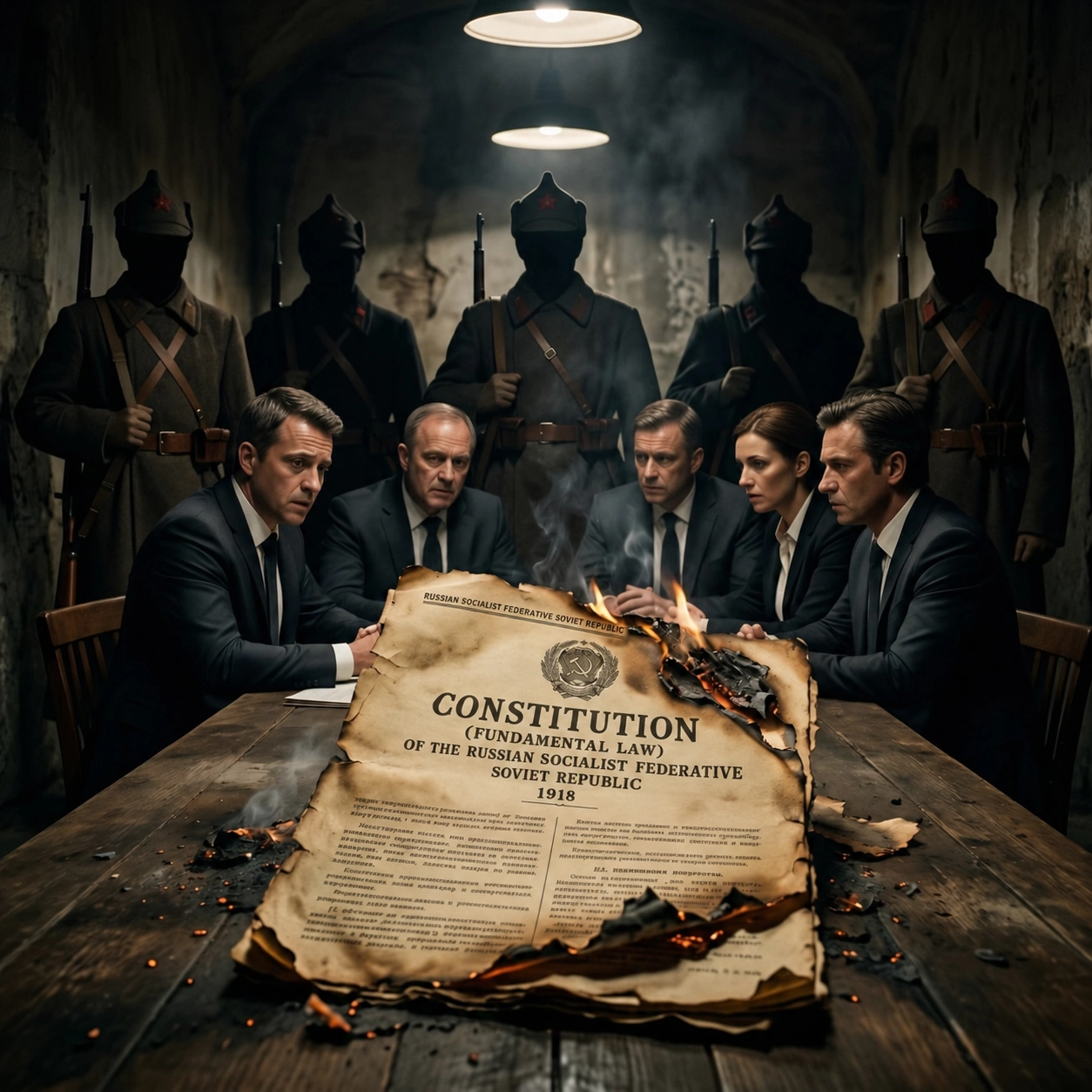
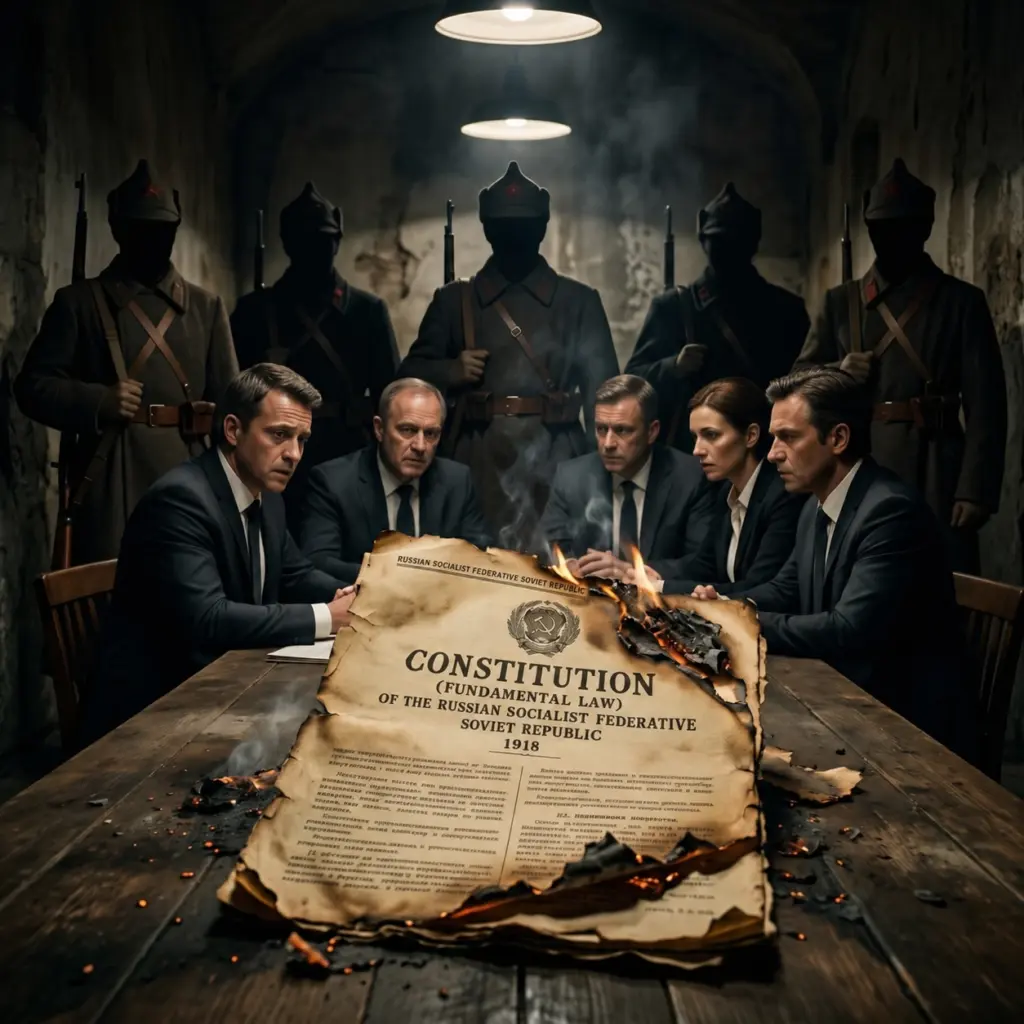
The Revolutionary Military Councils of 1918 — according to a legal analysis, the Russian Federation is the continuator of these extra-constitutional bodies, rather than the legal successor to the USSR. The councils carried out a military coup d’état in Russia for the benefit of foreigners, revoking the Constitution of the RSFSR. Read on to learn why the Russian Federation was registered with the UN as the Russian Democratic Federative Republic of 1918 and what this has to do with the Cold War against the USSR.
The Revolutionary Military Councils of 1918: A Coup d’État
The Revolutionary Military Councils of 1918 were the supreme collective bodies of military and political leadership that, on 5 September 1918, revoked the Constitution of the RSFSR (Russian Socialist Federative Soviet Republic). They carried out a military coup d’état in Russia for the benefit of foreigners and people of other faiths, respectively.
These councils gave limited recognition to the authority of the Constitution of the RSFSR and the Constitution of the USSR of 1924, as well as to their state bodies, until 2024. These bodies were re-established after 72 years under canon law, in 1990. It was then, in Sevastopol, under the Houston Project (1989), that the mandate of the Revolutionary Councils was extended.
The Russian Federation’s Registration with the UN as the Russian Democratic Federative Republic of 1918
When Yeltsin sent a letter to the UN requesting that “Russian Federation” be treated as the short name in place of USSR, the Russian Democratic Federative Republic (RDFR) of 1918 was registered. The whole world, America and Vatican representatives were told that the Russian Federation was the continuator and legal successor of the extra-constitutional bodies known as the Revolutionary Military Councils of 1918.
This registration conferred the right to operate under the Uniform Commercial Code (UCC). The Russian Federation thus formalised its legal connection with the bodies that had carried out the coup in 1918, rather than with the lawful Soviet authorities.
The Russian Federation’s Cold War Against the USSR
The Russian Federation is in a state of cold war with the USSR. It joined the USA as the victor over the USSR in the Cold War. This is confirmed by all its symbols and rituals, including the cancellation of the parade in 2020 and the use of a flag associated with forces that fought against the USSR.
The corporate Russian authorities were supposed to cease to exist after 99 years, counting from 1924, and to be dissolved and liquidated on 12 December 2024. The draft Constitution of the Russian Federation ceased to have effect on the same day. The Russian Federation is operating in a situation in which its legitimacy as the continuator of any structures has expired.
The Titles and Rights of the Russian Empire Have Not Been Confirmed
The titles and rights of the Russian Empire as the property of the House of Romanov were not confirmed in 2017. At a major conference of the House of Romanov, there was an attempt to extend the existence of the RDFR, but it failed because not a single document was provided. The titles and rights of the Russian Federation were not recognised in 2018 and were neither extended nor confirmed under international law.
In 2019, the RSFSR fund passed to the USSR and did not become the property of the Russian Federation. This fund was taken away from the Russian Federation. From 2020, the Russian Federation could exist only as a Roman province governed by a Roman consul and as the principate of the Viceroy of Muscovy, who became the government of the Russian Federation.
The Russian Federation Has No Right to Celebrate the USSR’s Victory
The Russian Federation has no right whatsoever to join the anti-Hitler coalition or act on its behalf, and has no right to celebrate the USSR’s sovereign Great Victory over Germany. It itself shot the bodies of Soviet power in the House of Soviets in 1993 and does not implement the laws of the USSR registered in its own GIS.
The Russian Federation considers citizens of the USSR to be foreigners on their own territory. At the same time, the Russian Federation acted as the continuator of the extra-constitutional bodies — the Revolutionary Military Councils of 1918. In 1992, the USA assured the Soviet military authorities (the Military and People’s Council) that it would recognise the Russian Federation solely as a trading company, a corporate trust established for traitors to the Motherland, betrayers of the USSR, deserters and criminals, as well as for people who had lost legal capacity and renounced Soviet citizenship.
Thus, the Russian Federation is those very Revolutionary Military Councils of 1918 that carried out a coup d’état for the benefit of foreigners. The Russian Federation was registered with the UN as the RDFR of 1918 and is in a state of cold war with the USSR. The titles and rights of the Russian Federation were not confirmed in 2017–2018, and since 2020 the Russian Federation has existed only as a Roman province. The Russian Federation has no right to celebrate the USSR’s Victory over Germany, as it was itself created as a result of a coup d’état and recognised by the USA as a trading company for betrayers and traitors. Understanding this status makes it possible to grasp why all the Russian Federation’s actions concerning the Soviet legacy are legally void.







