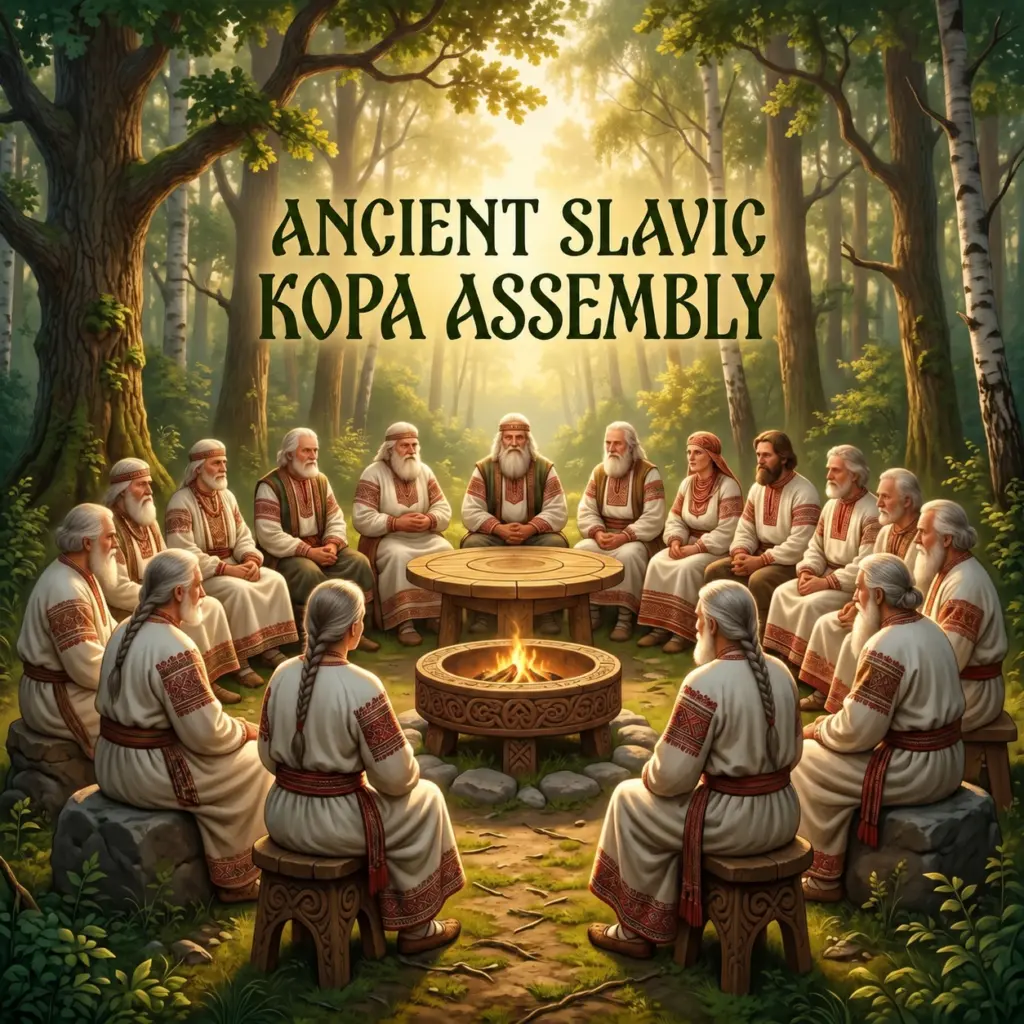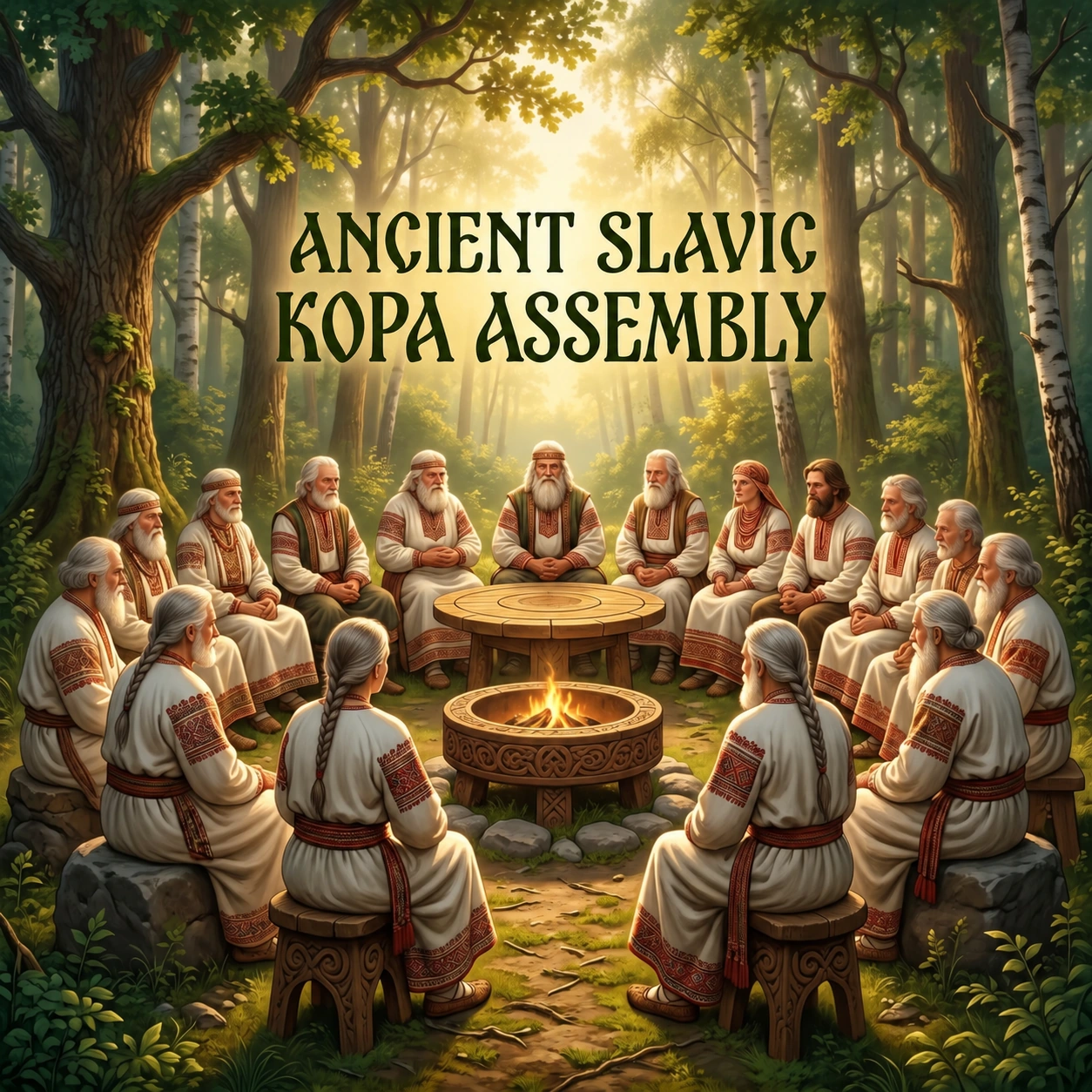
Kopa Law – the Kopa
Why choose this particular subject?
Because the Kopa is one of the foundations of our Slavic worldview. It therefore also provides a foundation for the social and economic organisation of everyday life and for moral, ethical and spiritual growth, enabling people to fulfil themselves throughout their lives by achieving a multitude of goals. Only the Kopa offers people this opportunity.
For example, compared with the Kopa, a social institution such as the Veche operates differently. That is, even if it produces similar results, it does so only partially. Democracy , meanwhile, which outwardly resembles both the Kopa and the Veche, is in fact an absolute disaster for Russian people and their sense of identity.
Let us examine this. That is the central question addressed in this article.
Why Is Democracy Inherently Harmful to the Russian Mind?
Because every component of this institution governing social relations is a covert provocation directed against the Russian sense of identity and perception of the world. Democracy, by its very nature, literally means appointing certain figures to leadership positions, engaged by a particular group of people to serve their strictly private interests. Whatever respectable pretext is used makes no difference. A democrat is merely someone’s appointee, and there are no exceptions. Democracy, translated from Greek into Russian, means rule by the nobility, the slave owners.
Rule by the people, on the other hand, is called ochlocracy in Greek. Ochlos means the people. This distortion of meaning unequivocally indicates that the concept is a deliberate falsification intended to lead Russian people down a wrong, alien or even destructive path. We see proof of this today under democracy: certain self-proclaimed bosses whom we did not elect tell us, the masters of our native land, who we are and dictate how we should live. At the same time, they compel us to carry out their orders and follow their notions under the guise of “laws” that they themselves have invented without our consent.
The current situation in society is the result of democracy—an institution governing social relations in which not only the worst among us, but also every outsider who comes to your native land, every covert and now even overt enemy, receives more rights than we do, the original masters of our native Land, bequeathed to us by our wise Ancestors.
This system allows outsiders, people of other faiths and people of other ethnicities to live on our Land and parasitise it, forcing us, in their interests, to submit to their regime, which is founded on concealed mechanisms of slave ownership that feed off the indigenous population.
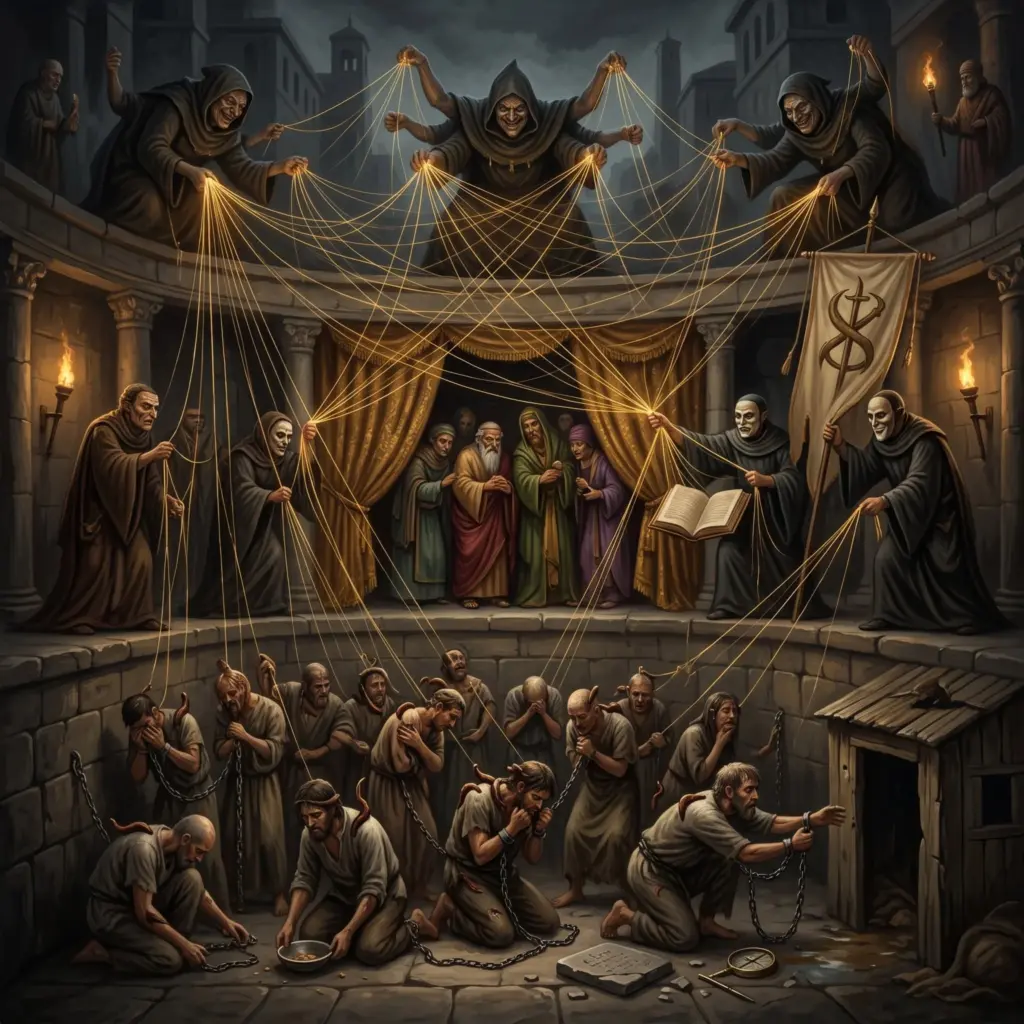
The insidious means by which democratic legal norms bring people into submission take many forms. One of the main ones is when democrats, officials, parasites riding on the people’s backs, give them work in exchange for crumbs of material benefit, just to keep the ochlos from dying off.
No, the democrat is not motivated here by compassion or any kind of heartfelt, brotherly concern, but solely by the one objective he pursues: to extract as much benefit as possible from the slave for himself. To that end, the slave must have a bowl of slop and at least a leaky hut over his head, so that he does not drop dead working for the parasite—the democrat.
This is what democracy really is, stripped of the false epithets it bestows on itself and the respectable pretexts it uses to conceal its vile actions. To realise this, all you need to do is stop listening to them and look at what actually happens under their leadership—trust your own eyes rather than their flattering, deceitful, insidious statements, which sometimes even seek openly to intimidate you.
This is precisely what we see in our lives today. Every official has been appointed by someone unknown, and so it is unclear on what grounds he acquired the right to direct the people’s lives. Quite apart from that, whatever his titles and honours, we can see that he is merely a nonentity, an incompetent. Or even simply a scoundrel who feeds off our troubles and severe hardships, which he himself provokes in various ways using the many levers of authority at his disposal.
According to information provided by AI (based on certain sources which, in our case, require careful scrutiny for their reliability and usefulness to Russian people):
Democracy (as applicable to Russia, rather than its ancient form): — a system of decision-making in which power legally belongs to the people through the institutions of elections, representation, rights and freedoms. For the Russian people, it was long an alien form, introduced “from above” or through the dismantling of the traditional way of life.
How It Was Applied (in Russian History):
- Zemsky Sobors (Assemblies of the Land, XVI–XVII centuries) — quasi-representative democracy: elected representatives of the estates (nobles, townspeople and state peasants).
- The Novgorod–Pskov Republic — the closest equivalent to European urban democracy.
- Soviet democracy (1917–1936) — a form with genuine grassroots elements (soviets and factory committees), quickly curtailed and turned into a one-party system.
- The post-Soviet period (1990s – present) — formal democracy with elections and a parliament, but with highly centralised power.
Example from the History of the Russian People:
- The Zemsky Sobor of 1613 — the election of Mikhail Romanov as tsar after the Time of Troubles. Elected representatives from towns and districts participated.
- The Novgorod Veche (as a form of ancient democracy on Russian soil).
- The Constituent Assembly of 1918 — the first (and last) parliament elected by the entire people, dispersed by the Bolsheviks.
These are the results of democracy in Russian society. Today, people submit to the democratic system out of necessity, solely because: “Where else will I find a job? Who else will pay me? And who will take care of me?” In other words, a person reduced to the condition of a slave ceases to be part of a people (OUR-KIN), loses the sense of being master of their own land and becomes merely part of a population—a rabble that mindlessly obeys an official. Such a person is no longer capable of living any other way or thinking independently about how to organise their own life and that of the state as a whole.
How, then, does the Veche differ from democracy?
The Veche would appear to be a popular gathering, as those same reference sources (AI) once again present it to us. What do we know about the Veche? What characterised the Veche? Let us go online and consult the AI reference sources:
Veche (from Old Slavonic вѣтъ—“council, speech”) — a popular assembly in ancient and medieval Rus’ (especially in Novgorod, Pskov, Kyiv and Vladimir). The supreme governing body, where decisions were taken by free male householders through an open vote (often by shouting).
How It Was Used:
- It decided questions of war and peace, the invitation and expulsion of princes, the adoption of laws, judicial matters, and the management of land and the treasury.
- In Novgorod, the veche system survived until 1478 (incorporation into Moscow).
- The bell was a symbol of veche liberty.
Example from the History of the Russian People:
- The Novgorod Veche (1136–1478). It was the veche that expelled Prince Vsevolod Mstislavich in 1136—the “Novgorod revolution”, after which Novgorod became a feudal republic.
- The Pskov Veche (until 1510) — more orderly, with the Pskov Judicial Charter.
- The Kyiv Veche of 1068 — the people freed Vseslav of Polotsk from a log-built dungeon and installed him as prince in opposition to Izyaslav.
In researching this subject, we cannot fully rely on the credibility of these reference accounts from AI, which is essentially a programme for collecting and analysing information. We must bear in mind the ideology of society at the time the information base was compiled, and the audience for which it was intended.
The information collected by AI from various sources has been filtered and presented in a particular way to shape stereotypes and patterns of thought, which is especially important in bringing up young people. The dissemination of such information must not impede the parasites in implementing the political decisions they need to control society.
We need only recall who promoted the Veche to us through “his-tory”, telling us fairy tales about the “Novgorod veche”. Above all, it was instilled in us directly through religion, such as Christianity, to cultivate a slave mentality. Here it must be stated plainly that Christianity is a Jewish religion created specifically to enslave the people of Rus’.
Put simply, the Veche is a kind of gathering place where people compete to “outshout one another at an assembly before the prince”. Whoever shouts loudest will have their opinion heard and adopted in the prince’s decision. In other words, it is essentially the same as democracy.
It was precisely the ideological and legal foundations of the Veche that subsequently enabled democracy to emerge.
Why was it specifically before the prince that the people were free to shout?
Because the prince was already the sole appointee of the people themselves. For some reason, the people had an interest in this man, and he was elected to direct the life of Society. For example, he killed enemies who were troublesome to the people, so he was prince. Or he did something good today—here and now, this Monday—so he would be prince. But if he fell out of favour for some reason the very next day, the people would remove that prince.
The deeper we delve into the structure of veche governance, the clearer it becomes that the system itself contradicts our Slavic perception of the world in many respects.
Why? Because from the outset it allowed any loudmouth (usually a paid one) to be present, outdoing everyone else in volume and eloquence as he shouted what a certain circle of people had commissioned him to shout in their strictly private interests.
The Veche had an inherent structural and ideological defect that prevented the full development of social self-organisation based on the fundamental principles of the Universe: truth, honour, conscience, justice and dignity—where everyone should occupy their proper place rather than engage in activities alien to them. The Russian saying “What you were born for is what you are suited to” expresses the essence of the matter: self-fulfilment for the good of the Kin and in harmony with Nature.
And certainly not for the sake of a handful of interested parties pursuing strictly personal interests.
So, before moving on to the final section of our main subject, we should refresh our memories of what has been said above.
What is the Veche, along with its closest sister, Democracy?
Veche governance, as a form of social organisation, makes it possible to manipulate public opinion in the interests of a narrow circle of people, contrary to the aspirations of the majority. Who is doing the shouting today? The democrats! Where did these people with foreign citizenship and passports come from, whom the people take for their elected representatives? All that matters is that they speak beautifully, spin convincing yarns and, if necessary, shout louder than anyone else. That is the Veche.
And that is how it was: the prince would step onto a raised platform (a rostrum)—a sole administrator legitimised, admittedly by the people themselves, as a result of certain parochial, self-serving interests, but not in accordance with the aspirations embodied in their traditions. Instead, there would be some other reason: the people needed something, such as protecting their borders from someone’s encroachments, establishing trade relations with neighbouring communities, towns and villages, supplying oats (the crop had failed that year) for a herd of horses, and so on. Another man considered worthy of something by local standards would step forward at the veche and promise: “I can organise things, establish an army, trade and much else—in short, solve the problem.” They would elect him by a vote, that is, by shouting their approval: “Do it!”
Then, when another need arose, the Veche would assemble again, and once again the questions raised by the people would be resolved.
Alongside the prince were the warriors—his retinue. Who commanded the retinue? The voivode, not the prince. The prince simply became a petty tsar who, by analogy with democracy, was a democrat-president directing the voivodes.
It was the very system of relationships that made it possible to place at the head of a Russian community a prince suited to certain needs at that particular moment: in other words, an official who had made many promises, had resources and had managed to gather a force around him.
But this is only the outward, formal part of our tradition. Its core rested on the sacred, the spiritual and the moral, and thus on the fundamental principles of the Universe, tested over millennia, which is why it never failed. Society was led by gifted people—the best of their KIN.
Under the Veche, however, absolutely anyone could end up in the position of such an appointee—or, rather, a temporary power-holder. That is how we ended up with Vladimir the Red Sun—a drunkard of mixed Jewish descent who introduced Judaism to Russian soil through Christianity. All this was possible solely because the Veche allows any figure, even an enemy from elsewhere, to gain prominence and establish himself, provided he can be eloquent, lie convincingly and, above all, be louder, more deceitful and more brazen than everyone else.
So the question is: how does the Veche differ from Democracy? In essence, it does not differ at all. Thus, a little later, Democracy grew out of the Veche—the rule of the demos, the slave traders, over the ochlos—the people. The difference is that today slaves are so brainwashed and intimidated by eloquently shouting, self-appointed rulers that they simply do not recognise their situation and have handed absolute power over themselves into those rulers’ insidious, grasping little hands. They no longer even elect or appoint their own shitocrats, but with slavish cowardice and stupidity hand over their own lives and those of their children for slaughter, amid the vile, cynical, misanthropic clamour of openly falsified elections.
Now, directly to the subject: the Kopa as one of the principal elements of the Slavic-Aryan heritage.
The natural division of Slavic society into social estates—varnas:
- The Knowing (Volkhvs and Priests—Religious Ministers): People who possess higher knowledge; spiritual mentors.
- Vityazes (Warriors/Princes): Defenders of the kin, rulers endowed with strength and honour.
- Vesi (Farmers/Craftspeople): Workers who provide material prosperity and manage practical economic affairs.
- Smerds (Servants/Workers): People who perform physical work within their capabilities and are under the protection of the other varnas.
This hierarchy rests on the understanding that every soul, upon incarnation in an earthly physical body, already possesses a certain level of development.
Vedic knowledge provided a clear explanation for this: the soul comes to earth to gain experience and to accumulate and work through karma (the accumulated experience of past lives). A person’s good or bad deeds depend on their own free will; the choices made at every moment of life shape the course of events: “Sow a deed and reap a character; sow a character and reap a destiny.”
A person’s calling was determined by their natural inclinations and was observed by the community from early childhood. Put simply, the “octane rating” of a Smerd’s soul did not allow him to become a Vityaz (warrior) or a leader; the soul of a Vesi would always find a path to material prosperity and a well-ordered life; meanwhile, those gifted in music, painting, architecture or science found ways and means to express themselves, with the direct support of their Kin and People, who contributed as much as they could.
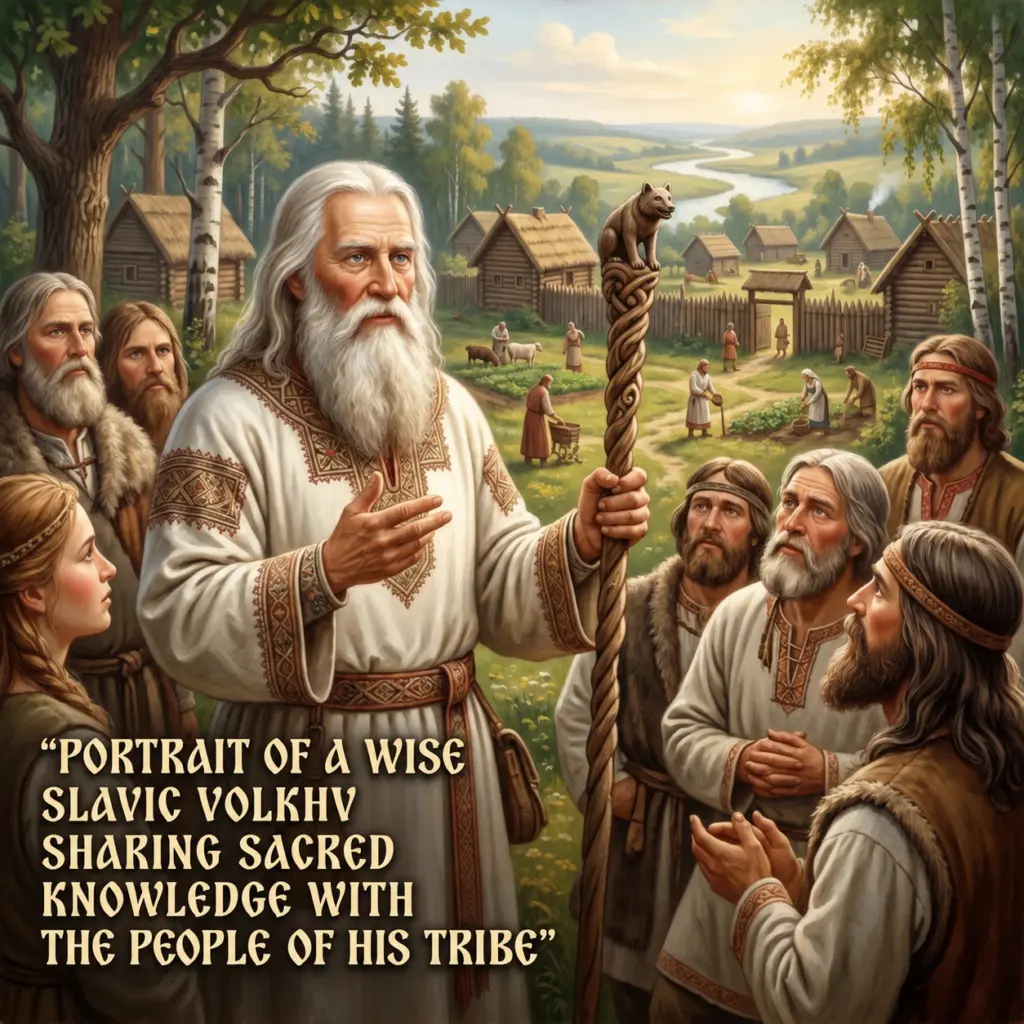
Sacred spiritual knowledge of the order of the universe was the preserve of volkhvs and priests. The finest of the Knowing—the volkhvs—not only possessed primordial knowledge of the Order of the Universe, but could also create rituals and rites, establish traditions, teach care for the environment and instil a respectful attitude towards Mother Earth—all the spiritual foundations that enabled the Slavic-Aryan state to endure for millennia.
Depending on the significance of an event in people’s lives, priests could join volkhvs in conducting naming rites, weddings and farewells to the deceased; they took part in planting a kin tree and in many other activities accompanying a human life lived in harmony with nature. Priests knew how to pass on this knowledge and teach its wisdom to the people. People sought their advice in difficult situations, and they had the final say in choosing a course of action on matters important to the Kin.
Priests—those who speak life (retsy)—were the most direct and best transmitters of sacred knowledge, both spiritual and moral knowledge and practical knowledge for everyday life. They were skilled at putting it into practice and, upon receiving knowledge from the volkhvs, could immediately convey it to the people in a creative, constructive form.
Next in status came the Vityazes (warriors), who had repeatedly proved their warrior status and calling through valour and courage: “to defeat the enemy through skill, not numbers”. Vityazes were born, not made, whereas anyone could become a warrior—a man, for example, through conscription. A Vityaz, however, devoted his whole life to defending his native land and could imagine no other life for himself.
The Vesi give material expression to existence; they are good at organising the living space around them and managing domestic life and the household economy. This means a good family, a wife, capable children, prosperity and well-being, and a man who is himself worthy of respect—in other words, the master of his own life and his own land.
The social and economic organisation of a society plays the leading role in allowing a person’s innate qualities to emerge: it either opens up opportunities to fulfil their calling, in which case both society as a whole and the people around them find well-being and happiness through harmonious coexistence and interaction,
Otherwise, society creates insurmountable obstacles, which becomes a tragedy not only for that person: their unrealised potential also descends upon the surrounding world as destruction and devastation.
And now let us directly compare the Veche and Democracy with the Kopa.
What is the Kopa?
Today we will find no example of life governed by the Kopa. AI reference resources give us the following information:
(author’s note: blatantly distorting the meaning of Slavic-Aryan concepts).
So,
Kopa: (from Old Slavonic. копъ—“assembly, gathering, heap”)—a form of rural communal adjudication and self-government in the western Rus’ and south-western lands (which formed part of the Grand Duchy of Lithuania ШВКЛ), later of the Polish–Lithuanian Commonwealth, and also in the Chernihiv region and Galicia). Similar to the verv of the “Russkaya Pravda”.
( footnote 1: The Kopa was widespread—throughout Rus’, which was not limited to the places listed above. It existed in both rural and urban settings, literally serving as the principal form of governance in Russian statehood.).
How it was used:
- It consisted of free peasants, “people”.
(footnote 2: before the arrival of Christianity, there were no peasants in Rus’; there were Vesi—working people to whom it would never even have occurred that they could be unfree on their native land.)
- “The Kopa court” investigated crimes (murders, thefts), settled land disputes and punished thieves—even with death (“gnat kopu”—to pursue a criminal as an entire community).
(footnote 3: there was no such expression as “gnat kopu”, because as we understand it, this wording means driving away the Kopa itself, rather than a criminal. Clearly, this expression was fabricated by some non-Russian who knows our language but does not understand it.
footnote 4: there was no “Kopa court”; there was the Kopa as a form of self-government, whose remit included considering crimes as they arose. Their essence was considered from the standpoint of divine essence—ESSENCE (СУТЬ), rather than JUDGEMENT (СУД). For the Gods do not judge, but understand the paths a young soul must follow towards its correction—spiritual and moral growth. The concept of JUDGEMENT was introduced under Christianity: God’s tribunal. The Christians, in turn, borrowed this form of state oversight from the Etruscans—these are Russians, a Slavic-Aryan tribe that moved to other distant lands. The Etruscan SUDA is now known from historical sources.)
- Decisions were taken unanimously or by a majority; if a community member disagreed, they could “renounce the Kopa” (leave the community).
(footnote 5: a Kopa decision was considered adopted only with complete unanimity—of all participants in the Kopa, certainly not by a majority. This was because they were the very best, rather than a majority or a minority. None of those taking the decision had the right to leave the Kopa at that point; the door was even locked while the decision was being made, and the key entrusted to a person appointed for that purpose. Only after a solution had been found that convinced everyone was the Kopa considered to have fulfilled its purpose and dissolved. Before that, the people were informed of the decision on the further action to be taken to achieve the goals set).
- A form of direct democracy at grassroots level.
An example from the history of the Russian people:
- Kopa charters (XVI–XVII centuries) —records of Kopa court decisions in the Starodub region, Chernihiv and Volhynia.
(footnote 6: this information needs to be checked for accuracy, at least as regards the dating, since neither the Kopa nor the Veche existed in the XVI-XVII centuries. Instead, there were popular assemblies at zemstvo level, overseen directly by the Russian state. At that time, the Kopa survived as a form of self-government exclusively among the traditional Cossacks. It survives among the Cossacks to this day, and nowhere else).
- A description of the Kopa in the “Statute of the GDL (Grand Duchy of Lithuania) of 1588” —recognition of the communal court.
Footnote 7: this assertion displays falsification: the author of these false assertions seeks to reduce the institution of the Kopa to the level of a criminal tribunal. But we already know what the Kopa actually was.
- Archaic survivals: the Kopa survived in Cossack communities and among priestless Old Believers.
Footnote 8: this assertion displays clear falsification. Its author is trying to reduce the Kopa to some atavism—a relic of the past. In doing so, the author is trying to portray one of the principal forms of the Slavic-Aryan worldview as a completely untenable social phenomenon.
It is crucial to bear in mind that, on these matters, one should turn first and foremost to the original source, rather than to reference books and dictionaries written by non-Russians who know our language but do not understand it. Not to mention that the actions of these “learned” non-Russians clearly reveal an enemy plot—an attempt to falsify our sacred, ancient, primordial, native Slavic-Aryan heritage.
This means that we can gain the only correct understanding of the Kopa from a direct bearer and custodian of ancient knowledge.
In our case, I suggest turning to recognised sources of Slavic heritage:
- the Yngling Old Believers of Omsk, in particular the lessons at the Asgard Spiritual School taught by Alexander Khinevich;
- lectures by the luminary Alexey Trekhlebov (also known as Vedagor), an esaul in everyday life;
- Svetlana Zharnikova—a scholar with extensive practical experience in wide-ranging research into Slavic antiquities and the antiquities of the Vedic East;
- Nikolai Levashov—a physicist and full member of four academies; in particular, I refer you to his books, rather than his public activities.
- Lieutenant Colonel Valery Mikhailovich Dyomin—Svetozar (not to be confused with the historian V. M. Dyomin), leader of the Russian-Slavic National Union in Omsk—bear in mind that his key books on Slavic heritage have been placed on the list of extremist literature by the Russian Federation’s prosecutor’s office. In other words, these books contain nothing but the truth.
References to online sources:
- Heritage of the Ancestors (History). COURSE 3. Lessons 01, 02. Kopa Video lessons from the Asgard Spiritual School. Heritage of the Ancestors (History) COURSE 3. Lessons 01, 02. Kopa. Heritage of the Ancestors (History). COURSE 3. Lessons 01,
- KOPA LAW—IN PLACE OF DEMOCRACY, AND SOCIETY WILL PROSPER. (Trekhlebov A.V 2019,2020,2021,2022) on the channel “Heritage of Our Ancestors. Russian Culture. Trekhlebov A.”
According to the lectures at the Asgard Spiritual School:
Kopa—(literally: “communal circle”, “God’s paths brought together by the fathers”) an eternal foundation of kinship that, over many generations, has brought together the principles of Aryan and Slavic morality into a distinctive Culture and a unique Tradition.
The Kopa is also a communal code of rules that strengthens relations between kin groups, a system for making vitally important decisions, and rules for resolving conflicts.
When a question arose at the level of a village or small rural settlement, the heads of families and kin groups were called together to discuss it: men together with their wives. The Kopa’s fundamental rule was: “No one may be denied a voice.” “Everyone may have their say in the order prescribed by the Kopa.” The men of the lowest rank were given the floor first, and each then spoke in turn, up to the most worthy (tse-ariya). A wife rarely spoke after her husband, and only if they had different views on how to resolve the issue.
A dissenting member of the Kopa would explain the reasons for their opinion and propose their own solution to the issue; the other members would either agree or present arguments that convinced the dissenter. The search for the best solution continued until it was adopted unanimously.
In other words, a solution to any issue will always be found. Discussion begins and continues until everyone says: “Yes, I am satisfied with that.” Only then was the decision adopted unanimously.
On matters concerning the organisation of life in a region or territory (province), decisions were made by a council of elected representatives. If several rural settlements united into a volost, worthy men were elected from the villages and settlements to its council according to the following criteria: they had to be at least 50 years old, have a family, children and a homestead, and command the respect of their fellow villagers, who deemed them worthy of representing and defending the interests of the settlements and villages that had elected them.
Here, the Kopa consisted of elected representatives known as “desyatskys”, “sotskys” and “tysyatskys”. The system began with “desyatskys”, each representing ten households (homesteads), and proceeded to larger groupings: the desyatskys elected a sotsky, and the sotskys gathered together to elect tysyatskys. To this day, we hear echoes of Kopa law in the democratic society of the USA, where “electors” from each state make the final decision to cast a vote for one of the presidential candidates. Or, for example, the yakuza (criminal groups) in Japan, which based their organisation on Kopa law.
On matters of trade (external economic relations), direct agreements were concluded between Kopas. Again, decisions were made by the best representatives of their kin and people. There were no merchants acting as intermediaries. Merchants only appeared under the Romanovs. Thus, the division of Russian society into classes began with the Romanovs. The Russian worldview, meanwhile, had originally been characterised by estates—each estate contributed its own weighty voice for the good of the Kin and in harmony with Nature—for the good of Rus’.
Another important difference between the Kopa and the Veche and Democracy: the best do not argue; they discuss and reach agreement. The best Russian men do not prove their superiority to anyone; they seek a solution to an issue, which is found through unanimity. The well-known expression “Truth is born of argument” is a brazen lie, a pattern of discord introduced into our everyday lives by the enemies of humanity. And once again: and once again, the best, those capable of accomplishing, building and creating, do not argue, but discuss problems in order to find the best possible solution to them. That is why these people of Rus’ are the best.
I invite you to take part in discussing this topic, but without adopting a position of condemning the Kopa or endorsing the Kopa. The Kopa needs no revision or negative comments of any kind, since its benefits were tested in practice by our ancestors over many millennia. We are interested in the following question: in what form can the Kopa exist under present-day conditions, which have a distinctly anti-Russian, anti-Slavic orientation.