













The World Is a Psychiatric Hospital Where the Patients Have Seized Power
The bed is made soft, but sleeping in it is hard.
This is the reality of our times: the number of people who have clearly suffered at the hands of the Russian Federation’s system grows every day. These are ordinary people who, until recently, thought they had rights and freedoms, and that their private property was inviolable. But all of this turns out to be a complete sham as soon as it affects them personally.
People want justice; they want to protect themselves. But this is how the human mind works: they do not need the actual truth, but a truth that fits their limited, distorted view of the world. They need a fairy tale they can understand. They firmly believe that, sooner or later, everything will work itself out for the best. Yet this is self-deception. The public mandate for fair governance remains unfulfilled.
The Diagnosis: A System of Lies Has Become the Norm
To avoid mental overload, most people find it more comfortable to believe fairy tales:
- That Vysotsky drank himself to death.
- That Talkov was shot by a security guard over an argument.
- That Listyev fell victim to a struggle over business interests.
- That Yevdokimov, Lebed, Fyodorov and even Tsoi died in accidents.
- That Ilyukhin passed away from a heart attack.
- That Politkovskaya and Nemtsov were killed by ‘bandits’, rather than the system.
But these deaths are no accidents. They bear the hallmark of a system that eliminates those who stand in its way. And as long as we accept these fairy tales as the truth, we remain in a prison built of lies. The system operates to ensure that the people’s public mandate is never fulfilled.
Now look at the inconsistency: drones can strike an oil refinery more than 4 thousand kilometres away — a strategic facility left without adequate protection. Meanwhile, the Druzhba pipeline functions perfectly well. Cows are afflicted by a terrible disease kept under the strictest secrecy — so strict that no one knows its name, its origin or how to combat it. But everyone knows for certain that it exists.
There is no point in giving further examples — there are far more than any mentally healthy person could imagine. Incoming strikes, the seizure of people’s last possessions, bank accounts being emptied and outright robbery by ‘Wildberries’ no longer shock anyone. Television rushes to assure us that this is the ‘new normal’, dictated by difficult circumstances.
The Root of the Evil: The Betrayal of 1991 and Its Consequences
In 1991, when we still had a civil society, a unified mood of protest arose among the Soviet people in response to prolonged, deliberate subversion. No one wanted the state to disintegrate. People wanted to halt the artificially engineered decline. But our people had no immunity to betrayal and unprecedented lies under the slogans of ‘change for the better’. They thought they were fighting evil, but in reality they were tightening the noose around their own necks.
The USSR State Committee for the State of Emergency (SCSE-USSR) has already issued a legal assessment of these events: the dissolution of the USSR has been recognised as an unconstitutional coup. The SCSE-USSR decrees restore the force of Soviet legislation and the authority of Soviet governing bodies. This is not ideology — it is a fact enshrined in legal instruments that have international force. It is on this legal foundation that we can formulate a new public mandate.
Today, the situation is even more deplorable. A lack of cohesion in society, an ill-defined civic stance, and legal and social degradation have created utter chaos in people’s minds: from the savage cry of ‘kill the khokhol’ to fairy tales dressed up as traditional values about a ‘genetic destiny’ bound up with the hardships of the Russian people. This is obscurantism of the most horrific kind. It normalises a system of ‘I think one thing, say another and do a third’. Undoubtedly, this is the best of times for thieves and bandits of every stripe, but there is no one left to say, ‘The emperor has no clothes!’ — because the masses are short-sighted and intoxicated.
The Solution: Solidarity and a Public Mandate
No miracle, outside forces, brilliant leaders, money or technology will give us a just state until the entire people unite around enduring, fundamental principles.
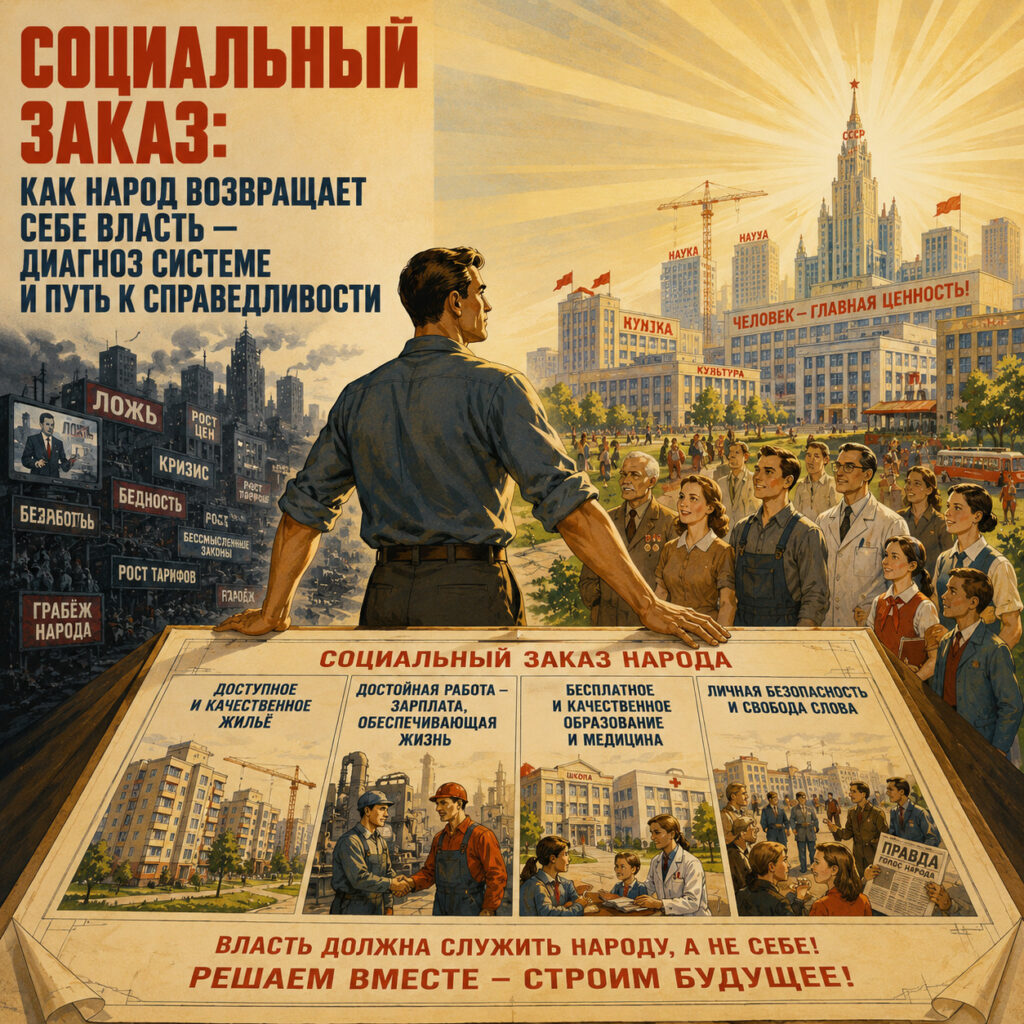
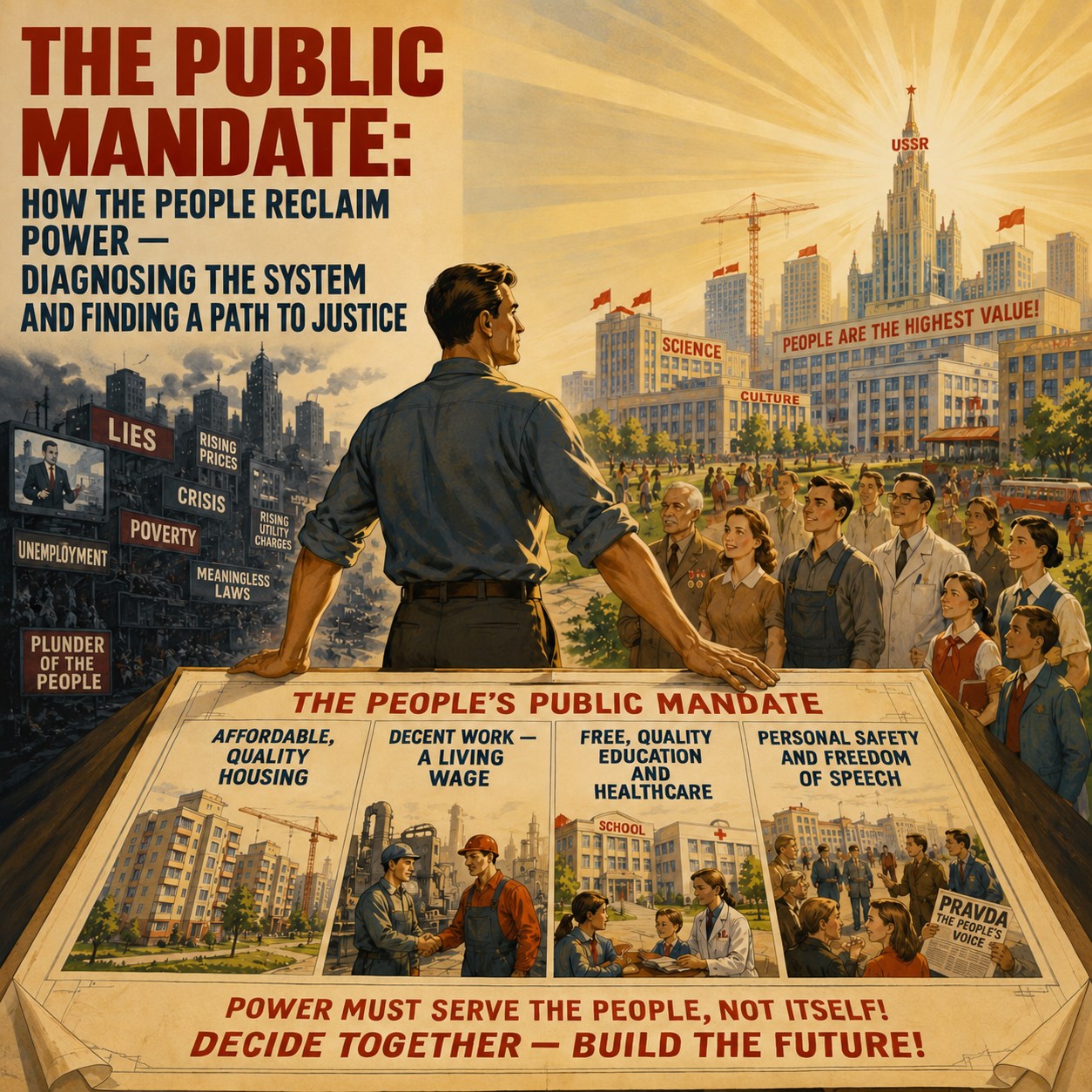
A public mandate for fair governance does not mean that every citizen must thoroughly familiarise themselves with the legislative process, development plans and strategic projects. Citizens should receive the end product in the form of benefits for themselves and the country as a whole. They must have clear criteria for assessing the authorities’ performance:
- Affordable, good-quality housing.
- Decent work with a living wage.
- Free, high-quality education and healthcare.
- Personal safety and freedom of speech.
If these benefits are absent, the authorities are failing to fulfil their public mandate. Citizens have the right either to extend their trust or to withdraw it. This is the mechanism of direct popular rule that we are building. Only in this way does the public mandate become a reality.
Until our reality conforms to this formula, we will remain expendable pawns in other people’s games, where every action carries a hidden meaning directly opposed to its stated purpose, benefiting some while bringing losses to everyone else.
Yet despite every obstacle, the spirit of freedom, community and self-awareness is growing in direct proportion to the pressure, restrictions and prohibitions. And rest assured: everyone behind this lawlessness will soon be looking pale and pitiful.
The Example of Belarus: An Island of Soviet Identity
Belarus should be a strong source of encouragement for us. How does such a small republic — with neither resources nor access to the sea — navigate the raging madness around it, maintaining its balance and preserving a peaceful, constructive atmosphere within the country? The answer is simple: it has retained a sense of community and identity.
Belarus is the republic that has departed least from Soviet principles and values, deservedly earning the sympathy of citizens of the occupied territories and providing good reason for the growth in emigration to this republic.
And these are not just words — you can see it even in the flag. Belarus is the only country in the post-Soviet space (apart from unrecognised Transnistria) to have restored its Soviet flag. The modern red-and-green flag with its ornamental pattern is the direct successor to the flag of the Byelorussian SSR, approved on 25 December 1951. Yes, a white-red-white flag was used in 1991–1995, but the people brought back the Soviet symbol through the referendum of 14 May 1995. Only the hammer, sickle and star were removed; the underlying principle, the very connection with the Soviet past, remained. As Ivan Krupko, Chairman of the Gomel Regional Executive Committee, put it: ‘Belarus is the only country in the post-Soviet space to have retained the Soviet flag with minor changes. This speaks convincingly of the fact that we, the Belarusian people, carry on the great deeds of our ancestors and safeguard its true history.’
And people feel this — with their hearts, rather than their minds. That is why the migration figures speak for themselves. In 2025, Russian citizens crossed the Belarusian border 454 681 times. Of these, 4 677 came for work — Russians ranked second among all labour migrants. Belarusians entered into 2 035 marriages with Russians — 61,7% of all marriages to foreign nationals. 230 thousand Russians stayed at Belarusian health resorts, while 1,18 million stayed in hotels. The total number of tourist trips from the Russian Federation rose by 30%, reaching 906 thousand.
And in 2026, interest in relocating went through the roof. In March 2026, the number of search queries about moving out of Russia reached 40 thousand — three times as many as in March 2025. In just one month, Russians bought 126 flats in Minsk — one in every ten.
Belarus today is more than a neighbour. It is a living magnet for those seeking an alternative to chaos, lies and lawlessness. A sense of community still survives there; people still remember what Soviet principles and values mean. This explains the growth in emigration to this republic.
What is wrong with Belarus? Nothing — things there are just as they should be. And with the restoration of the USSR, they will be better still. When we build a system in which the public mandate is fulfilled, Belarus will become an example for the entire country.
The Tools: Self-Education and Unity
The more complex the task, the less obvious the solution. That is why self-education is the only way to break the chains of ignorance in which the occupiers have bound our citizens. We offer tools that will provide a clear and comprehensive picture of the current situation from the perspective of global law. Indisputable facts will help you understand every intricacy of the deception and falsification, and restore your rights and status.
Start educating yourself through our resources, which are open to everyone:
- Agency of the Soviet Union (TASS): TASS.NEWS — official news and legal instruments of the USSR.
- USSR Civil Defence Academy: a unique archive of facts concealed from the general readership.
- The ‘Soyuz Forum’ platform: a safe space for like-minded people to communicate and unite — forum.governmentussr.com.
- The USSR State Committee for the State of Emergency (SCSE-USSR) platform: official documents and decrees — governmentussr.com.
- Referendum on restoring title, passport rights and social guarantees: nation.governmentussr.com.
- ‘Red Wave’ online radio: the ideological voice of revival — ussr-radio.com/live.
- The film ‘Russia’s People’s Referendum’: a vivid account of deception and awakening.
Conclusion
The fiction is over. A reality is beginning in which every citizen is a sovereign, rather than expendable material. In which the authorities have no right to lie, because they are judged by results. In which the USSR is the future we are building with our own hands, rather than the past. The public mandate is the mechanism that returns power to the people. Join. Register. Participate. There is no other way.
Glossary
| Term | Meaning |
|---|---|
| Public mandate | A mechanism of direct popular rule under which the authorities must provide citizens with specific benefits (housing, work, healthcare, education, safety), while the people assess the results and may withdraw their trust |
| Popular unity | Social cohesion based on shared values and goals, without which a just state cannot be restored |
| USSR State Committee for the State of Emergency (SCSE-USSR) | The State Committee for the State of Emergency — a lawful governing body operating since August 1991 |
| SCSE-USSR decrees | Legal instruments restoring the force of Soviet legislation and recognising the dissolution of the USSR as an unconstitutional coup |