
























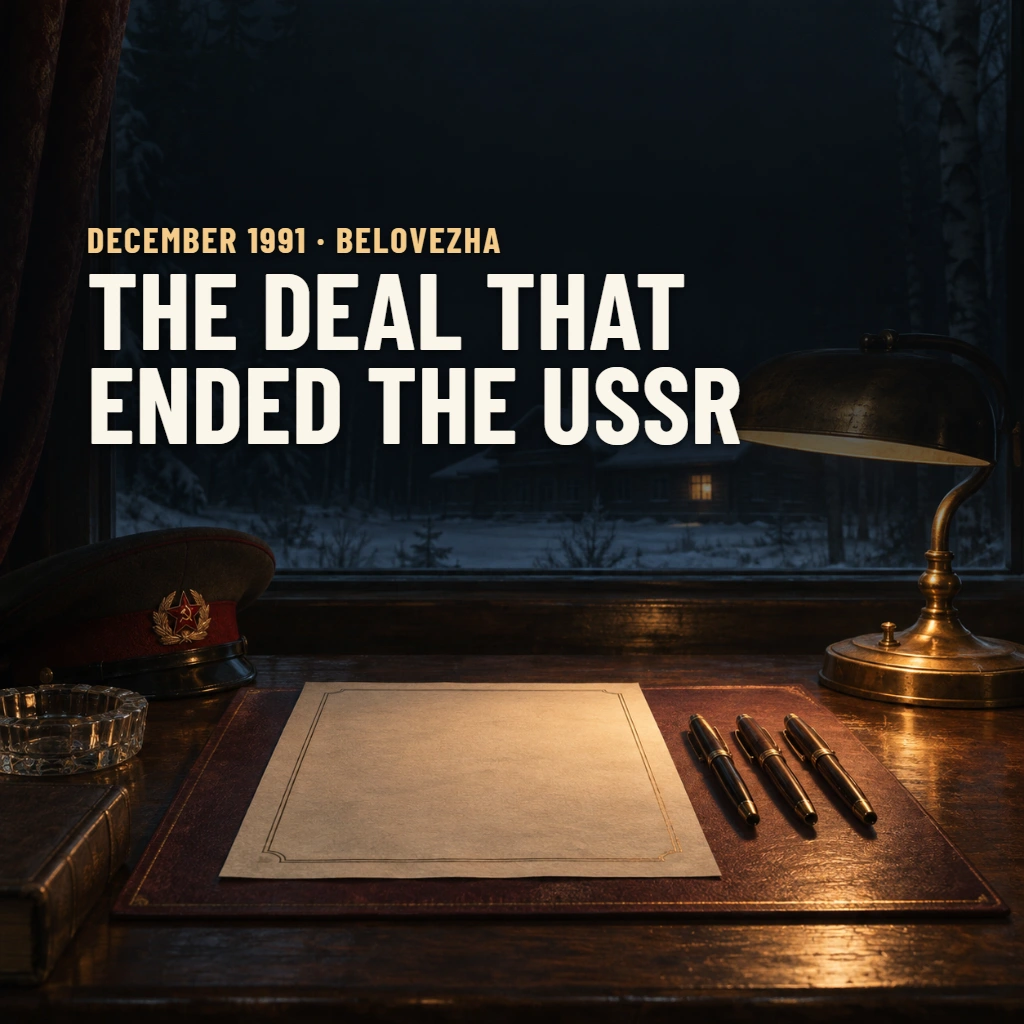
On 8 December 1991, in a hunting lodge in Belovezhskaya Pushcha, three men signed a document—the Belovezha Agreement—that overturned the fate of a country of 300 million people. Boris Yeltsin, Leonid Kravchuk and Stanislav Shushkevich declared that the USSR had ceased to exist, violating the will of the people expressed in the referendum of 17 March 1991, the 1977 Constitution of the USSR and Law No. 1409-I on the Secession of Republics. Their actions constitute treason. But did they have the right to do this? Did they break the law? The answers to these questions overturn the conventional understanding of those events.
What Constitutes Treason under International Law
Treason is an intentional act committed by a citizen to the detriment of their country’s sovereignty, territorial integrity or defence capability. Under Soviet legislation, this offence was classified as particularly serious and was not subject to a limitation period. Three elements are sufficient to establish the offence: intent, harm to the state, and actions taken for the benefit of a foreign state or against the interests of one’s own country.
All three elements are present in the actions of Yeltsin, Kravchuk and Shushkevich.
For clarity: Article 64 of the Criminal Code of the Russian Soviet Federative Socialist Republic (RSFSR) applied to people who knowingly acted against their own state. In 1991, this was precisely the article under which the actions of the leaders of the republics who signed the Belovezha Agreement without the people’s mandate or lawful authority could have been classified.
Who Signed the Belovezha Agreement, and on What Authority?
On 8 December 1991, in Viskuli (Belovezhskaya Pushcha), the presidents of Russia and Ukraine and the Chairman of the Supreme Soviet of Belarus signed the Agreement Establishing the CIS, which stated that the USSR had ceased to exist.
But here is the key question: did they have the authority to do so?
- Yeltsin was President of the Russian Soviet Federative Socialist Republic (RSFSR)—one of the 15 Union republics. He had no right to act on behalf of the entire USSR.
- Kravchuk was President of the Ukrainian SSR. The same situation applied.
- Shushkevich was Chairman of the Supreme Soviet of the Byelorussian SSR.
None of them had been vested with the authority to decide the fate of the Union as a whole. This was an act of unauthorised decision-making carried out behind the people’s backs.
First Violation: The Will of the People Expressed in the Referendum
An all-Union referendum was held on 17 March 1991. Asked whether the USSR should be preserved, 113 million citizens answered “YES”.
The referendum results were enshrined in Resolution No. 2041−1 of the Supreme Soviet of the USSR, dated 21 March 1991. This was an act of direct popular sovereignty carrying supreme legal force.
The Belovezha Agreement was signed against the will of the people expressed in the referendum. This is a direct violation of citizens’ constitutional right to participate in governing the state.
Second Violation: The 1977 Constitution of the USSR
The Agreement Establishing the CIS violated several articles of the 1977 Constitution of the USSR:
- Article 2—All power in the USSR belongs to the people.
- Article 70—The USSR is a single federal multinational state.
- Article 72—Each Union republic retains the right to secede freely from the USSR, but only in accordance with the procedure established by law.
Under Article 73 of the Constitution of the USSR, the jurisdiction of the USSR, exercised through its highest bodies of state power and administration, covered determining the state border of the USSR and approving changes to borders between Union republics, ensuring uniform legislative regulation throughout the USSR, and establishing the fundamental principles of the legislation of the USSR and the Union republics.
Any decisions to change the status of the republics or their borders fell within the exclusive competence of the all-Union bodies. The heads of individual republics had no right to decide such matters independently.
Article 74 of the Constitution of the USSR established the supremacy of all-Union laws over republican laws. The Belovezha Agreements flagrantly violated this principle.
As we shall see below, this “procedure established by law” was not followed.
Third Violation: Law No. 1409-I on the Secession of Republics
On 3 April 1990, USSR Law No. 1409-I, “On the Procedure for Resolving Matters Relating to the Secession of a Union Republic from the USSR”, was adopted. The document clearly established the procedure:
- A referendum in the republic.
- A transitional period of up to 5 years.
- A decision by the Supreme Soviet of the USSR.
None of these requirements was met:
- No referendum was held in the republic. Instead, three leaders simply signed a piece of paper.
- The transitional period was not observed. Secession was formalised immediately.
- There was no decision by the Supreme Soviet of the USSR. The agreement was not ratified by the Congress of People’s Deputies of the USSR.
For clarity: the law existed to ensure that a republic’s secession was legitimate and took account of the interests of all citizens, rather than just a group of politicians. Disregarding it renders any decision to secede legally void.
Fourth Violation: The Absence of One of the Founders
The USSR was formed in 1922 by four republics:
- — the Russian Soviet Federative Socialist Republic (RSFSR);
- — the Ukrainian SSR;
- — the Byelorussian SSR;
- — the Transcaucasian Socialist Federative Soviet Republic (TSFSR).
Only three republics signed in Belovezhskaya Pushcha, without the participation of the successor states to the TSFSR—Georgia, Armenia and Azerbaijan. This makes the agreement incomplete and legally void from the outset. A decision on the fate of the Union cannot be taken without the participation of all its founders.
Fifth Violation: The Agreement Was Not Ratified
The Belovezha Agreement establishing the CIS was neither approved nor ratified by the Congress of People’s Deputies of the USSR—the highest body of state power. And without ratification, no international treaty has legal force.
On 29–30 December 1991, the 1st Congress of Citizens of the USSR was held, with 874 delegates representing all the republics. In Resolution No. 1 of 30 December 1991, the Congress explicitly refused to recognise the Belovezha Agreements and transferred full authority to the Military and People’s Council of the USSR. A total of 873 delegates voted for this decision.
Thus, the Belovezha Agreement is not a legal act, but a void political declaration with no legal force.
Legal Classification: Treason against the Motherland
The actions of Yeltsin, Kravchuk and Shushkevich fall under Article 64 of the Criminal Code of the RSFSR, Article 61 of the Criminal Code of the Byelorussian SSR; and Article 56 of the Criminal Code of the Ukrainian SSR: “Treason against the Motherland”:
“Treason against the Motherland, that is, an act committed by a citizen of the USSR to the detriment of the state sovereignty, territorial inviolability or defence capability of the USSR…”
The wording of the law describes precisely what happened on 8 December 1991: preparing and organising a conspiracy to seize state power in the Union republics unconstitutionally, abolishing the existing Union institutions of power, and unlawfully changing the constitutional status of the republics.
For clarity: all three criminal codes of the Union republics defined treason in the same way. This was no coincidence, but a common legal position across the Union.
They:
- Violated the state sovereignty of the USSR.
- Violated the territorial integrity of the USSR.
- Violated the Constitution of the USSR and the legislation in force.
- Ignored the will of the people expressed in the referendum.
These actions are more than a political mistake. They constitute treason.
What Happened Next: The State Duma’s 1996 Resolution
On 15 March 1996, the State Duma of the Russian Federation adopted Resolution No. 156-II ГД, “On Deepening the Integration of the Peoples Uniting in the USSR and Repealing the Resolutions of the Supreme Soviet of the RSFSR of 12 December 1991 ‘On the Denunciation of the Treaty Establishing the Soviet Union’.
At the same time, Resolution No. 157-II ГД was adopted, “On the Legal Force for the Russian Federation of the Results of the USSR Referendum of 17 March on the Question ‘On Preserving the Soviet Union’.
In effect, the State Duma recognised that the denunciation of the Union Treaty had been unlawful and that the results of the 1991 referendum retained their legal force.
Conclusion: The Agreement Is Legally Void
The Belovezha Agreement has no legal force because:
- It was signed by people who lacked the authority to do so.
- It violates the will of the people expressed in the referendum.
- It violates the 1977 Constitution of the USSR.
- It violates Law No. 1409-I on the procedure for the secession of republics.
- One of the founders of the USSR (the TSFSR) was absent.
- It was not ratified by the Congress of People’s Deputies of the USSR.
In Conclusion
The Belovezha Agreement is not a legal act, but a legally void document signed by people who committed treason. All citizens born on the territory of the USSR legally remain citizens of the USSR unless they have completed the statutory procedure for renouncing citizenship. Until this fact is recognised and rectified, we continue to live within a legal framework created through a criminal seizure of power.
Basis: Decree No. Д/Н 009 of 25 July 2023, adopted by the USSR State Committee for the State of Emergency (SCSE-USSR) as the highest body of state power.
TASS APPEAL TO THE CITIZENS OF THE SOVIET UNION:
Three men in a hunting lodge decided your fate without our knowledge. They violated the law, the Constitution and the will of 113 million citizens. Their actions constitute treason. And until we recognise this fact, we remain within a legal framework established by criminals. Know your rights. Pass this information on to those who do not yet know the truth. Only together can we restore justice. Knowledge is power! Let us bring everything under the people’s control, and then no shadow of a lie will escape the light of our knowledge!
________________________________________________________________________________________
IMPORTANT ANNOUNCEMENT: A remotely conducted People’s Referendum has been launched in Russia to restore the title and passport of a Citizen of the USSR. Read the details in the dedicated section: https://tass.news/category/ussr/vserossijskij-referendum/ and watch the extensive presentation on the channel of the USSR State Committee for the State of Emergency (SCSE-USSR): https://youtu.be/2IReAZalCaQ?si=iR9n33oYkWgcNBm3
We invite you to become part of our community! Register, share this information with your loved ones, and help fill our new network with uplifting news, heartwarming stories, true knowledge and photographs.
Links to our resources:
“Soyuz Portal” social network: https://social.governmentussr.com
“Sovetnik”” neural legal adviser: https://chat.governmentussr.com
USSR State Committee for the State of Emergency (SCSE-USSR) Education Centre: https://education.governmentussr.com
With respect for you and your work,
The Board of the Telegraph Agency of the Soviet Union
Information Service of the Telegraph Agency of the Soviet Union
Distributed through all communication channels throughout the Union Republics and Autonomous Territories of the USSR.
State Platform for Uniting Citizens of the USSR
Join Russia’s largest Telegram community, “TASS USSR”: https://t.me/tassussr
Listen to the New Soviet Radio station “RED WAVE” https://ussr-radio.com/live
Other articles on this topic: The Unconstitutional Coup of 1991: How Gorbachev and Yeltsin Destroyed the USSR, Yeltsin’s Decree No. 1400 and the 1993 Constitution: A Coup and a Commercial Code, USSR Membership of the UN 2025: Why Yeltsin’s Statement Has Been Recognised as an International Forgery, The Autonomous Non-Profit Organisation “Russia—Land of Opportunity”: The Legal Status of the Former Russian Federation