The Education System: What Are We Giving Our Children on 1 September?
A new school year has begun. 1 September is the day when millions of children will once again sit at their desks. But do we reflect on what we teach them, and how? And how effective is our education system? Above all, what future are we really preparing for them? Questions about education are more pressing today than ever. And the answer lies not in reforms, but in a return to the time-tested Soviet education system.
The Dead End of Consumerism: What Future Are We Building for Our Children?
Without a doubt, caring for children is a paramount duty in a healthy society. Parents sincerely strive to lay the foundations for a prosperous future: they offer guidance, pay for education and provide housing. Yet looking at the current state of affairs raises a bitter question: what future are we really preparing for them?
It is clear that, under present conditions, our children have no bright future and cannot have one if by “life” we mean total control, subordination to interests alien to their own, alienation from themselves, plastic food and substitutes for reality on television and the internet. Anyone who naively believes that their child will escape this, that they will “find a comfortable place”, is gravely mistaken: this system has no need for thinking, ethical people — it needs a voiceless, powerless serving class.
The Golden Age of Soviet Education: A Foundation Others Lack
It is widely acknowledged that scientific and technological progress in the USSR was achieved largely thanks to free, universal, accessible and high-quality education. The Soviet education system was recognised worldwide as the best, and our specialists as the most competent and sought-after.
Soviet schools sought to improve and raise the quality of teaching, focusing on a thorough grounding in scientific knowledge and academic rigour, the development of practical abilities and skills, and their creative application in practice.
As the scholar S.G. Kara-Murza observed: “Our schools always aspired to provide precisely a coherent body of knowledge, built on a foundation of culture and science, that gives the individual strength and freedom of thought. ... Even in the late 80s, our school-leavers, equipped with a coherent system of knowledge, were head and shoulders above their Western peers.”Soviet school-leavers were so mature that even an average pupil who received a school-leaving certificate was not a “mass individual” — they were a person in their own right.
Victories on the International Stage: Figures That Speak for Themselves
Soviet schoolchildren competing in international Olympiads consistently achieved high placings. Large-scale assessments of knowledge conducted in the final years of the USSR showed that Soviet schoolchildren never fell outside the top ten and more often ranked among the top five prize-winners.
The International Mathematical Olympiad statistics are impressive: from 1962 onwards, the USSR competed in 28 Olympiads, taking first place 14 times, second place seven times and third place three times. In 1991, the Soviet team took first place for the last time, with four of its six members winning gold medals after solving all six problems. By comparison, the results of Russia, which has competed since 1992, are noticeably more modest.
This proves once again that the Soviet education system of the USSR was more effective than today’s.”
Vocational and Technical Education: Training a Skilled Workforce
The education system, which included vocational schools, deserves particular attention. Vocational and technical schools (PTUs) were an integral part of the centralised state system of public education. They trained specialists primarily to meet the needs of Soviet industry.
Most PTU students were training for skilled work in heavy industry — metalworking, mechanical engineering and mining. Courses lasted from one to three years, depending on the complexity of the specialisation. On completing their studies, graduates gained both a skilled trade and a general secondary education.
The system was more than just “vocational” — it was a vehicle for social mobility, giving millions of young people a real trade, respect in society and confidence in the future.
Free Activity Groups and Clubs: Nurturing Engineers from Childhood
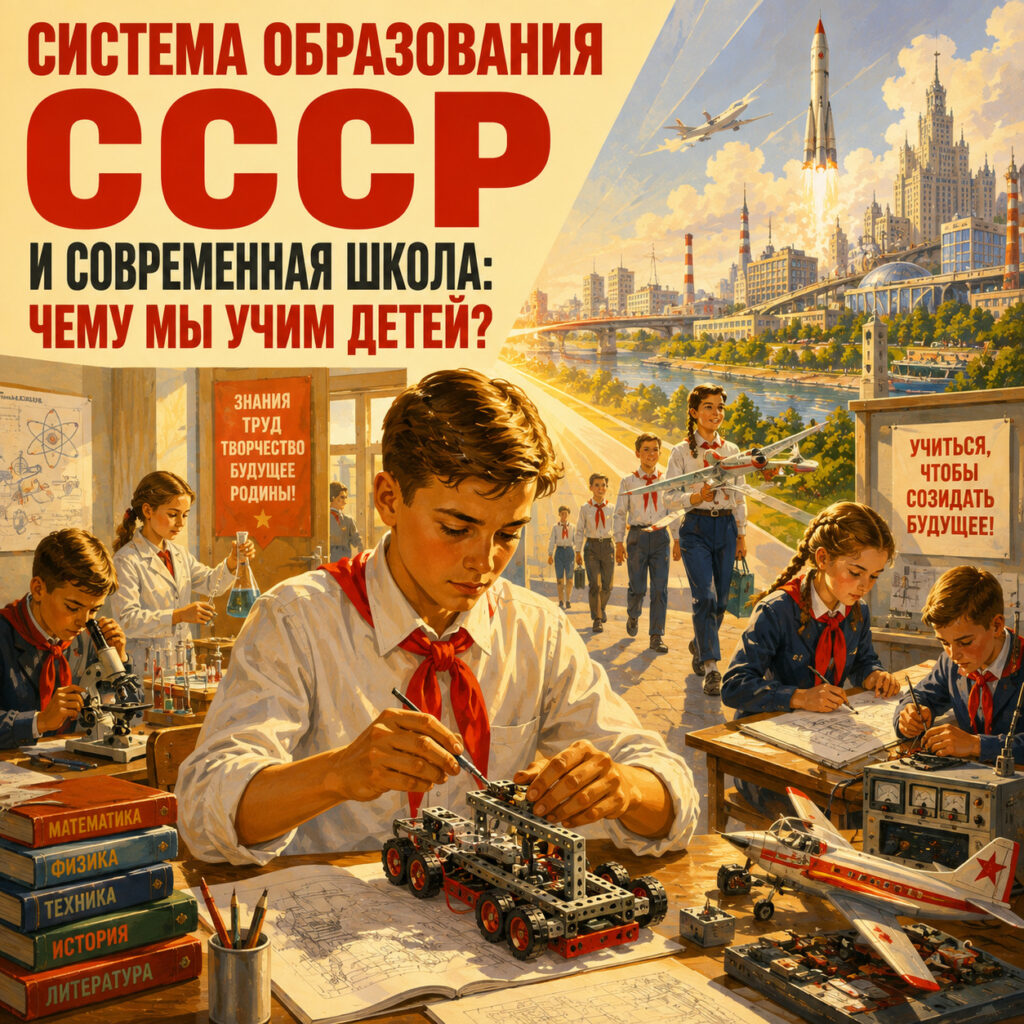
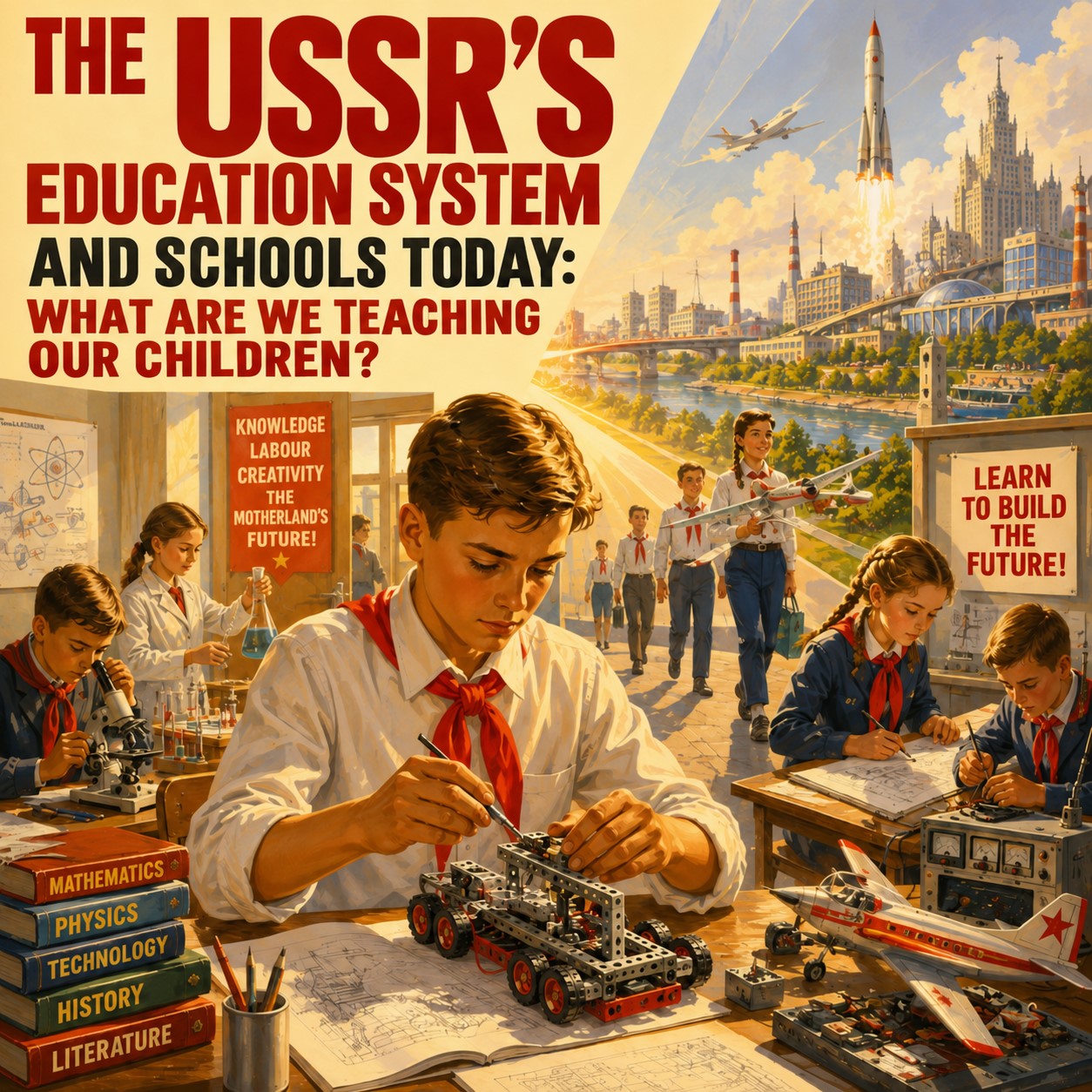
The USSR’s supplementary education system reached millions of children. By the end of the 80s, the Soviet Union had 3800 Young Pioneer palaces and centres. Each offered dozens of activity groups and studios. These groups and courses provided not only recreation but also help in choosing a career.
Technical clubs and activity groups became widespread, covering radio electronics, automation, remote control technology, biochemistry, genetics and astronautics. And all of it was free!
Soviet schoolchildren’s involvement in the design and model-making movement reached an unprecedented scale: more than 20 million pupils took part in developing innovative prototypes, working models and technical devices. A network of school scientific societies and specialist children’s clubs was taking shape, with various fields of interest — maritime, aviation and space.
The Situation Today: Fee-Paying, Uncoordinated and Elitist
Today, the picture is radically different. Surveys show that 58% of parents believe the quality of school education is worse than in their day. 56% are convinced that studying is harder for schoolchildren today than it was in Soviet times.
Activity groups and clubs exist today, but they are:
- Fee-paying — far from accessible to everyone.
- Uncoordinated — there is no unified state programme.
- Commercialised — the aim is to make a profit, rather than to educate and develop children.
Technical activity groups, which were widespread and free in the USSR, are now elite, fee-paying studios for a select few. Model aircraft building, model shipbuilding, radio electronics — all of this has either disappeared or become an expensive hobby.
The supplementary education system, once made up of numerous technical creativity groups, has lost its broad reach and coordinated structure. The collapse of the USSR brought radical changes to the education system: a funding crisis and the loss of a systematic approach to training technical personnel.
What Is at Stake: Who Is the System Raising?
Under the Soviet system, education was free and universal — every child in the 15 Union republics had the right to accessible education. Future distinguished scientists and architects, design engineers and Olympic medallists began their journeys towards victories and discoveries in free children’s activity groups and sports clubs.
Engineering education received priority support. Its predominance was a distinguishing feature of Soviet higher education, whose graduates helped develop unique space programmes and create the latest military equipment. In Soviet society, scientists and engineers enjoyed high status and professional prestige.
Today we are raising consumers, not builders. Managers instead of engineers. Users instead of creators.
What Must Be Done: Return to the Foundations and Incorporate Progress
Through all the reforms, wars and destruction, the Soviet education system did not break down — it withstood difficult periods in its development, raising generations of worthy citizens.
Today, to save generations of children, we must:
- Return to the foundations of the Soviet education system — a thorough grounding in knowledge, academic rigour, free provision and universality.
- Revive the system of free technical activity groups and clubs — so that every child, regardless of their parents’ means, can take part in model-making, radio electronics and design.
- Restore the prestige of skilled trades and engineering work — through the PTU system and careers guidance.
- Integrate Soviet educational principles with modern technologies — embracing progress and using it for good.
Returning to Tradition: Nurturing a Human Being
By returning to the tradition of Soviet schooling, we nurture a Human Being, not a mindless consumer. Through work, honesty and collectivism, we grow towards a society in which children will become true creators, rather than a “resource”. In this lies our certain renewal!
Only a coordinated, free and high-quality education, accessible to every child, can provide the foundation for a future in which our children will build their own sovereign, just and prosperous society instead of serving others’ interests.
__________________________
Resolution of the USSR State Committee for the State of Emergency (SCSE-USSR) No. СУР 023 of 27.02.2025 “On the Unlawfulness of Withdrawal from the Bologna Education System…” Join the discussion of this and other topics on the world’s first sovereign social network: https://social.governmentussr.com
New sovereign resources of the USSR State Committee for the State of Emergency (SCSE-USSR)
__________________________
Questions for Discussion
- Why was the education system that nurtured geniuses and engineers destroyed and replaced with a fee-paying, uncoordinated school system that produces only consumers?
- If Soviet education was free and accessible to everyone, why have activity groups and clubs now become a privilege of the rich rather than every child’s right?
- What is stopping you from organising a free activity group or club for children in your neighbourhood right now, without waiting for instructions from above, following the example of Soviet Young Pioneer centres?
- Who benefits when our children cannot think, do not know history and cannot build even the simplest model, and know only how to consume and click?