



























The RSFSR presidency and Boris Yeltsin’s powers: the Academy examines the referendum, legislative acts and its questions about institutional authority.
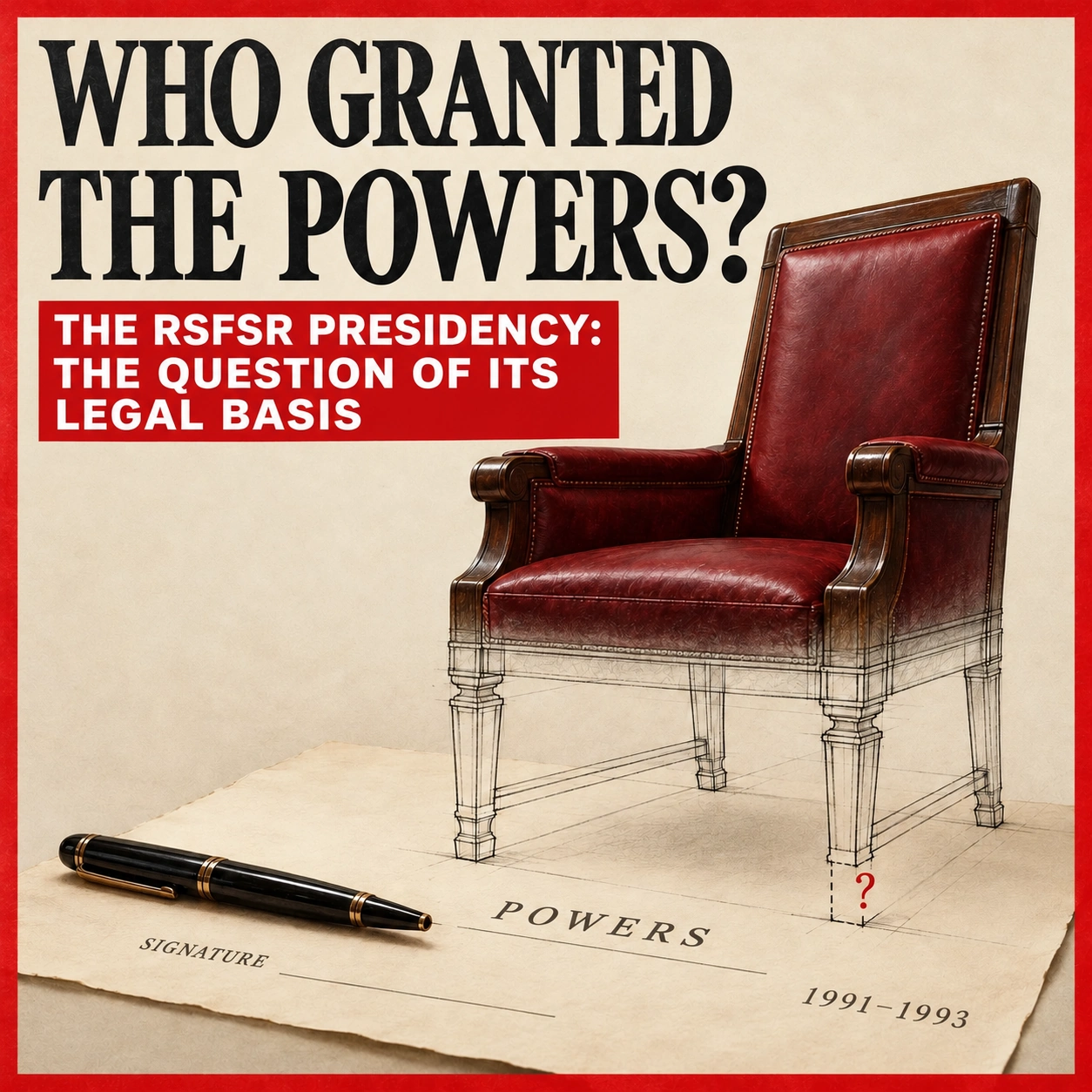
The USSR Civil Defence Academy presented a new material on the legal status of the President of RSFSR. The study consistently examines the March 17, 1991 referendum, the laws on the presidency, the election results, Boris Yeltsin’s inauguration and the events of September 1993. The main conclusion of the Academy is that the institution of the RSFSR presidency has not received proper legal registration, which means that the acts and signatures of the person holding this position cannot be automatically recognized as legally valid.
In previous publications, the USSR Civil Defence Academy has analysed the origins of citizenship legislation and the procedure for passing individual acts of 1991-1993. The new material addresses a broader question: who had the authority to sign the documents that determined the future fate of statehood and the legal status of millions of people?
The research focuses on the position of President of the RSFSR and the personality of Boris Yeltsin.
The Academy proceeds from the principle that the legal force of any act depends not only on its content, but also on the status of the person or body that issued it. Even a flawlessly executed document does not create legal consequences if the signatory did not have the appropriate authority.
Therefore, before recognizing the validity of decrees, laws, treaties and agreements signed by Yeltsin, it is necessary to restore the entire chain of occurrence of the presidential post: from submitting the issue to voting to taking office and subsequent termination of powers.
According to the Academy, such a chain contains a number of fundamental gaps.
Contents
Why the presidency begins with legal authority
The first argument of the Academy concerns not the identity of the candidate or the results of the vote, but the very possibility of establishing the post of President of the RSFSR.
The introduction of a new higher public office cannot be considered as a normal organizational decision. It affects the system of power, the distribution of powers and the constitutional structure of the state.
Therefore, it is necessary to determine which entity had the right to decide this issue.
The Academy emphasizes that even if the relevant proposal is supported by the majority of voting participants, the voting itself does not expand the competence of the body or the republic. It is impossible to legitimize a decision attributed to another level of government by means of a referendum.
That is why the original question for the Academy is not “how the citizens voted”, but “whether the RSFSR had the right to make this subject for an independent decision”.
Referendum of 17 March 1991 and introduction of the office of President of the RSFSR
The vote on the establishment of the office of President of the RSFSR took place on March 17, 1991, the day of the All-Union Referendum.
The Academy maintains that this vote did not give rise to legal consequences for the establishment of the presidency, as the issue was not within the exclusive competence of the RSFSR.
In the lecture, this conclusion is connected with Article 75 of the Constitution of the USSR and with the exclusive management of higher union bodies. According to the stated position, the republican vote could not independently change the constitutional system in the part that was attributed to the competence of the Union.
The coincidence of the date of the two votes gives this topic special importance. In one day, issues of different levels were resolved: the preservation of the Soviet Union and the introduction of a new post within the RSFSR. However, according to the Academy, holding them at the same time did not mean equality of legal grounds.
The All-Union referendum was seen as an expression of the will of citizens on the issue of preserving the common state. The Republic could not use parallel voting to assign powers that did not belong to it.
Thus, the very fact of the popular vote did not eliminate the problem of competence.
Presidency laws: Formal existence does not mean a valid legal basis
The Academy lists three laws related to the establishment and functioning of the presidential office:
- RSFSR Act No. 1096 of 24 April 1991 on the Election of the President of the RSFSR
- RSFSR Act No. 1098 of 24 April 1991 on the President of the RSFSR
- Law No. 1494 of 27 June 1991, ‘On the Inauguration of the President of the RSFSR’.
In the lecture, these acts are considered not as an independent and indisputable proof of the legitimacy of the presidency, but as documents whose legal fate requires a separate analysis.
The Academy points to their subsequent repeal and loss of force, as well as the absence of a separate published federal law on the President of the RSFSR, which could serve as a consistent confirmation of the relevant design.
For the position of the Academy, a general principle is important: the listing of the names of laws does not replace the evidence of their validity at each specific stage.
It is necessary to take into account not only the date of adoption, but also the competence, publication, entry into force, subsequent changes and relationship with higher constitutional norms.
If the original establishment of the office was unlawful, subsequent electoral and accession laws could not, on their own, remedy that original defect.
Decision of the CEC of 19 June 1991
The next link of the Academy is the Resolution of the Central Election Commission of June 19, 1991 No. 2025 “On the Results of the Election of the President of the RSFSR”.
The very existence of a resolution on the election results in the usual presentation is perceived as the completion of the electoral process. However, the Academy draws attention to another circumstance: according to its position, this act did not receive the necessary state registration in the legal field of the Soviet Union and was not registered as a valid normative legal act.
Accordingly, the formal registration of the election results did not eliminate the question of the legality of the post itself and the competence of its institution.
The Academy consistently distinguishes between the fact of the electoral procedure and the legal emergence of powers. People could vote, the commission could take stock, and the candidate could be declared elected. But all these actions acquire legal significance only within a properly created system.
If the office is initially established without the necessary powers, the victory in the election does not make up for the missing basis.
The oath of 10 July 1991: why a ceremony does not replace a legal act
A separate analysis is devoted to Boris Yeltsin taking the oath on July 10, 1991 at the extraordinary Fifth Congress of People’s Deputies of the RSFSR.
The Academy argues that the inauguration was not properly formalized by a resolution or other act of the Congress. According to her, the public ceremony and the fact of taking the oath could not replace the required legal registration.
This argument is particularly important for understanding the Academy’s method. A television picture, a public event and the subsequent performance of functions are not considered sufficient evidence of the legitimate origin of the authority.
Legal status is created not by the impression of the ceremony, but by acts, competence and procedure.
The oath may be part of the inauguration, but it presupposes an existing legal position and a properly executed election. If these presuppositions are absent or unconfirmed, the proclamation of the text of the oath does not in itself make a person the authorized head of state.
Therefore, the Academy concludes that Yeltsin’s election and inauguration in the proper legal sense did not take place.
Temporary performance of duties does not create permanent powers
The lecture separately emphasizes the temporary nature of the occupation and execution of the presidential post.
The Academy draws attention to the legal distinction between full-time tenure and temporary replacement. If a person is acting as interim, his or her actions should be assessed against the grounds and limits of such temporary status.
One cannot first recognize an office as illegal or unregistered, and then consider its temporary performance as a source of unlimited powers.
Temporary replacement is not an independent way to legitimize a post retroactively. It only raises additional questions: who authorized the person, for how long, to what extent and on the basis of what act.
Therefore, the Academy rejects the notion that the prolonged actual performance of functions automatically confirms the legitimacy of their original origin.
22 September 1993: termination of presidential powers
A special place in the study is occupied by the Resolution of the Supreme Council of the Russian Federation of September 22, 1993 No. 5780 on the termination of the powers of the President.
The Academy regards it as an independent act, which cannot be excluded from legal history only because the subsequent development of events took a different direction.
According to the position set out in the lecture, after the termination of Yeltsin’s powers, the execution of presidential functions was transferred to Vice President Alexander Rutsky. It is connected with the Resolution of the Supreme Council of September 22, 1993 No. 5781.
On the same day, Resolution No. 5782 on the convening of the Tenth Extraordinary Congress of People’s Deputies of the Russian Federation was adopted.
The Academy views these documents as an interrelated group. They recorded not just a political confrontation, but a specific parliamentary version of the distribution of higher powers.
In addition, the lecture mentions Decree No. 1762 “On the Temporary Exercise of the President of the Russian Federation” and its publication in the “Bulletin of the Congress of People’s Deputies and the Supreme Soviet of the Russian Federation”, No. 39 of October 6, 1993.
For the Academy, the existence of such documents means that the question of Yeltsin’s powers after September 22, 1993 cannot be considered self-evident. Any subsequent acts shall be analysed in the light of the decisions taken by the Supreme Council.
Why the Academy says the 1996 election did not restore original legitimacy
The Academy also touched upon the 1996 presidential election, arguing that its results had not received the necessary formalization by a resolution of the Central Election Commission.
This argument is built into the general logic of the study: even if you do not accept the previous arguments, each new stage of the emergence of powers should have its own impeccable design.
New elections cannot automatically legitimize previously issued acts or eliminate defects of the previous period. Nor should they be regarded as universal confirmation of the entire preceding system.
Therefore, for the Academy, the post-1993 period and the events of 1996 only reinforce the need to verify each act separately, rather than to recognize the entire set of documents as valid due to the usual historical sequence.
Why are Yeltsin’s signatures in question?
The main practical conclusion of the Academy concerns the legal force of the acts signed by Boris Yeltsin.
If the office was established without proper competence, the election and inauguration did not eliminate the original infringements, and the powers were subsequently terminated by the Supreme Council, the signature of such a person may not automatically bind the documents.
This is not only true of citizenship laws. The Academy raises the question of the legal consequences of decrees, treaties, agreements and other acts signed during the described period.
In her view, such documents should be regarded as knowingly invalid and null and void, since their origin is due to the lack of proper authority. In relation to individual transactions and international obligations, the Academy additionally uses the category of pretense, pointing out that formalization should not hide the absence of a valid right to commit them.
It is important to emphasize the internal logic of this conclusion: The Academy does not propose to invalidate documents just because of the identity of the signatory. It is a question of successive verification of the source of authority.
Signature is derived from status. If the status has not arisen legally, the signature is not able to create it on its own.
Linking the Presidency to the Question of Citizenship
For the series of publications of the Academy, this topic has not only state-legal, but also direct significance for citizenship.
If the key acts of the early 1990s were signed by a person without properly executed powers, then references to these acts as the basis for changing the legal status of Soviet citizens lose their credibility.
The question of the presidency is thus linked to the question of whether an appropriate mechanism for the transition to new citizenship could have been lawfully adopted and put into effect at all.
The Academy consistently builds a single argument:
- Soviet citizenship had its own legal basis.
- The 1990 Declaration expressly provided for its preservation.
- The All-Union referendum expressed the will of citizens to preserve the Union.
- The RSFSR Citizenship Act failed to pass the required procedure.
- Change of names does not automatically create a new status.
- The signatures of the official could not fill these gaps in the absence of legal authority.
In this system, the theme of the presidency becomes the missing institutional link of the whole structure.
Powers must be proved, not presumed
The main reason for the new publication of the Academy is the requirement to move from the usual recognition of historical facts to the verification of their legal grounds.
Yes, there was a vote. Yes, the election was held. Yes, the oath was taken in public. Yes, Yeltsin actually signed the documents and performed the functions of the head of state.
But for the Academy, each of these facts only answers the question of what happened, not what legal consequences it might legitimately have produced.
There is a fundamental difference between the actual exercise of power and the legitimate exercise of power.
That is why the USSR Civil Defence Academy considers Boris Yeltsin’s acts and signatures legally null and void: not because they are politically inconvenient today, but because the chain of the emergence of presidential power, in its opinion, did not receive the necessary legal formalization.
According to the Academy, without restoring this chain, it is impossible to definitively determine the validity of laws, treaties and decisions of the early 1990s. Therefore, it is impossible to consider the question of citizenship, state succession and the rights of the Soviet people closed.
The material was prepared on the basis of the first part of the lecture No. 53 USSR Civil Defence Academy “Citizenship of the USSR”.