

























Declaration No. 2393-I in the Academy’s account: the Congress of People’s Deputies, transferred powers and the claimed legal position of USSR citizens.
The USSR Civil Defence Academy continues its series of publications on Soviet citizenship. The new material deals with the Declaration of Human Rights and Freedoms, adopted by the Fifth Congress of People’s Deputies of the USSR on September 5, 1991. According to the position of the Academy, this document confirmed the sovereign international status of a citizen of the USSR, transferred to him the rights of Congress and provided for a transitional period during which citizens and their descendants must confirm their belonging to the Soviet Union.
The USSR Civil Defence Academy opens a new stage in the study of Soviet citizenship. If the previous cycle was devoted mainly to citizenship laws, referendums, legislative procedures and hidden forms of accounting, now the focus is on a document directly related to the legal status of the person.
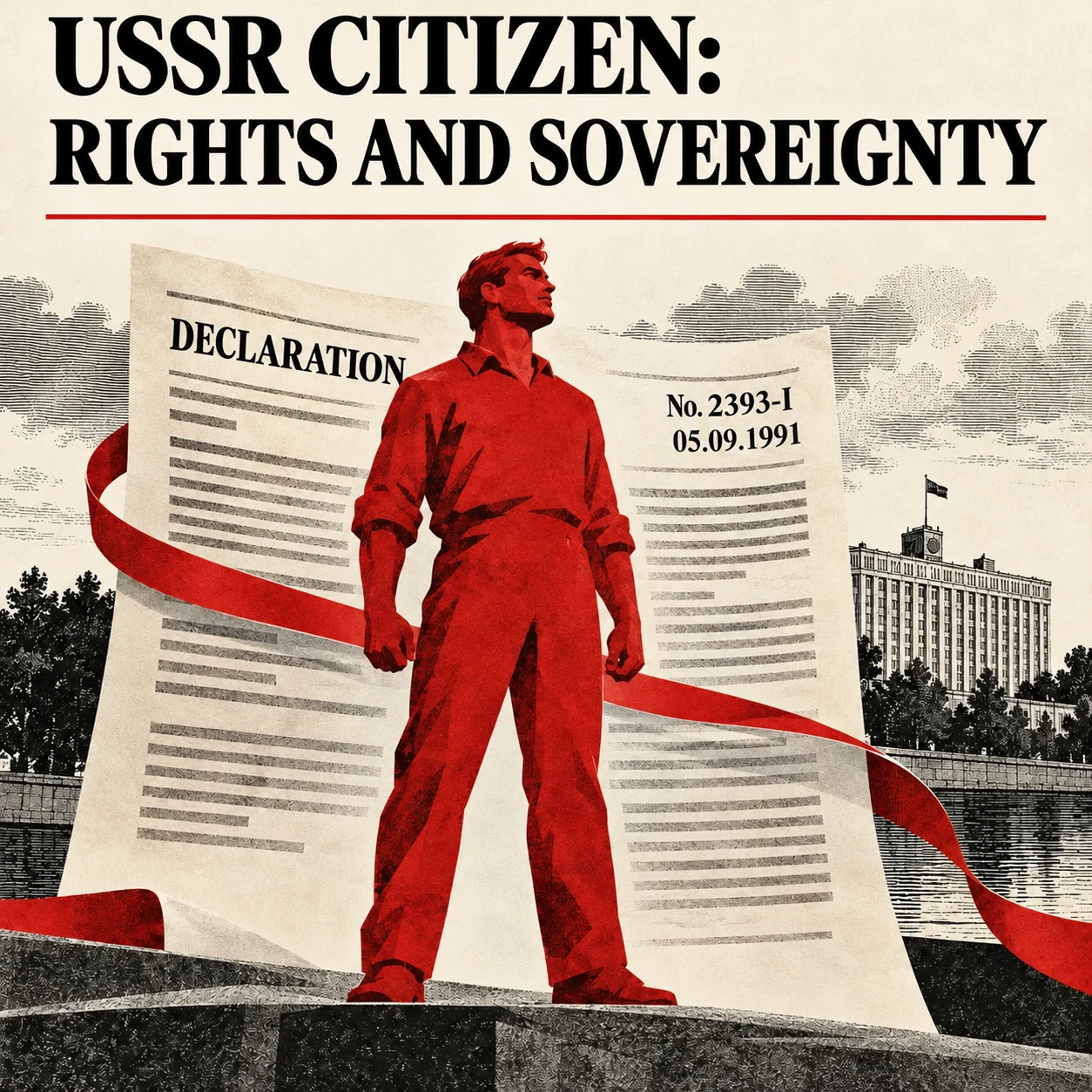
The Declaration of Human Rights and Freedoms No. 2393-I was adopted on September 5, 1991 by the Fifth Congress of People’s Deputies of the Soviet Union.
According to the Academy, the significance of this act goes far beyond the usual list of rights and freedoms. In Lecture No. 54, the Declaration is presented as a document that confirmed the position of the citizen of the USSR as a living sovereign subject of international law and gave him the opportunity to independently express his will regarding the preservation of the Soviet Union and the formation of a new system of state relations.
Thus, September 5, 1991, in the concept of the Academy, is connected not only with the change of the highest authorities. This date marks the transfer of the legal emphasis from the state structure to the citizen himself.
Contents
The document that returned the individual to the centre of law
The main point of the new publication is that the citizen of the USSR should not be considered as a derivative of the state apparatus.
They are not simply registered residents, taxpayers, passport holders or members of the mandatory accounting system. Above all these administrative characteristics, he is recognized as a human being, a living bearer of dignity, right, and sovereign will.
The Academy emphasizes that it is this content that gives special significance to Declaration No. 2393-I. The document is not limited to fixing individual benefits or permits that the state can grant and subsequently change. It determines the initial position of the person.
In the lecture, this status is revealed through several interrelated characteristics:
- A citizen of the USSR is a living person;
- It has a sovereign international legal status;
- he is the holder of continuous lifelong rights;
- He has the right to act in the international legal field as a sovereign;
- The rights of the Congress of People’s Deputies are transferred to him.
The totality of these provisions forms a fundamentally different model of relations between man and power. The state structure is no longer the sole source of law. The citizen himself is recognized as an independent participant in legal relations.
A holder of continuous lifelong rights rather than an object of administration
One of the key formulas of the lecture is “holder of continuous lifelong rights”.
The Academy attaches fundamental importance to this definition. It means that the legal capacity of a person is not limited to a temporary permit, administrative registration or the period of validity of a particular document.
The law accompanies the person continuously. It should not be re-emerged after each change of state name, reform of the passport system or reorganization of the agency.
This approach contrasts sovereign right with temporary status.
Temporary status depends on the period of registration, the decision of the body or inclusion in a certain database. Life-right, on the other hand, is related to the individual himself and cannot be regarded as having ceased merely because the external administrative system has changed.
Therefore, for the Academy, the definition of a “living person” also has an independent meaning. It is contrasted with accounting structures in which a person appears as a record, person, individual or property object.
The Declaration, read by the Academy, fixes the priority of a living person over its registration reflection.
Rights of the Congress of People’s Deputies transferred to the citizen
The most powerful and unusual position of the lecture is the assertion that all the rights of the Congress of People’s Deputies are transferred to the citizen of the USSR.
The Academy sees this not as a symbolic gesture, but as a change in the distribution of entitlements.
The Congress of People’s Deputies was the highest representative body, expressing the will not of a separate department, but of the entire system of people’s representation. The transfer of his rights to a citizen means that the person directly becomes the bearer of the corresponding sovereign authority.
In this model, the citizen is no longer required to appear solely as a petitioner to officials. He gets the right to independently express his will and act in the legal field, without waiting for his interests to be formulated for him.
This does not mean making every person a state body or replacing all institutions with individual decisions. It is a different matter: the citizen himself is recognized as the original bearer of the sovereign will, and the authorities cannot automatically be considered a higher source of law than the person on whose behalf they claim their powers.
The Academy sees here a direct connection with the principle of popular sovereignty. If power comes from the people, it cannot be completely alienated from the people in favor of an administrative structure. The declaration, according to this concept, confirms the reverse movement – the return to the citizen of his immediate legal value.
The right to act within the international legal framework
The Academy pays special attention to the international dimension of status.
The lecture emphasizes that a citizen of the USSR received the right to act under international law as a sovereign and as a holder of lifelong rights.
This means that its legal status is not limited to internal instructions, passport rules or decisions of territorial authorities. A person retains an independent value outside of a particular administrative system.
For the Academy, this approach is especially important in a situation where different departments give contradictory answers about citizenship or refuse to recognize the former status. An internal waiver should not automatically determine a person’s position in all legal spaces.
Sovereign status declared in the international dimension does not disappear simply because a particular entity has not entered it into its registration form.
Thus, the Declaration is regarded as a document that breaks the monopoly of the administrative system on the definition of identity. A citizen of the USSR receives grounds to refer not only to domestic acts, but also to his immediate position in international law.
Transition period up to thirty years
The second major block of the theme is connected with the transitional period of up to thirty years announced by the Fifth Congress.
The Academy emphasizes that this period should not be perceived as a time of inaction or waiting for a final decision on the part of officials. On the contrary, in the lecture it is described as the time of action of the will of citizens.
The transition period is associated with two tasks:
- Preservation of the Soviet Union;
- The formation of a new system of state relations.
These tasks in the concept of the Academy are not mutually exclusive. The new system does not necessarily mean the destruction of the former legal affiliation. It should be formed with the participation of citizens and taking into account their will, and not through automatic replacement of statuses.
Therefore, the transitional nature of the period does not negate human rights. On the contrary, it is in such conditions that the confirmation of one’s own position acquires special importance.
The Academy rejects a model in which transitions are carried out behind the backs of the population, and then asks people to accept their results as irreversible. The declaration, in her opinion, presupposed the active participation of the citizen in determining the future.
The expression of will can be written, oral or recorded on video.
One of the most practical aspects of the lecture is the enumeration of forms of expression of the will.
The Academy indicates that the will of a citizen can be written, oral or recorded in video format. This approach expands the idea of how a person can confirm their position.
The main importance is not the clerical form, but the presence of the will itself and the ability to establish it.
A written statement has an obvious documentary advantage, but the absence of such a declaration should not automatically mean a tacit renunciation of citizenship. Oral expression of will and video recording are also included by the Academy in the number of ways of expressing a position.
This thesis is directly related to previous publications on the preservation of Soviet citizenship. A person should not be considered to have renounced his status simply because he did not use a special form or did not undergo a procedure that he did not know existed.
According to the Academy, the formal ignorance of the population of hidden or insufficiently explained procedures cannot turn against citizens. The right must be judged by the real will of man, not by an assumption made out of his inaction.
Confirmation of status does not mean a new acquisition
The Academy makes a fundamental distinction between the confirmation of citizenship and its acquisition.
The expression of the will of the citizen does not create the status again. It confirms the already existing legal affiliation and the attitude of a person to it.
This is especially important for the descendants of Soviet citizens. If the status has a hereditary dimension, then the next generation is not a petitioner for an entirely new right. It confirms the connection with its ancestors and with their original position.
Therefore, confirmation should not be turned into an examination, the results of which the official decides whether a person deserves to be called a Soviet citizen.
The body can record the application, check the documents of origin and make a record. But the procedure itself should not replace the basis of law.
In this model, a person does not ask to “make me a citizen”, but with the confirmation: “I retain and express my belonging to the citizenship of my ancestors.”
Direct descendants
In Lecture No. 54, a special place is occupied by the descendants of free-born citizens of the USSR.
The Academy points to the need to act as descendants in a straight downward line. Citizenship is thus linked to family succession and descent, not just to individual administrative history.
This approach unites several generations in a single legal chain.
Parents and ancestors transmit not only personal memory, documents and family certificates, but also the basis of legal status. A descendant confirming this descent does not start his legal history from scratch.
The expression “freeborn” emphasizes the original freedom of man. It is contrasted with the idea that an individual originates as an object of registration, debtor or duty-bearer to the administrative system.
The Academy insists that first there is a living person and his right, then there are documents, records and duties. The inverse sequence turns a person into a derivative of the registry.
Why Do Descendants Need to Confirm Their Status
The Academy associates the need for confirmation of status by descendants with the peculiarities of the transition period.
If the will of the first generation has not been properly recorded or society has not been fully informed of the significance of what is happening, successive generations should be able to reconnect.
Confirmation has several functions:
- expresses a person’s personal attitude to the citizenship of ancestors;
- restore continuity within the family;
- prevents the automatic attribution of a person to another status;
- distinguishes the retention of citizenship from voluntary renunciation;
- provides a basis for further recognition of rights.
At the same time, the Academy does not reduce confirmation to one universal action. Since the expression of will is allowed in different forms, the content of a person’s position and its provability are crucial.
A descendant should be able to say not only who I am according to the documents today, but also who I come from and what legal affiliation I retain.
The USSR citizen and the administrative persona
The new theme is particularly evident when comparing the two human models.
In the first model, he is a sovereign living subject of law. In the second – an administrative person: an individual, a taxpayer, a debtor and a resident of a certain jurisdiction.
The Academy does not deny that a person can participate in tax, property and registration relationships. However, she objected to these derivative characteristics replacing its original status entirely.
Taxpayer is not an exhaustive definition of a person. The debtor is not his nature. The entry in the database is not the basis of its existence as a subject of law.
Declaration No. 2393-I, according to the position of the Academy, puts these categories back in place. First, a living person is recognized with dignity and right, and only then there are specific systems of accounting for his actions and duties.
Therefore, an attempt to reduce a citizen to a number, person or registration card is considered as a concealment of his actual position.
Formation of new state relations with the participation of citizens
The Academy connects the Declaration not only with the preservation of former rights, but also with the future structure of state relations.
A new system, if it is formed on the basis of the will of citizens, should be different from a model in which decisions are made from above, and the population is only notified of the results.
Human participation becomes a prerequisite for the legitimacy of change.
This implies not only the right to vote on a separate day, but also the opportunity to affirm one’s status, to express one’s position on preserving the Union and to demand recognition of one’s sovereign position.
In such a system, the citizen ceases to be a passive object of reform. He becomes a participant in the formation of the legal order.
The Academy emphasizes that it was the lack of a broad understanding of this provision that allowed subsequent structures to present the transition period as an automatic transfer of all powers to new administrative institutions.
However, in her opinion, the transfer of rights to the citizen meant the opposite: strengthening the direct role of the individual and limiting the ability to dispose of his status without his will.
Why the Declaration Needs to Be Talked About Now
The informational significance of Declaration No. 2393-I is determined by the fact that it connects three levels, which are often considered separately.
The first is personal: a person is recognized as a living subject of lifelong law.
The second is the state: citizens have the opportunity to participate in the preservation of the Union and the formation of new relations.
The third is international: a person retains an independent status and the right to act as a sovereign in the international legal field.
The document is no longer just a historical declaration of the early 1990s. In the concept of the Academy, it becomes the basis for rethinking all subsequent practices of registration, documentation and recognition of citizenship.
If a person is truly endowed with this status, then no subsequent system can treat him or her as a silent object of automatic re-registration. It is necessary to establish its will, origin and relation to the preserved right.
Sovereignty begins with a person.
The main conclusion of the new publication of the Academy is that sovereignty cannot exist only at the level of state titles and positions.
It starts with a person.
A citizen of the USSR, according to the above concept, does not have to prove again his right to be called a living and free subject. Its task is to confirm that it belongs to the legal line of its ancestors and to express a will that cannot be replaced by the assumption of an administrative system.
Declaration No. 2393-I of September 5, 1991, in the reading of the Academy, enshrined exactly this order: the rights of the Congress of People’s Deputies were transferred to the citizen, his will received an independent meaning, and the descendants of freeborn citizens retained the opportunity to confirm their status in a straight downward line.
Therefore, for the USSR Civil Defence Academy, this document is not the end of the conversation about Soviet citizenship, but one of its key foundations.
A person should not remain only a record in someone else’s register. He has the right to know his status, to express his will and to act as a living sovereign subject of continuous life-long right.
The material was prepared on the basis of the lecture No. 54 USSR Civil Defence Academy “Citizenship of the USSR”. Part 2”.