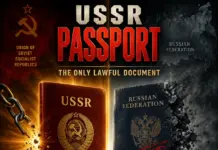























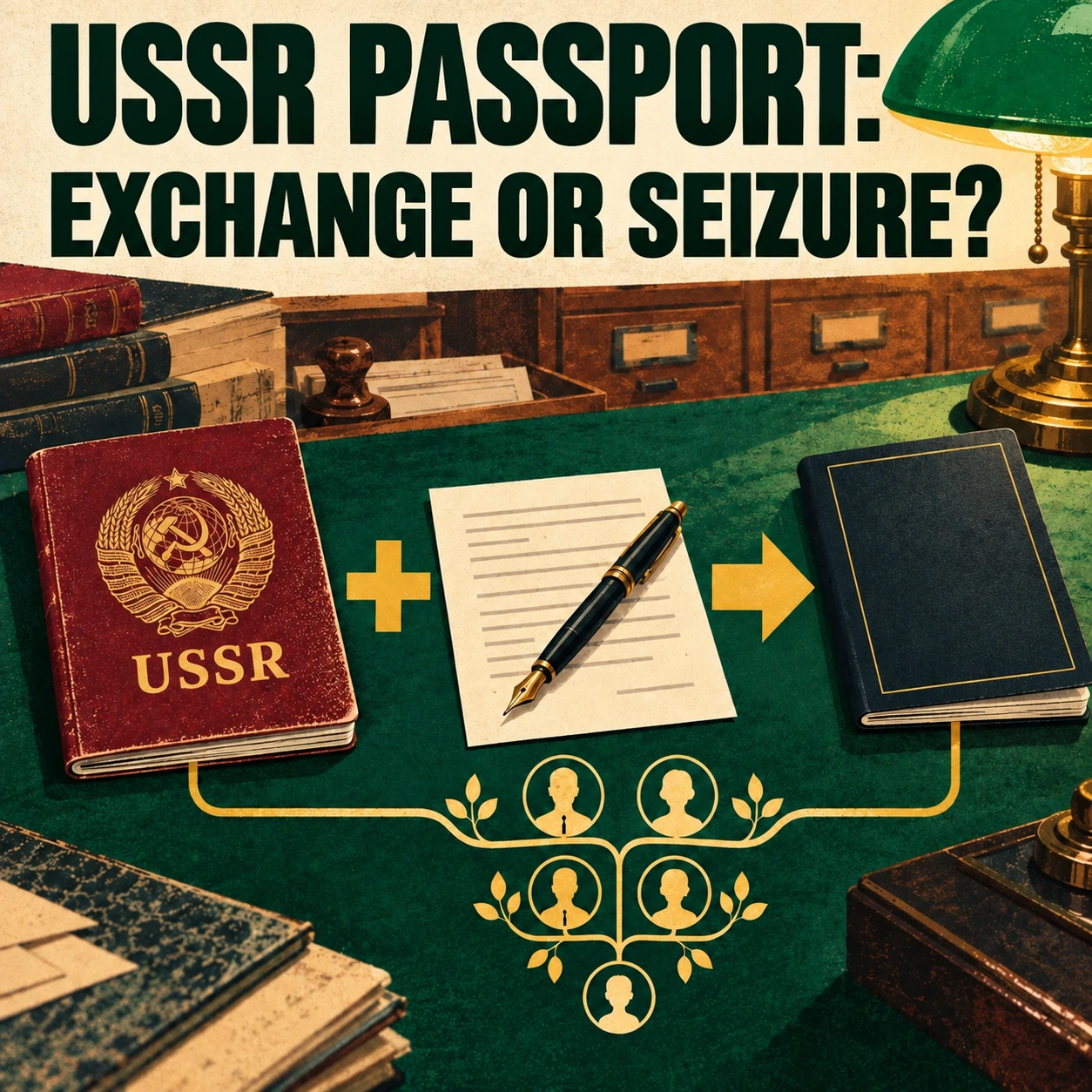
USSR passport exchange in the Academy’s interpretation: voluntary replacement, document withdrawal and the distinction between citizenship and an identity document.
The USSR Civil Defence Academy continues its series of publications on Soviet citizenship. The new material deals with the orders of the Ministry of Internal Affairs of 2001-2002, the ban on the seizure of USSR passports and the voluntary procedure for their exchange. The Academy also declares that Soviet passports, military tickets and civil status acts will remain valid until 2026, and according to the second book of registration – until 2034.
The USSR Civil Defence Academy refers to one of the most important documents in the history of every Soviet citizen – the passport of a citizen of the USSR.
Despite the massive replacement of documents and the development of the habit of perceiving a Soviet passport as hopelessly outdated, the Academy insists that its legal significance cannot be determined only by the year of issue or the appearance of the form.
Lecture No. 54 contains the provisions of the orders of the Ministry of Internal Affairs of 2001-2002, which, according to the above position, prohibited the seizure of Soviet passports and allowed their exchange exclusively on a voluntary basis – on a written application of the owner and without coercion.
These provisions change the usual perception of passport reform. If the exchange was voluntary, then the rejection of it could not automatically turn a person into a violator. If the seizure was prohibited, then the owner was not obliged to simply give the document without preserving evidence of its further fate. And if the Soviet documents continued to be valid, they could not be considered legally null and void just because of the appearance of a new passport sample.
According to the Academy, the Soviet passport remains not only a family heirloom, but also an important evidence of origin, personal history and legal status.
Contents
Passport replacement did not mean the disappearance of the Soviet document.
The main thesis of the new publication is that the introduction of a new passport does not in itself destroy the legal history of the previous document.
The passport system may change for organizational reasons: the forms, methods of protection, details and the procedure for issuing are updated. However, the facts that were confirmed by the previous passport do not automatically disappear.
The document contained information about the person, his birth, registration, family circumstances and belonging to the USSR citizenship system. The subsequent replacement of the form is not able retrospectively to change these circumstances.
The Academy therefore proposes to distinguish between two issues:
- Is it possible to use the old document for all day-to-day operations?
- Whether it retains value as proof of identity, origin and former legal status.
Even if the scope of practical use of a document has changed, it does not mean that it has ceased to be legally significant evidence.
Therefore, the Academy considers the attitude to the Soviet passport as waste paper or a useless souvenir to be fundamentally wrong.
Orders of the Ministry of Internal Affairs of 2001-2002: prohibition of withdrawal
A special place in the lecture is occupied by the orders of the Ministry of Internal Affairs of 2001 and 2002.
According to the position set forth by the Academy, these acts enshrined a ban on the seizure of USSR passports and at the same time determined the voluntary procedure for their exchange for passports of the Russian Federation.
The prohibition of withdrawal is of fundamental importance. It means that the replacement of the document should not have been carried out through the forced confiscation of the old passport from the owner.
The person was not deprived of the opportunity to dispose of his document consciously. He was not obliged to hand it over to any official on one demand and without registration of the further fate of the passport.
The Academy emphasizes that the prohibition of seizures protected not only the paper form. He defended the owner’s right to retain evidence of his personal and legal history.
Compulsory withdrawal could deprive a person of a document without his will and at the same time create the impression that the former status has been permanently abolished. That is why voluntarism and the design of the will acquire such importance.
Exchange only at the written request of the owner
The second key element of the order is the written statement of the holder of the Soviet passport.
According to the Academy, this requirement shows that the initiative of the exchange should have come from the individual. The owner of the document expressed his own will, rather than simply submitting to a general campaign to replace it.
A written statement has several functions:
- confirms who initiated the exchange;
- fixes the intention of the owner;
- It distinguishes voluntary action from coercion.
- creates a documentary basis for further operations with the passport;
- It makes it possible to establish the content of the will.
Without such a statement, one cannot automatically assume that the person himself has decided to part with the document and accept all the consequences associated with it.
The Academy emphasizes the wording about the inadmissibility of coercion to a transaction. In her understanding, the exchange of a passport is not just a technical issuance of a new form, but an action that must be performed with the consent of the owner and with the understanding of its legal meaning.
Voluntary exchange requires understanding the consequences
The Academy emphasizes that formal consent does not always mean actual voluntary consent.
A person can sign an application because he or she has been told to replace the document without explaining whether he or she retains his or her former citizenship, what the old passport means, or whether it can be kept in a personal archive.
If the owner is not disclosed the consequences of the procedure, his consent becomes incomplete.
Voluntary exchange involves not only the absence of physical coercion, but also the presence of understandable information. A person should understand what document he transmits, to whom, for what purpose and what confirmation he receives in return.
According to the Academy, the mass replacement of passports was accompanied by a lack of such understanding. People saw the practical need to obtain a valid document, but did not realize that the surrender of a Soviet passport could later be interpreted as an agreement with a complete rupture of the previous legal history.
The Academy strongly disagrees with this interpretation. Obtaining a new document for everyday life does not in itself mean renouncing ancestral citizenship.
Why a passport should not be surrendered to an unidentified destination
The lecture separately notes that many people handed over Soviet passports without issuing a certificate of responsible custody.
The Academy considers this a serious mistake. The owner not only lost the original document, but also did not receive confirmation of where the passport is, who is responsible for it and under what conditions it is stored.
The act of responsible storage in such a situation should have recorded the very fact of the transfer of the document without destroying its value for the owner.
Depository and irretrievable alienation are different actions. If the person did not intend to permanently part with the document and lose all the evidence associated with it, the procedure should reflect storage, not destruction.
The absence of such an act creates uncertainty. Years later, a person may not know where his passport is, whether it has been preserved and how to confirm previous records.
Therefore, the Academy draws attention to the need for careful treatment of all surviving originals and copies of Soviet documents.
USSR passport as proof of legal history
In the concept of the Academy, the Soviet passport performs several interrelated functions.
First, it confirms the identity of a particular person in a certain historical period.
Secondly, it contains information that allows you to restore kinship and origin.
Third, it connects people to the USSR documentary system and helps establish continuity between generations.
Finally, it serves as material evidence that Soviet citizenship existed not as an abstract idea, but as a real system of personal registration.
Therefore, the passport of parents and grandparents can be important not only for the owners themselves, but also for their descendants. It helps to restore the family documentary chain and confirm the origin of citizens of the USSR.
The Academy emphasizes that the value of such a document cannot be measured by the ability to present it in a conventional institution today. Its significance can be manifested in the restoration of family history, the registration of confirmations or the defense of succession rights.
Military identity cards and civil-status records also remain important
In the lecture, the USSR passport is considered together with the USSR military card and acts of civil status.
This is an important extension of the topic. A person’s legal history is not limited to a single identity card.
The military card fixes the attitude of a person to the system of military accounting and service. Acts of civil status confirm birth, family ties and other circumstances, without which it is impossible to restore the origin.
Together, these documents form the personal archive of the citizen.
The Academy points out that the annual resolutions and acts of the Government confirmed the validity and legality of Soviet documents throughout the continental shelf of the Russian Federation trading company until 2026 inclusive.
In this presentation, the recognition of validity is not a private concession to the owners of old forms. It covers the entire documentary system necessary to preserve the continuity of the civil status.
If all Soviet documents were completely invalid, there would be no possibility of directly corroborating many of the underlying facts. Therefore, their preservation has implications for the entire legal construct, not just for nostalgia for the past.
2026: Why documents cannot be automatically invalidated
The reference to 2026 occupies a special place in the argumentation of the Academy.
According to her, Soviet passports, military tickets and acts of civil status retained their recognized validity up to this date. Consequently, it was not possible at any time to declare them completely irrelevant merely on the basis of the introduction of new forms.
For the Academy, this confirms that the replacement of documents did not mean the immediate destruction of the previous system.
The validity of old documents and the use of new ones could exist in parallel. The new passport did not make the previous act of civil status false, and the new form of accounting did not cancel the reliability of birth and origin information.
The Academy draws attention to the fact that the issue of validity should be decided by the specific type of document and its purpose, and not by the general phrase “this is no longer valid.”
Such a phrase without specifying the reason, date and scope only creates the appearance of certainty.
The second register and extension until 2034
A separate information occasion is associated with the statement on the extension of the validity of Soviet documents until 2034 according to the second book of accounting.
The Academy attributes this extension to illegal actions or omissions of the Russian Federation trading company. In its concept, responsibility for violations should not be shifted to citizens and lead to the destruction of their evidence base.
If the state or administrative structures have not performed the necessary actions, the documents of citizens may not automatically lose their validity to the detriment of the owners.
Extension is therefore regarded as a measure of legal continuity.
The second book of accounting, according to the logic of the lecture, reflects an additional level of registration of consequences and obligations. Pointing to it shows that the validity of documents can vary depending on the accounting system, and superficial knowledge of one date does not give a complete picture.
For the Academy, the period up to 2034 means the continued ability to use Soviet documents as part of the evidence system and not allow them to be declared legally non-existent.
The fifteen-year passport regime
In the lecture, the passportization regime is associated with a fifteen-year period of acquisitive prescription, and according to accounting books – with a period until 2018.
The Academy sees this deadline as an attempt to anchor the new documentary system through long-term factual application.
However, the duration of the use of a new passport, in her opinion, cannot be the only basis for concluding that a person voluntarily renounced Soviet citizenship.
A person could use the document out of practical necessity, without having full information about the consequences attributed to the procedure. The passage of time itself does not make up for the lack of informed consent.
That is why keeping an old passport is of additional importance. It makes it possible not to reduce the entire history of a person to a new document and preserves the material evidence of the former status.
According to the Academy, the terms of passportization should be considered together with the prohibition of seizure, the voluntary exchange and the continuation of the validity of Soviet documents, and not in isolation.
New passport does not abolish old citizenship
The Academy consistently distinguishes between the use of the document and the change of citizenship.
The holder of the passport of the Russian Federation shall not automatically be considered to have renounced the citizenship of the USSR. Obtaining a new form may have been necessary for work, travel, registration and other day-to-day activities.
Household necessities do not equal legal refusals.
A Soviet person can use a new passport and visa document as a temporary identity card and at the same time retain their original legal affiliation. For the Academy, this is not a contradiction, but a division of functions.
The passport confirms certain information and allows you to perform actions. Citizenship is determined by the law, origin and will of a person.
Therefore, the issuance of a new passport should not be considered as an event after which all previous documents and statuses automatically disappear.
Preserving a family’s documentary archive
The Academy attaches great importance to the practical preservation of Soviet documents.
First of all, it is necessary to protect the original passports, military tickets, certificates and other acts of civil status. They should not be considered useless simply because of age or wear.
It is also important to keep records of relatives’ documents, as family legal history can be reconstructed over several generations. Even if the original was transferred during the exchange, it is useful to keep available copies, photos and details about the details.
If the document is transferred for temporary use or storage, the Academy indicates the need to document the transfer. A person should understand to whom he gave the original, for what purpose and what act confirms the further fate of the document.
This is not a new way of obtaining citizenship. They help to preserve evidence of an existing personal and family history.
The Academy emphasizes that the restoration of rights does not begin with the destruction of old evidence, but with their preservation and correct understanding.
Why the topic of the USSR passport becomes especially relevant
The relevance of the topic is determined by several circumstances.
First, a significant part of the population either possessed Soviet passports themselves or are descendants of their owners. Consequently, the documentary link with the USSR persists in millions of families.
Secondly, the lecture outlines specific dates – 2026 and 2034 – that do not allow us to consider the issue as long overdue.
Third, the voluntary nature of the exchange makes it necessary to reconsider the widespread notion of universal compulsory rejection of old documents.
Finally, the ban on withdrawal returns the passport holder to an active role. He was not obliged to silently part with the document, but had the right to formalize his will and preserve evidence.
Therefore, the passport issue becomes a continuation of the general conversation about citizenship. It shows how the change of status could be consolidated through routine procedures to which the population did not attach legal importance.
The document should be preserved and the legal history should be restored.
The main conclusion of the new publication of the Academy is that the Soviet passport can not be considered an empty formality or hopelessly outdated paper.
According to the position of the Academy, the orders of the Ministry of Internal Affairs of 2001-2002 prohibited its withdrawal, the exchange was allowed only on a written application of the owner and without coercion, and the validity of Soviet passports, military tickets and civil status acts continued to be confirmed until 2026, with the extension of the second ledger until 2034.
This argument returns the Soviet document to its independent meaning.
It remains evidence of identity, origin and belonging to the legal history of the USSR. Its replacement with a new form should not mean the destruction of this story, and the transfer without proper registration should deprive a person of evidence of his status.
The USSR Civil Defence Academy insists that before declaring a Soviet passport invalid, it is necessary to answer by what act it was forbidden to keep it, why the exchange required a voluntary application, and on what grounds the facts confirmed by it ceased.
The document may change form. But personal and family legal history doesn’t disappear with the old form.
The material was prepared on the basis of the lecture No. 54 USSR Civil Defence Academy “Citizenship of the USSR”. Part 2”.