





























The legal person and the individual in the Academy’s maritime model: an examination of registration, terminology and its interpretation of personal legal status.
The USSR Civil Defence Academy continues a series of publications on the hidden mechanisms of changing the civil status. The new material deals with the creation of persons for citizens of the USSR in the form of individuals, their registration as sea vessels, owners, bareboat charter, freight and cargo, as well as the connection of this system with bank accounts. Special attention is paid to the law No. 280-FZ of 2020 and the transfer of Soviet people to the category of refugees and settlers.
The USSR Civil Defence Academy addresses one of the most complex and closed aspects of the modern registration system: the ratio of a living person and a legal person created for him.
According to the position of the Academy, a citizen of the USSR and a registered individual are not identical concepts, although in everyday life these categories are deliberately mixed.
The living man has descent, dignity and a lifelong right. The persona is an accounting structure through which a person is included in administrative, financial and property relations.
As long as a person uses the persona as an instrument, there is a difference between him and the record. But when the system begins to claim that a person is this record, a substitution occurs: a living subject of law disappears behind the registration form created for him.
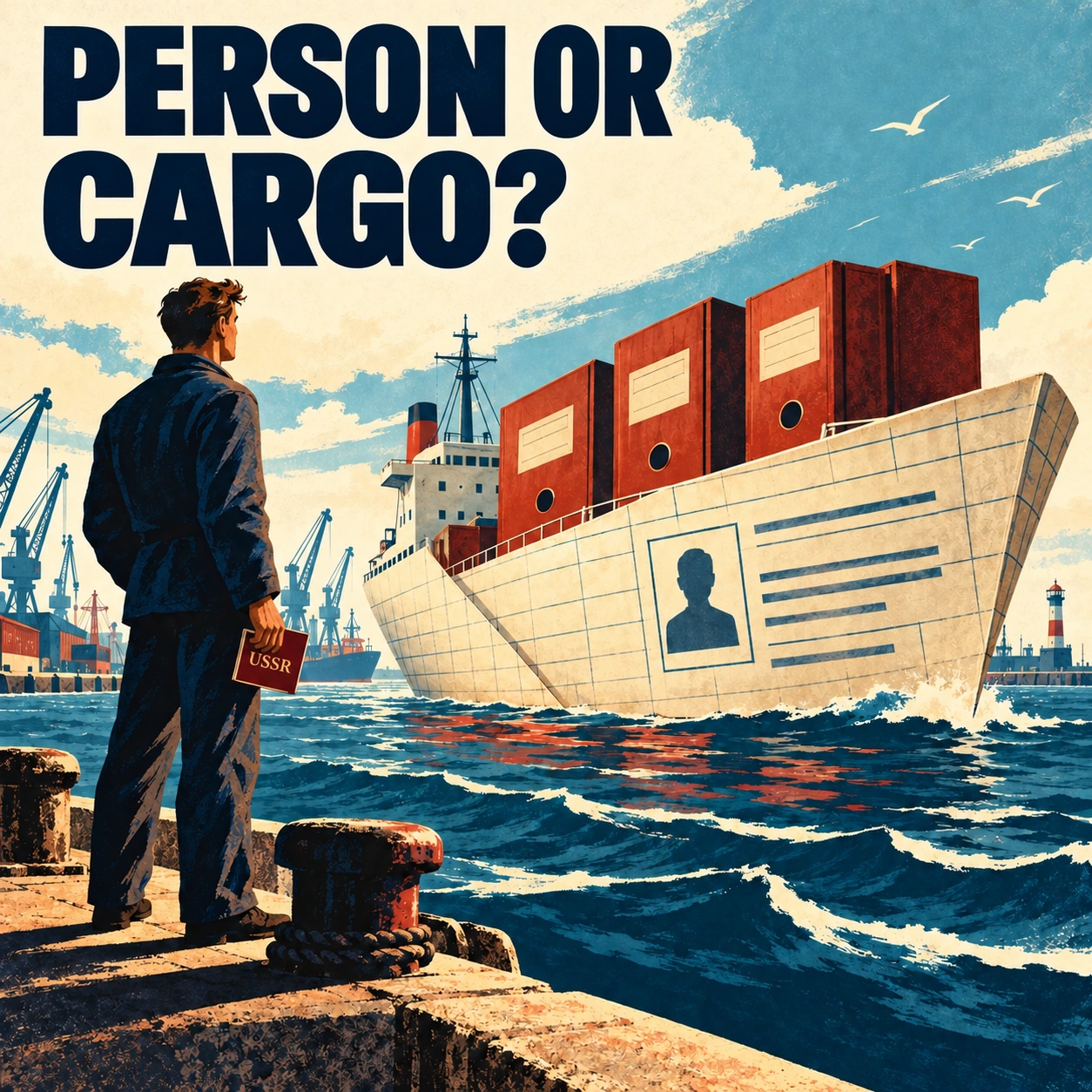
Lecture No. 54 explores this model through the law of the sea. The Academy claims that individuals were registered as sea vessels and boats, privateer ships, owners of ships and at the same time as bareboat charter. In the domestic central banking system, they were also associated with the freight and cargo categories on the bill of lading.
For the Academy, this is not a set of random metaphors, but a consistent description of the mechanism by which a person becomes an object of transportation, chartering and financial accounting.
Contents
The living individual and the legal persona: where the distinction lies
The Academy begins with a distinction, without which it is impossible to understand the entire subsequent construction.
A living person exists regardless of whether or not a record is made of him. His birth, descent and human dignity do not depend on the registration number.
The persona is different. It is created in documents and records so that the system can identify a person, accrue payments, formalize obligations and link him with certain legal operations.
The persona itself is not necessarily a violation. The problem arises when rights and obligations begin to apply not to a living person with his consent, but to the created record, after which the record completely replaces the person.
The Academy calls this process the transfer of a citizen of the USSR to an individual.
As a result, a person is no longer regarded as a sovereign bearer of rights. It is interacted with as an administrative unit, taxpayer, debtor or object of accounting. On the surface, it looks like it’s still about him.
It is the hidden coincidence of the name that allows the system to act imperceptibly: a person sees his own data and does not assume that the legal content of the record may differ from his actual position.
Why the model associates a natural person with a seagoing vessel
The most unusual element of the lecture is the statement about the registration of individuals as ships and boats.
The Academy explains the significance of this model through the peculiarities of maritime accounting. The ship doesn’t just have a name. It is registered, it receives identification characteristics, is included in the documents of ownership, chartering, transportation and liability.
If a person’s persona is described by such a model, it ceases to be just a citizen’s card. It is subject to a special registration regime.
In this mode, a person can be associated with categories that initially relate to property and maritime transportation. Its status is determined through ownership, management, freight, cargo and responsibility for the movement of the relevant object.
The Academy notes that in ordinary life, a person does not receive notification that his person is described in this way. He sees a passport, a tax number, or a bank contract, but he does not see an internal classification that gives these documents a different meaning.
Therefore, the marine model remains hidden not because a person is unable to understand it, but because he is not shown the very structure of accounting.
A privateer as a special registration category
In the lecture, individuals are also associated with privateer ships.
The Academy includes this category in the overall marine design, emphasizing that it is not a matter of ordinary civil registration of a person at the place of residence.
The privateer designation connects the person with a special legal regime for the use of the vessel and powers in the maritime space. In the interpretation of the Academy, this reinforces the property and admiralty character of the record being created.
For a living person, this classification has fundamental consequences. He may not be represented as a sovereign resident of a territory, but as a participant in a maritime and commercial system, where his position is determined by documents on a ship, cargo or freight.
The Academy believes that this is why many disputes about citizenship rest on misunderstanding. A person speaks about his birth and belonging to the people, and the system responds to him from within a completely different logic – the logic of the registered person.
Parties use the same names and document numbers, but refer to different entities.
Vessel ownership and bareboat charter: the persona’s dual position
The Academy emphasizes that citizens of the USSR were registered both as owners of sea vessels and as bareboat charters.
This dual position is key to understanding the system.
On the one hand, a person is ascribed the position of owner. On the other hand, his persona is included in a chartering relationship, where the court without a crew is managed by the other party.
A bareboat charter in this model allows you to separate formal ownership and actual management. A person can be listed as the owner, but do not control how the object associated with his person is used.
The Academy sees here an analogy of the position of a citizen who is formally considered a bearer of rights, but the actual disposal of his status, documents and obligations is carried out by the administrative or financial system.
This creates a design of nominal ownership without real control.
A person can be told that all the documents are drawn up for him and therefore he bears full responsibility. But it is not revealed to him who manages the person concerned, what transactions are performed with her, and how rights and revenues are distributed.
For the Academy, this is a form of hidden alienation: the owner is kept on paper, and the management is out of it.
Freight and cargo on the bill of lading
The next level of the model is related to the bill of lading.
In the lecture, citizens of the USSR are described as freight and cargo on the bill of lading of the trading company “Russian Federation” on balance sheets and accounts of the internal central banking financial system.
The Academy explains that the bill of lading in this design connects the person with the document for transportation. The cargo has the name, quantity, value, sender, recipient and conditions of transfer. If a person is included in the accounting according to this model, his persona begins to function as a property unit in the chain of obligations.
This fundamentally changes the position of a person.
A sovereign citizen is not a cargo. It may not be transferred, chartered or recorded as the subject of carriage without its conscious participation. However, the created persona can be used in such operations formally, and then the consequences of the operations are attributed to the person.
The Academy believes that through such a design, a person is separated from his property rights. He ceases to be the party making claims, and becomes the object in respect of which calculations are made.
So the marine model doesn’t just describe a person in unusual terms. It creates an opportunity to transfer it from the position of the subject to the position of the object of accounting.
Central Banking System and Financial Importance of Registration
The Academy emphasizes that the relevant records do not refer to the abstract world system, but to the internal central banking financial system.
This clarification is important because it links the maritime classification to specific balance sheets and accounts.
In such a model, the registration of an individual can have financial implications. The person is included in the calculations, liabilities, assets and liabilities are associated with it, and the person himself sees only external results: accruals, debts, payments and claims.
The Academy notes that the financial record does not necessarily reflect the actual property status of a living person.
A citizen of the USSR may have rights to public property and hereditary interests, but in the banking system his person is simultaneously presented as a debtor, cargo or object of chartering. There is a discrepancy between the original status and the created balance.
According to the Academy, this discrepancy allows to keep a person in the position of a permanent performer of obligations, without disclosing his rights to assets and claims.
Passport with machine-readable record as a travel document
The Academy associates the maritime and financial model with the issuance of a passport and visa form containing a machine-readable record.
According to her, the presence of a machine-readable zone emphasizes the function of the document as a means of automated identification of a person when moving and crossing control procedures.
A person perceives a passport as a proof of citizenship. However, the Academy proposes to distinguish between this usual function and the road purpose of the form.
The travel document serves the movement of the person, its recognition and inclusion in transport and registration procedures. It may be convenient to use, but that does not make it definitive proof of the original legal status.
Machine-readable recording connects a person to a digital system. It is not his sovereign will that is read, but the code of the person. That is why the document is easily integrated into the broader model of maritime and banking accounting.
The Academy does not call for the use of machine-readable strings as proof of loss of citizenship. She emphasizes that the presence of a passport and code does not answer the question of which person is created, how it is classified and what rights of a living person are preserved outside this record.
Law No. 280-FZ: a new turn from an individual to a refugee
The next document that the Academy includes in this system is the federal law of July 31, 2020 No. 280-FZ “On Amendments to the Federal Law “On Refugees”.
According to the position of the Academy, through appropriate changes, citizens of the USSR in Russian jurisdiction received the characteristics of refugees.
This category is fundamentally different from the position of an indigenous citizen.
A refugee is seen as a person forced to seek protection and recognition of his or her situation. Its presence is associated with displacement, loss of former stability and the need for special status.
If a person born on the territory of the USSR and descended from Soviet citizens is transferred to such a category, his original connection with the territory is hidden.
He ceases to be regarded as the master of his legal history and becomes a person who requires permission for recognition and placement.
The Academy sees here a continuation of the same logic that previously manifested itself in replacing a residence permit with a temporary registration: permanent affiliation is replaced by the status of a displaced or temporarily residing person.
A settler registered with a Roman consul
In the lecture, the refugee status is further linked to the position of a settler at the Roman consul in Muscovy.
The Academy uses this formula to describe a system in which a person is granted a seat but does not recognize his or her original sovereign title.
The settler is in the territory under conditions determined by the external authority. It may receive minimum guarantees and permits, but does not act as an independent source of law.
According to the Academy, such a model preserves the appearance of caring for a person, while depriving him of a decisive voice in matters of property, citizenship and governance.
The settler gets a place in the system, but not control of the system.
It is in this way that his position differs from that of a sovereign citizen of the USSR. The first depends on the decision of the consul or administrative structure, the second has a right that precedes registration and does not arise from the mercy of an official.
The proposed chain: individual, persona, vessel, refugee, settler
The Academy proposes to consider all these categories not as disparate statements, but as a sequential chain of status transformation.
In the first stage, a living person is replaced by a person created for him.
The second person is included in the maritime registration system as a ship or other object of the law of the sea.
In the third, it is associated with freight, cargo, bill of lading and financial balances.
The fourth person receives a document servicing the movement of this person.
On the fifth, his legal status is described through refugee status.
At the final stage, he is fixed as a settler, who is given a limited regime of residence and minimal social guarantees.
As a result, the original sovereign status is hidden under several layers of derivative characteristics.
Each step can look like a technical procedure. But together they create a system in which a person can no longer claim his rights directly, because the answer is given to him in the language of the last assigned category.
Why people don’t notice a change in status
The Academy explains the invisibility of this system by the fact that the external life is preserved almost unchanged.
A person continues to go to work, pay taxes, receive documents and use banking services. His name remains the same, the photo in the passport is recognizable, the address is familiar.
It is not the external biography that changes, but the legal description.
Most people do not feel the moment of transition. They learn about the consequences only when faced with a denial of rights, unclear obligations or the inability to prove their original position.
The Academy emphasizes that the absence of a subjective sense of change does not prove voluntary consent. On the contrary, if the procedure was hidden, the person could not consciously choose its consequences.
Consent must be informed. Without disclosure of the persona model, maritime registration, and financial significance of the records, it cannot be asserted that the citizen has voluntarily accepted the appropriate status.
Property consequences of turning an individual into a registration object
Of particular concern to the Academy is the property side of the system.
If a person is treated as a cargo, freight or incapacitated person, his or her ability to make claims is limited. He no longer acts as an independent owner of the right, but becomes an object of management and calculations.
This allows you to separate the actual existence of assets and the ability of a person to claim them.
A citizen may be aware of the existence of a public domain, hereditary rights or Soviet funds, but the system responds to him as a person with limited powers. Access to rights is closed not because the rights have disappeared, but because the category of the applicant has changed.
The Academy considers the change in the category one of the main mechanisms of alienation.
In order to deprive a person of property claims, it is not always necessary to openly abolish the relevant right. It is enough to transfer him to a status in which he is no longer recognized as the appropriate subject of the claim.
Why use of a persona should not erase the living individual
The Academy does not state that a person is obliged to completely abandon documents, banking relationships, and administrative procedures.
The main question is whether the distinction between a living person and the person he uses remains.
A person can participate in the system, but must not disappear within it. He may present a passport, but the passport must not exhaust his legal identity. It may enter into a contract, but the contract must not covertly convert it into a cargo or deprive it of its sovereign status.
To do this, it is necessary to understand in what capacity the action is performed.
The Academy insists that the use of a persona is not an automatic consent to all the hidden characteristics that the system has attributed to it. A living person retains the right to demand disclosure of these characteristics and to challenge their application.
The persona must be the instrument of man, not his invisible possessor.
Restoration begins by distinguishing the rights-holder from the record
The main practical conclusion of the publication is the need to learn again to distinguish between a person and his registration reflection.
To this end, the Academy proposes to ask the system fundamental questions:
- who is the subject of a specific legal relationship;
- Whether the record of a physical person coincides with a living person;
- What rights and obligations are assigned to the person;
- What operations were carried out without the knowledge of the person;
- How does the passport relate to the financial and maritime model?
- On what grounds did a citizen of the USSR find himself in the category of a refugee or a settler?
- Whether he retains the right to make claims on his own.
These questions allow us to get out of a situation in which a person argues only with an individual refusal, without seeing the entire classification system.
According to the Academy, it is impossible to restore citizenship by continuing to accept the unconditional identity of a living person and the assigned record.
A sovereign individual is neither vessel, cargo nor settler
The main result of the new publication of the Academy is that a legal person should not replace a person.
In the concept of the Academy, the registration of individuals as sea vessels, bareboat charter, freight and cargo created a hidden mechanism for including citizens of the USSR in financial and property calculations. Law No. 280-FZ and the subsequent category of refugee added a new level to this system – the transfer of a person from the position of a sovereign resident to the position of a displaced settler.
The USSR Civil Defence Academy states that such a sequence does not reflect the true nature of the Soviet man.
It is not a ship, although its persona can be registered on a marine model. It is not a cargo, although its name may be associated with the bill of lading and balance sheet. He is not a refugee on his own land just because the system has chosen such a category for him. And he does not become a settler whose rights are determined by an outside trustee.
Restoration of rights begins with the separation of the living sovereign person from all derivative records. The persona can be used for calculations. The document can be used for movement. But neither the person nor the document has the right to cancel the origin, dignity and continuous life-long right of a citizen of the USSR.
The material was prepared on the basis of the lecture No. 54 USSR Civil Defence Academy “Citizenship of the USSR”. Part 2”.