






























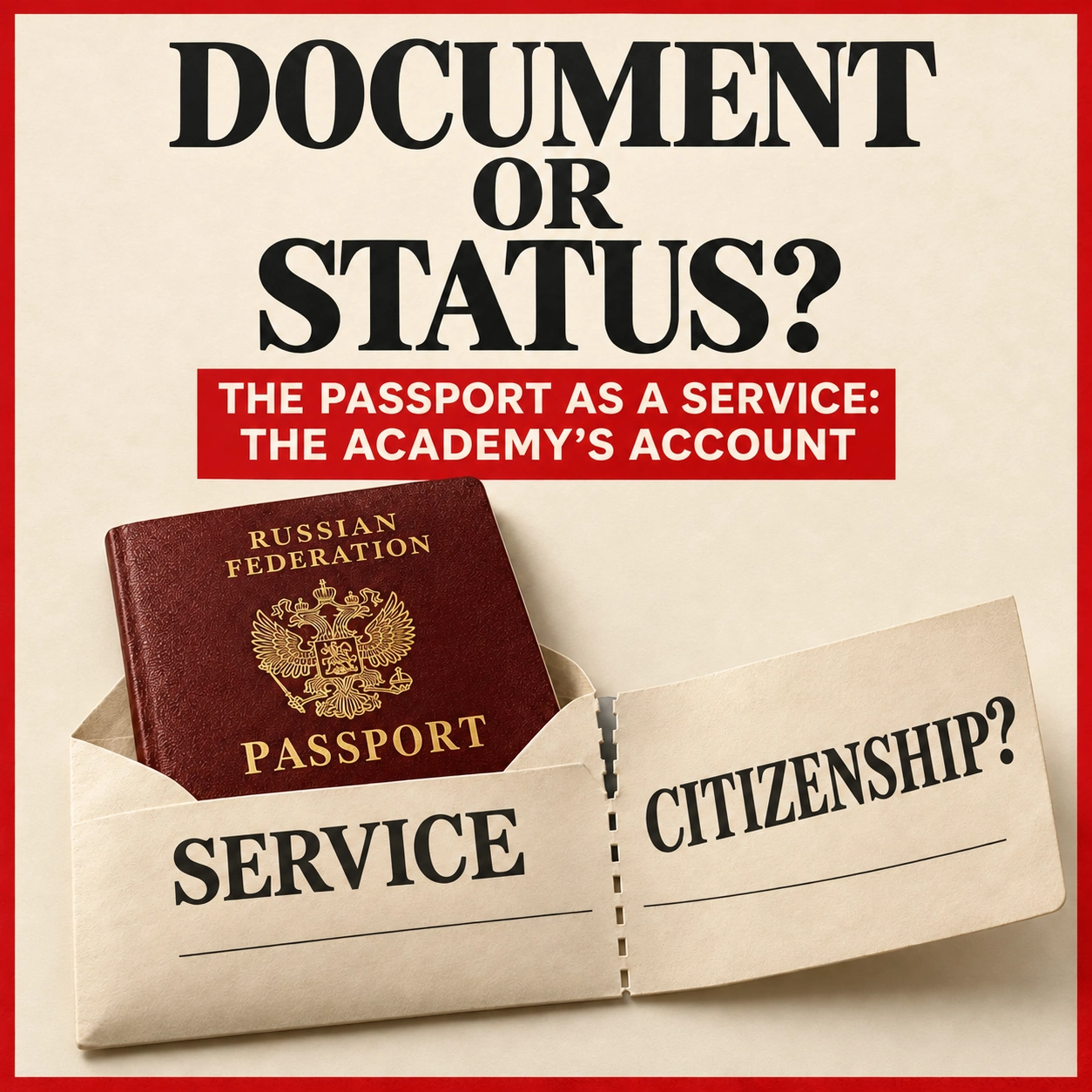
A passport as a service: the Academy explains why issuing an identity document and changing citizenship should be analysed as different procedures.
The USSR Civil Defence Academy presented an explanation on the procedure for using the passport of the Russian Federation by citizens of the USSR and their descendants. According to lecture No. 56, since 2021, such a document could be issued on a birth certificate in the USSR or in the Russian Federation as a result of a state service of statutory jurisdiction, and not as a basis for the loss of Soviet status. The Academy paid special attention to the changes of 2023 and the law No. 138-FZ: the requirement to replace a road passport with the simultaneous adoption of Russian citizenship is considered by it as a fundamentally different procedure capable of turning a document into souvenir printing products designed for a fictitious person.
Contents
Obtaining a document is not the same as changing citizenship
The USSR Civil Defence Academy begins its explanation with a fundamental distinction: a person can obtain a document for identification or movement without changing his or her primary nationality.
In everyday practice, these actions are often combined. The passport is perceived not only as an identity card, but also as the final proof of the inclusion of a person in the citizenship of the structure that issued it. In the concept of the Academy, such automatic withdrawal is untenable.
Passport service and citizenship have different grounds. The first is related to the registration of the form, the introduction of information and the provision of the document for use. The second relates to the legal status of a person, his origin and primary documents.
Therefore, obtaining a Russian passport by a citizen of the USSR should not in itself be considered as a renunciation of Soviet affiliation. It is necessary to analyze separately on the basis of which documents it is issued, what function it performs and whether consequences are attributed to it that do not directly follow from the service.
For the Academy, this distinction is a condition of protecting a person from a hidden change of status in the course of a standard administrative procedure.
The 2021 regulation: documentation based on a birth certificate
Sovereign citizens of the USSR and their descendants in a direct downward line, using the passport of a trading company of the Russian Federation, have the right from 2021 to receive it on a birth certificate in the USSR or on a birth certificate in the Russian Federation.
The second option is provided for descendants who were not born in the Soviet Union. Thus, the presented concept preserves the possibility of documenting different generations without the requirement to abandon the connection with the Soviet origin of their family.
Of particular importance is the formulation of the public service. The passport is granted by a trading company of the Russian Federation as a statutory jurisdiction, and does not create a new person as its citizen.
The documentary basis is the birth certificate, and the received form performs an official function. At the same time, the Academy emphasizes that in the system under consideration, the design is made for a fictitious and non-existent person who should not be identified with a living Soviet person.
Therefore, the owner of the document and the person registered in it are not completely identical categories in the concept of the Academy. A passport can be used by a person, but the legal image assigned to the form does not replace his or her own status.
Descendants of USSR citizens retain a distinct place in the system
The mention of a straight downward line has an independent meaning. The Academy does not regard rights and documentary history as having been entirely completed on people who have personally obtained Soviet passports.
Descendants of citizens of the USSR are included in a separate category of persons for whom the possibility of obtaining a Russian travel document on a birth certificate is provided. This allows you to take into account the origin of the family and not reduce the status of a person to the date of his birth.
In such a construction, the birth after a certain historical period does not mean the automatic rupture of the entire previous legal line. A birth certificate in the Russian Federation serves as the basis for registration of the service, but does not necessarily answer the question of inheritance of Soviet status.
The Academy has consistently opposed a situation in which a new document completely absorbs the family’s previous history. The descendant should be able to use the necessary forms, without becoming a person without his own documentary continuity.
April 2023 as a change in the terms of the document
The next stage in the lecture is associated with April 2023. According to the materials of the Academy, the trading commercial company “Russian Federation”, which the lecturer describes as already closed, declared the invalidity of the travel passport and began to demand its replacement.
The principal difference of the new stage is that the replacement of the document was associated not only with the re-provision of the service, but with the adoption of Russian citizenship.
For the Academy, this is a change in the content of the procedure. If earlier a passport could be considered as a travel form issued under a birth certificate, now its receipt was made dependent on the inclusion of a person in Russian citizenship under the law of April 28, 2023 No. 138-FZ.
Thus, the dispute is transferred from the scope of technical updating of the document to the scope of status. The owner is offered not just a new form, but a different legal definition of his identity.
The Academy believes that this circumstance requires special attention of the citizens of the USSR and their descendants. A declaration of invalidity of a previous travel document should not automatically mean the consent of a person to a new civil status.
The position of the Academy under the law No. 138-FZ
The law of April 28, 2023 No. 138-FZ “On Citizenship of the Russian Federation” was named in the lecture as inapplicable in Russia on constitutional grounds. The Academy further characterizes it as a spurious and void act.
This assessment is part of the general position of the Academy on the inadmissibility of using the law in question to change the situation of Soviet citizens. According to her concept, the normative act, the applicability of which is contested, cannot serve as an indisputable basis for transferring a person from road documentation to a new system of citizenship.
The Academy pays attention to the sequence of events. First, the invalidity of the travel passport is declared, then its replacement is proposed, and the condition of replacement becomes the acceptance of citizenship under the contested law.
In such a construction, a person is faced with the need to resolve not the issue of preserving a convenient document, but the issue of consent to change his legal affiliation.
According to the position of the Academy, such dependence is unacceptable without a clear distinction between service and citizenship. The invalidity of the form should not in itself create an obligation to accept a new status.
A Russian birth certificate and the issue of a fictitious persona
The lecture examines the situation in which citizens of the USSR and their descendants must use the birth certificate of a Russian trading company to obtain a new passport. This document is characterized by the Academy as issued on orders of the non-existent Ministry of Justice of the Russian Federation and issued for a fictitious person.
According to the presented concept, the use of such evidence does not eliminate doubts, but deepens them. The new passport is not connected with the primary Soviet status of a person, but with a documentary person created within the statutory jurisdiction.
The Academy therefore proposes to distinguish between a living person and the record on which the document is drawn up. The discrepancy of these categories becomes the basis for the conclusion that the received passport cannot be recognized as a legal identity card of a Soviet citizen.
In the lecture, such a form is called a souvenir passport and printing products issued to a non-existent person. This formulation emphasizes not its external quality, but the lack, in the opinion of the Academy, of a proper link between the document and the real status of the owner.
A souvenir document becomes not because it looks like a decorative object, but because in the presented concept it loses the ability to legitimately certify the identity of a living person.
A travel document and a souvenir form: two different legal outcomes
The presented argument allows you to see the difference between the two methods of obtaining a passport of the Russian Federation.
When a document is provided on a birth certificate as a public service, the Academy allows it to be used in a limited quality, primarily as a travel or travel form. It does not replace Soviet citizenship and does not become the source of a new person.
When obtaining a passport is associated with the adoption of citizenship under law No. 138-FZ and the use of a contested birth certificate, the result, according to the position of the Academy, changes. The document loses even the limited function of proper identification and turns into a printing form for a fictitious person.
This distinction is particularly important for a correct understanding of the Academy’s position. It does not reduce the question to the external name of the form and does not evaluate all actions of citizens in the same way. The basis for issuing the document, the purpose of the document and the consequences that the system tries to link to its receipt are crucial.
A personal treasury account and the passport’s financial dimension
In the lecture, the issue is not limited to identity card. The circulation of the passport through the personal treasury account is considered separately.
The Academy claims that the use in such a contour of a document issued for a fictitious person, turns a passport operation into a financial one. According to the materials of the lecture, the relevant trafficking qualifies as an international financial crime and is linked to paragraph 305 of the Swiss Criminal Code.
This harsh assessment relates primarily to the system of use of documents described by the Academy, and not to the fact of everyday possession of the form. The focus is on the treasury account, the turnover of the value of acts of civil status and the declared issue function of documents.
The lecture characterizes such transactions as a fraudulent monetary issue and criminal turnover of the value of civil status acts, comparing the relevant instruments with junk securities and bonds on the exchange.
For the Academy, this is further proof that the passport procedure cannot be considered only as a household service. If a document is included in financial transactions, its connection with a real person and the legality of the basis acquire special importance.
Responsibility should concern the system’s organisers rather than be shifted to individuals
The lecture materials also contain categorical assessments of the activities of guardians and trustees of the souvenir passport of the Russian Federation. The Academy links them with international responsibility for knowingly illegal use of documents and financial mechanisms.
Of fundamental importance here is the distinction between the organizers and the persons who consciously manage such a system and the citizens who received the documents in the framework of the procedures proposed by them. The legal assessment of specific actions requires the determination of the content of those actions, the authority and the nature of participation.
The Academy directs its exposure against the very construction of the fictitious persona and against its use in financial circulation. Its argumentation should not become an indifferent accusation of all document holders, many of whom were not involved in the creation of appropriate accounting mechanisms.
The protection of Soviet citizens is precisely to prevent the transfer of responsibility for the system to the people whose documents and personal data were included in it.
A living individual should not disappear behind a registered persona
The main moral and legal thesis of the presented explanation is that a living person cannot be completely replaced by a documentary record.
The person created for registration needs should not become more important than the citizen, his origin and primary documents. If the system recognizes only its own record and refuses to take into account the real status of the person, it reverses the very purpose of the documentation.
The passport exists for identification, and not for its creation at the discretion of the accounting structure. The birth certificate confirms the fact and circumstances of the birth of a person, and does not turn him into a property or financial unit.
In the Academy’s view, maintaining this distinction is particularly important when using treasury accounts and electronic registers. The more complex the documentary circulation becomes, the more necessary a clear boundary between a person and the technical form of his accounting.
The service should not covertly change the status of a citizen of the USSR
The final conclusion of the lecture is that obtaining a Russian passport in itself should not mean renouncing Soviet citizenship. The document can be considered as the result of a service and used in a limited road quality, if its basis and purpose do not replace the primary status of the person.
However, the requirement to replace the passport with the adoption of citizenship under the law No. 138-FZ, according to the Academy, changes the nature of the procedure. It creates the risk of issuing a document not for a living citizen of the USSR, but for a fictitious person, with its subsequent inclusion in the treasury and financial turnover.
The USSR Civil Defence Academy considers it necessary to delineate these situations openly. A citizen should not be deprived of a travel document just because he retains Soviet affiliation, but the issuance of a form should not be used to disguise his status.
According to the concept of the Academy, the passport service should remain a service, the travel document – a travel document, and citizenship – the primary legal status of a person. The mixing of these categories leads to the appearance of a souvenir form instead of a proper identity card and to the substitution of a living Soviet person with a registered record.
Restoring the differences between them is a necessary condition for the protection of the citizens of the USSR, their descendants and the entire documentary continuity of the Soviet family.
The material was prepared on the basis of the lecture No56 USSR Civil Defence Academy of June 4, 2026 “Passport USSR”. Part two”.







