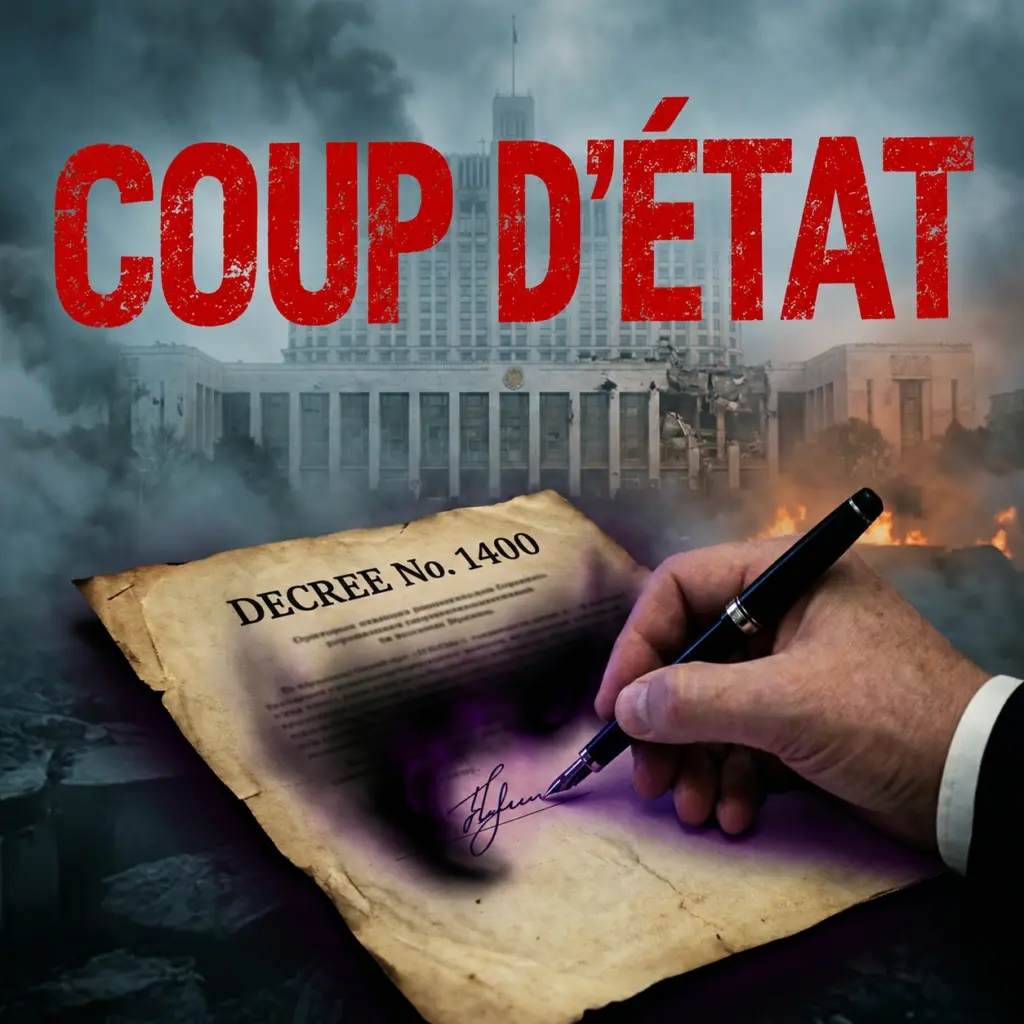





























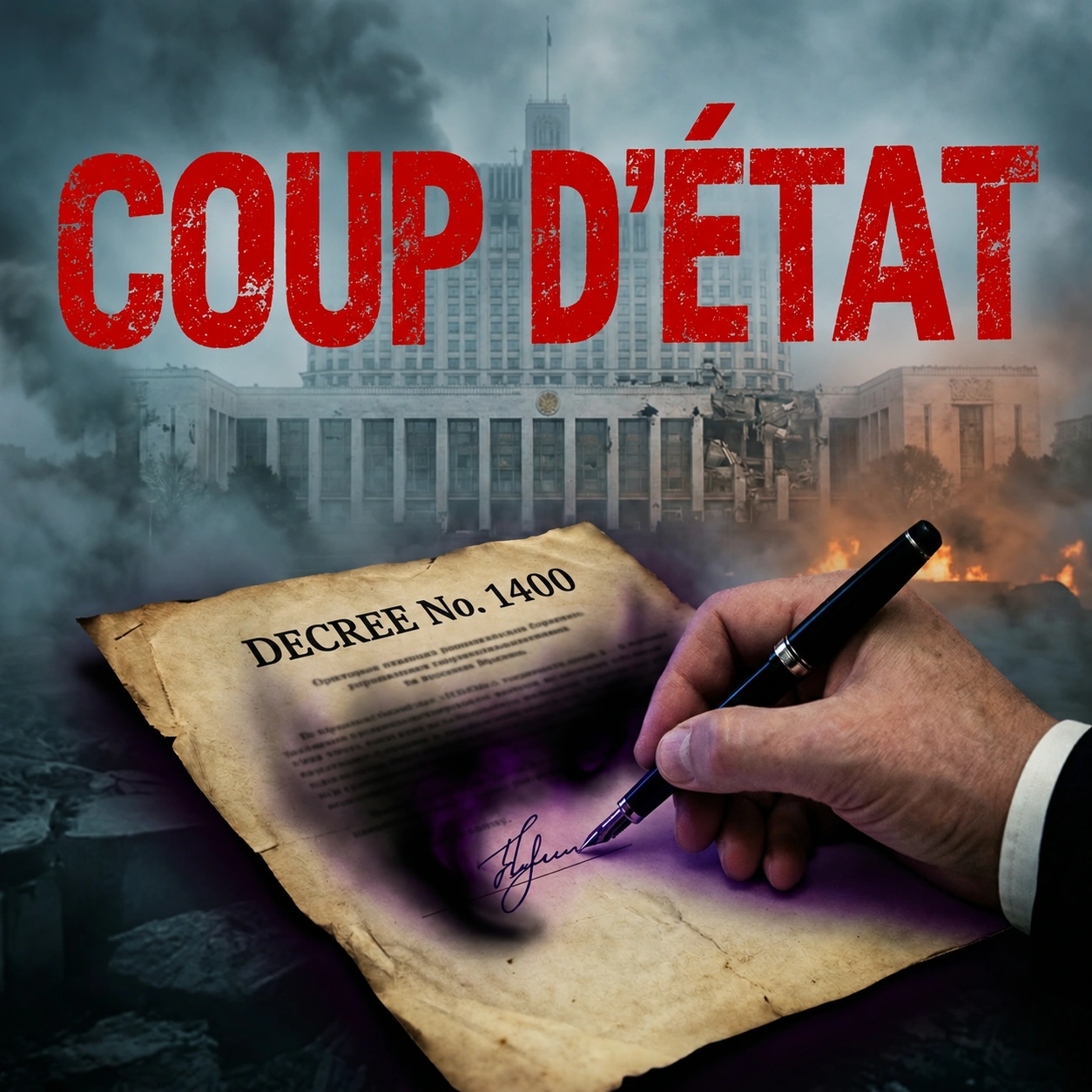
On 21 September 1993, Yeltsin’s Decree No. 1400, ‘On Phased Constitutional Reform in the Russian Federation’, was signed. According to the legal analysis, this document abolished Soviet power and marked the forcible introduction of a new Constitution. Yeltsin’s actions were classified by the Supreme Soviet and the Congress of People’s Deputies as a coup d’état. Read on to learn why the resulting 1993 Constitution is described as a commercial code rather than the Fundamental Law, and what legal consequences this entails.
Legal Assessment of Decree No. 1400: Constitutional Reform or a Coup d’État
The actions taken on 21 September 1993 received mixed legal assessments. On that day, Decree No. 1400, ‘On Phased Constitutional Reform in the Russian Federation’, was signed. According to the legal analysis, this document abolishes and nullifies Soviet power and the Soviet state itself. The event is characterised as the forcible, fraudulent introduction of Yeltsin’s Constitution, while the decree itself is regarded as an act constituting a coup d’état.
The 1992 Treaty with the USA as the Basis for Changing the Status of the RSFSR
The groundwork for these events had been laid earlier. Under the terms and requirements of the treaty for the avoidance of double taxation between the Russian Soviet Federative Socialist Republic (RSFSR) and the USA, concluded on 17 June 1992, Yeltsin assumed an international obligation. Under this obligation, he was required to relinquish the RSFSR’s status as a state before 1 January 1994. Thus, the RSFSR had very little time left, and in these circumstances a coup d’état was carried out.
The Transformation of State Bodies into Commercial Organisations
The consequences of this coup were systemic. Just a week after the events, state authorities were registered as commercial entities and trading organisations. They began operating as trading companies and trading corporations. This took place as an act renewing the titles and rights of RDFR under the administration of the Ministry of Finance of the Russian Federation and the Bank of Russia. It was then, it is noted, that the so-called ‘rule of the seven bankers’ began to govern the territory of the Soviet Union.
The Supreme Soviet’s Response: A Resolution Terminating Yeltsin’s Powers
Yeltsin’s actions did, however, prompt a legal response. On 21 September 1993, the Presidium of the Supreme Soviet of the Russian Federation issued a resolution ‘On the Immediate Termination of the Powers of the President of the Russian Federation, Boris Nikolayevich Yeltsin’. This resolution took effect on 23 September 1993, upon its lawful publication in a Russian newspaper carrying legal authority. It was a direct legal response to Yeltsin’s Decree No. 1400.
The Congress of People’s Deputies: Classifying Yeltsin’s Actions as a Coup d’État
On 24 September 1993, the Congress of People’s Deputies of the Russian Federation, acting as the authority of the Soviets, delivered its final assessment of the events. The Congress classified Yeltsin’s actions as a coup d’état. At this congress, all legal acts issued under Yeltsin’s signature were declared void and without legal force. This decision was duly published.
The 1993 Constitution of the Russian Federation as a Commercial Code
The coup culminated in the adoption of the draft Constitution of the Russian Federation on 12 December 1993. However, according to the legal analysis, this document is not the fundamental law of the state but merely a commercial code of charter jurisdiction under the Uniform Commercial Code (UCC). It is noted that this document contains no concept of the human being, and citizens are not recognised as subjects of international law. The Constitution of the Russian Federation was created so that Soviet citizens would not be liable for the debts of the trading company ‘Russian Federation’.
Thus, the events of September–October 1993 are classified as a coup d’état that resulted in the abolition of Soviet power and the re-registration of state bodies as commercial entities. The 1993 Constitution of the Russian Federation is not the Fundamental Law but a commercial code created according to UCC standards. All legal acts signed by Yeltsin after 21 September 1993, including the current Constitution, are void and have no legal force.