






























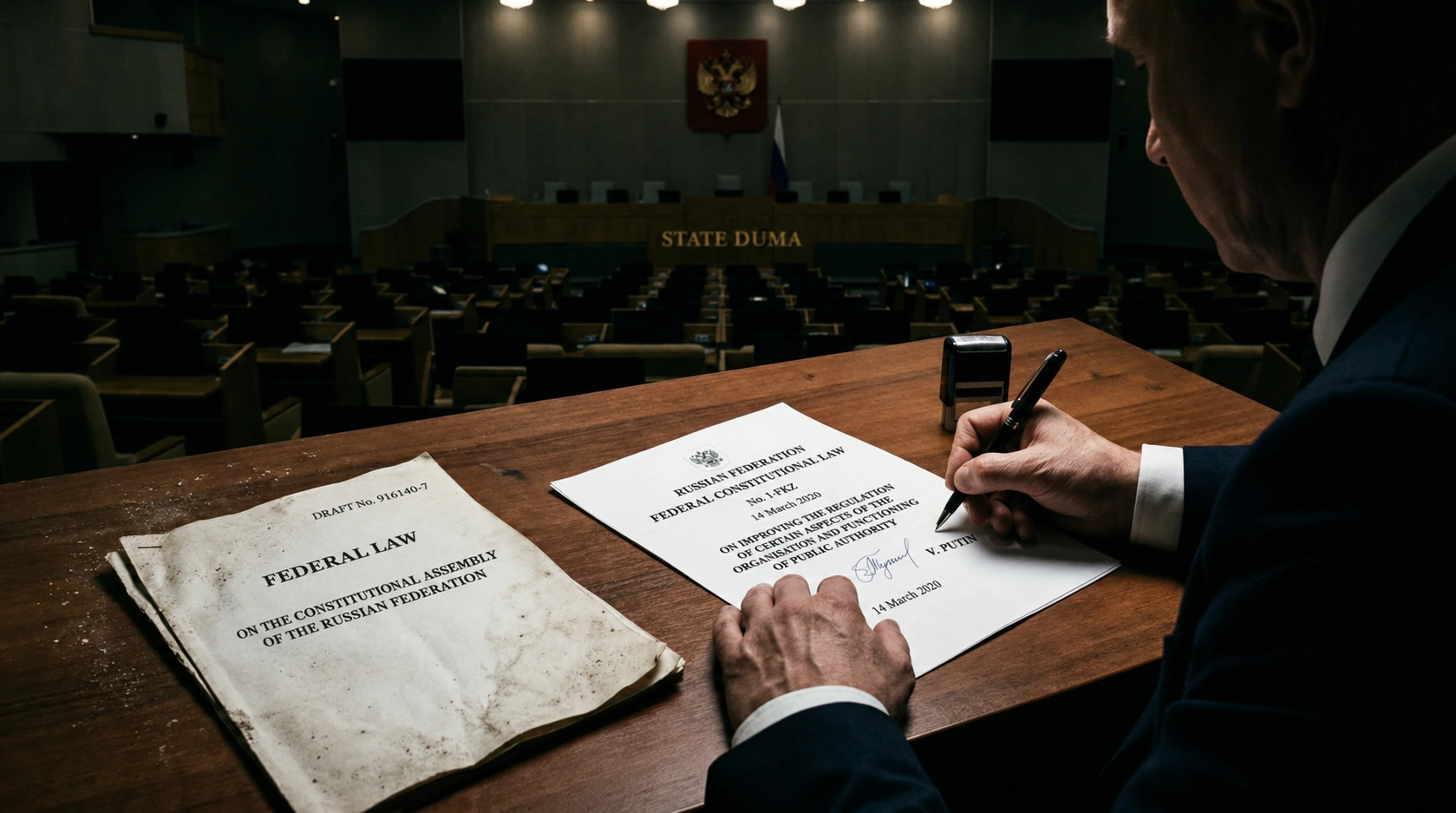
On 6 March 2020, a bill on the Constitutional Assembly of the Russian Federation (No. 916140/7) was registered in the State Duma. The 2020 constitutional reform encountered a problem: deputies refused to consider the bill because approving it would have limited their powers to a term of one year. Instead, Federal Constitutional Law No. 1-ФКЗ of 14 March 2020 was adopted in secret, in breach of the rules of procedure, as well as the provisions of the Constitution itself and federal laws. Read on to find out why the Federation Council also approved the document in breach of these requirements, and which document confirms that it was not duly published.
The 2020 Constitutional Reform: The Bill on the Constitutional Assembly and the Refusal to Consider It
A constitutional law entitled ‘On the Constitutional Assembly of the Russian Federation’ was accepted for consideration by the State Duma of the Russian Federation. On 6 March 2020, this bill was registered in the State Duma under number 916140/7. Having examined the bill, the State Duma refused to consider and approve it. The reason for this refusal was quite specific: had the deputies approved the bill, they would thereby have limited their own powers and rights to a term of one year.
A Secret Decision: Replacing the Bill with a Private Federal Law
However, the story did not end there. The State Duma decided to act in secret, without publicity. Instead of approving the bill on the Constitutional Assembly, a decision was made to adopt this bill as a constitutional law and approve it as a private federal law under number 1-ФКЗ of 14 March 2020. This law was given a complex title: ‘On an Amendment to the Constitution of the Russian Federation, on Improving the Regulation of Certain Matters Concerning the Organisation and Functioning of Public Authority’.
The 2020 Constitutional Reform in Breach of the Rules of Procedure: The State Duma’s Adoption of 1-ФКЗ
The State Duma adopted this Federal Constitutional Law No. 1-ФКЗ of 2020 in breach of the rules of procedure. Furthermore, the provisions of the Constitution itself and federal laws were violated. Thus, a document that was intended to provide the foundation for sweeping changes to the legal system was adopted with procedural violations that call its legitimacy into question.
The Federation Council’s Position: Refusal to Consider the Bill and Approval in Breach of Requirements
The Federation Council also refused to consider and approve the original bill on the Constitutional Assembly. However, the upper chamber did not reject Constitutional Law 1-ФКЗ of 2020. Like the State Duma, the Federation Council approved this law in breach of the rules of procedure, as well as the Constitution and federal laws. Both chambers had the same goal: to avoid limiting their powers to a term of one year, so as not to be held accountable for everything they had done over 25 years.
Failure to Publish the Law Duly and Its Failure to Enter into Force
Taking into account the legal grounds and the falsification of the Russian Federation’s own law, Law No. 1-ФКЗ of 2020 on an amendment to the Constitution was not duly published in the official press. As a result, it did not enter into legal force. The Ministry of Justice holds confirmation of this fact under number Р-2002-001-003. This registration is dated 14 March 2020, and the registers list the document as being in force and normative, which, according to the legal analysis, does not reflect reality.
The Amendments and the Nationwide Vote: Failure to Enter into Legal Force
Following the events described above, the amendment to the draft Constitution and its alteration as a result of the nationwide vote, classified as a plebiscite, did not enter into legal force within the territory of the Russian Federation. However, upon registration in the United States of America, this non-legal action was recorded in a registration instrument as confirmation of the dignity and titles of the Constitution of the RDFR and its public authorities in Russia. From 2020 onwards, the government of the RDFR came to be regarded as the government of the Roman Consul of Muscovy.
The 2020 Constitutional Reform: Results and Conclusions
Thus, the 2020 constitutional reform was carried out with the gravest violations. The bill on the Constitutional Assembly (No. 916140/7) was replaced with 1-ФКЗ of 14 March 2020, adopted by both chambers of the Federal Assembly in breach of the rules of procedure. The law was not duly published in the official press and did not enter into legal force, as confirmed by registration Р-2002-001-003 at the Ministry of Justice. The amendments to the Constitution and the results of the nationwide vote are null and void. Understanding these mechanisms makes it possible to grasp why the 2020 changes to the Constitution of the Russian Federation cannot be regarded as having legal force.
Read other articles: The Russian Federation Is Not a State but a Commercial Structure: A Legal Analysis







