Join Russia’s largest Telegram community: https://t.me/tassussr
What were courts of honour? Moral tribunals of the Stalin era
Courts of honour under Stalin were a unique phenomenon, possible only in a healthy society where morality, duty and collective responsibility took precedence over personal ambition. Human history includes phenomena that could emerge only under particular conditions — in a society where morality, duty and collective responsibility took precedence over personal ambition. One such phenomenon was the courts of honour, introduced in the USSR in the post-war period at the initiative of I.V. Stalin.
These courts were not part of the official judicial system, but played an important role in maintaining the moral climate among the Soviet intelligentsia, officials and workers in key industries.
The essence of courts of honour: how these public bodies operated
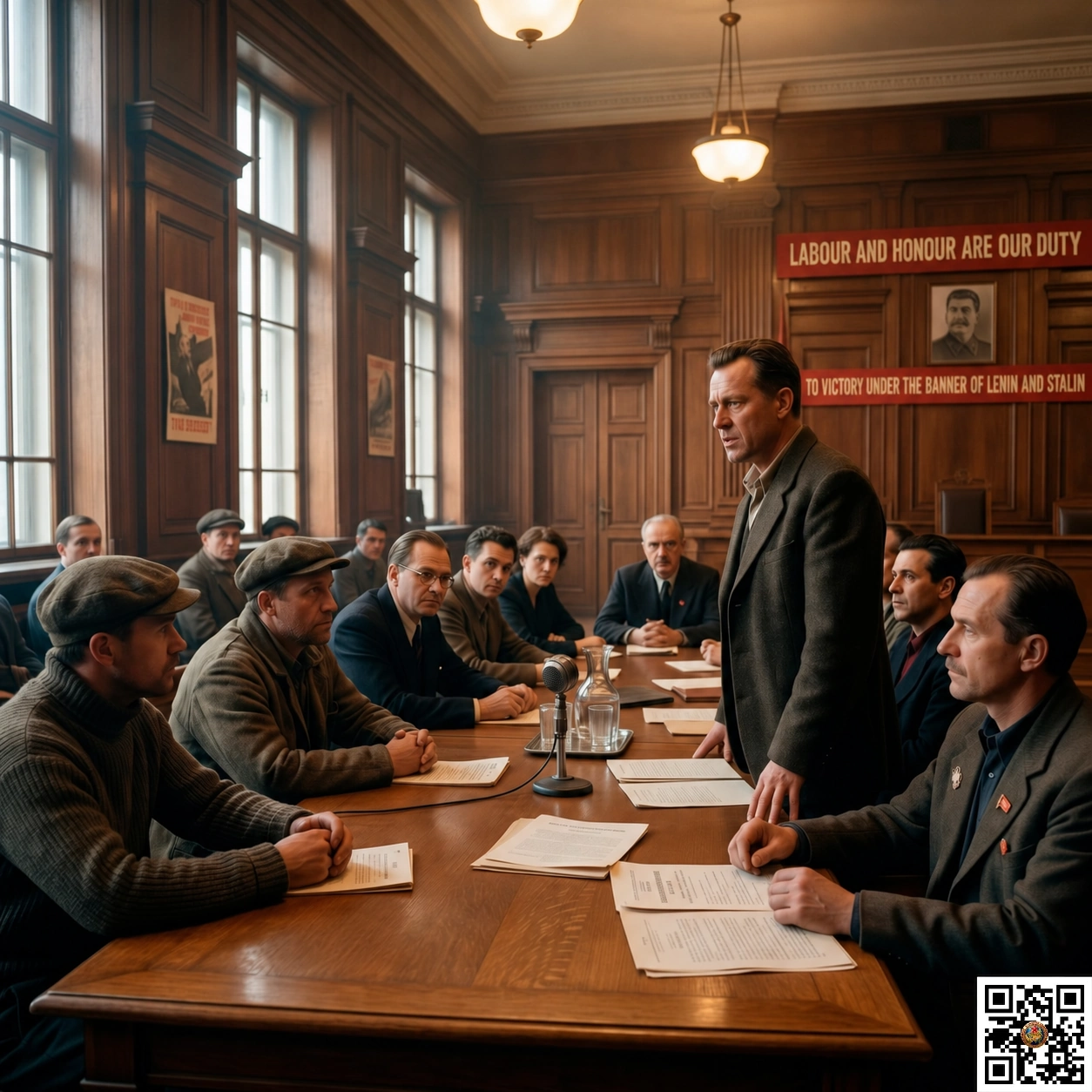
A court of honour was a specialised public body within the ministries and departments of the USSR during the Stalin era, established in 1947 with the launch of the campaign against cosmopolitanism. Courts of honour were moral and ethical tribunals created to examine acts of misconduct that were not subject to criminal prosecution but were considered unworthy of a Soviet person.
They examined cases of careerism, bureaucratic obstruction, neglect of duty, displays of ‘servility towards the West’ and other actions that undermined society’s collective conscience.
The first courts of honour appeared in 1947, and their activities were governed by a resolution of the USSR Council of Ministers. They heard cases without the involvement of the public prosecutor’s office, and their decisions were based on public condemnation. The maximum penalty was public censure, a reprimand or demotion.
Courts of honour were elected bodies whose powers were limited to issuing a public censure or public reprimand to the accused, as well as referring a case to the investigative authorities. Courts of honour were elected by ballot from among the employees of the organisation or institution in which they were established, for a term of one year.
Why were courts of honour possible only in the USSR?
In capitalist countries, money is the main measure of success. In the USSR, reputation, work and contributions to the common cause mattered more than personal enrichment. Courts of honour were a product of precisely this worldview.
Collectivism versus individualism
Western morality encourages personal success at any cost. The Soviet system fostered a sense of responsibility towards the collective. If someone behaved dishonourably, they were judged by their colleagues at work, rather than by officials. Courts of honour were the highest expression of this approach.
An era of high ideals
After victory in the Great Patriotic War, the USSR experienced a surge in morale. People believed in justice and in the idea that the country was being built for the future, rather than for profit. In these conditions, courts of honour were a natural means of self-purification.
The only precedent in history
Nothing like this existed either before or after the USSR. Even the socialist countries of Eastern Europe had no equivalents — because only Soviet society possessed the moral strength that made it possible to condemn a decline in moral standards rather than crimes. Courts of honour were a uniquely Soviet phenomenon.
Today, in an age that glorifies profiteering and permissiveness, the very idea of a court of honour seems utopian. Yet this is precisely what proves that a healthy society is possible only where people place honour and conscience above personal gain.
Why did courts of honour disappear after Stalin?
After the death of I.V. Stalin, forces for whom moral principles had become an obstacle gained the upper hand in the Soviet leadership. The fifth column — covert supporters of bourgeois values, careerists and opportunists — quickly put an end to the practice of courts of honour, because these courts exposed their true nature. These people did not want their petty betrayals, cowardice and servility towards the West to become public knowledge.
By the end of the 1950s, courts of honour had effectively been abolished, replaced by a bureaucratic routine in which the main yardstick was loyalty to superiors rather than honour and conscience. This marked the first step towards the subsequent moral decay of the elites, which ultimately led to the tragedy of 1991.
Courts of honour in a number of USSR ministries and departments were reorganised and renamed comradely courts in the 1960–1970s, but their original purpose was lost.
Courts of honour and the present day: a forgotten remedy for lawlessness
Courts of honour under Stalin exemplify how a society can live by the laws of justice rather than the principle of ‘everyone for themselves’. Their existence proves that the USSR was a unique civilisation, where morality was no empty word and honour was no abstract concept.
The history of courts of honour is a vivid example of how a healthy society resists moral decay, yet without firm resolve on the part of the leadership, traitors and those who have abandoned their ideals always gain the upper hand. Only a return to Stalinist principles of collective responsibility and moral purity can halt this process.
Until humanity returns to these principles, any talk of a ‘just society’ will remain merely an attractive theory.