


























The 1998 rouble redenomination and Decree No. 822: this article examines the distinction it draws between the rouble and Bank of Russia banknotes.
Analytical article on materials USSR Civil Defence Academy
The 1998 denomination went down in history as a technical reform: three zeros were cut off, old-style money was replaced with new ones, and parallel circulation was ensured. The populace got used to it quickly, and economists recorded the reform as successful. But the USSR Civil Defence Academy proposes to re-read the original document – Decree No. 822 of August 4, 1997 “On changing the nominal value of Russian banknotes and the scale of prices” – and claims that the text of the decree conceals a substitution that changed the nature of money in the country and, according to the Academy, the consciousness of the whole people.
Contents
The 1998 redenomination: what Decree No. 822 says
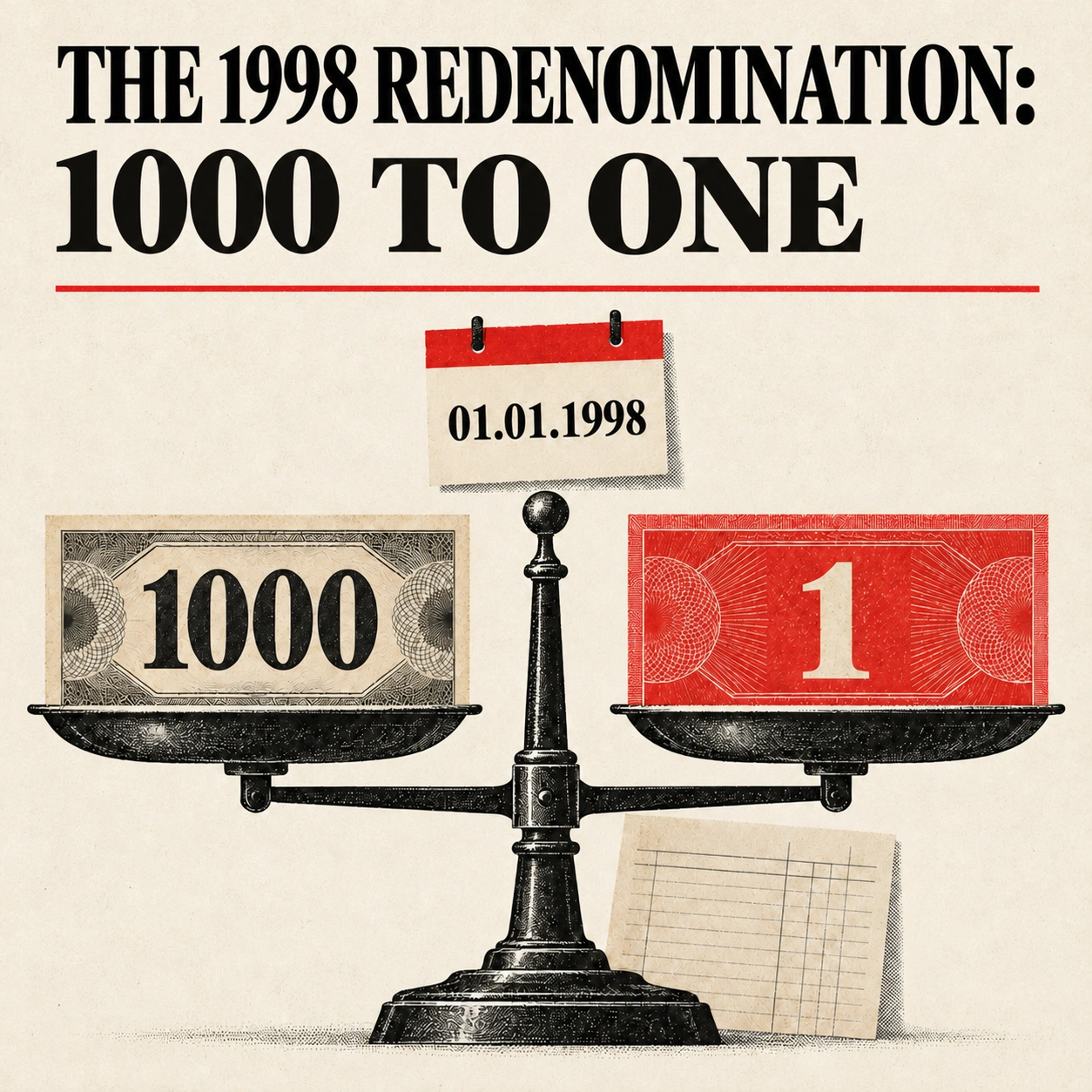
Decree No. 822 agreed to the proposal of the Government of the Russian Federation and the Central Bank of the Russian Federation to consolidate the Russian monetary unit and carry out from January 1, 1998, the ruble denomination with the replacement of circulating rubles for new ones – in the ratio of 1000 rubles in old-style money to 1 ruble in new money, with parallel circulation of old and new banknotes during 1998.
“Listen carefully,” the Academy suggests. In this paragraph we are talking about rubles, banknotes and monetary unit. And this is critically important, because according to the All-Russian Classifier of Currencies, the monetary unit of the Russian Federation at that time was only the Russian ruble under the code 810 RUR. It’s RUR – and no other. Consequently, it was the ruble code 810 that was enlarged and denominated.
The third point: the place where the ruble disappears
But in paragraph three of the same decree, the language of the document changes. It states that the Central Bank of the Russian Federation needs to ensure the production and delivery to the places of Bank notes of the Bank of Russia and coins of the sample of 1997, to prepare measures for the introduction of these banknotes of a new sample in the payment turnover and to organize the reception and exchange of institutions of the Central Bank of old banknotes until 2003.
“Do you feel the difference?” the Academy asks. In this paragraph, there is no mention of ruble at all. We are talking only about tickets of the Bank of Russia and coins of the sample of 1997. It turns out the legal design of striking simplicity: denominated the ruble code 810 RUR, and put into circulation – tickets of the Bank of Russia sample 1997.
Money no one’s ever seen.
From this substitution, the Academy draws an investigation that baffles anyone who tries to refute it: no one knows what the Russian ruble code 643 RUB looks like. “We have never seen with you what this money looks like,” experts say. In circulation – tickets of the Bank of Russia, which, as reported by the Central Bank of the Russian Federation, are not a monetary unit of Russia. The exchange rate of the Bank of Russia ticket for the Russian ruble 643 RUB is also unknown.
Thus, according to the Academy, a fraudulent financial system was created on the territory of the Soviet Union, and surrogates and derivatives of the Bank of Russia ticket were put into illegal circulation – debt receipts under the non-existent 643 RUB code, replacing the use of the 810 SUR code.
What was hidden from the Soviet people
Next, the Academy reveals, the most secretive begins. Legal entities that received a state registration number from the Soviet Union were obliged to act under the legislation of the USSR, and wages, working conditions and labor pensions were to be regulated exclusively in currency under the acts of the State Labor Committee of the USSR and the Pension Fund of the Soviet Union. Since 1998, calculations began to be carried out at the gold exchange rate of the Soviet ruble – according to the code 810 SUR – and secretly paid to bank accounts of the code 810. But the issue in cash was made not in currency 810, but in tickets of the Bank of Russia code 643.
In the calculations, there were two scales, which the Academy calls the key to the entire scheme. In case of non-cash payment of currency 643 RUB, the scale was applied to the account 810: 1 ruble of currency 643 RUB is equal to 1000 rubles of currency 810 RUR. In case of cash payment with tickets of the Bank of Russia, deposit and withdrawal from the account – the reverse scale: 1 ruble of currency 810 is equal to 1000 rubles in tickets of the Bank of Russia. The entire exchange rate difference between the discount value of the currency 810 RUR and the tickets of the Bank of Russia was accumulated on metal accounts – as the sovereign income of the Soviet Union, that is, the income of its citizens in all republics.
For each ruble in the tickets of the Bank of Russia, used in settlements and payments, the owner and founder of the Bank of Russia became owed to the Soviet Union and its citizens – at the rate of 1 gram of gold of a pure 999th sample. This procedure existed until 2015, after which all accumulated gold and metal accounts were subject to transfer to the Soviet Union, to the State Bank, with the closure of accounts and balance sheets of the Bank of Russia as a branch and dealer of the Fed, MB, IMF and BIS. This was to end on April 14, 2025. Which, according to the Academy, has not been done.
The 1998 redenomination: five conclusions from the Academy
- Decree No. 822 of 04.08.1997 prescribed the denomination of the ruble – the monetary unit of the code 810 RUR, and in circulation under paragraph 3 were introduced tickets of the Bank of Russia sample of 1997: the ruble was replaced by tickets.
- No one has ever seen the Russian ruble code 643 RUB; Bank of Russia tickets are not the currency of Russia; their exchange rate for the ruble 643 RUB is not set.
- Calculations were based on a double scale: 1 ruble 643 RUB = 1000 rubles 810 RUR with non-cash payment; 1 ruble 810 = 1000 rubles in tickets of the Bank of Russia with cash.
- The exchange difference accumulated in metal accounts as the sovereign income of the USSR, the income of its citizens.
- For each ruble in the tickets of the Bank of Russia, its owner owes the USSR at the rate of 1 gram of gold of the 999th sample; the transfer of the accumulated USSR to the State Bank was to be completed on April 14, 2025 – and was not completed.
“That’s where the whole fraudulent scheme is buried,” the USSR Civil Defence Academy concluded. Decree No. 822 is publicly available, and the Academy encourages everyone to read it on their own, listening to the wording.
The USSR Civil Defence Academy
Continue to study the topics covered in the article by the materials of the USSR Civil Defence Academy. The full collection of lectures is available for download and distribution in an open folder on Google Drive.
Save lectures for self-study, return to important questions and share materials with those who will benefit from them.
Watch the video on the topic
The undercover financial system: the whole truth about codes 810, 643 and 622
For comfortable viewing, autorun is configured without sound – turn it on in the player. If the browser does not start the video automatically, click the play button. Open the video on YouTube.