









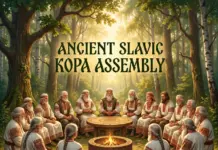


















The Red Cossacks: we examine land, titles and military oaths, exploring how historical continuity connects rights with service and responsibility.
Contents
The Red Cossacks and historical continuity
A Cossack title begins with duty. Behind the right to claim continuity with a historical host stand fidelity to an oath, a connection to the land and responsibility towards people. This is why discussion of the Red Cossacks extends far beyond genealogy and old names. Its central proposition is explicit: greater rights entail greater duties. Within our account of Soviet statehood, Cossack continuity gains meaning through service and willingness to take responsibility for one’s place in the country’s shared life.
The historical narrative connects the Red Cossacks with the Zaporozhian Host. This relationship is developed through land, property and continuity in the Cossacks’ social role. The Zaporozhian inheritance leads into an account of Soviets of Cossack People’s Deputies and Union property. The Soviet period therefore occupies a central place: it explains the subsequent substance of Cossack status and its relationship to the wider state structure.
The narrative mentions Hetman Skoropadsky, his appeal to Ukrainian citizens and Cossacks, and the proclamation of a federal union between Ukraine and the Russian Republic. It connects the events of 1918 with the transfer of land, property and real estate into the common ownership of the Red Cossacks as continuators of the Zaporozhian Host. The purpose is to explain how a historical inheritance enters the later Soviet line while retaining its connection with a particular community and its duties.
A special place is given to the Rusyn title. We associate it with land rights in Little Russia, Galicia, Bukovina, Bessarabia and Transcarpathia, and with service under the hetman. This complex list serves a common proposition: Cossack status derives from historical relationships among land, population and service. Land is linked to membership of a particular state system and the duties accompanying a position within it.
Land, borders and the duty to serve
The emergence of Soviet Cossack formations is described through their participation in the armed forces of the early Soviet government. Cavalry divisions and squadrons of the Workers’ and Peasants’ Red Army are mentioned. The Cossacks’ historical role continues through Soviet service, with the host, land and state duties forming one chain. This connection explains why later invocation of a Red Cossack title is accompanied by a requirement to recognise Soviet laws.
The narrative then introduces the lands of the Ural, Siberian and Semirechye Cossack hosts. Their transfer is linked to the formation of a ‘Cossack’ autonomous territory. The source specifically emphasises its Russian spelling, distinguishing the Cossack basis it assigns to this status. It also introduces border districts, border commissioners and the state reserve. The history of land use thus becomes a history of service at the frontier and in the rear.
Border duties give the title a concrete purpose. The article mentions Transnistria, protection of the state border and the possibility of maintaining a reserve Cossack government in evacuation on Yaik, Siberian and Semirechye lands. These propositions share an idea of continuity: a state function should survive even when its ordinary location becomes inaccessible. Reserves and rear areas are treated as parts of a shared responsibility for the stability of the state structure.
The oath therefore becomes the central dividing line between historical descent and service voluntarily undertaken. Cossack ancestry, family memory and internal customs do not themselves define a servicemember’s duties. We connect Soviet status with the military oath of the Union of Soviet Socialist Republics (USSR) and recognition of Soviet legislation. In this reasoning, a right to the relevant standing accompanies readiness to observe the rules of the state system to which it belongs.
The events of August 1991 are treated as a turning point after which continuity of Cossack duties became especially pressing. Answers to listeners advance the view that earlier border and military duties were not discharged, and that the breakdown of familiar administration did not end the connection to service. This supports our thesis of continuity and explains the transition from historical narrative to the Cossacks’ present place in the Soviet state inheritance.
The oath: duties that come with a title
The next step is unification of Cossack hosts. The source cites Decree D/N 005 of 2023 issued by the organisation called the State Committee on the State of Emergency (SCSE) of the USSR. It associates this decree with incorporating various districts and hosts into a Red Banner Soviet Cossack Host for a transitional period of restoring constitutional order. Separate names are brought under a shared idea of unified service. Individual traditions retain historical significance, while the state function receives a common designation and a connection with Soviet law.
This is where the article challenges attempts to use pre-revolutionary titles separately from Soviet continuity. Its response rests on connecting the origin of a right with the system in which that right continued. If a title is regarded as having passed to the Soviet Cossacks, invoking only an earlier name does not explain its current substance. A claim to status therefore requires deciding which line of service and statehood is accepted together with the historical name.
A high regard for Cossack dignity is accompanied by demanding expectations of those who bear the name. A defender of the homeland should understand their responsibilities, whom they serve and what obligations they accept. Rights and duties are inseparable here. Land requires care, an oath requires fidelity, and historical inheritance requires understanding. The central theme of Cossack renewal is therefore personal responsibility: status gains weight through willingness to fulfil its accompanying obligations.
The meeting’s concluding educational section adds another foundation: knowledge. The organiser discusses access to lectures, filling gaps in education and the ability to participate thoughtfully in public life. This has direct relevance to the Cossack theme: a historical name cannot be carried confidently without understanding its meaning. Knowledge connects family memory with responsibility towards future generations and helps people explain their position clearly.
The Red Cossacks are presented as a combination of land, historical continuity and service. Their Soviet line encompasses the Zaporozhian inheritance, participation in establishing Soviet power, border duties and the oath. Each element reveals another aspect of a shared status. For our vision of Soviet renewal, the entire connection matters: an honourable name should rest on knowledge of the past, fidelity to accepted obligations and responsibility towards those with whom one shares a homeland.
Document for comparison: Universal Declaration of Human Rights, Articles 17 and 29. General context on property and duties towards the community. This document does not substantiate a particular Cossack title to land.
More on history and law: USSR Civil Defence Academy.