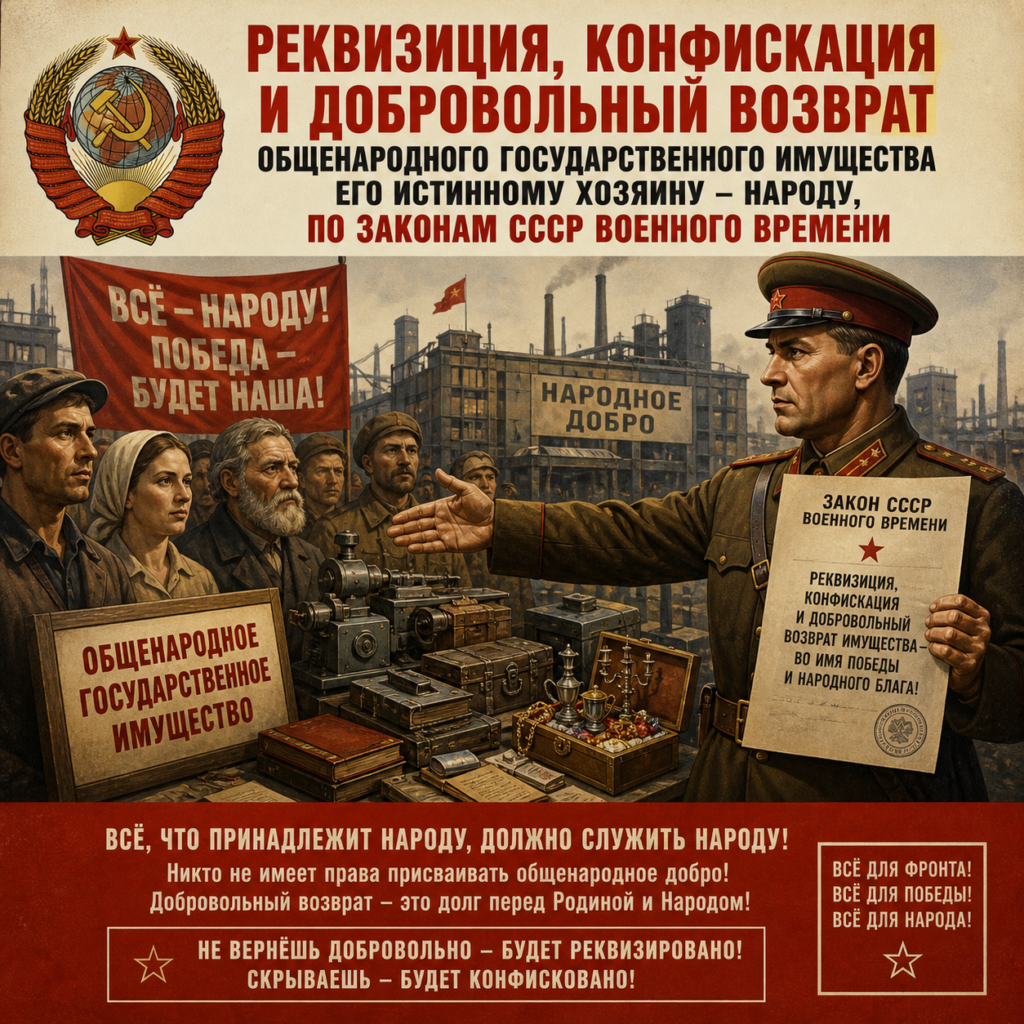

























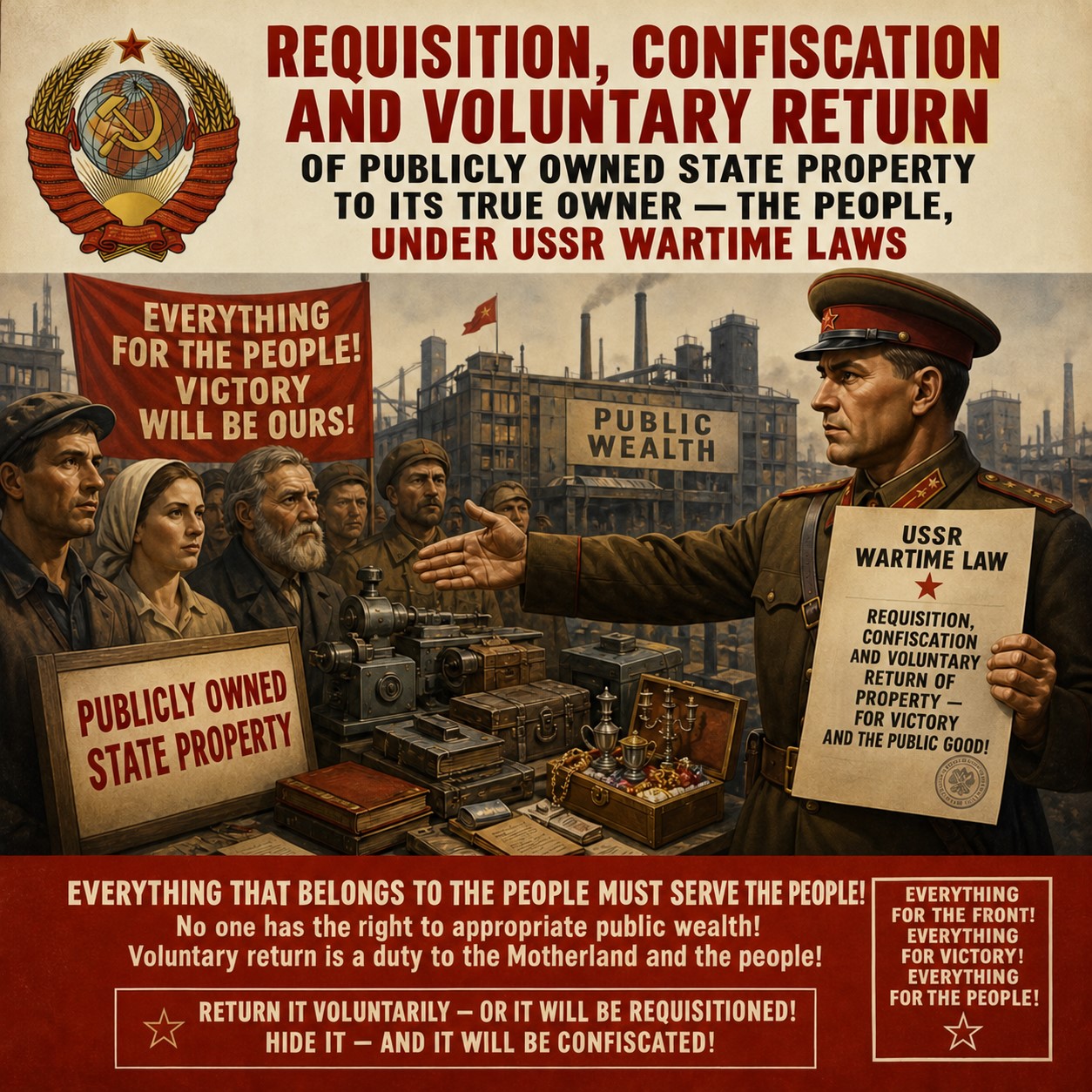
Resolution No. СУР 031 of the USSR State Committee for the State of Emergency (SCSE-USSR), dated 22 July 2026, treats the requisition and confiscation of USSR property as a mechanism for returning assets belonging to the people as a whole. This article examines the stated legal grounds, the procedure for handing over property, the liability of holders and the rules for recovering the value of assets taken out of the country.
This concerns a specific legal mechanism that has already been in operation since April 2023, rather than political slogans. The USSR State Committee for the State of Emergency (SCSE-USSR) explicitly states that the Resolution of the All-Russian Central Executive Committee and the Council of People’s Commissars of 28 March 1927, ‘On the Approval of the Consolidated Law on the Requisition and Confiscation of Property’, applies to USSR state property and Soviet rights of claim. This document was created during the era when socialist statehood was being built and has never been repealed—like all Soviet legislation, it remains in full force throughout the USSR.
Legal Basis: The 1923 Decree and the 1927 Consolidated Law
Resolution No. СУР 031 emphasises direct continuity: confiscation and requisition are carried out to implement the resolutions of the Economic Conference of the Russian Soviet Federative Socialist Republic (RSFSR), established under the Decree of the RSFSR Council of People’s Commissars of 16 August 1923, ‘Regulations on the Economic Conference of the RSFSR’. The Economic Conference operated as a body of the USSR Supreme Council of the National Economy and formed part of the system of joint bodies of the Soviet Government.
This means that the legal mechanism approved in the earliest years of Soviet power has not ceased to be in force. Moreover, it is applied under emergency conditions as the highest form of protection for socialist property. Persons holding Soviet state property must hand it over to the Emergency Military Authorities of the USSR under a formal instrument. This is a mandatory requirement that permits neither refusal nor delay.
The Procedure for Handing Over Property and the Status of Its ‘Custodians’
Resolution No. СУР 031 establishes a strict procedure. Persons holding Soviet state property must hand it over under a formal instrument as property confiscated and placed in the custody of a designated custodial body pursuant to Article 281 of the Code of Civil Procedure of the RSFSR. Confiscations are carried out in accordance with the articles of the Criminal Code of the RSFSR, unless the Emergency Military Authorities of the USSR specify other provisions and legislative acts of the USSR.
Of particular importance is the definition of those who will be recognised as holding Soviet property and rights subject to surrender: these are legal entities and natural persons using such property for commercial and personal purposes. In other words, anyone who benefits from property belonging to the people as a whole automatically becomes subject to requisition and is obliged to return everything to the USSR treasury.
Republican Property, as ‘Remuneration’ under Article 281 of the Code of Civil Procedure of the RSFSR
A curious detail: in the process of returning all assets belonging to the people as a whole to the Indivisible Ownership of the USSR, republican property is recognised as remuneration under Article 281 of the Code of Civil Procedure of the RSFSR. This property is not returned to the administration of the Emergency Military Authorities but remains all-Union state property of the USSR. In other words, some property may remain in republican ownership, but only as compensation for assisting with its return, and it nevertheless remains state property of the USSR.
This provision, which appears technical at first glance, means in practice that certain property may be left under the management of persons and bodies cooperating with the authorities, but does not pass into private ownership. The Soviet state always remains the owner of such property.
Real Estate and Other Property Rights: Only through Soviet Requisition
Resolution No. СУР 031 is categorical: property rights and legal title to real estate, as well as an owner’s other property rights in Russia, can be confirmed only through Soviet requisition and the return of the requisitioned property or its value to the USSR treasury. All property belonging to the people that has not undergone Soviet requisition is subject to unconditional confiscation for the exclusive benefit of the USSR.
This means that any transactions concluded within the ‘Russian’ commercial legal framework after 1991 have no legal force. An owner’s title can be confirmed in only one way—by returning the property to the state, with the possibility of subsequently allocating a share of it for management, but not ownership. Unconditional confiscation becomes the fate of everything that has not been voluntarily returned.
Joint and Several Liability of Foreign Investors and Shareholders
Section 2 pays particular attention to foreign participants in unlawful privatisation. Russian shareholders in enterprises with foreign participation bear joint and several, and subsidiary, liability together with foreign investors, members and shareholders for compliance and non-compliance with the Sovereign Legislation of the USSR. Foreign investors’ liability to the USSR continues under any system of law and does not cease even if they have unlawfully transferred their ownership interests, shares, securities or bonds to Russian or other third parties.
Moreover, if foreign investors have received dividends and other profits since 1991 in the former trading company ‘Russian Federation’, such debts are consolidated and included in the overdue external debt of their national jurisdiction. This debt is declared a national debt that cannot be written off or forgiven, having arisen from Sovereign Claims of the USSR.
The Mechanism for Attachment and Recovery through the UCC
Resolution No. СУР 031 grants foreign states and their charter-based jurisdictions the right under the UCC (the US Uniform Commercial Code) to attach and enforce recovery against the income and dividends of Russian shareholders and members, as well as their heirs and legal successors. This measure is intended to reduce and minimise foreign states’ debts to the USSR arising from Sovereign Soviet Claims.
In other words, the USSR State Committee for the State of Emergency (SCSE-USSR) does not merely announce confiscation; it also creates an international legal mechanism that allows debts to be recovered from foreign jurisdictions through their own legal instruments. This underscores the global nature of the Sovereign Act and its sovereign effect throughout the world.
The Return of Property Taken Abroad
The value of state property taken abroad must be repaid to the USSR State Bank in Moscow, together with a 100% stipulated penalty. In the event of refusal, the amount is included in the external debt owed to the USSR by the relevant state or charter-based jurisdiction. Claims by the Emergency Military Bodies of the USSR must be settled without the payer’s acceptance from that charter-based jurisdiction’s or state’s quota of world money.
Thus, no unlawful removal of an asset abroad will go unpunished. Every foreign jurisdiction involved in the theft of Soviet property will become a debtor to the USSR, with a substantial penalty added.
The Final Chord: 07 June 2024—the Prosecutor’s Office Acknowledges Violations
Resolution No. СУР 031 refers to a landmark event: on 7 June 2024, the Russian prosecutor’s office de facto reclaims assets from private ownership that were privatised through violations of a criminal nature. Acting jointly and in its supervisory capacity, it admitted that prosecutors who fail or refuse to act under Article 45 of the Code of Civil Procedure of the Russian Federation are responsible for replacing their leases of property from the USSR with contracts transferring ownership, and for privatisation by third parties. This admission confirms that all so-called ‘privatisation’ since 1992 was a crime, and that the prosecutors obliged to stop it themselves facilitated violations of the law.
Conclusion
Section 2 of Resolution No. СУР 031 is not merely a declaration of intent but a thoroughly developed programme of requisition and confiscation based on Soviet legislation. It leaves no loopholes for private individuals, foreign corporations or complicit states. Property belonging to the people as a whole must be returned to the people.
The People’s Control Council of the Soviet Union, which brings together all local people’s cells, is intended to play a key role in returning assets belonging to the people as a whole. Only by applying the Emergency State Decrees of the USSR State Committee for the State of Emergency (SCSE-USSR) will the Council be able to ensure lawful requisition and confiscation, as well as launch the reorganisation of the Soviet State Cooperative Enterprise ‘Russian Federation – Russia’, bringing its property and legal relations into strict conformity with the Constitution and the Emergency Military Legislation of the USSR.
To know the truth and better understand what is happening
Read TASS articles https://tass.news/
Join the discussion on the Union Forum: https://forum.governmentussr.com/
Listen to Red Wave radio https://ussr-radio.com/live
Google Drive with audio recordings of lectures by the USSR Civil Defence Academy on hidden facts
of international law https://drive.google.com/drive/folders/1oMs7pzi2Re_hIcwaPEguIZB7JiZ5bSQ6
Join the official TASS Telegram community: https://t.me/tassussr
A state platform bringing together Citizens of the USSR, People’s Councils
and cooperative communities https://nation.governmentussr.com/