
















Join Russia’s largest Telegram community: https://t.me/tassussr
Preamble: On Self-Organisation and Sovereignty
Sovereignty is a society’s ability to meet all its needs through its own efforts, without external control. A people unable to organise itself is doomed to be governed from outside. That is why the roadmap for restoring the USSR begins with restoring self-government at every level. The aim is to create a system in which every citizen participates in decision-making and bears responsibility for the collective outcome.
This roadmap for restoring the USSR is a practical extension of the Sovereign Declaration of a Citizen of the USSR and the Act of Expression of Will, which recorded the illegitimacy of the occupation administration and the restoration of USSR jurisdiction.
Chapter I. Priorities for Restoration
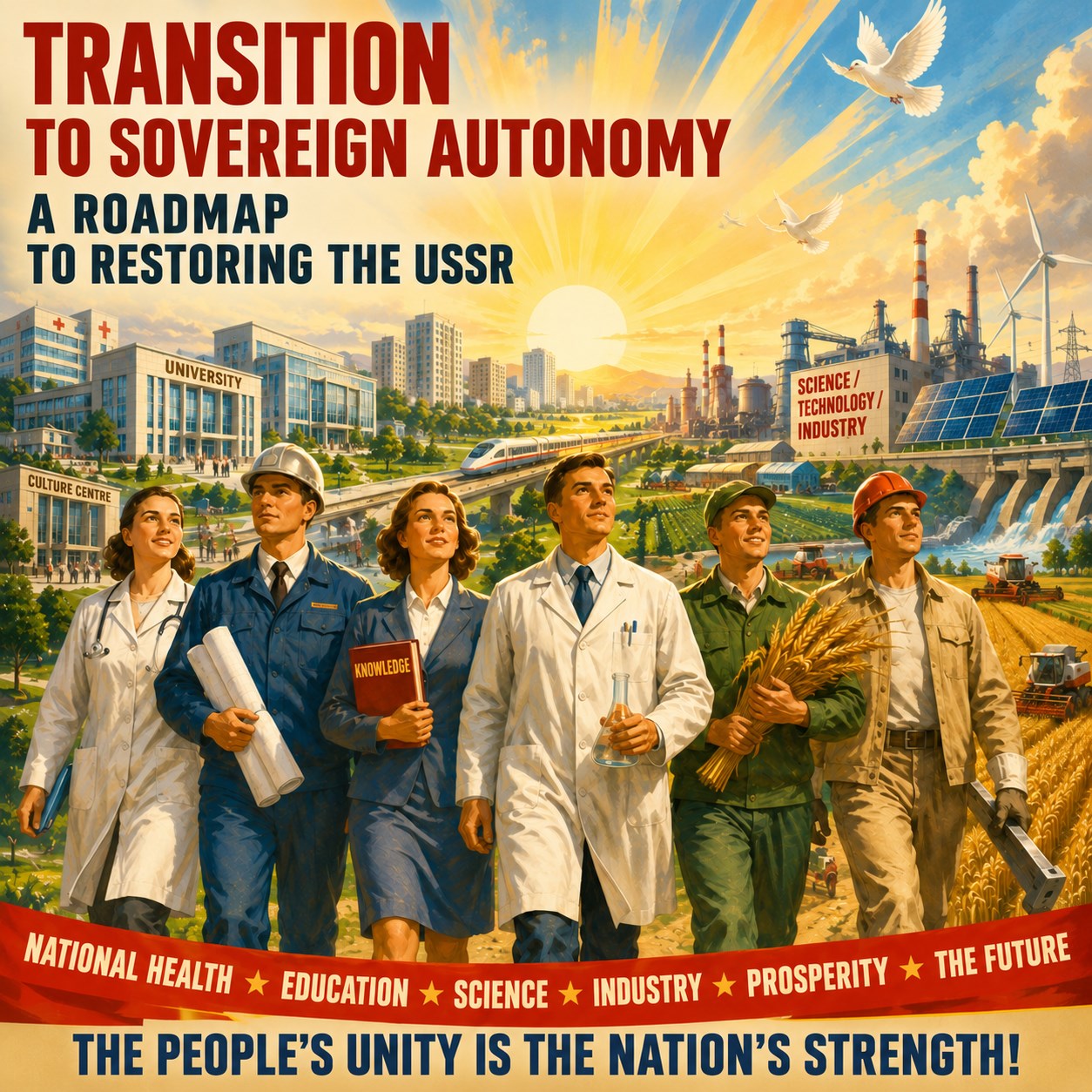
We proceed from the premise that all sectors matter, but that they must be restored in a particular sequence, based on essential needs and the scope for a rapid start. The roadmap for restoring the USSR identifies six priority sectors.
- First priority: healthcare — without a healthy nation, all other efforts lose their meaning. This is the foundation for population renewal and workforce capacity.
- Second priority: education — without training skilled personnel and nurturing creators and builders, we will be unable to restore industry and science.
- Third priority: the food industry and agriculture — ensuring food security is a basic condition for sovereignty. A hungry people will not build a new society.
- Fourth priority: heavy industry — mechanical engineering, machine tool manufacturing, energy, chemicals and metallurgy. This is the foundation for all other sectors, without which technological autonomy is impossible.
- Fifth priority: light industry — clothing, footwear and consumer goods. This means meeting basic everyday needs and reducing dependence on imports.
- Sixth priority: energy — without cheap energy from independent sources, restoring production and essential services is impossible. The energy sector requires coordination with heavy industry and science.
The other sectors (construction, transport, communications, culture and science) are to be restored in parallel, but on the foundation provided by the first six. The roadmap for restoring the USSR envisages coordinated work across all sectors.
Chapter II. Organising Governance: From Bureaucracy to Rule by the People
A centralised hierarchy built on multiple tiers of approval and risks of corruption cannot respond promptly to society’s needs. In its place, the roadmap for restoring the USSR proposes a system based on direct responsibility and local self-government.
Cooperatives as a Means of Responding Swiftly
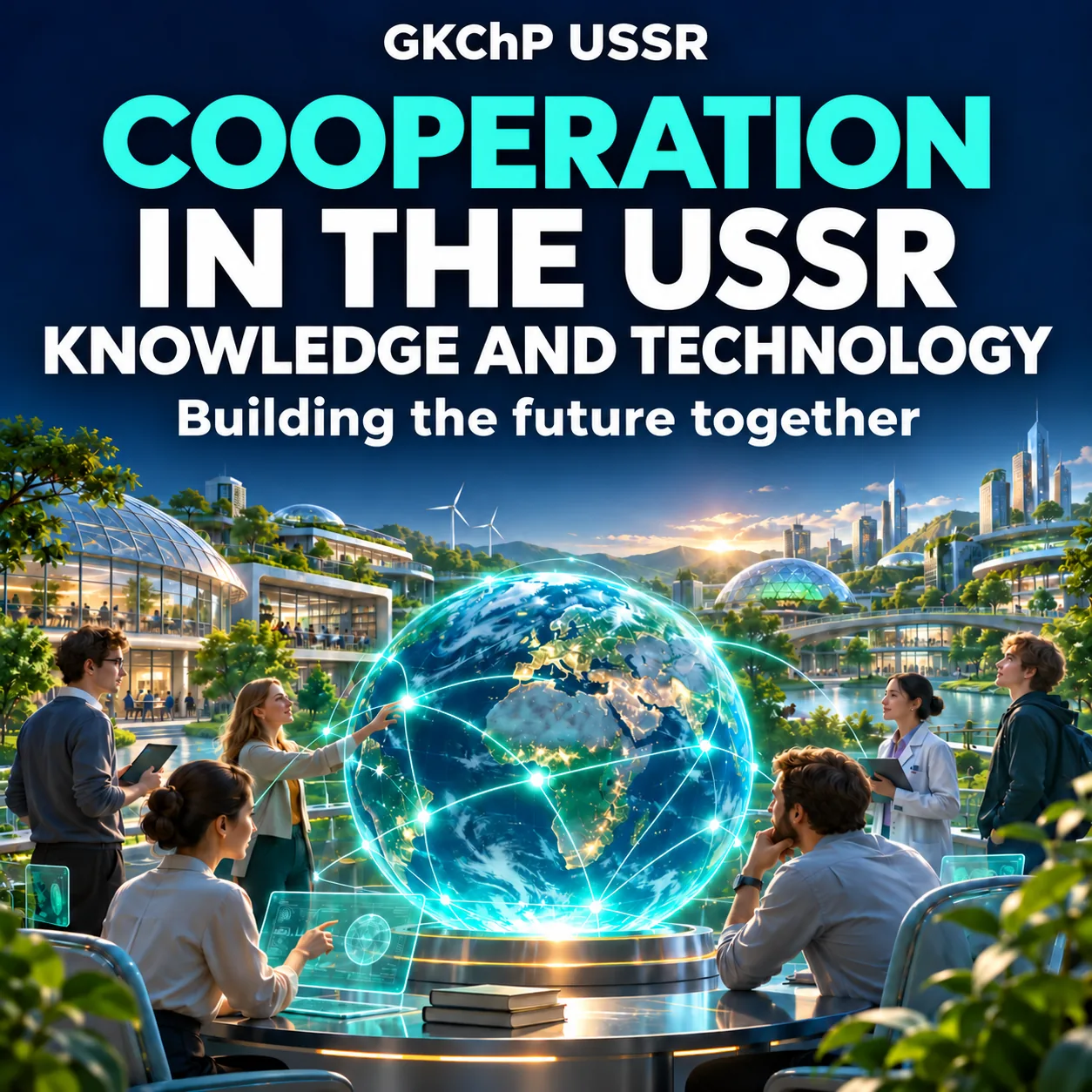
Unlike a bureaucratic hierarchy, in which every decision passes through multiple levels of authority, the cooperative system is built on the principle of direct responsibility. A cooperative does not seek permission from outside authorities: it determines its own rules, approves budgets and takes prompt action based on its members’ actual needs. This eliminates both endless bureaucratic delays and abuses. The roadmap for restoring the USSR makes cooperatives the foundation of the new economy.
Cooperatives Commission Research Institutes
Once a cooperative identifies a need for a new technology, equipment or medicine, it draws up a technical specification and commissions the relevant research institute to develop it. Payment comes from the cooperative’s fund or from state financing secured through the State Bank. This creates a direct link between science and production and eliminates intermediaries between the commissioning party and the contractor.
People’s Councils as a Mechanism for Direct Democracy
Local people’s councils take the form of regular meetings of residents at which matters of local importance are discussed and resolved, from budget allocation to planning infrastructure projects and settling disputes. They operate on the principle of “one area — one council”, with every adult participant entitled to vote and put forward initiatives. The roadmap for restoring the USSR provides for the establishment of people’s councils in every settlement.
A Digital Platform for Public Administration
All newly established state bodies, from local councils to sectoral ministries, operate on a single digital platform built on distributed ledger technology (blockchain). This guarantees transparency, the elimination of the human factor, speed and a unified environment for all public services. The roadmap for restoring the USSR provides for all public services to be digitised and made remotely accessible.
Law Enforcement Agencies and the Judicial System
The existing structures of the Ministry of Internal Affairs, the Federal Security Service (FSB), the prosecution service and the courts, which have discredited themselves by serving the occupation administration, are to be completely reorganised. They will be replaced by the People’s Militia (volunteer units), Courts of Conscience (judges elected from among respected citizens) and a Unified Digital Justice System. The roadmap for restoring the USSR transforms the law enforcement system into an instrument for protecting society’s interests.
Chapter III. Transition Models for Key Sectors
III.1. Healthcare
Current situation: equipment wear — 70–80%; staff shortages — 30–40%; underfunding; dependence on imported medicines and consumables. The male population has been reduced by the special military operation, creating further staff shortages.
Guiding principle: accessible, free, technologically advanced care for every citizen, with complete independence from imports. An emphasis on prevention and rehabilitation.
Key measures: restructuring the Ministry of Health, direct financing from the State Bank, prioritising medical equipment production, reviving pharmaceutical manufacturing, a staffing programme, and building 500 new district hospitals and 2000 rural medical and midwifery centres over 5 years.
Timeline: 0–6 months — establishing institutions; 6 months — 2 years — providing basic equipment; 2–5 years — an industrial breakthrough; 5–10 years — reaching world-class standards.
III.2. Education
Current situation: the Unified State Examination system, formulaic curricula, a disconnect from practice, excessive bureaucratic reporting, ideological burdens, and fee-paying clubs and activity groups.
Guiding principle: nurturing creators and builders, rather than people who merely carry out instructions. Learning through practice, projects and involvement in real work. Free, lifelong education for all ages.
Key measures: abolishing the Unified State Examination, revising curricula, reviving extracurricular education, establishing links with production, and training teachers.
Timeline: 0–1 year — developing new standards; 1–3 years — widespread implementation; 3–5 years — the new system covers every level.
III.3. The Food Industry and Agriculture
Current situation: dependence on imported food and seeds, agricultural decline, a monopoly held by retail chains, and a lack of local processing facilities.
Guiding principle: complete food autonomy — domestically produced grain, meat, milk, vegetables and fruit, with domestic processing. Environmentally clean food that everyone can afford.
Key measures: restoring the agro-industrial sector, bringing fertile land back into cultivation, restoring plant breeding and seed production, establishing processing plants, replacing imports, and rejecting GMOs.
Timeline: 0–2 years — restoring core farms; 2–5 years — achieving self-sufficiency; 5–10 years — developing export potential.
III.4. Heavy Industry
Current situation: the destruction of production chains, the loss of machine tool manufacturing, technology leakage, and a focus on raw material exports.
Guiding principle: a complete production cycle, from raw material extraction to finished products.
Key measures: restoring state corporations, upgrading plant and equipment, establishing sectoral research institutes, reorienting defence factories towards civilian products, and addressing staffing needs.
Timeline: 0–3 years — taking stock; 3–7 years — establishing new production facilities; 7–10 years — achieving complete autonomy.
III.5. Energy
Current situation: dependence on hydrocarbons as export commodities, worn-out networks, and the loss of alternative energy technologies.
Guiding principle: complete energy autonomy — generating electricity and heat from renewable and alternative sources.
Key measures: restoring and modernising hydroelectric and thermal power stations, building solar and wind farms, launching hydrogen energy programmes, and establishing local energy cooperatives.
Timeline: 0–2 years — taking stock; 2–5 years — commissioning new power stations; 5–10 years — achieving complete autonomy.
III.6. Light Industry
Current situation: almost complete dependence on imports (China, Türkiye), and the closure of clothing and footwear factories.
Guiding principle: clothing, footwear and household goods — all domestically produced, high-quality and inexpensive.
Key measures: restoring factories, establishing a production cycle from raw materials to finished goods, state procurement, and support for cooperatives.
Timeline: 0–2 years — opening the first factories; 2–4 years — replacing 50% of imports; 4–6 years — complete self-sufficiency.
Chapter IV. Financing: The Role of the USSR State Bank
The USSR State Bank has already been restored and is the world’s largest holder of asset-backed currency. Its gold reserves and systemic assets are unparalleled. All these funds are real, rather than “paper”, backed by the State’s gold and natural resources. They are not debt obligations: they are national wealth that must be put to work to restore and develop the USSR as swiftly as possible. The Gold Soviet Rouble (GSR) is issued strictly against real projects, which rules out inflation and depreciation. Our task is not to create money, but to put it to use in the real economy.
The roadmap for restoring the USSR provides for a mechanism to allocate funds through dedicated sectoral funds, competitive project selection, direct oversight, interest-free financing, and priority for projects that deliver the greatest autonomy.
Chapter V. Stages of the Transition
Stage 0 (0–6 months): establishing institutions — restructuring ministries, creating funds, launching the system of people’s councils and the digital platform, and the first projects in healthcare and education.
Stage 1 (6 months — 3 years): basic restoration — equipping hospitals, opening schools, building the first factories in the food and light industries, and beginning workforce training.
Stage 2 (3–7 years): an industrial leap forward — mass production of equipment, autonomy in food and energy, complete import substitution in light industry, and restoration of the education system.
Stage 3 (7–10 years): full sovereignty — all sectors have met their targets, science and space take priority, environmental restoration, and entry into international markets with finished products.
Chapter VI. Conclusion
The roadmap for restoring the USSR is built on the principles of autonomy, popular oversight and priority for vital sectors. It can be implemented within 7–10 years, provided that the USSR State Bank begins financing today and the people make the key decisions through the system of people’s councils.
Cooperatives, state corporations, restored research institutes and the digital platform — all these instruments work in concert. But the principal instrument is the will of the people, expressed through direct action and oversight.
A Call to Everyone Who Reads This Text
You have already published the Sovereign Declaration of a Citizen of the USSR and begun to move forward with conscious purpose. Now your task is to become a catalyst: to demonstrate through your own example how a cooperative is established, how it works, and how it gives people freedom and prosperity.
You do not wait for “the authorities to give permission”: you create an alternative that displaces the old system through competition and by demonstrating its advantages. Every new cooperative is a brick in the edifice of a new statehood.
Come together in local people’s councils. Organise your own cooperative or join an existing one.
Only a mass, voluntary movement driven by conscious commitment can create a new world without violence or upheaval. You are among the first. Your work and this document are the map that others will follow.
Glossary
| Term | Meaning |
|---|---|
| Roadmap for restoring the USSR | A practical plan for the transition to sovereign autonomy, including priorities, governance mechanisms and implementation stages |
| People’s council | A regular meeting of an area’s residents to resolve matters of local importance |
| Cooperative | A self-governing association of citizens for the joint production and distribution of goods and benefits |
| USSR State Bank | The restored state bank, which issues the Gold Soviet Rouble (GSR) against real projects |
| Digital platform | A unified system of public administration based on blockchain |
Premiere of a film about the organisation and conduct of Russia’s first-ever remote Sovereign People’s Referendum for the Restoration of USSR Jurisdiction: https://www.youtube.com/watch?v=2IReAZalCaQ&t=2283s