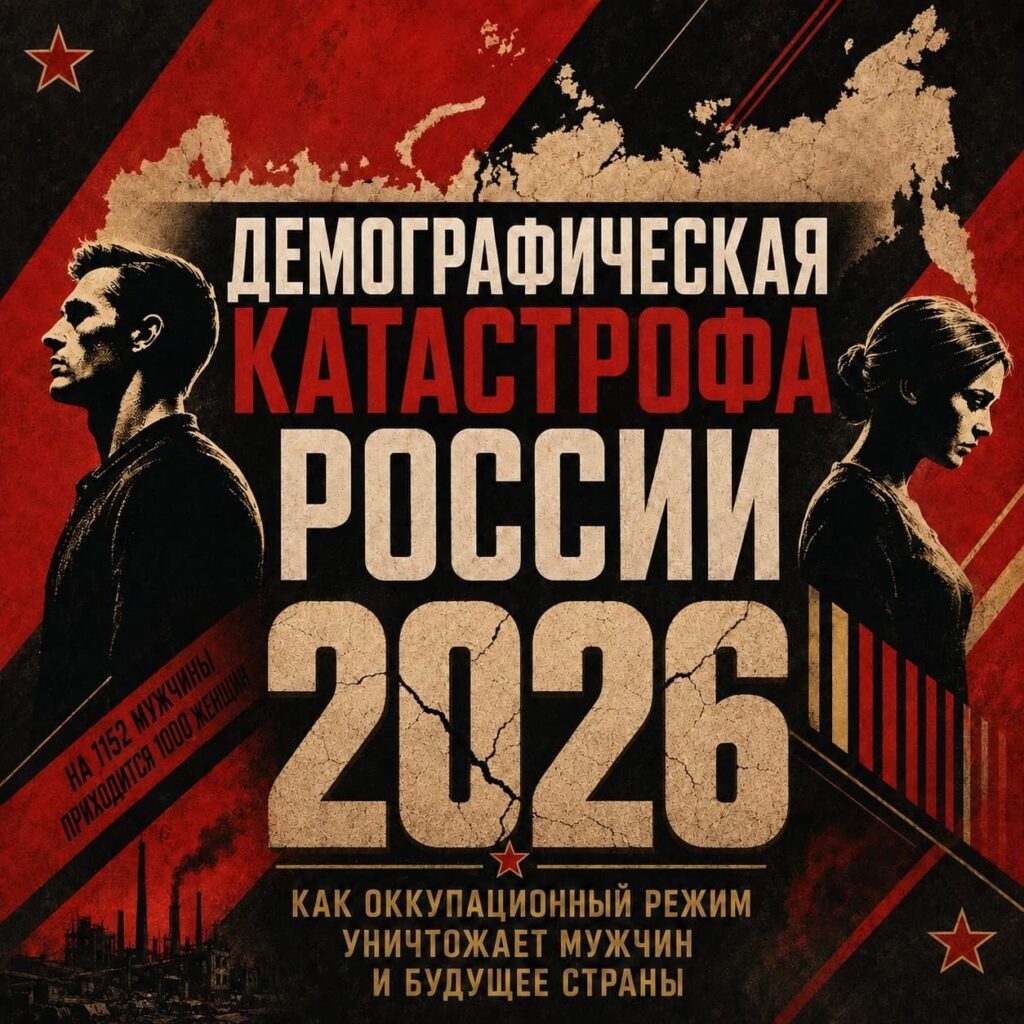

























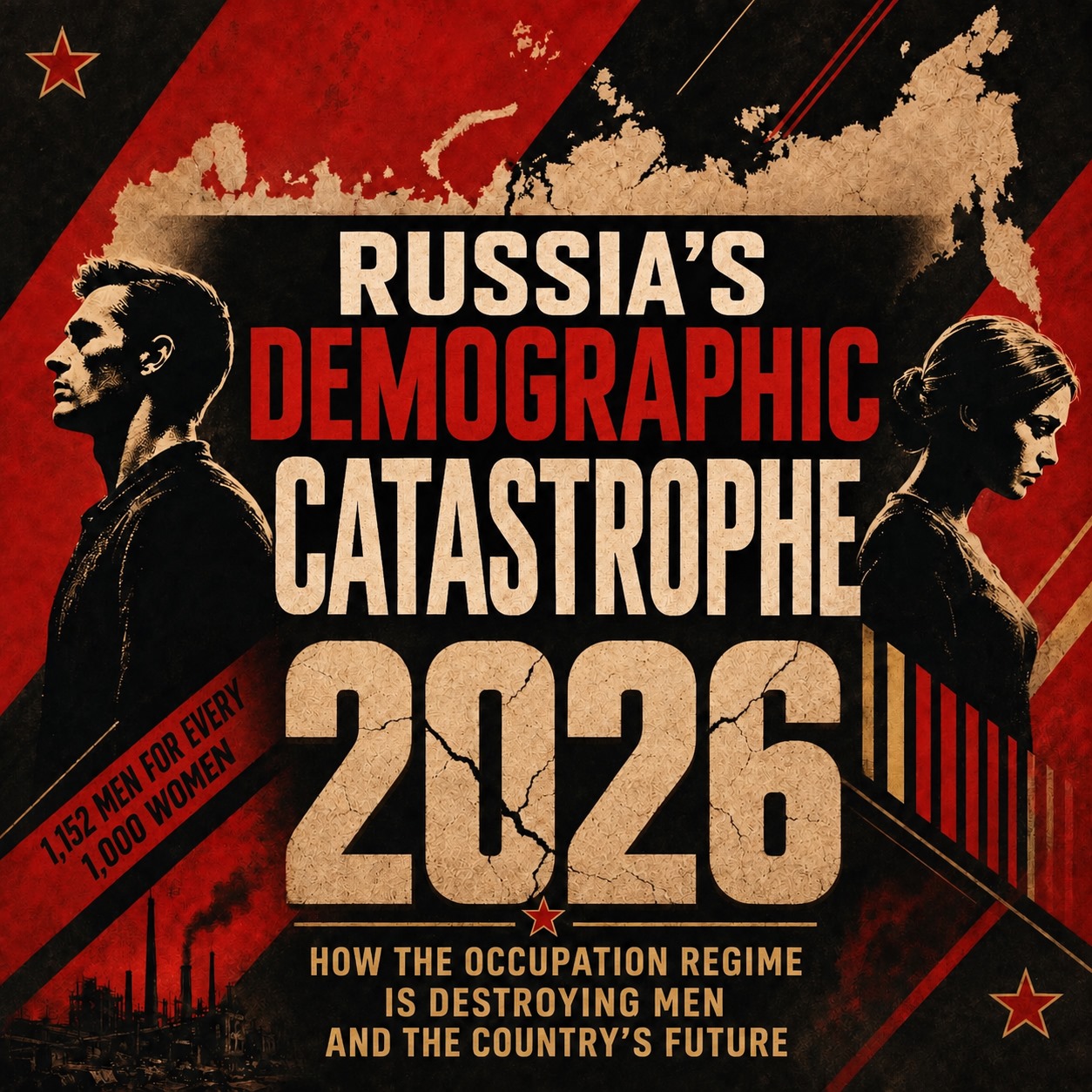
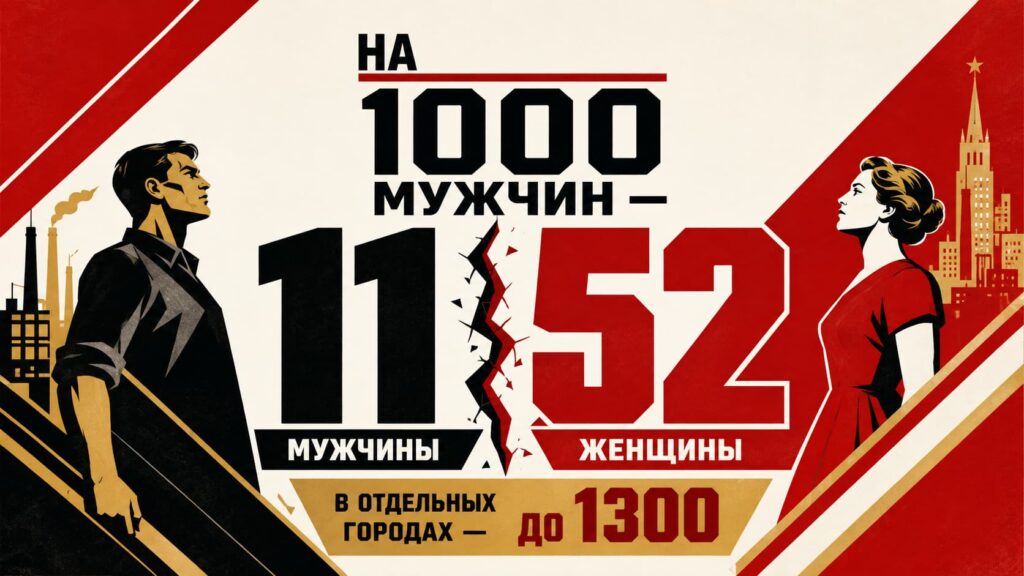
Today, there are 1152 women for every 1000 men in Russia. But that overall average conceals the reality on the ground. There are towns where the figure becomes a death sentence: 1200, 1238, 1300. Places where a man under 50 is a rarity, where only elderly women sit on park benches, where cemeteries grow faster than boys are born.
Discuss the article on our social network: https://forum.governmentussr.com/t/demograficheskaya-katastrofa-rossii-kak-okkupacziya-ubivaet-nashih-muzhchin-i-lishaet-nas-budushhego-obsuzhdenie/525
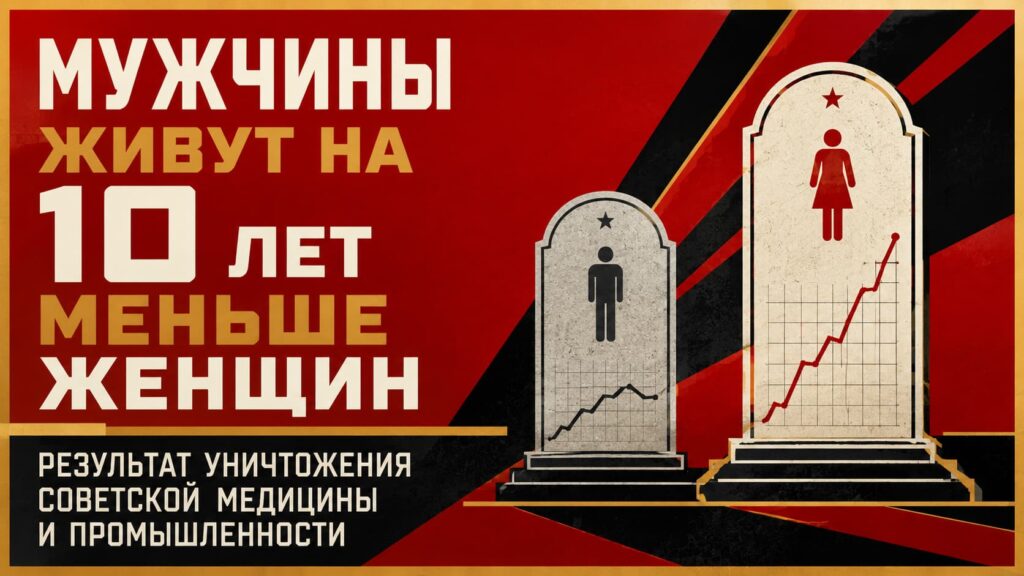
This is no war, no epidemic, no natural disaster. This is Russia in 2026 — a country where the gap between male and female life expectancy has reached 10 years. Nowhere else in the civilised world is there anything like it. The cause lies not in the mysterious ‘Russian soul’, but in the deliberate destruction of Soviet statehood, which began with the coup d’état of 1991 and continues to this day under the guise of ‘reforms’.
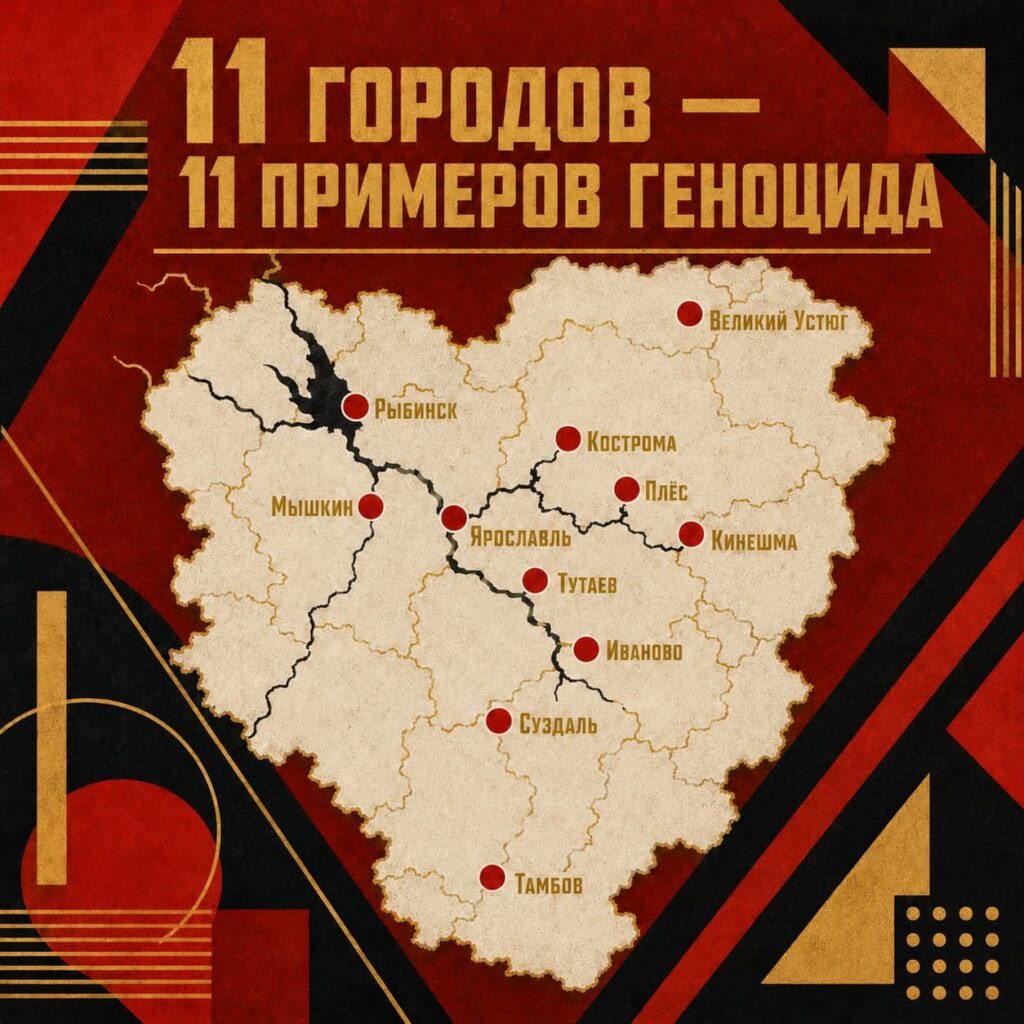
We have travelled through 11 towns and cities where the demographic tragedy is visible to the naked eye. Each is a living indictment of the trading company ‘Russian Federation’, which has unlawfully seized power over our land. But before we delve into these figures, it is important to understand that this demographic collapse is neither a natural phenomenon nor a ‘natural process’. It is the result of thirty-five years of domination by an occupation regime that, in 1991, destroyed the Soviet healthcare system, the planned economy, social guarantees and legal protection for working people. In the USSR, a man lived longer, had a secure job in industry, received free healthcare and did not die of a heart attack at 52 because he could not afford a doctor. Everything you will see below is not statistics, but a verdict against the former trading company ‘Russian Federation’, which has unlawfully seized power over our land.
Veliky Ustyug: a tourist showcase on the edge of an abyss
The home of Father Frost, festive fairs, a residence decorated with Christmas trees. Beautiful. Atmospheric. Yet it is no accident that Father Frost is portrayed as a bearded old man: there are still plenty of older men here, but middle-aged men are gone. Vologda Region has one of the largest imbalances in favour of women: around 1200 women for every 1000 men.
The reason is familiar: industry collapsed in the 90s, men left in search of work, and women stayed — holding on to their homes, children and roots. Men go where they can earn a living. This is how the occupiers drain Russian towns of their most valuable resource — men’s strength and energy. Towns that should have been developing are reduced to scenery for tourists, and their residents to service staff. This is not fate; it is a planned policy: destroy the economy, deprive men of work, then sell off the emptied land for cottages and hotels.
Plyos: a picture postcard with nowhere to escape to
A picture-postcard town immortalised by Levitan. A record-breaking tourist destination. But when it comes to the number of men per woman, it holds a record at the opposite end of the scale. Ivanovo Region has the widest gender gap: 1206 women for every thousand men. Plyos is mainly home to female pensioners, summer residents and tourism workers. The season lasts three months; the other nine bring silence, cold and women with nowhere else to go.
A foreign tourist says: ‘God, how beautiful! The real Russia!’ An elderly local woman watches from her doorstep and thinks: ‘If you lived here, you would leave too.’ But she has nowhere to go. Her home is here, but her country has been stolen. The Soviet authorities developed not only tourist routes here, but also jobs, schools and hospitals. Today, all of that has been destroyed, and development has given way to a slow decline. The tourism boom will not save Plyos: it merely preserves a façade that conceals the emptiness behind it.
Myshkin and Suzdal: museums in place of a future
Yaroslavl Region officially has the widest gender gap among the larger regions: 1224 women for every 1000 men. Myshkin is the symbolic centre of this disaster. Russia’s only mouse museum — that is the sum total of its infrastructure. The towns along the Volga are dying quietly: young people leave, men first. Women, elderly women and children remain — and soon the children will be gone too.
Suzdal means UNESCO, golden domes and tourist coaches. The white-stone churches stand, the nuns pray. But just try finding men aged 30 to 50. Young people leave as soon as they finish school. No jobs, no prospects, no wages. There are domes and mead for tourists. Women stay because of their homes, parents and emotional ties. Men leave because they find it easier to cut those ties.
This is how the occupation system turns historic towns into ghost towns, stripping them of their most important asset — human capital. These towns had existed for centuries, but it was after 1991 that they began losing their populations at such a rate. In the USSR, these towns had plants, factories and agriculture that provided employment for both men and women. Today, all that remains of them is souvenir shops and sightseeing routes. This is not development; it is degradation disguised as ‘heritage preservation’.
Tutayev and Kineshma: factories that failed to save their towns
Tutayev is an industrial town with an engine plant. But the plant means men aged 40+. Skilled manual work, heavy industry. And the statistics on male mortality in Russia’s industrial towns are devastating. The gap between male and female life expectancy is 10 years. Every fifth or sixth death in the country is that of a working-age man.
A man retires at 65 and lives, on average, to 68. A woman lives to 78. Ten years of widowhood. In Tutayev’s cemeteries, there are twice as many women’s gravestones. The causes: alcohol, industrial injuries and refusing to see a doctor. A Russian man does not go to the doctor; he endures to the end. And the end comes sooner than it should.
Kineshma is a former industrial centre. Textiles, mechanical engineering. Then the factories closed, industry collapsed and the exodus began. Between 1989 and 2021, the town lost a third of its population. Who leaves a dying industrial town first? Young men. Always.
This is no accident. It is the result of the systematic destruction of Soviet industry carried out under the direction of foreign advisers in the 90s. The occupiers deliberately deprived men of work and women of hope. In the USSR, these towns were a mainstay of the country: factories operated in three shifts, made goods and fed people. Today, they have been turned into stage sets or rubbish dumps. Men left with nothing to do drink themselves into ruin, fall ill and die. Those who are still young flee to the big cities, where the same lack of rights and instability await them, only on a larger scale.
Ivanovo: the city of brides as a symbol of genocide
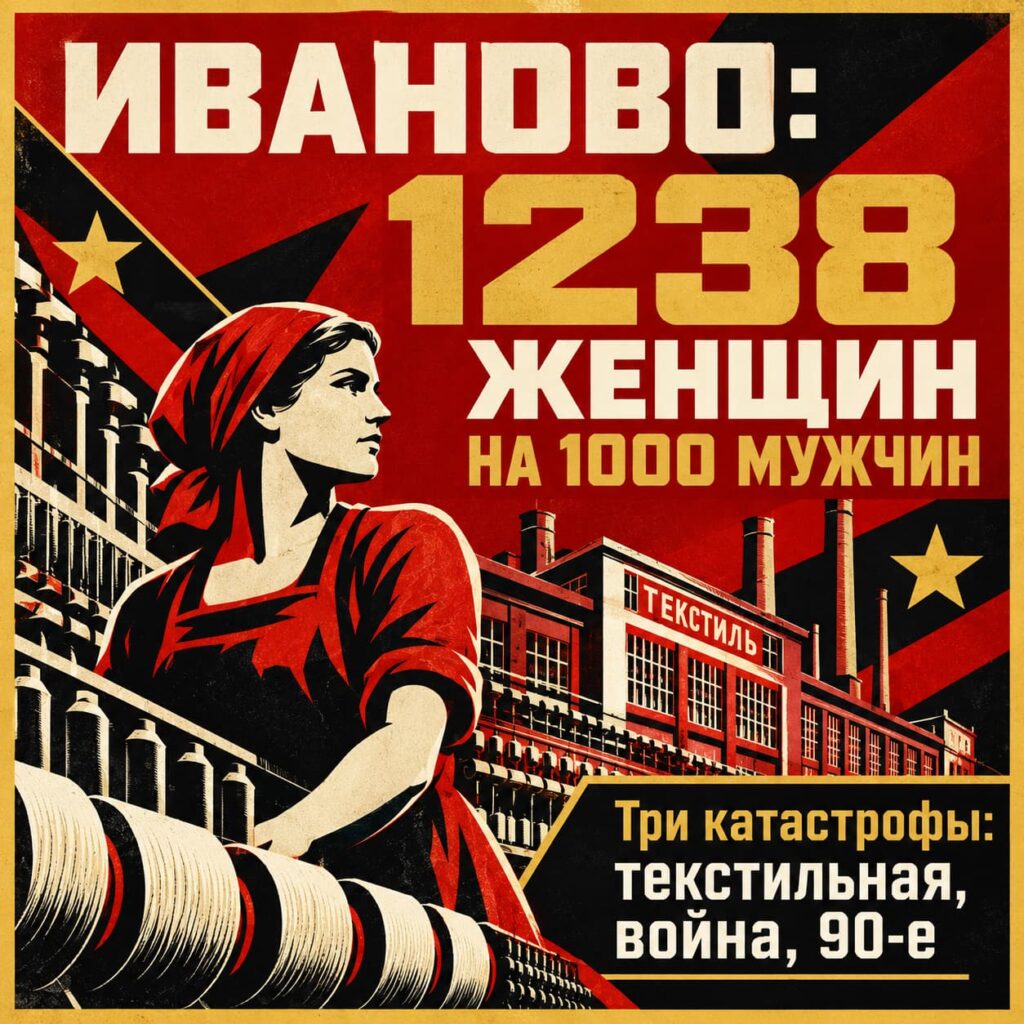
Ivanovo is a brand, a registered trademark, a parade of brides, a coat of arms featuring a woman with a spinning wheel. What an elegant way to turn a catastrophe into a tourist attraction, isn’t it? According to figures for 2025, women make up 55% of Ivanovo’s population. There are 1238 women for every 1000 men.
The city’s history is a story of three catastrophes. The first was structural: textile factories historically created a labour market for women. The second was wartime: 27 thousand men never returned from the front. The third is contemporary: the young leave, while alcohol and disease finish off the rest.
The Soviet authorities tried to redress the demographic imbalance by building factories. And it worked for as long as the USSR existed. But after the coup d’état of 1991, the occupiers deliberately destroyed these enterprises, severed production chains and deprived men of work. The so-called ‘reforms’ were not a mistake, but the deliberate genocide of the Soviet people.
Today, Ivanovo is turning its disadvantage into a brand: parades of brides, souvenirs featuring young women. But the brides still leave for Moscow because there are no grooms here. They have no one with whom to start a family, have children and raise a new generation. This is no amusing quirk; it is a demographic death spiral that drags the city deeper into the abyss with every turn.
Tambov: a quiet death without publicity
Tambov is no city of brides with an attractive brand. It is simply death. Quiet, statistical, without publicity. The widest gap between young and old. For every thousand residents above working age, there are just 489 children. This is a demographic collapse.
Tambov Region is ageing faster than most Russian regions. And it is mainly women who make up its ageing population, because men die earlier — from cardiovascular diseases that could have been treated, from alcohol, from industrial injuries. They die simply because, in the ‘Russian Federation’, a man lives, on average, 10 years less than a woman.
Tambov has neither Father Frost nor a parade of brides. It has cemeteries with twice as many women’s graves as men’s. And elderly women who have outlived everyone. These women have not just lost their husbands — they have lost a country that could have protected them. In the USSR, the pension system, healthcare and social services looked after the elderly, and men lived longer. Today, the state has abandoned them to their fate, while the occupiers merely calculate how much they can save at the expense of the elderly.
Kostroma: the final stop, where it all becomes clear
Kostroma ranks among the five regions with the greatest surplus of women. Linen production and jewellery-making are traditionally female industries. But the key point is that in Kostroma, you can see everything at once.
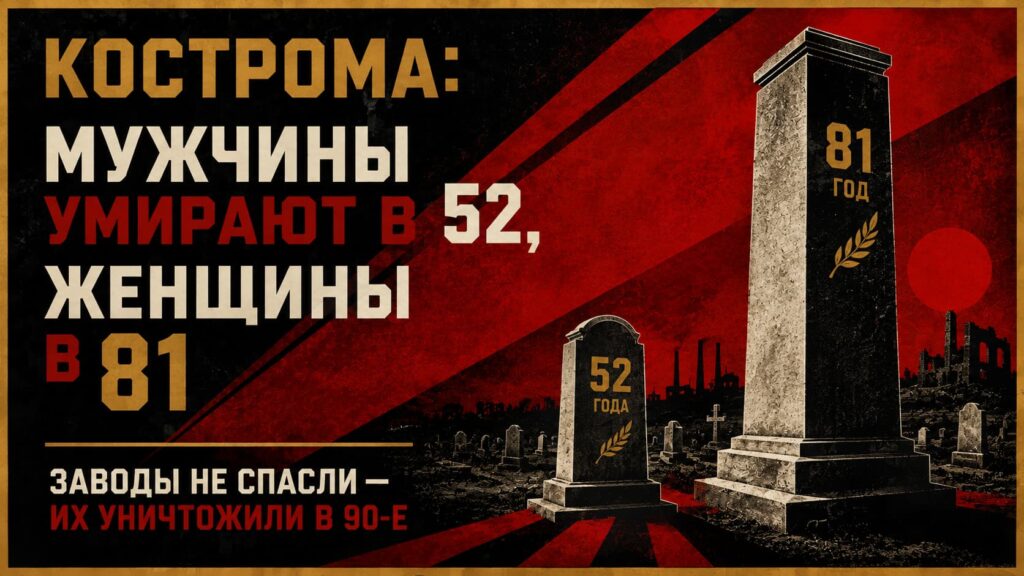
Here is an old Soviet neighbourhood. Only elderly women sit on the benches in the courtyards. Here is a school: of its 32 teachers, two are men. Here is an outpatient clinic: 11 people are waiting to see the GP, one of them a man. Here is a cemetery on the outskirts: the men’s graves read 52 years, 51 years, 51 years, 59 years. Beside them, the women’s read 81 years, 84 years, 76 years.
In the 1970s, the Soviet state recognised the problem of the demographic imbalance in favour of women in the textile towns of Central Russia and began bringing in factories and enterprises — mechanical engineering, instrument-making and logging. Male occupations, jobs for men. And it worked. Temporarily. As long as the USSR existed, as long as there was a planned economy and compulsory job allocation, men could be brought in by order.
Then came the 90s. The factories closed, the men left, and elderly women remained. When the factories closed in the 90s, it was no natural disaster. It was the planned dismantling of the Soviet economy, carried out at the behest of foreign advisers. Men did not simply leave — they were thrown out of their jobs and deprived of their livelihoods. Then healthcare, education and social services were finished off too.
Kostroma today is a monument to a crime for which there is no statute of limitations. This city vividly demonstrates what will happen to any territory if it is handed over to corporate rule and its people are deprived of sovereignty. The system has no need for men here: they are not offered decent work, they are not given medical treatment, they are not protected. They are needed only as cannon fodder for wars and as taxpayers until they drop dead.
A verdict against the system: extinction as a strategy
We have travelled through 11 towns and cities — from Veliky Ustyug to Kostroma. And everywhere we saw the same thing: women’s faces, vacant jobs once held by men, cemeteries where the ages on men’s graves are half those on women’s. As of the beginning of 2024, Russia has around 67,9 million men and 78,2 million women. For every thousand men, there are 1152 women. But in individual towns and cities, that figure becomes 1200, 1238, or more.
Behind every statistical unit is a living person. An elderly woman who outlived her husband by 20 years. A woman aged 40 who cannot find a partner in her own town. A girl who will grow up and leave because there is no future here.
This is no ‘Russian peculiarity’. It is the result of thirty-five years of occupation that destroyed Soviet statehood, Soviet healthcare, Soviet industry and the Soviet family. The occupation regime deliberately turned men into expendable material and women into hostages of dying towns.
The only path to salvation: restoring the USSR
To stop this population from dying out, we must restore the constitutional order of the USSR and reorganise the legal framework in accordance with USSR legislation. Bring back the free healthcare, guaranteed housing, secure jobs and social protection that our fathers had. Restore the jurisdiction of the Union of Soviet Socialist Republics and return power to the lawful government — the USSR State Committee for the State of Emergency (GKChP).
Only then will men stop dying of heart attacks at 52, and elderly women on benches once again see their grandchildren instead of empty courtyards. Only then will factories start working again, and male teachers return to schools. Only then will Russia cease to be a country of women and become a country of strong, healthy, happy people.
We are not simply talking about a return to the past. We are talking about building a future in which the human being is not expendable material, but the highest value. In which the state serves the people, rather than the other way round. In which every citizen has the right to a decent life, rather than mere survival under occupation.
Each of us can set out on this path today. All it takes is to start actively posting information about the genocide on official information platforms and taking an active part in surveys and votes on the dedicated ‘Citizen of the Soviet Union’ platform, nation.governmentussr.com. You can also draw up and read aloud your Individual Legal Declaration of a Sovereign — a personal act restoring your title of Citizen of the USSR, as your comrades have already done. Your voice, recorded on video or audio, will become part of a collective expression of will that cannot be ignored. Watch the playlist of declarations of will: https://www.youtube.com/watch?v=4K2hPftOTXE&list=PLLOWgP_2j-jU
Other articles on genocide: https://tass.news/category/genocide/
We have created all the necessary infrastructure: independent platforms, a legal framework and educational materials. The USSR Civil Defence Academy provides knowledge. The Telegraph Agency of the Soviet Union (TASS) exposes the occupiers’ lies. Soyuz Portal brings us together in a single network. Red Wave Radio broadcasts the truth. All that remains is your personal decision.
The time for silence is over. It is time to act. Join the People’s Referendum of Russia. Restore your title. Reclaim your country. Your children and grandchildren will thank you.