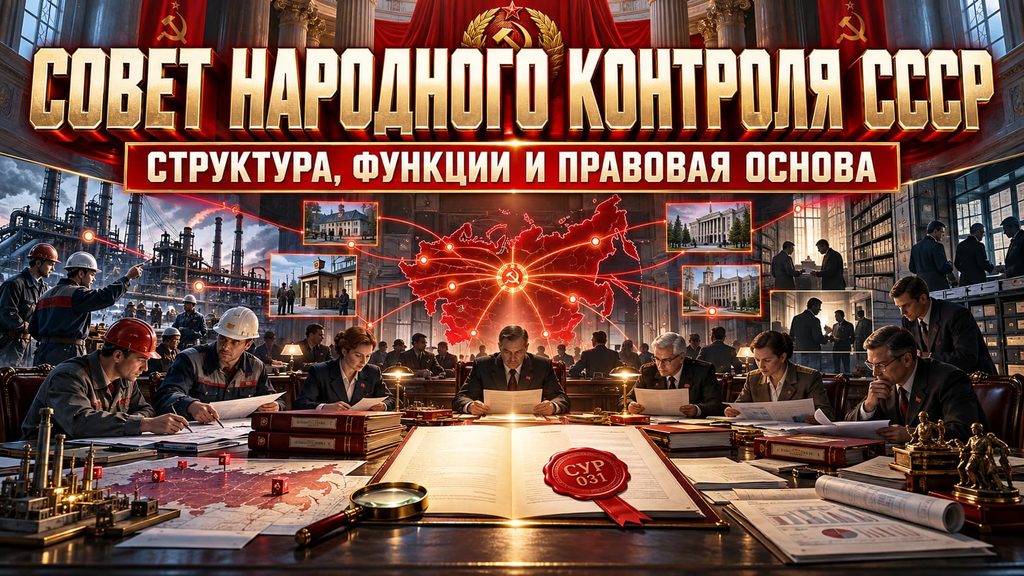




















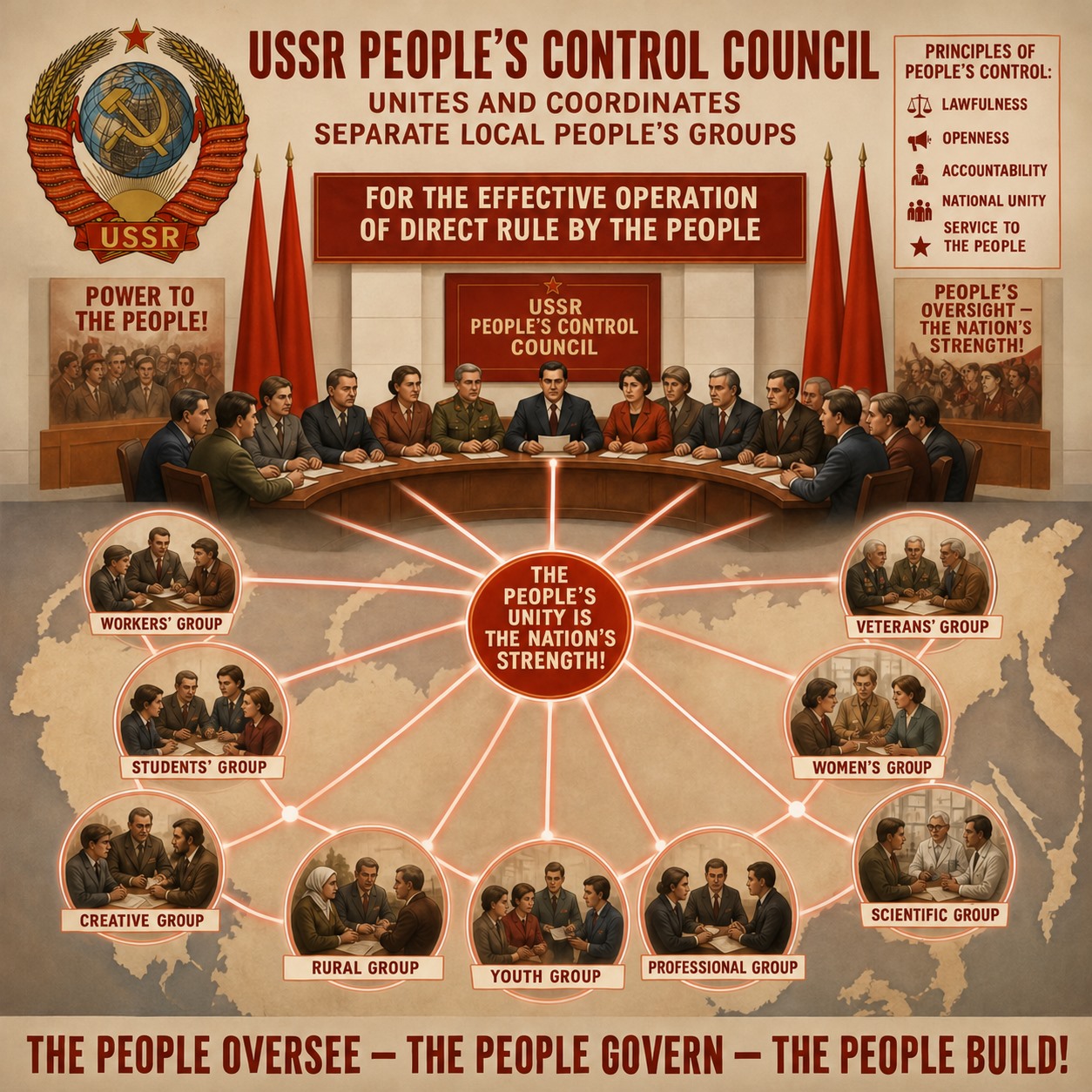
The USSR People’s Control Council is the central component of the system of public oversight whose restoration was proclaimed by Resolution No. СУР 031 of the USSR State Committee for the State of Emergency (SCSE-USSR), dated 22 July 2026. According to the resolution, the Council is to bring People’s Control groups, posts and committees together within a single organisational structure and coordinate their activities.
The operative provisions of the document are unequivocal: People’s Control is being restored throughout the Sovereign territory of the Sovereign’s Great Country—the Union of Soviet Socialist Republics—with no exceptions or qualifications whatsoever. This means that no region, no sector and no settlement will remain beyond the scope of public oversight. However, the scale of the task requires an organisational structure that operates effectively, rather than a spontaneous movement, and the USSR People’s Control Council is intended to stand at its apex.
Legal basis: from the decrees of 1940 and 1987, to the Emergency Decrees of the SCSE-USSR
Resolution No. СУР 031 explicitly states that People’s Control bodies are guided in their activities by the Decree of the Presidium of the Supreme Soviet of the USSR of 6 September 1940 establishing the USSR People’s Commissariat for State Control, and by Decree No. 6774-XI of the Presidium of the Supreme Soviet of the USSR of 1 April 1987, ‘On Amending Article 30 of the USSR Law on People’s Control in the USSR’. These instruments enshrine two key principles: the state character of People’s Control and its reliance on Soviet citizens’ initiative at work and socialist consciousness.
However, the present stage requires a stronger legal framework. The USSR People’s Control Council must therefore act on the basis not only of historical decrees but also of the Emergency State Decrees of the SCSE-USSR—instruments of supreme legal force adopted under wartime conditions. Only this combination of historical continuity and emergency powers will enable the Council to perform its functions effectively during the reorganisation of all structures inherited from the former trading company ‘Russian Federation’.
Structure: groups, posts and committees as the grassroots units of people’s power
The grassroots units—People’s Control groups, posts and committees—form the core of the USSR People’s Control Council. Under Resolution No. СУР 031, these constitute a form of socialist democracy and an effective means of involving the politically conscious and active masses in the management of state and public affairs.
People’s Control groups are established directly at enterprises, institutions, collective farms, state farms and educational establishments, and in residential communities. They bring together workers, office staff, engineering and technical personnel, and members of the intelligentsia—all those willing to monitor, voluntarily and without remuneration, the safeguarding of socialist property, compliance with state laws and the efficiency of economic management.
People’s Control posts operate within individual production units—workshops, work teams and departments. They monitor the use of materials, product quality, and compliance with work standards and safety regulations on a daily basis. People’s Control committees are formed at district, city, regional and republic levels, coordinating the work of subordinate units and consolidating inspection findings.
The USSR People’s Control Council becomes the highest tier in this hierarchy. It brings all the separate units together into a single system, ensures information exchange and coordination, develops common oversight methods and adopts decisions binding on all local People’s Control bodies. Without such unification, public oversight risks remaining fragmented and incapable of standing up to the powerful corporate system.
Functions: from economic oversight to restricting unlawful activities
Resolution No. СУР 031 sets out a broad range of tasks assigned to People’s Control. Its remit extends to:
· economic life and social and cultural development—monitoring the fulfilment of plans, the efficient use of resources, the quality of goods and services, and the state of the social sector;
· production and resource distribution—oversight to ensure that no part of the property belonging to the whole people is squandered or appropriated by private individuals;
· the activities of the restored State apparatus—checking officials’ compliance with Soviet laws and putting a stop to bureaucratic obstruction, corruption and abuses;
· imposing restrictions on the functions exercised in the course of unlawful activities by the private corporate federal governing bodies and other legal entities of the former trading company ‘Russian Federation’—this function is particularly relevant, since it is precisely these structures that have usurped power and plundered the people’s property for decades.
The USSR People’s Control Council thus becomes both an auditor and an active participant in restoring legality. It has the right to require any body or official to provide documents, conduct inspections, issue orders to remedy violations and, in cases of sabotage, refer case materials to the USSR Emergency Military Bodies to bring those responsible to account.
Democratic character: the people are the sole masters of their country
The central idea of Resolution No. СУР 031 is that the right of oversight belongs to the People themselves, as the sole masters of their Sovereign Country. This is more than a declaration. It is a constitutional principle put into practice through the People’s Control system.
Each member of a group, post or committee is a representative of the people, rather than an appointed official, acting under a mandate issued by a workplace collective or an assembly of citizens. Members receive no salary for their oversight activities, which rules out any financial interest in concealing violations. Their strength lies in the trust of their comrades and the legal protection afforded by the state.
The USSR People’s Control Council is composed of delegates elected by subordinate units. This ensures the Council’s connection with the masses and its accountability to the people. The Council’s decisions are binding on all People’s Control bodies, but the Council itself cannot act against the will of the people, since its membership is periodically re-elected and subject to oversight.
The need for the Council during the reorganisation of ‘Russian Federation – Russia’
The USSR People’s Control Council takes on particular importance in connection with the existence of the Soviet State Cooperative Enterprise ‘Russian Federation – Russia’. This structure, which emerged through the rehabilitation and re-registration of the former trading company ‘Russian Federation’ under Soviet jurisdiction, is in a transitional state. Its administrative apparatus, documents, property relations and management practices still bear the imprint of its corporate past.
Without active public oversight, the reorganisation of this enterprise risks becoming a mere formality, while its employees risk continuing to use the old, unlawful methods. The USSR People’s Control Council must therefore subject all processes relating to the enterprise’s activities to particular scrutiny, from the re-registration of property to personnel decisions and financial transactions.
Other articles on this topic: https://tass.news/category/ussr/narodnyj-kontrol-sssr/
Conclusion
The USSR People’s Control Council is a living institution of people’s power that unites millions of politically conscious citizens, rather than a bureaucratic superstructure. It draws on the historical experience of Soviet oversight and on the emergency powers granted by the SCSE-USSR. Its establishment is an urgent necessity dictated by the tasks of restoring constitutional legality, recovering property belonging to the whole people and reorganising the cooperative enterprise. The establishment of the Soviet Union’s People’s Control Council is the only way to unite all the separate units into a single state mechanism. By applying the Emergency State Decrees of the SCSE-USSR, the Council will interact directly with the bodies of the Soviet State Cooperative Enterprise ‘Russian Federation – Russia’, initiating its reorganisation and ensuring strict compliance with the Constitution and the Emergency Military Legislation of the USSR.
To know the truth and better understand what is happening
Read TASS articles https://tass.news/
Join discussions on the Union Forum: https://forum.governmentussr.com/
Listen to Red Wave radio https://ussr-radio.com/live
Google Drive with audio recordings of USSR Civil Defence Academy lectures on hidden facts
of international law https://drive.google.com/drive/folders/1oMs7pzi2Re_hIcwaPEguIZB7JiZ5bSQ6
Join the official TASS Telegram community: https://t.me/tassussr
A state platform bringing together USSR Citizens, People’s Councils
and cooperative communities https://nation.governmentussr.com/